 |
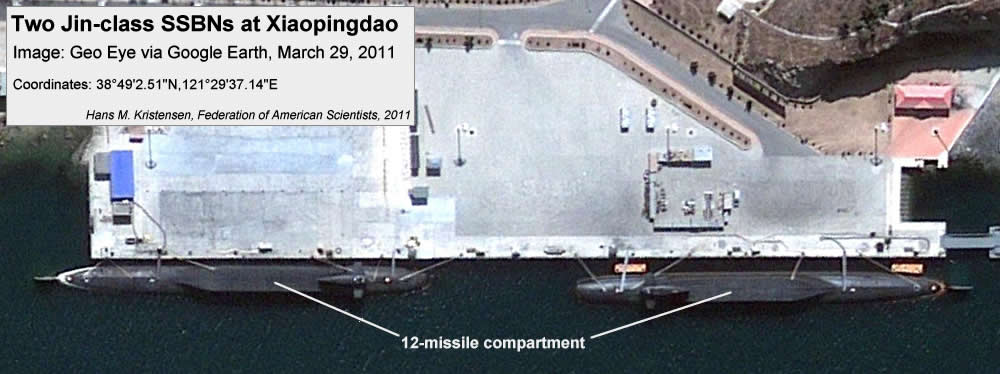
| Two of China’s new Jin-class nuclear-powered ballistic missile submarines were photographed at Xiaopingdao in late-March 2011, possibly in preparation for missile test launches. (Click for larger picture). |
.
By Hans M. Kristensen
Two of China’s new Jin-class nuclear ballistic missile submarines have sailed to the Xiaopingdao naval base near Dalian, a naval base used to outfit submarines for ballistic missile flight tests.
The arrival raises the obvious question if the Jin-class is finally reaching a point of operational readiness where it can do what it was designed for: launching nuclear long-range ballistic missiles.
The Pentagon reported a year ago that development of the missile – known as the Julang-2 (JL-2) – had run into developmental problems and failed its final test launches.
The Long March to Operational Capability
Even if the Jin subs are in Xiaopingdao to load out for upcoming missile tests and manage to pull it off, the submarines are unlikely to become operational in the sense that U.S. missile submarines are operational when they sail on patrols.
Chinese ballistic missiles submarines have never sailed on a deterrent patrol or deployed with nuclear weapons on board. Chinese nuclear weapons are stored on land in facilities controlled by the Central Military Commission (CMC), and the Chinese military only has a limited capability to communicate with the submarines while at sea.
It is possible, but unknown, that the two submarines are the same two boats that have seen fitting out at the Huludao shipyard for the past several years. One submarine was also seen at Jianggezhuang naval base in August 2010 (see below). Prior to that a Jin-class SSBN was seen seen at Xiaopingdao in March 2009, and at Hainan Island in February 2008. The first Jin-class boat was spotted in July 2007 on a satellite photo from late-2006.
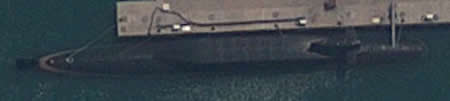 |
| One of the Jin-class SSBNs was seen at Jianggezhuang in August 2010, the first time commercial satellite images have shown a Jin-class submarine at China’s northern fleet submarine base. |
.
And Then What?
Indeed, it is unclear how China intends to utilize the Jin-class submarines once they becomes operational; they are unlikely to be deployed with nuclear weapons on board in peacetime like U.S. missile submarines, so will China use them as surge capability in times of crisis?
Deploying nuclear weapons on Jin-class submarines at sea in a crisis where they would be exposed to U.S. attack submarines seems like a strange strategy given China’s obsession with protecting the survivability of its strategic nuclear forces. The Jin-class SSBN force seems more like a prestige project – something China has to have as a big military power.
Whether it makes sense is another matter.
This publication was made possible by a grant from Carnegie Corporation of New York and Ploughshares Fund. The statements made and views expressed are solely the responsibility of the author.
It is difficult to assess from photos whether the Sentinel missile is longer or wider overall than the Minuteman, but the Sentinel clearly has a thicker second stage, which could potentially contribute to the missile’s extended range.
This is not the first time Google has agreed to censor imagery at the behest of governments, but be warned: obfuscation at this broad level poses a direct threat to the public’s ability to monitor and scrutinize government operations.
As humans expand our geographic reach, encroach on untouched natural territories, and interact more with animal populations, we will encounter novel zoonotic diseases that threaten the human body. The sooner we act to address these risks, the better.
“One thing became increasingly clear: AI doesn’t simply introduce a new category of risk. It changes the speed, scale, complexity, and interaction of risks that already exist.”