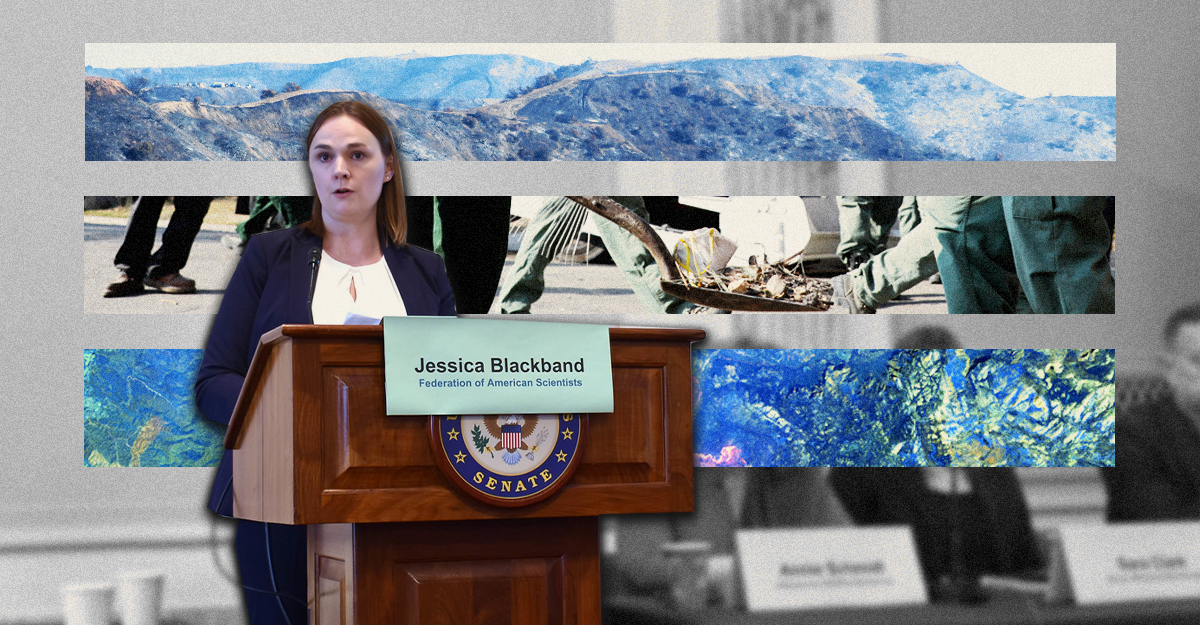
Igniting Innovation: Progress and a Path Forward for Wildfire Policy
Communities nationwide are experiencing longer wildfire seasons and more intense, destructive wildfires. Hotter and drier weather, decades of fire over-suppression leading to the buildup of flammable materials, and increasing development in and around fire-prone areas have transformed wildfire—once a natural and sustainable part of American landscapes—into a major threat. From California to New Jersey, wildfires are taking a toll—costing the United States up to $424 billion annually and displacing tens of thousands of people.
One year after catastrophic wildfires blazed through southern California, the Environmental and Energy Study Institute (EESI) and the Federation of American Scientists (FAS) held a Congressional briefing on emerging solutions to tackle the wildfire crisis and federal policy strategies for getting these solutions into the field. The briefing was followed by a reception co-hosted by FAS and Megafire Action.
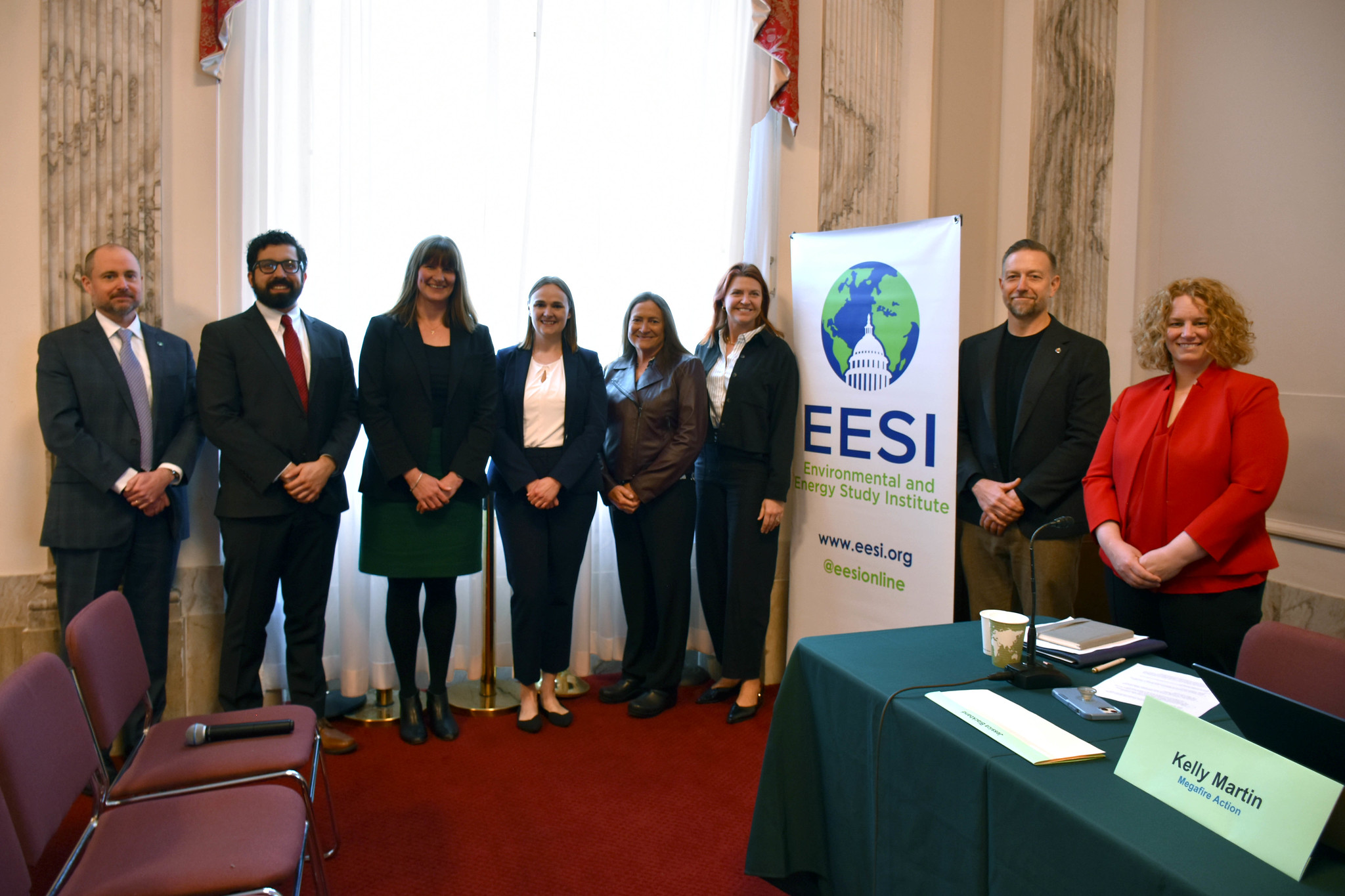
The briefing featured four expert panelists who brought decades of experience building wildfire resilience from space, from sky, from the fireline, and from the law office.
- Kelly Martin (Megafire Action) discussed opportunities and challenges for homeowners and communities to build wildfire resilience, informed by what she saw on the ground in the aftermath of the LA wildfires.
- Annie Schmidt (Alliance for Wildfire Resilience) discussed the impacts of urban conflagrations on communities and explored risk reduction for a variety of impacts, expanding beyond traditional partnerships, and cross-cutting collaboration.
- Sara Clark (Shute, Mihaly & Weinberger) discussed the need for beneficial fire, articulated the difference between cultural burning, and highlighted how we can get more fire on the ground by addressing liability concerns; enabling cultural burning; and cutting “green tape.”
- Dr. Michael Falkowski (Earth Fire Alliance) discussed Earth Fire Alliance’s vision to deliver transformative data from all wildfires on earth and underscored it as an example of a public-private partnership for technology innovation.
The briefing came at a pivotal moment for U.S. wildfire policy. Since FAS started working on wildfire four years ago, we’ve helped to cultivate a growing coalition of partners who have elevated wildfire as an urgent concern in Congress, the White House, governors’ offices, and boardrooms. All of these stakeholders recognize that the wildfire crisis is solvable. FAS is proud to have been an early champion of the Fix Our Forests Act (S.1462), whose provisions would be a critical step in improving how we use science, data, and technology to build wildfire resilience. We’ve also seen the private sector and philanthropic investment supercharge innovation. And we’ve seen stakeholders, from insurance companies to utilities, recognizing the urgent need to act.
In a lively Q&A, panelists answered audience questions about how to act: how to incentivize home hardening, how the federal government can lead wildfire resilience, budget barriers to risk reduction, and more.
What we discussed
- Wildfires become urban conflagrations when homes and infrastructure become the fuel. The disaster in Los Angeles in January 2025 is an example of an urban conflagration that began in the wildland urban interface (WUI) and spread into a community. Some of the most devastating fires in modern history have been urban conflagrations. These kinds of fires are likely to worsen and happen more often if we don’t act.
- Resilience requires solutions in communities and in our environment. To effectively tackle the wildfire crisis, we must invest in risk reduction in both the built environment (e.g., home hardening, infrastructure retrofits) and the natural environment (e.g., prescribed fire and mechanical thinning). Science, data, and technology can support resilience across these domains.
- Solutions must be tailored to the needs of communities at risk and the unique relationships between ecosystems and wildfires. As Kelly Martin summarized, “not all trees are good, and not all fires are bad.”
FAS understands that how we govern science, data, and technology will play a huge role in determining whether we achieve wildfire resilience. We know a future of coexisting safely with beneficial fire is possible if we act with urgency, fidelity to science, and a collaborative spirit. FAS is pushing energetically towards this future and we look forward to continuing to work closely with Congress and with partners to that end.
For International Year of the Woman Farmer and International Women’s Month, we spoke to five women farmers in America about planting the next generation.
From California to New Jersey, wildfires are taking a toll—costing the United States up to $424 billion annually and displacing tens of thousands of people. Congress needs solutions.
FAS is launching the Center for Regulatory Ingenuity (CRI) to build a new, transpartisan vision of government that works – that has the capacity to achieve ambitious goals while adeptly responding to people’s basic needs.
This runs counter to public opinion: 4 in 5 of all Americans, across party lines, want to see the government take stronger climate action.