
How State Governments Should Purchase AI to Ensure Fair, Transparent, and Accountable Use
State and local governments are rapidly procuring AI systems, but the contracts governing these tools overwhelmingly lack provisions for transparency, fairness, and accountability. While attention has been paid to the way the federal government procures AI, comparatively little attention has been paid to procurement by state and local governments. However, some of the most consequential AI systems spanning areas such as criminal justice, healthcare, and education are being deployed at these levels of government. Our analysis of thousands of state AI contracts across California, Florida, and Utah finds that 77% of provisions are standard boilerplate. 3.0% of these provisions address cybersecurity, 5.3% address transparency, and 2.4% address fairness and accountability. Meanwhile, these procurement decisions lock in governance choices for years, with some contracts spanning a decade or more.
Procurement is not merely an administrative function—it is how AI enters government and the first line of defense for responsible AI in the public sector. Contract language is often a relatively low friction and politically viable tool that can generate concrete governance benefits without requiring new AI legislation. State governments should adopt three reforms: (1) standardized responsible AI contract clauses aligned with the NIST AI Risk Management Framework, (2) risk-tiered procurement review processes modeled on proven approaches in San José and Colorado, and (3) mandatory AI vendor fact sheets as a condition of contract award and renewal.
Challenge and Opportunity
Procurement is the first line of defense for responsible AI in the public sector
Governments adopt AI to save money and improve efficiency. But poorly written contracts can hard-code opacity, vendor lock-in, and weak accountability for years or decades. They also waste scarce public resources in ways that are difficult to unwind. According to our analysis of the Electronic Privacy Information Center (EPIC)’s dataset of more than 600 state contracts (2023), the median contract value is approximately $1 million.
Although procurement may sound like a technical or unfamiliar term to many, it is not merely an administrative function. It is a core governance tool. Anyone who cares about how technology is used in government should care about procurement, because it is how technology enters government. Procurement is the first line of defense for ensuring responsible AI in the public sector. Most AI policy debates focus downstream on regulation, but some of the most consequential decisions are made upstream in contracts. Legislation and regulation of AI can be difficult, especially at the state level. AI procurement promises to be a potent tool for security, transparency, fairness, and accountability, not just compliance and cost containment.
In either case, AI-specific considerations rarely enter the process. For example, agencies may not ask about bias testing, government access to training data, or requirements for vendor to disclose how the model makes decisions. A joint National Association of Statement Procurement Officers (NASPO) and National Association of State Chief Information Officers (NASCIO) report recommended that states prioritize bias mitigation, transparency, and accountability in AI procurement. Standard procurement evaluates cost, vendor qualifications, and compliance with existing regulations, but typically lacks the government capacity to assess algorithmic risk.
There is a growing race between technological change and government capacity
State and local governments are rapidly procuring AI systems, with EPIC documenting 600 such contracts in 2023 and our analysis identifying over 1000 just in the states of California, Utah, and Florida. Governments are acquiring AI through both stand alone procurements and renewals of broader technology contracts that now embed AI features. In both cases, procurement capacity has not kept pace with technical complexity, leaving many agencies ill-equipped to evaluate performance, negotiate price and scope, and ensure these tools are used effectively and responsibly.
Cooperative procurement can save time and resources, but it can also concentrate risk by locking many jurisdictions into the same contractual terms
Because procurement takes time and resources, governments often rely on cooperative purchasing agreements (arrangements in which one state competitively bids and negotiates a contract that other states and local governments can adopt without rerunning the procurement process) to buy goods and services together and reduce administrative costs. The National Association of State Procurement Officials (NASPO) is often the institutional vehicle for this process. It was founded in 1944 during World War II, following President Franklin D. Roosevelt’s signing of the Surplus War Property Disposal Act. In the EPIC dataset, more than 4 out of 5 state AI contracts were negotiated through the NASPO ValuePoint platform (NASPO’s flagship cooperative contract program). Cooperative procurement can increase bargaining power and reduce administrative costs for participating states. Yet it also makes the initial contract especially consequential, as boilerplate language often becomes the template for all participating jurisdictions.
In our ongoing research, we analyzed AI contracts from three states—Utah (which initiated many NASPO agreements), California, and Florida—classifying 3,771 individual contract provisions across 215 contracts.
We found that 77% of provisions are standard boilerplate, such as force majeure and indemnification clauses. Transparency provisions (audit rights, reporting obligations) are the most common substantive category at 5.3%. Cybersecurity provisions (data encryption, breach notification, access controls) account for 3.0%, and fairness and accountability provisions (non-discrimination, bias testing algorithmic accountability) are about 2.4%.
Long term contracts are often poorly suited to rapidly evolving technologies and governance norms
Contract terms may also be lengthy. In the EPIC data, the average contract length was seven years. Some contracts even span a decade. When governments experience a failed AI implementation, they often respond by signing longer, not shorter, contracts. In the aftermath of failure, agencies may turn to more established vendors that appear credible and reliable, even if they are more expensive.
In 2013, Michigan’s Unemployment Insurance Agency entered into a $47 million contract with Fast Enterprises to design and run the Michigan Integrated Data Automated System, or MiDAS. The system incorporated algorithm-based fraud detection tools. From 2013 to 2015, MiDAS wrongly accused more than 34,000 unemployed individuals of fraud. In 2022, the state replaced it with the Deloitte-developed Unemployment Framework for Automated Claim and Tax Services, known as uFACTS. It is projected to cost about $78 million over a 10 year contract. Throughout this fiasco, little attention was paid to how the original contract was negotiated and structured. Nor was there meaningful scrutiny of whether procurement practices improved when the state later signed an even larger contract with Deloitte.
Critically, neither the original $52 million MiDAS contract nor the replacement $78 million uFACTS agreement included meaningful provisions for algorithmic transparency, bias testing, or independent performance auditing—precisely the types of clauses that could have flagged the system’s 93% false-positive rate before it devastated tens of thousands of families. The MiDAS debacle cost the state over $125 million across two contracts, falsely accused 40,000 residents, and resulted in a $20 million class-action settlement. In short, the absence of responsible AI contract provisions creates real-world harm.
Locking in AI governance decisions for years, or even a decade, leaves little room to adapt. It places states and local governments in a vulnerable position, as the underlying models and risks can evolve dramatically within just a few years. Once a contract is signed, the window for negotiating transparency, fairness, or accountability provisions largely closes. Revisiting core terms mid-contract is costly and legally complex, which means the initial procurement decision effectively sets the governance framework for the system’s entire operational life.
Vendor lock-in compounds these risks. Once an AI system is deployed under a long-term contract, governments may lose meaningful control over the data the system processes. Vendors may retain proprietary rights over training data, model architectures, or performance analytics, making it difficult for the government to audit system behavior or switch providers. When institutional knowledge becomes embedded in vendor-controlled platforms—as happened when Arkansas could not explain the details of a model used to determine Medicaid benefits—the dependency becomes nearly irreversible. In Idaho, a state agency refused to disclose its benefits allocation formula, claiming it was a vendor trade secret, effectively shielding a public decision-making system from public accountability.
Contracts are an underutilized policy lever
Although state governments rarely include responsible AI provisions in their contracts, these clauses represent an important policy lever. Based on the EPIC data, all 50 states, as well as DC and Guam, have entered into AI related contracts.
Contract language is often a relatively low friction and politically viable tool that can generate concrete governance benefits without requiring new AI legislation. Moreover, vendors tend to be repeat players, with companies such as Deloitte, Accenture, and Pondera providing various types of government technology. This fact creates opportunities to negotiate principles across various AI products. Clearer contract language standards also benefit smaller companies and new entrants by demystifying expectations and lowering the barrier for bidders that lack dedicated government affairs teams.
Nonetheless, a contract’s leverage is time sensitive. Once it is signed, the window of opportunity largely closes. Revisiting or unwinding core terms can be difficult and costly. Governments therefore need to use the negotiation process to exercise their purchasing power to reduce risk and strengthen transparency and accountability. The cost of failing to do so is substantial. These agreements are often sticky and are frequently reused as boilerplate language, allowing weaknesses to persist across agencies and over time.
What role do policy networks play in AI procurement reform?There are growing AI communities within state and local governments that view procurement as an underutilized governance tool. The GovAI Coalition, launched by San José in 2023, has expanded to more than 3,000 members across 900 government agencies. In April 2026, the San José City Council approved the Coalition’s transition into an independent nonprofit organization. Within the coalition, procurement is one of the core committees, and vendors are not permitted to serve on it. There are also networks such as the National Association of State Chief Information Officers and the Beeck Center for Social Impact and Innovation’s State Chief Data Officers Network, where best practice sharing, information gathering, and coalition building are active. These networks enable state and local governments to use their collective purchasing power more strategically in their dealings with vendors.
Plan of Action
State governments have both the authority and the practical tools to strengthen AI procurement today. The following three recommendations can be implemented through existing procurement authority, without requiring new legislation, and draw on proven models already in use.
Recommendation 1. State procurement offices should adopt standardized responsible AI contract clauses aligned with the NIST AI Risk Management Framework.
AI procurement should not rely solely on traditional cost benefit analysis, but also incorporate a systematic risk benefit assessment. The EU’s AI Act, which entered into force in 2024, distinguishes between high and low risk AI systems and is accompanied by model contractual clauses tailored to different risk categories. In the U.S, the National Institute of Standards and Technology (NIST) has developed the AI Risk Management Framework (2023), a cross sector tool to guide risk evaluation and mitigation. Aligning these risk assessment frameworks with standardized contract clauses would substantially improve responsible AI procurement practices across state and local governments, while also reducing administrative burdens. Even if adoption is not mandatory, such resources can encourage more proactive engagement with responsible AI provisions by lowering the cost of asking the right questions, identifying relevant information, and translating risk considerations into clear contractual language.
IEEE Standard 3119-2025, an international standard specifically for AI procurement, provides a ready-made framework covering problem definition, solicitation, vendor evaluation, and contract monitoring. A multi-state working group convened through NASPO—building on its existing collaboration with NASCIO on AI procurement—could adapt these standards into model contract clauses within 12 months. At minimum, clauses should address: data governance and retention, algorithmic bias testing, explainability requirements for high-risk decisions, breach notification procedures specific to AI systems, and performance benchmarks with renewal contingencies. Canada’s Algorithmic Impact Assessment and the EU’s model contractual clauses for AI offer proven international templates.
Recommendation 2. States should implement risk-tiered AI procurement review processes, modeled on San José’s Digital Privacy Office approach.
The City of San José, located in the heart of Silicon Valley, has already adopted this risk analysis approach. When a city department submits a procurement request, the Digital Privacy Office assesses its risk level. If the system is deemed low risk, the request is approved without creating a backlog. If it is classified as high risk, the office conducts an impact assessment and requires the vendor to complete a structured AI FactSheet. This simple document helps government officials know what questions to ask and how to communicate with vendors about them. It covers training and test data, model characteristics, update procedures, performance metrics, and related information. These materials are then reviewed by cybersecurity and privacy teams, followed by testing and ongoing monitoring.
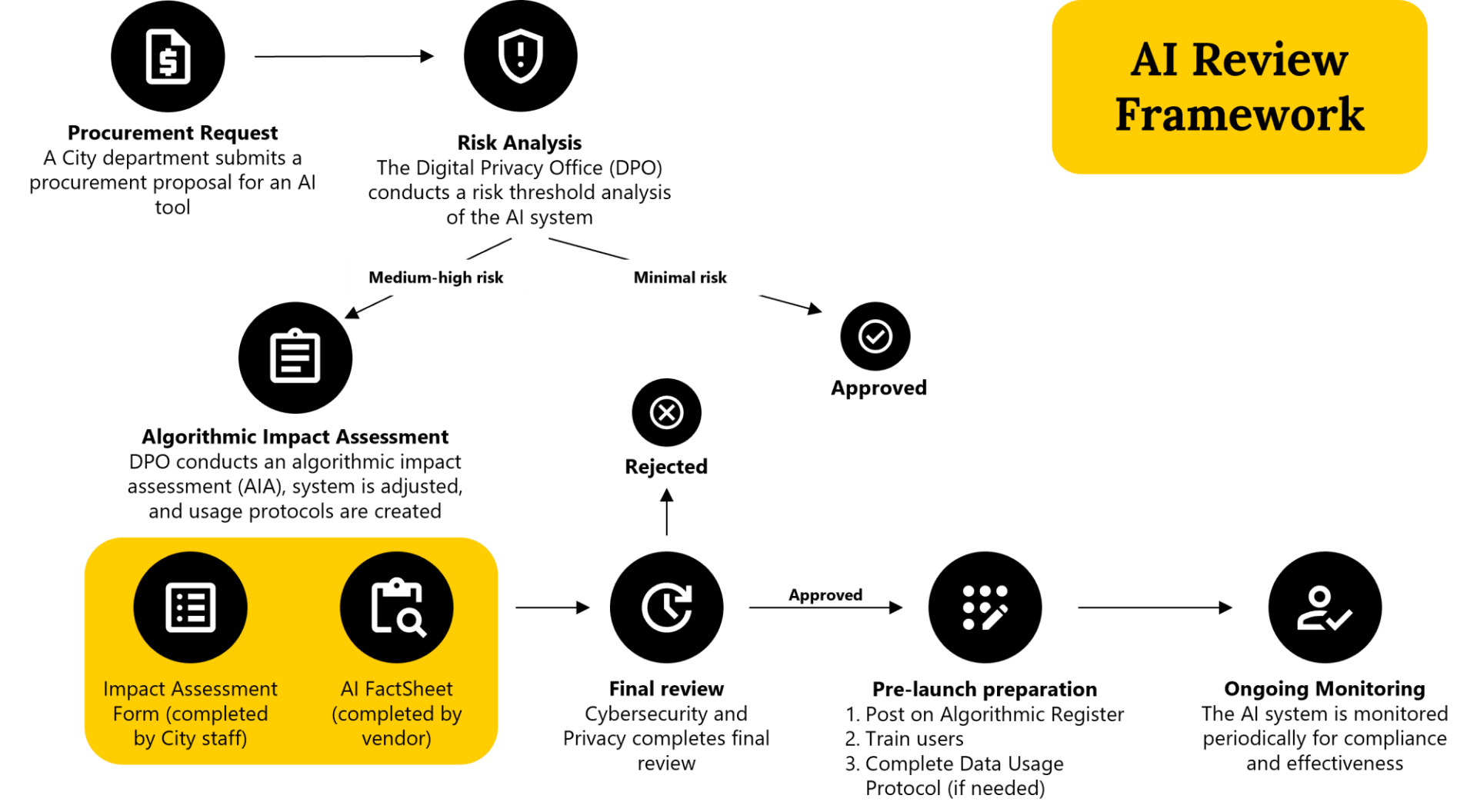
City of San José website (2026)
This approach can be elevated to the state level by establishing a similar risk analysis procedure within the procurement process. The Colorado Office of Information Technology (OIT) already uses a NIST-based risk assessment framework to evaluate all generative AI use cases and ensure that procurement complies with state law and data security requirements, providing a state-level proof of concept.
States with existing AI governance infrastructure are natural pilots. California’s Governor issued an executive order in 2023 directing the development of AI procurement guidelines, and the state has since published purchasing rules for generative AI. Colorado’s AI Act (SB 24-205) already requires reasonable care for high-risk AI systems. These states, alongside jurisdictions active in the GovAI Coalition could pilot risk-tiered review processes within existing procurement office budgets. San José’s Digital Privacy Office operates within the city’s IT department without a dedicated budget line, demonstrating that this model can be implemented by designating existing staff rather than creating new offices. NASCIO, which has made AI governance a top priority for 2026.
Recommendation 3. State governments should require AI vendors to complete structured AI fact sheets as a condition of contract award and renewal.
One relatively easy to implement reform is to adopt shorter term contracts with built in opportunities for revision or modification after a clearly defined period of use and evaluation. This recommendation aligns with the call to avoid rigid procurement cycles and embrace more modular, outcome-driven buys by Lewis and Pahlka (2025). Renewal should be contingent on demonstrated performance. The guiding principle is simple: no test, no renewal. As part of contract negotiations, vendors should be required to provide an AI fact sheet and update it as needed. No high-risk, high-impact, high-stakes AI system should be launched or renewed without appropriate testing and ongoing monitoring.
The AI fact sheet can serve as a condition of contract award and renewal. It should function as a “nutrition label” for government AI systems, modeled on San Josés vendor-facing template and inspired by IBM Research’s AI FactSheets 360. At minimum, the template should capture: training data provenance and representativeness, model performance metrics and known limitations, bias audit results across protected classes, update and versioning procedures, data retention and deletion policies, and human oversight mechanisms. Fact sheets should be updated whenever the model is retrained or its scope of use changes, and must be submitted as a condition of both initial contract award and each renewal cycle. New York City’s Local Law 144 demonstrates that mandatory AI disclosure requirements are implementable, though its enforcement challenges underscore the importance of tying disclosure to the procurement process itself—where the government has direct leverage—rather than relying solely on post-deployment regulation.
There is a role for the federal government
The federal government can also reinforce and scale these organic, though still scattered, reform efforts. The AI in Government Act of 2020 and Office of Management and Budget Memorandum M-25-21 offer a federal-level template that states can adapt to their own procurement contexts. Perhaps the most effective thing the federal government can do in this space is avoid preempting state efforts to innovate. Recent legislation and executive orders, including proposed moratoriums on state AI rulemaking advanced in federal budget and regulatory packages, have attempted to create regulatory ceilings on state efforts. Such efforts could prematurely stunt useful state innovation.
Conclusion
Procurement is how technology, including AI, enters government. It is the first line of defense for responsible AI in the public sector. When procurement fails, the downstream consequences can be significant and long-lasting.AI procurement is not a narrow technical issue. It is the mechanism through which governments quietly govern AI at scale. Strengthening procurement today will shape AI outcomes for decades. By adopting standardized contract clauses, risk-tiered review processes, and mandatory vendor fact sheets, state governments can use their existing procurement authority to build transparency, fairness, and accountability into AI systems from the outset.
When a state agency needs an AI system, it follows one of three paths: issuing a competitive request for proposals (RFP), using an exemption (for emergencies or sole-source purchases), or purchasing through a cooperative agreement like those administered by NASPO ValuePoint, where a single “lead state” negotiates terms that dozens of other states can adopt. In competitive bidding, agencies define the problem, draft an RFP specifying scope and terms, evaluate vendor bids on cost and technical merit, negotiate final contract terms, and monitor vendor performance through the contract’s life. However, as EPIC’s report documents, many AI systems enter government through cooperative purchasing agreements or emergency exemptions that bypass competitive bidding entirely — meaning AI-specific considerations like bias testing and data governance never get evaluated. EPIC identified 621 AI contracts across all 50 states, finding that the top ten vendors alone accounted for over $715 million in potential contract value.
Cooperative procurement allows multiple government entities to purchase goods and services under a single contract, reducing administrative costs and increasing bargaining power. The National Association of State Procurement Officials (NASPO) facilitates this through the ValuePoint platform. In the EPIC dataset, more than 4 out of 5 state AI contracts were negotiated through NASPO ValuePoint. While this efficiency is valuable, it means a single contract’s terms—including any gaps in AI governance provisions—can propagate across dozens of jurisdictions.
Once an AI system is deployed under a long-term contract, governments may lose meaningful control over the data the system processes and the decisions it produces. Vendors may retain proprietary rights over training data, model architectures, or performance analytics, making it difficult for the government to audit system behavior or switch providers. Over time, institutional knowledge becomes embedded in vendor-controlled platforms — staff learn the vendor’s system rather than the underlying process, and the data needed to transition to a new provider may not be readily exportable. These dynamics create high switching costs and reduce the government’s bargaining power at renewal. Shorter contract terms with performance-contingent renewal clauses (Recommendation 3) help mitigate these risks by preserving the government’s ability to reassess and, if necessary, change course.
Risk-tiered review ensures low-risk AI systems are approved quickly—San José’s model only triggers full review for high-risk systems, avoiding bottlenecks. Standardized contract clauses and fact sheet templates actually reduce negotiation time by providing ready-made language that procurement officers can adopt rather than draft from scratch. Also, the cost of upfront review is far less than the cost of failure downstream: Cooperative procurement means the review investment is shared across participating jurisdictions.
Several federal frameworks support the recommendations in this memo. The AI in Government Act of 2020 established requirements for federal AI governance. OMB Memorandum M-25-21 emphasizes structured governance, accountability, and public trust in federal AI use. The NIST AI Risk Management Framework provides a cross-sector tool for risk evaluation. While procurement is primarily a state and local function, federal guidance can reinforce state-level reforms by encouraging contract transparency and model standards.
OIT AI governance framework was implemented by designating existing staff rather than creating a new office. A NASPO-convened working group could develop model contract clauses once for shared use across all member states, amortizing development costs across dozens of jurisdictions. IEEE 3119-2025 provides a ready-made procurement framework that reduces the need for states to develop standards independently. The cost of inaction—failed AI deployments, legal liability, and harm to constituents—far exceeds the cost of reform. AI initiative failure rates in government settings reach 70-85%, and the federal government already spends 80% of its $100 billion IT budget maintaining legacy systems.
Finally, implementation costs should be understood not only as personnel expenses but also as internal coordination burdens created by fragmented procurement processes. Clear ownership across agencies is essential to manage these risks and ensure accountable, responsible AI procurement from start to finish.
AI’s high-stakes outputs directly shape American economic, industrial, and technological outcomes. They must not be accepted entirely on the basis of institutional faith rather than verifiable evidence.
The clearinghouse will also neutrally mediate the assignment of auditors to audits—strengthening independence, trust, and ethical governance across the AI ecosystem.
Soft law was never meant to be a permanent solution. Treating it as one, and letting the sandcastle stand in for the skyscraper indefinitely, is how we end up with a decade of voluntary commitments and no enforceable accountability to show for it.
Jobseekers, employees at smaller organizations, and local public workers need more than a weekend crash course in AI. They need practice choosing useful tasks, protecting data, testing outputs, and explaining where human judgment remains necessary.