 |
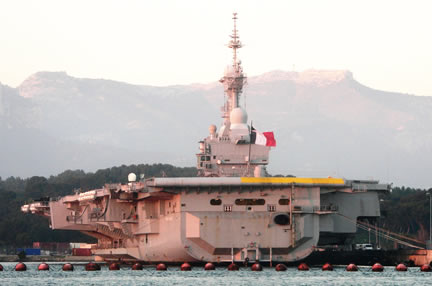
| Sarkozy says he wants to be more open about France’s nuclear arsenal “than anyone ever has been” about theirs. OK, does the aircraft carrier Charles de Gaulle still carry nuclear weapons in peacetime? |
.
By Hans M. Kristensen
The French nuclear weapons arsenal currently includes approximately 300 warheads, according to our latest estimate published in the Bulletin of the Atomic Scientists. Roughly 80 percent of the warheads are for delivery by three ballistic missiles submarines. The remaining warheads are on cruise missiles for delivery by land- and sea-based strike aircraft. The total arsenal is expected to decrease further to some 290 warheads in the next few years.
Although President Nicolas Sarkozy declared in March 2008 that he had “decided that France could and should be more transparent with respect to its nuclear arsenal than anyone ever has been,” France remains the only European nuclear weapons state that has not yet declared whether its aircraft carrier still carries nuclear weapons under normal circumstances.
Background: French Nuclear Forces 2008
The last remaining agreement limiting U.S. and Russian nuclear weapons has now expired. For the first time since 1972, there is no treaty-bound cap on strategic nuclear weapons.
The Pentagon’s new report provides additional context and useful perspectives on events in China that took place over the past year.
Successful NC3 modernization must do more than update hardware and software: it must integrate emerging technologies in ways that enhance resilience, ensure meaningful human control, and preserve strategic stability.
The FY2026 National Defense Authorization Act (NDAA) paints a picture of a Congress that is working to both protect and accelerate nuclear modernization programs while simultaneously lacking trust in the Pentagon and the Department of Energy to execute them.