Gil on the Hill: Congress is Back. Science Policy is About to Get Messy
Congress emerges from a sluggish, humid August recess into a raucous, sweltering September session. For now, it’s ahead of schedule, with the Senate passing a Continuing Resolution (CR) to fund the government past the September 30th deadline to December 11th (and safely beyond the midterms). Now the House must act. They may end up needing every minute of negotiation time, however, as major Trump administration priorities come to a head with congressional realities.
The science policy community has been active all summer, with a new NSF X-Labs program, an OSTP “Science: A New Golden Age” Report, and FAS Chief Science Officer, Dr. Jedidah Isler’s testimony on “American Global Competitiveness” in front of the House Energy and Commerce Committee (humble brag), to name just a few. As we head into the fall and the end of the 119th session, we face significant S&T issues of concern. Here is what we’re tracking:
1. Continually Resolving (& Gas Station Weed)
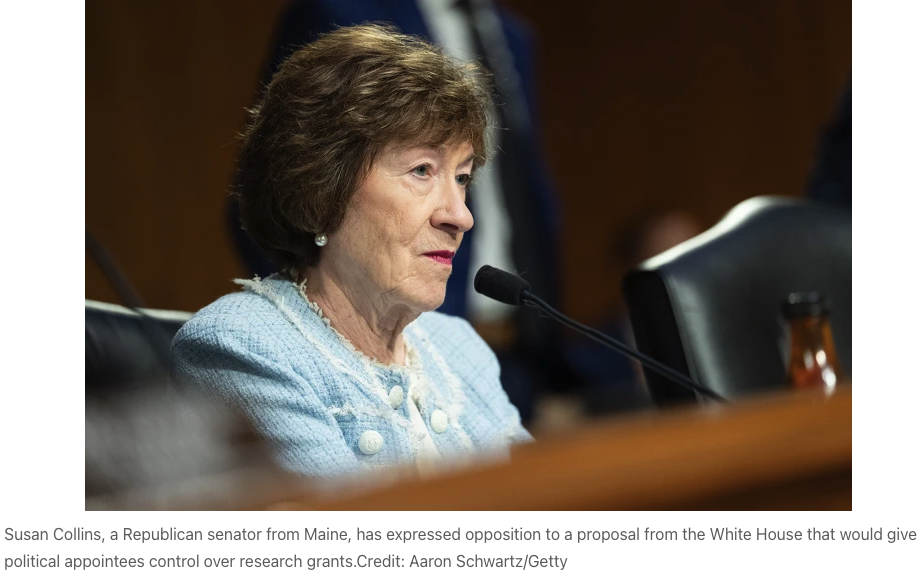
Before breaking for August, the Senate passed a CR to kick the government funding can down the road to December 11th and provide for some choice anomaly funding and policy riders. Most importantly for us, Appropriations Chair Susan Collins (R-ME), who pressed for changes to the rule in a July 6 letter, said the agreement “prevents the Office of Management and Budget (OMB)’s proposed rule regarding federal financial assistance from taking effect” and “avoids any poison pills.” Senator Collins and her colleagues demonstrated tremendous leadership by heeding the call from the science community (and many more constituencies) and asserting congressional authority over the power of the purse.
If your life is impacted by federal grantmaking (it is), then you care about the OMB rule. FAS has done some explaining before, but the TL;DR is that it allows for significant, unprecedented influence from political appointees on how federal funding decisions get made. It would put political appointees in charge of federal grant review, allow termination of active grants at any time for shifting priorities, and restrict international research collaboration. FAS called for a delay and filed our comment, arguing among other things that “a termination authority operating under undefined standards is unaccountable.”
The issue is not settled, however, and we’re set for another September shutdown showdown as all eyes are on the House to pass the Senate’s CR with the OMB Rule delay attached. Senator John Kennedy (R-LA) claims President Trump is “comfortable” with the bill, which notably only delays the OMB rule implementation and does not eliminate it, but even if the administration decides not to pick that fight right now, there are other pain points that could become excruciating. The Senate CR included a delay of a ban on sales of certain intoxicating hemp-derived products, which has House Republicans uneasy about “gas station weed.” Add on to this midterm developments, a trade war, a real war, and more, and it becomes clear all the ways this can go wrong between now and then.
The House has options – it could bring the CR up under “suspension of the rules,” which bypasses a key initial voting hurdle without needing to acquiesce to smaller factions on select issues, but requires two-thirds of members voting to pass. We’ll see how creative they have to get.
What matters: The Senate-passed CR must be passed by the House before September ends, and it contains at least one high-profile provision that could cause trouble. It’s the last chance to address the OMB proposed rule before it goes into effect.
2. The OMB Rule & Impoundment
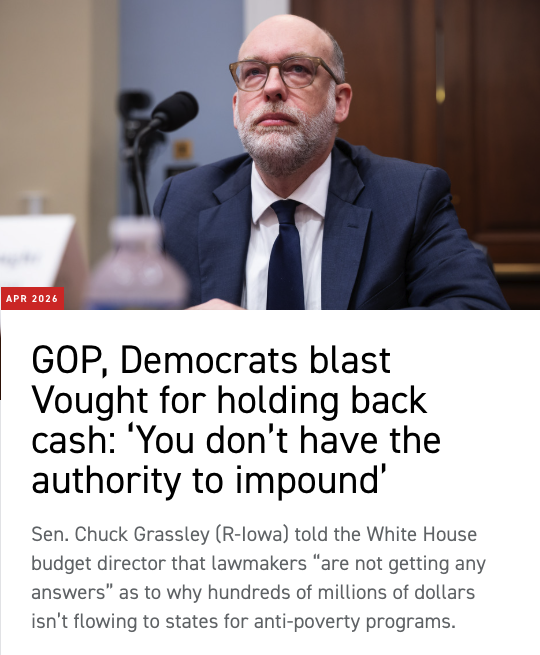
There is compelling evidence that the administration has been engaged actively in impoundment – the illegal withholding of congressional funds. Yes, this is still happening, and it’s still a massive deal. The OMB proposed rule is the administration’s attempt to formalize and endure tactics the administration has already been using to exert as much control as it can on federal funding at the individual award level.
Taken together, it is clear that the administration has been overreaching on federal funding decisions big and small, including and especially on programs specifically appropriated by Congress (which is law). The OMB proposed rule stands on a roof and shouts to the world what so many in the science community have been documenting for over a year: the Administration is testing the limits of the American taxpayer’s tolerance for unprecedented control of federal funding by the executive branch. The final theater of this fight will be in the courts.
As we track and respond to individual grantmaking decision changes and are still licking wounds from DOGE cuts (GAO isn’t buying the “savings” claims), in the big picture, agencies are still dealing with major budget shifts and withholdings. Recent reports suggest NSF will award roughly 46% fewer research grants than the 2021–24 average, and the lowest count since the early 1980s. Spending across nearly all eight of NSF’s main directorates is down 20% to 40% year over year despite Congress directing that no directorate be cut more than 5% against FY2024. Congress is flexing oversight muscles, and if Democrats expectedly take over at least one chamber next year, they’ll be doing much more than flexing.
In early August, Reps. Zoe Lofgren (D-CA) and Rep. Gabe Amo (D-RI) referred Energy Secretary Chris Wright to the Justice Department, alleging he testified falsely in June that $7.5 billion in clean energy grant terminations were not politically motivated. In July, DOJ itself acknowledged in a federal lawsuit that hundreds of terminations were “based solely on the political identity of the grant recipient’s state,” and 283 of the 284 were states that voted for Harris. According to Secretary Wright’s June 10 testimony: “…no decisions were made on politics.” Expect more, and more emboldened, oversight action like this these next two years.
What matters: We spent a year arguing about whether appropriated funds would be spent at all. Now we’re debating the basic structure of awarding individual federal grants. Next we need to know whether anyone will say out loud where the money is going and what Congress and American taxpayers want to do about it.
3. Science Leadership and the Midterms
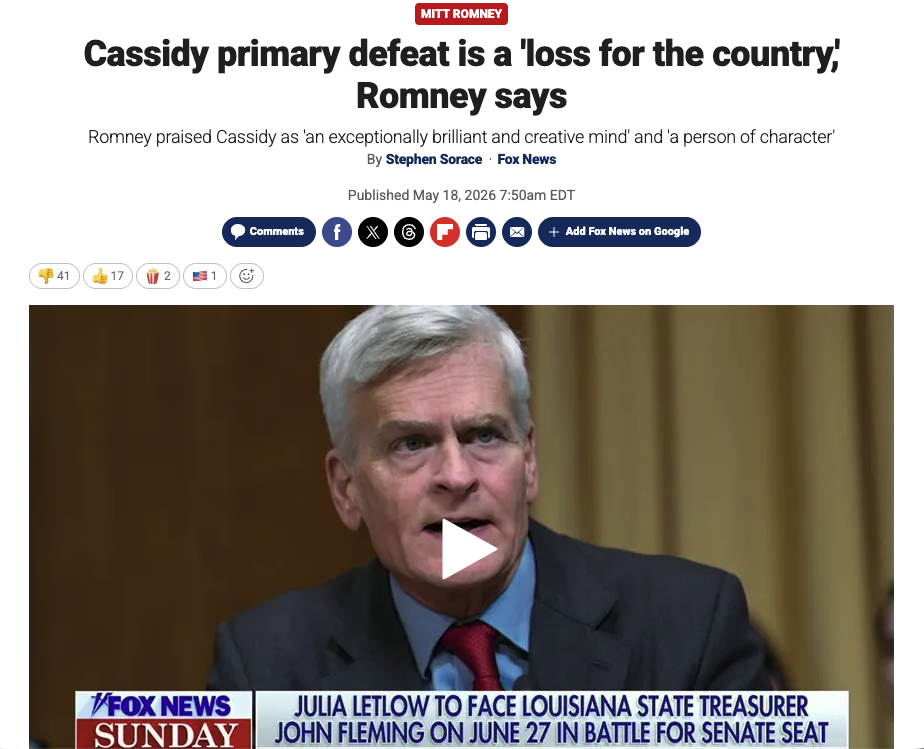
Midterm primaries are coming to a close, and with it consequences for scientific leadership in Congress. Some notable science and health leaders were removed by their own party’s voters this cycle:
- Sen. Bill Cassidy (R-LA), chair of the Senate Health, Education, Labor, and Pensions Committee. Sen. Cassidy is a physician, noted science champion, and one of my personal favorite legislators. He lost his May primary to a MAGA/MAHA-aligned candidate and joins the list of Republican members who vocally opposed President Trump and lost.
- Rep. Haley Stevens (D-MI), ranking member of House Science’s Research and Technology subcommittee and a CHIPS and NSF reauthorization principal, lost Michigan’s Senate primary on August 4. Rep. Stevens was also a member of the Select Committee on the Strategic Competition Between the United States and the Chinese Communist Party, and a co-chair of important S&T caucuses such as the Future of Work Caucus.
- Rep. Raja Krishnamoorthi (D-IL), ranking member of the Select Committee on the CCP and member of the House Intelligence Committee, lost Illinois’s Senate primary in March.
Add the retirements, and you have up to ten science and technology leadership positions vacating before a November general election vote is counted:
- Sen. Mitch McConnell (R-KY) as Chairman on the Senate Appropriations Subcommittee on Defense,
- Sen. Joni Ernst (R-IA) as Chair on the Senate Armed Services Subcommittee on Emerging Threats,
- Rep. Don Bacon (R-NE) as Chair of the House Armed Services Subcommittee on Cyber, IT and Innovation,
- Sen. Gary Peters (D-MI) as Ranking Member of the Homeland Security and Government Affairs Committee,
- Rep. Jan Schakowsky (D-IL) as Ranking Member on the House Energy & Commerce Subcommittee on Commerce, Manufacturing, and Trade, and
- Sen. Steve Daines (R-MT) as Chairman of subcommittees on the Senate Energy and Natural Resources and Foreign Relations Committees.
One of the most consequential races for science leadership concerns the aforementioned Senator Collins in Maine. As Chair of the Appropriations Committee, she has maintained her status as one of the most high-profile members of Congress, and her centrist and bipartisan profile cast her as a key figure in every major congressional negotiation. On top of that, as recently demonstrated by her leadership in opposition to the OMB rule, she has been a stalwart champion and defender of science and technology priorities in Congress. Polls are classifying this race as a toss-up and essentially tied against Troy Jackson, who only became the nominee on July 25 after the widely reported Graham Platner controversies forced Platner’s dropout.
What matters: if you work a science portfolio, your customer list is about to change more than at any point since 1992. At least 83 members will not return, and 58 House retirements are the second-highest total in history.
4. Looking Ahead – Closing of the 119th Congress
Congress is running out of track to deliver on key priorities that have been in negotiation throughout the 119th session. There are really only three legislative vehicles left (that could become one by December) – the CR funding package, the follow-up bill on December 11th for full annual funding (if the CR passes), and the yearly National Defense Authorization Act. Everything else – NASA reauthorization, National Quantum Initiative, Fix Our Forests Act, permitting, the farm bill, the Export-Import Bank reauthorization, and so much more – is cargo looking for a ride on one of these must-pass vehicles.
That’s a lot to squeeze in, but we know when Congress really wants to do something, they will. And even while it may feel fraught and intractable, somehow they find a way to get the necessary done in the end. Many of these items may well fall off and into the next Congress, but many too will pass into law (if I may provide such an uninspired expert take). External factors like wars, trade policies, and election security all loom large over all of it, however, and a month is a long time in Washington, D.C.
We’ll check back then! Ta-ta for now.
Gil on the Hill: More Budget, More Problems
Spring is here and so is the debate on the budget. The Fiscal Year 2027 (FY27) President’s Budget Request (PBR) is out and the appropriations process is in full bloom, even if one small but important piece of FY26 lags behind in the form of funding for the Department of Homeland Security (DHS). Meanwhile, states continue to step up and address the most pressing science and technology gaps.
FY27 Science Funding: “Aww Mom, science cuts for budget again!?”
As expected, there are more deep cuts for science R&D in the FY27 PBR.
- Not So Fast: Appropriators on both sides are already signaling skepticism towards sweeping cuts and changes, such as Senator Moran‘s (R-KS) concerns about eliminating the National Institute for Standards and Technology’;s (NIST) Manufacturing Extension Partnership.
- More $$$ for AI: According to Department of Energy (DOE) Chief of Staff, Carl Coe, his agency “will need a lot more” funding to hit Genesis Mission targets. That says a lot from the guy who used to lead DOE’s Department of Government Efficiency (DOGE) efforts.
- Power of the Purse: FY26 oversight is still important as ever, and the House Science Committee minority released an impressive report detailing how NASA implemented unauthorized (read: illegal) cuts in last year’s budget in accordance with the FY26 PBR. It’s impossible to overemphasize how important it is to keep attention on this.
- “In 2025, NASA acted in concrete and formal ways to implement the proposals of the President’s Budget Request for Fiscal Year 2026 (FY26 PBR).”
Trump to NSB: “You’re Fired!” A moment of silence for science governance
All 22 members of the National Science Board (NSB) have been fired as the National Science Foundation (NSF) and science at-large absorbs the latest blow to its basic operation from this administration. The NSB is mandated by law and appointed by the president. It advises the NSF, Congress, and the president on science.
- Bc the Constitution?: There is little explanation for the dismissal, other than comments to Inside Higher Ed regarding the constitutionality of the board’s membership without Senate confirmation. Meh.
- Lots of Change: This comes as we await a new NSF leader – Jim O’Neill – and NSF deals with sweeping changes like the elimination of the Social, Behavioral, and Economic Sciences directorate.
- Grants Still Slow: This massive loss of leadership only compounds the slow-trickle of science grant approvals and accusations of politicization. So far, this administration has canceled or suspended nearly 1,400 NSF grants. The NSF has only doled out 758 grants compared with 2,327 grants the same time last year.
Labs of Democracy: States keep pushing on S&T policies
States have no choice but to deal with the ever-pressing issues associated with the AI explosion and uneven federal support for innovation. We’re continuing to see the “Patchwork-Moratorium” AI policy tension play out at federal and state levels on both data centers and safety.
- AI legislative action highlights include:
- Maine’s governor vetoed a bipartisan moratorium on large data centers that would have made them the first state to do so.
- Florida is seriously considering an “AI bill of rights,” with the Governor and allies pressuring the legislature to act on tech accountability and child safety.
- States are investing in entrepreneurship
- Indiana is investing $15M to attract international tech startups through a venture initiative tied to Israel.
- West Virginia is launching a new Office of Entrepreneurship to support startups and small businesses navigate state agencies and processes
Looking to May
May brings more appropriations process fun as the committees scrutinize the president’s FY27 budget request and compose their own funding bills (which we can expect will again rebuke the massive proposed cuts to science).
This contentious summer period will reach a boiling point as we arrive closer to the midterms, making meaningful legislating even more complicated. Congress is racing to get laws passed on pressing matters like AI and housing as well as standing business like FY27 funding.
No one will be surprised if we end up with a continuing resolution to push our shutdown deadline out past the midterms, so the real question is what else will they get done this summer? We know this Administration will be staying busy.
There are lots we didn’t cover, so we’ll just have to talk again soon!
Gil on the Hill: You can’t spell funding without “fun”
Me to the U.S. Government:
This presidential administration has promised energy dominance, AI leadership, and a secure nation. What do all these things have in common? They cost money! And a functioning government apparatus to deliver. The first fiscal year of the Trump administration still hobbles on as the Department of Homeland Security flails about without funding and specially-funded Immigration and Customs Enforcement (ICE) get drafted in to run airport security. We’ve discussed the political potency of airport delays on shutdown scenarios before, and they’ll be playing their major part yet again as they reach the biggest delays in history.
It’s a busy time and you have things to do. Here are three things worth tracking in science policy as Fiscal Year 2026 (FY26) wraps and we head into FY27.
DHS shutdown deal – too little too late?
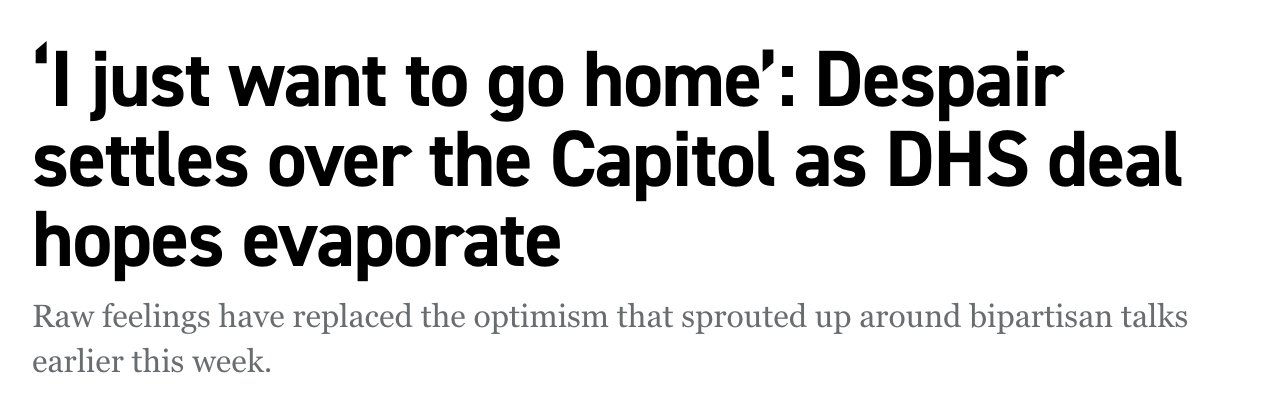
Politico: “‘It looks like everybody is going to stare at each other for a little while,’ Senate Majority Leader John Thune said Wednesday, before nodding at lawmakers’ best hope for getting a deal — their overwhelming desire to leave town.”
A Republican deal, blessed by the White House, to fund DHS, limit ICE enforcement, and include some parts of Trump’s desired voting law changes has hit major roadblocks that leave little optimism for a DHS shutdown conclusion by week’s end. If the Senate cannot pass something by Friday, the House will go home for the recess and the DHS shutdown will linger on at least another week.
Congress is racing against the spring travel surge and the inevitable viral images of massive Transportation Security Administration (TSA) lines operated by ICE agents. Visuals like these speak thousands of words a floor speech cannot.
Complicating matters is the growing possibility of another GOP-led reconciliation bill, also being mulled by President Trump, as an alternative path for delivering on various items like the Iran war, DHS funding, and Trump’s voting rules changes, but it’s unclear that would pass Senate rules scrutiny.
The White House published “A National Policy Framework for AI”

White House: “The Administration recognizes that some Americans feel uncertain about how this transformative technology will affect issues they care about, like their children’s wellbeing or their monthly electricity bill. These issues, along with other emerging AI policy considerations, require strong Federal leadership to ensure the public’s trust in how AI is developed and used in their daily lives.”
This framework addresses six key objectives regarding families, communities, intellectual property, censorship, innovation, and workforce. It’s the latest push against the “patchwork” of AI regulation as the Administration continues to demand a moratorium on state AI laws and acquiescence to a national set of rules. FAS has concerns about such an approach.
This all comes against the backdrop of a great deal of legislative activity concerning data centers and as specific topics come into more of a focus, like a serious bipartisan look at AI use in courts, scrutiny of data privacy and supply chain security.
Science Funding – let it flow
FAS: “The Federation of American Scientists urges the U.S. government to release holds on Congressionally-appropriated funding for scientific research, education, and critical activities at the earliest possible time.”
The Presidential Budget Request for Fiscal Year 2027 should arrive in the coming days, and with it a barrage of budget hearings, oversight, and negotiation over topline priorities. We’re still checking the receipts from FY26, and lots of discrepancies remain to be sorted out about how (and if) that money was properly spent as legally prescribed by Congress.
The first big flashpoint of the FY27 Presidential Budget arrives with OMB Director Russ Vought testifying on Capitol Hill on April 15th. Military funding, homeland security, and economic affordability will demand attention, but we cannot lose sight of how the slow-rolling of scientific funding is harming economic competitiveness, national security, and global scientific leadership. Core government functions, like grantmaking for research, are being directly and indirectly disrupted. It’s hard to see this Administration delivering on the promises of its agenda without the scientific progress to power us through unprecedented challenges presented by AI, energy, and an evolving national security landscape. My smarter colleagues put it more eloquently here.
Ta-Ta for now!
There is so much more to discuss, but we’ve only so much word count. Keep up the convo here GRuiz@FAS.org and let us know what you think.
We’ll be closely tracking science funding budget hearings and FY26 spending accountability, the growing urgency around AI and emerging tech legislation, and the actions of the Trump administration as they helm the world’s greatest scientific enterprise of all time in the form of the U.S. government.
Gil on the Hill February 2026 – Appropriations: Signed, Sealed… Will It Be Delivered?
Implementation Season
January saw us watching whether the government would fund science. February has been about how that funding will be distributed, regulated, and contested.
Appropriations are (mostly) done. The shutdown clock has (mostly) stopped ticking. Congress, federal agencies, and the states are quietly settling into regular business for the year.
Let’s see what’s been going on.
Appropriations: Signed, Sealed… Will It Be Delivered?
As we’ve been tracking together, on January 23, the President signed into law the Commerce, Justice, Science; Energy and Water Development; and Interior and Environment Appropriations Act (H.R. 6938), locking in funding for core science accounts at the National Science Foundation (NSF), the Department of Energy (DOE), the National Aeronautics and Space Administration (NASA), and related agencies.
One week later, the Senate passed a bipartisan spending package funding most remaining agencies, including Defense, Health and Human Services (HHS), and Education, through September, while providing only a two-week stopgap for the Department of Homeland Security (DHS). That deadline has since come and gone, leaving DHS with lapsed funding and technically a partial government shutdown. With political ire as high as ever around Immigrations and Customs Enforcement (ICE) and high-profile incidents involving the deaths of U.S. citizens, it’s safe to assume we will not reach agreement on that front any time soon.
So, we avoided the shutdown cliff (mostly), but careful scrutiny about how (and how much) federal funding will be spent is the real point of contention now. Congress gives the money and the Administration is supposed to spend it. This has always been a given, but right now anyone with an interest in how federal funding is spent should be paying attention to the receipts coming in from the Administration.
For the science enterprise, a key takeaway is that topline federal funding stability comes bundled with increased reporting, compliance, and political scrutiny, but those measures still need to be tested outside of the confines of bill text and in the real world that Office of Management and Budget Director Russ Vought operates in.
Congress Gets Busy
We saw Congressional science committees active with oversight as well as moving legislation.
NIH Modernization
The Senate HELP Committee held a full committee hearing titled “Modernizing the National Institutes of Health: Faster Discoveries, More Cures.” NIH Director Dr. Jay Bhattacharya testified amid broader institutional transition, including the prospects of delinking NIH research facility support from research projects in an effort to change up the geographic and institutional concentration of NIH funding.
At the same time:
- NIH lost another institute director. Of 27 institutes and centers at NIH, 16 are missing a director.
- Bhattacharya may be tapped to lead CDC.
Research Security Pressure
The House Science, Space and Technology (SST) Committee has been active:
- Leaders requested answers from DOE, EPA, NASA, NOAA, and NSF about foreign-backed “paper mills.”
- The Select Committee on China sent letters to NASA and the FBI regarding CCP-linked research collaboration.
- Science Democrats raised concerns about potential NIST policy changes affecting foreign researchers.
Research security and foreign research collaboration remain central congressional pressure points and continue to see legislative activity.
AI Policy Highlights
- A GAO review of federal and state AI regulations was requested by House SST Committee leadership.
- The House SST Investigations and Oversight Subcommittee held a hearing: “Powering America’s AI Future: Assessing Policy Options to Increase Data Center Infrastructure.”
Bipartisan Bright Spots for Science Bills
Three bipartisan House SST Committee bills passed the House under suspension:
- ACERO Act (H.R. 390) – Directs NASA to improve aerial wildfire response using advanced aircraft and real-time data.
- Small Business Artificial Intelligence Advancement Act (H.R. 3679) – Directs NIST to develop AI resources for small businesses.
- ASCEND Act (H.R. 2600) – Establishes a commercial satellite data acquisition program within NASA’s Science Mission Directorate.
These are pragmatic, application-driven bills that harness science and evidence-based policy to address difficult challenges. We love to celebrate bipartisan collaboration on science over here at FAS.
Exec Branch Watch
Tariffs!
President Trump’s new 10% global tariffs are kicking in as the Supreme Court’s ruling invalidates his most sweeping duties. The president threatened to raise the levy to 15% on certain countries “where appropriate.”
EPA and the GHG Endangerment Finding
The Environmental Protection Agency announced what it described as the largest deregulatory action in U.S. history, eliminating the 2009 Greenhouse Gas Endangerment Finding. Legal challenges are already on the way. FAS happened to launch the Center for Regulatory Ingenuity (the same day) which aims to address systemic regulatory challenges such as this.
NSF Workforce RFI
The National Science Foundation issued an RFI: “Investing in U.S. Workforce Training and Innovation to Advance the President’s Trade Agreements and Ensure America’s Energy Dominance.”
NSF: Quantum and Agriculture
NSF launched a $100M National Quantum and Nanotechnology Research Infrastructure program. It also announced first awards under AI-ENGAGE, modernizing agriculture via AI systems.
OPM Civil Service Rule
The Office of Personnel Management finalized a rule creating Schedule Policy/Career, a new category for certain career federal positions they deem as “policy-influencing.” Read the FAS analysis.
Space, Satellites, and AI Infrastructure
The Federal Communications Commission accepted for filing SpaceX’s application for orbital data centers. There remain concerns in the astronomy community over satellite proliferation impacts.
Ta Ta for Now
“Structural reform” is the theme reverberating throughout Congress, the White House and the S&T ecosystem right now. The relationship between the executive branch and Congress is being tested in unprecedented ways as we all witness the “impoundment” fight play out in real time. Federal agencies are ramping up activities that are questioning longheld assumptions of how science is conducted in America. Science policymakers are thinking big about the future of science and opportunities for good-faith reforms.
If it’s all successful and carefully thought out, then it could be a welcomed and overdue evolution that stands to benefit the public significantly. However, it’s easy to be skeptical. And if it is indeed successful, will the systems we’re building be durable enough to survive the next political turn?
Onward.
Gil on the Hill: January 2026
2026’s Roaring Start
We’re back! So much has happened in the first month of 2026. So much. January brought a jolt of game-changing national political events and government funding brinksmanship. If Washington, D.C.’s new year resolution was for less drama in 2026, it’s failed already.
As we reflect on 2025 and head into 2026, the question now is less about whether science and technology will stay rhetorically important (we saw that it will). Rather, it’s whether policymakers are willing to go beyond the platitudinous “China competition” or “AI leadership” talking points and invest in the unglamorous infrastructure that makes scientific and technological progress possible in the first place.
Appropriations and Shutdown Watch
So, what’s happening? Did Congress fund science? Will we shut down? What does it all mean for us? Here is where things stand at the time of writing.
Status. In November, Congress ended the longest government shutdown in history by extending its deadline for a funding deal to January 30th, 2026. That date has fast arrived, and Congress has fully passed 6 of 12 appropriations bills – Agriculture, Military Construction & Veterans Affairs, Legislative Branch, Commerce, Justice, & Science, Energy & Water Development, and Interior & Environment. No one wants a shutdown, least of all the agencies that are forced into a contingency mode that disrupts operations and destabilises long-term planning.
Things Were Going Well for a Minute. After a string of successive compromises on bundles of appropriations bills (“minibuses”) and final passage into law of the minibus for Commerce, Justice, and Science, Energy and Water Development, and Interior and Environment (CJS-E&W-Int), Congress finds their momentum abruptly halted ahead of voting on the remaining 6 bills with urgent calls for more Department of Homeland Security (DHS) oversight in the wake of the killing of Minneapolis ICU nurse Alex Pretti by a U.S. border patrol agent.
75% of Fed Funding Still at Stake. Furor over the Trump Administration’s immigration crackdown which now includes the killings of American citizens and other high-controversy incidents by DHS agents, on top of brewing tensions over the conflict in Venezuela and diplomatic standoffs over Greenland, have threatened an already-strained process that still needs the final passage of the full Congress for six bills which account for more than 75 percent of federal discretionary spending.
Oof, another shutdown…? Probably. There is a serious likelihood of a partial government shutdown as the Senate takes up its next votes on remaining funding bills ahead of the Jan 30th deadline. The House did its part, and 6 funding bills remain for final passage in the Senate – Defense, Labor-Health and Human Services-Education, Transportation-Housing and Urban Development (THUD), Financial Services, Homeland Security, and National Security-State. Republicans will need Democratic votes to pass it, and so far, not enough have indicated they will support it without DHS oversight.
Dems DHS Oversight Demands. DHS Oversight Senate Minority Leader Chuck Schumer wants DHS funding legislation changed, but the other five pending appropriations bills passed in the meantime. Several Democrats who crossed over with Republicans to end the previous shutdown plan to vote against the funding bills without the inclusion of more oversight for Immigration and Customs Enforcement (ICE) and Customs and Border Protection (CBP) in the bill.
Republican Concerns. Senate Republican leadership wants to vote on the six-bill package, including DHS, with no changes, and is pushing back against calls to “defund DHS.” President Trump has entered the negotiations with a push forRepublicans to pass a bill to “END Sanctuary Cities.” Republicans are voicing concerns about DHS actions and calling for an investigation.
Earmarks at Stake. A shutdown will have state and local communities anxiously awaiting the fate of their earmarks, or congressionally directed spending that sends federal funds directly to local projects. Part of the package (agreed to, but not voted on) includes $16 billion worth of earmarks for everything from construction projects to new police equipment to wastewater infrastructure.
Bottom Line. Midnight on Saturday, January 31, may yet see us hit another government shutdown, albeit partial yet substantial.
Science in Approps
There is positive news for the science and tech community as Congress passed and President Trump signed into law a full-year appropriations package that included accounts critical to science and technology at federal agencies. It may not be everything the science community wanted, but considering the Republican-controlled Congress and White House and their pledges to massively cut spending, the modest cuts in the final bill can be received in that context as a reprieve from the worst-case scenarios. It also means that these accounts (such as the National Science Foundation, Department of Energy, etc.) will not be directly impacted by the potential government shutdown. The funding bill, including the Department of Education and its programs, however, is still at risk, as well as countless other programs that touch the scientific enterprise.
Proposed Cuts vs Final in Minibus. In the bill considered most directly important for scientific research, the CJS-E&W-Int minibus rejected the Trump Administration’s cuts for the National Science Foundation by 57%, for the Department of Energy’s (DOE) Office of Science by $1.1 billion, and for NASA’s science budget by 47%. Instead, the package sustains research funding for NSF, provides $160 million more for the DOE Office of Science (which supports critical research being conducted by 22,000 researchers at our 17 national labs and over 300 universities), and provides $7.25 billion for NASA’s science budget.
Funding Oversight. The final CJS-E&W-Int minibus included hundreds of specific policy provisions to accompany the funding that detail how the funding should be spent. This is in response to the misuse of funds by the Trump Administration that many agree amounted to illegal impoundment. We’ll have to wait and see if it has the desired effect…
Indirect Costs. The minibus includes language blocking the imposition of a 15% cap on indirect cost reimbursement at the federal science research agencies funded in the package (NSF, the National Institute of Standards & Technology, NASA, and the Department of Energy’s Office of Science). This is on top of a federal appeals court ruling blocking the NIH from moving forward with a cap on research indirect cost payments. The administration has not announced whether it intends to appeal this ruling.
NDAA and Science
Appropriations is taking up a lot of attention, but it’s not all that Congress is up to. Most importantly, Congress passed the 2026 National Defense Authorization Act (NDAA), which includes important provisions for science, R&D, and national security. Maybe more importantly, it omitted several controversial provisions, too.
Research Security. The NDAA contains some controversial new restrictions on research collaborations with China and other “countries of concern.” It also drops other research security proposals that had drawn objections from the U.S. scientific community, and blocks a unilateral reduction of overhead payments to DOD grantees. Notably, the SAFE Research Act did not pass with the NDAA, and neither did a Senate provision to prohibit any higher education institution conducting research funded by DOD from entering into contracts with a covered nation or foreign entity of concern.
AI. Renewed efforts to restrict state regulation of AI landed flat once again as they did not make it into the final NDAA. It does, however, direct the Secretary of Defense to establish one or more AI research institutes, known as National Security and Defense Artificial Intelligence Institutes, at higher education institutions that conduct DOD-sponsored research.
Indirect Costs. (again!) Similar to language in the CJS-E&W-Int minibus, the NDAA blocks the Secretary of Defense from changing or modifying the indirect cost rates for DOD grants to research institutions until the Secretary certifies that DOD has developed an alternative model in consultation with the extramural research community that reduces the rate for all institutions and allows “adequate transition time” for affected institutions to adjust.
Executive Branch Highlights
Genesis Mission. A recent executive order from the White House establishes a “Genesis Mission” that aims to “mobilize the Department of Energy’s 17 National Laboratories, industry, and academia to build an integrated discovery platform.” According to the DOE press release, the platform will draw on the expertise of roughly 40,000 DOE scientists, engineers, technical staff, and private sector innovators.
NSF Tech Labs. We are thrilled about NSF’s launch of a new “Tech Labs” program that represents a new federal science funding paradigm: team-based, outcome-driven, independent labs, each targeted to receive between $10M and $50M a year. Overall, NSF expects to put up to $1B into this new program.
FAS is particularly excited about this, as it played a central role in introducing this concept in 2020 in the form of a proposal for Focused Research Organizations. Several FAS teammates have spent years evangelizing the concept across research agencies and Congress. Check out what FAS is saying about it:
- Team Science needs Teamwork: Universities should get in on the ground floor in shaping the vision for new NSF Tech Labs (from Erica Goldman)
- NSF Plans to Supercharge FRO-style Independent Labs. We Spoke with the Scientists Who First Proposed the Idea. (from Daniel Correa)
Higher Ed Watch
Universities and higher ed continue to deal with the dynamic state of politics and federal policies, yet a new R&D survey reminds us how valuable they remain to the nation’s research enterprise – $117 billion worth.
Education and Approps. The House passed the Labor-HHS-Education package by a margin of 341-88. Now we await Senate passage of theeducation funding bill that would allot $79 billion in discretionary funding. The legislation would flat-fund the Pell Grant, Federal Supplemental Educational Opportunity Grant (FSEOG), Federal Work-Study (FWS), the federal TRIO, and Gaining Early Awareness and Readiness for Undergraduate Programs (GEAR UP) programs at FY 2025 levels. The legislation also included a provision that would block funding for ED from being transferred to other agencies, unless specified in the appropriations law.
Higher education R&D expenditures reach $117 billion in FY 2024. The smart folks at SSTI have taken an informative look at Higher Ed R&D expenditures.
Higher Education R&D expenditures jumped 8%, or nearly $9 billion, from fiscal year (FY) 2023 to 2024, reaching an all-time high of over $117 billion, according to new Higher Education R&D (HERD) survey data. The funding sources of HERD expenditures remain proportionally unchanged from the prior year, with all sources increasing, and the federal government ($5 billion) and institution funds ($2.5 billion) accounting for the largest dollar increases.
Adjusted for inflation, overall HERD expenditures increased by 5%—the second largest year-over-year increase in the past decade—while all sources of funds except business increased.
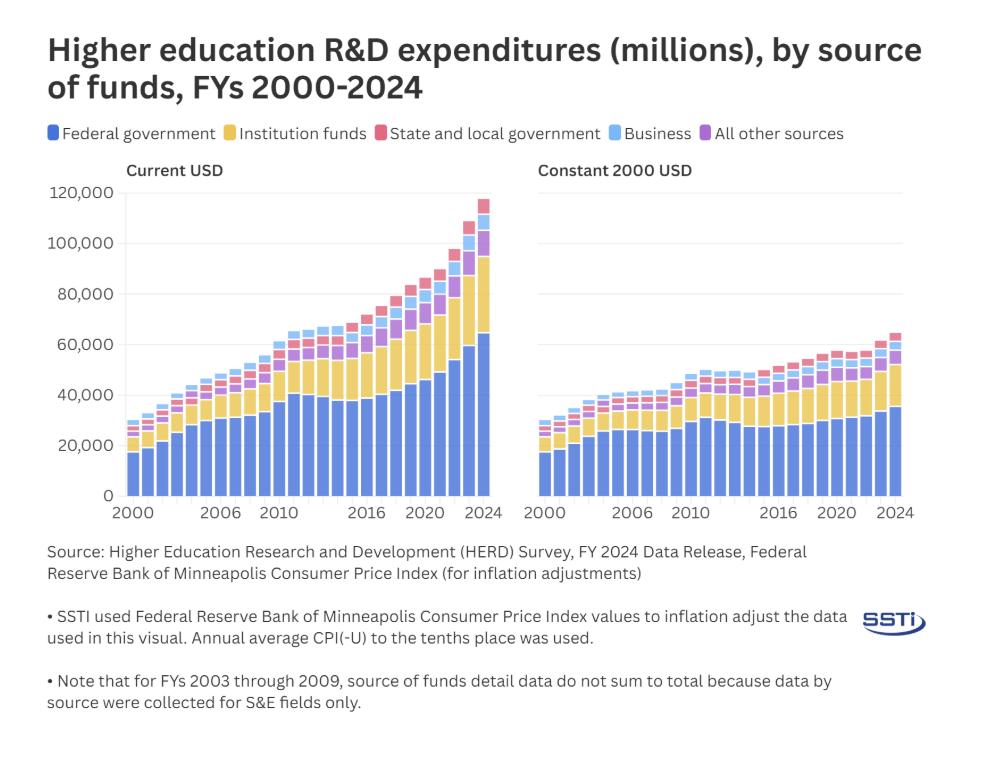
source: Higher Education Research and Development (HERD)
Ta Ta for Now!
2026 will be another landmark year for how we make an affirmative, public-interest case for science amidst turbulent political times. We’re looking forward to making that case together with you.
Right now, the premium is less on splashy tech announcements and more on signals of institutional commitment like stable funding, durable governance, and a willingness to invest in systems that do not produce immediate political wins.
Reach out for any shutdown questions or requests for topics next month! It’s going to be a fun year.
Gil on the Hill: Who Won the Shutdown?
We came out of the longest shutdown in history and we are all worse for it. Who won the shutdown fight? It doesn’t matter – Americans lost. And there is a chance we run it all back again in a few short months.
A Continuing Resolution (CR) stops the bleeding, but healing and recovery is still far off.
The Deal. A continuing resolution, or CR, is an extension of existing funding levels and is a common solution to budget stalemates. That’s where Congress ended up after 8 Senate Democrats broke ranks and agreed to vote for a CR with a pinky promise from Republicans that they would resolve the impending healthcare subsidy cliff.
The CR means most federal agencies remain at Fiscal Year 2025 funding levels until January 30th, 2026 when we do this dance all over again. That makes any future planning at agencies near-impossible with such uncertainty lurking. Plus, inflation means working with last year’s funding levels amounts to an effective cut.
Still Uncertainty. Meanwhile, some agencies, like NASA’s science budget, are still facing significant cuts as the Senate and House negotiate a long-term deal. Leadership at these agencies have to responsibly plan for the lesser funding scenarios which further limits activities on top of backlog clearing that must be prioritized.
Science Highlights from the CR
Most of the Budget Incomplete. Congress’s agreement extended funding levels through January 30, 2026 for most federal agencies and programs, while providing full-year funding to a handful of others, namely for Military Construction and Veterans Affairs, the Legislative Branch, and Agriculture, Rural Development, and Food and Drug Administration divisions (some might call these the “easy” ones to negotiate).
Key highlights for science in the CR include:
- Flat funding for major agencies like NIH, ARPA-H, CDC, BARDA, NSF, and Defense and its Congressionally Directed Medical Research Programs (CDMRP).
- The deal reverses recent federal reductions in force (RIF), prohibits further RIFs through January 30th, 2026, and ensures back-pay for furloughed workers.
- The CR maintains the ban on changes to indirect cost rates but does not fix the risks associated with forward funding NIH grants.
Will Congress reach a full deal?
Congress’s Fave Vehicle. At the time of writing, the Senate is considering advancing a major fiscal 2026 appropriations package that combines the ever-reliable National Defense Authorization Act (NDAA, or defense spending bill) with as many as four additional bills, including Labor-HHS, Commerce-Justice-Science, Interior-Environment, and Transportation-HUD. It’s a common vehicle for these scenarios, as Congress has never failed to pass the NDAA. No one wants to be accused of leaving us defense-less, making a NO vote less likely even if there are funding lines in there that would otherwise be unappetizing to members – not unlike a pill pocket for sick pups needing medicine.
Still Seeking Agreement. While those four bills may hitch a ride, the Senate Appropriations Committee has not held markups for its Energy-Water, Financial Services, Homeland Security, and State-Foreign Operations bills. Without bipartisan agreement on those individual spending bills, Senate Republicans could proceed with partisan versions of the bills as a starting position for later negotiations, likely complicating an already-tense process.
Healthcare Must Get Resolved. Healthcare will likely play a major role in a final deal again. Congress currently remains deadlocked over extending enhanced Affordable Care Act premiums, which are set to expire at the year’s end. Democrats are pushing for a clean extension to avoid premium spikes and Republicans cannot yet agree on their own solution. According to POLITICO, a health package to address the subsidy cliff is unlikely to advance this year, but is expected to be back in play in January when Congress faces the next government funding deadline. We may just be hitting replay on everything we just saw in September. Stay tuned!
Science Agencies Back On, but Backlogged
Creaking Back to Life. The shutdown’s end is just the beginning of a slow recovery for scientific operations. The National Science Foundation (NSF) announced panels and reviews will resume after reopening Nov 13. They will “…prioritize the most pressing issues, including restoring the capacity to make awards and ensuring continued management and oversight of existing awards.” As one example, NSF will have to reschedule over 300 grant-review meetings.
The backlog is fueled by countless furloughed staff delaying grant reviews and reimbursements, scrambles to reallocate funding and activate cash reserves for paychecks and essential work, and cutting costs wherever they could.
Another Setback for American Scientific Leadership
China Keeps Outpacing. The shutdown has consequences for current and future work, and American global scientific competitiveness takes yet another step back. China was already projected to out-pace U.S. R&D funding before the shutdown, and according to the Quincy Institute, that prediction has come true. In recent years, China has surged to the top of global scientific output and is now publishing in respected journals like Nature and Science more than the U.S. China’s fast growth reflects deliberate investments in strategically important fields, while the U.S. remains stagnant or in a decline on certain federal research investments, leaving its historical leadership increasingly vulnerable.
Some Positive Signs for Science
It’s not necessarily all only doom and gloom though, folks. Some research fields are seeing meaningful action, and we have talked about how appropriations committees have largely rejected the president’s budget request for massive cuts to science agencies.
Nat Sec Tech. National security-focused emerging tech is seeing gains too. The Department of Energy (DOE) renewed the five National Quantum Information Science Research Centers with about $625 million in funding over five years. DARPA also moved into Stage B of its Quantum Benchmarking Initiative.
Ag Research. As part of the CR, after USDA faced a 38% cut to its research-granting National Institute of Food and Agriculture (NIFA) and a 5% cut to the Agricultural Research Service (ARS), Congress ultimately maintained their budgets roughly at current levels with ARS at $1.8 billion and NIFA at $1.7 billion.
FDA. The FDA is fast-tracking cures for ultra-rare diseases by introducing a new “Plausible Mechanism Pathway.” The goal being to get treatments to patients faster when traditional trials aren’t feasible. The pathway leans on understanding a therapy’s mechanism of action in lieu of large studies that require a large patient population.
AI State-level Preemption is Back on the Menu
Labs of Democracy. As Congress stalls on meaningful AI regulation, states have been stepping up. All 50 states introduced AI‐related legislation in 2025. 38 states adopted or enacted around 100 measures. NCSL has an incredibly useful tracker of AI state laws.
The EO. It may all be for naught, however, as the Trump administration prepares an executive order to pre-empt state laws on artificial intelligence. At the time of writing, leaks of the EO suggest they’ll have Attorney General Pam Bondi establish an “AI Litigation Task Force whose sole responsibility shall be to challenge state AI laws…”
This Already Failed in Congress. They’ll likely leverage federal funding to override state regulatory authority, similar to an approach earlier this year that the Senate rejected 99-1. FAS opposed it then, and remains similarly opposed to new efforts now.
Higher Ed Shakeup
Unprecedented Changes. The Trump administration is upholding its promise to dismantle the Department of Education, a process kicked off in March by Executive Order. They’ve announced six new interagency agreements (IAAs) with four agencies to break up the federal education system. Everything from K-12 to medical schools to international students will be managed by different parts of the government. Expect lawsuits and sustained uproar, as this is undoubtedly something Congress will need to approve.
Congress Needs to Approve. House Appropriations Labor-HHS-Education Subcommittee Chair Robert Aderholt (R-Ala.) said “If you’re going to completely try to do away with the Department of Education, I’d say yes,” they’d need an act of Congress. Moving them around, I think is a little bit more of a gray area. But I think in order to make it permanent, you’d need to have it by law because obviously the next administration could change it.”
Cornell Deal. Cornell University is the latest to strike a deal with the Trump administration to restore its federal funding. They will directly pay the federal government $30 million and also invest $30 million in “research to strengthen U.S. agriculture” and benefit U.S. farmers. They’ll also hand over massive amounts of admissions data.
International Graduate Student Enrollment Down. New enrollments for international grad students is down 17%, according to fall 2025 snapshot data in the annual Open Doors report, published by the Institute for International Education. Ninety-six percent (96%) of survey participants cited visa concerns. Read a full breakdown at Inside Higher Ed.
Degree Redefinition. The Trump administration is redefining which advanced degrees count as “professional,” excluding fields like nursing, engineering, and social work from the higher loan limits previously available. This shift will almost certainly discourage students from entering these critical fields at a time when they’re needed most.
Keep That Energy
Permitting Reform. Congress is energized about simplifying permitting. Lawmakers across both parties and chambers are treating the upcoming markup by the House Natural Resources Committee of permitting-reform legislation as a pivotal moment in efforts to streamline the federal project-approval process for energy projects. The goal is to maintain momentum toward a broader agreement this Congress to speed energy-project delivery by reforming how federal permits and reviews are handled.
Data Centers and Energy. Meanwhile, attention is increasingly focused on the growing energy footprint of AI-driven data centers. A bipartisan group of 20 House lawmakers has formally asked regulators and industry stakeholders to assess how the expansion of these data centers might translate into rising electricity costs for everyday consumers.
What to Watch in December
Sandwiched between Thanksgiving and Christmas, a limited number of Congressional working days will mean the NDAA, appropriations negotiations, and Congress’s own backlog of priorities will be squeezed into a potent month of activity. There will be lots of moving parts that will all inform January’s next shutdown showdown one way or the other. Let’s hope it doesn’t end with another shuttering of the government, though some Democrats are already signaling a willingness to do it over again if their original healthcare requests are not met. It’s going to be icy cold on many fronts.
We’ll keep tracking and you keep reaching out to us at Gruiz@FAS.org with questions and suggestions. Ta ta for now!
November 2025: Science in the Shutdown
One month of a government shutdown is in the books, but how many more months will (or can) it go? Congress is paralyzed, but there are a few spasms of activity around healthcare and the prospects of a continuing resolution to punt this fight out until January or later. Oh, and non-shutdown related news is happening too…
Government Shutdown Update
The human and scientific toll of the government shutdown mounts by the hour. The landscape for American science and technology is bleak as ever. From unpaid scientists to shuttered labs to universities negotiating political loyalty tests amidst it all, frustration and confusion have long boiled over into terror as lives are impacted and scientific progress is stunted.
“The Congress is adrift”
That’s according to Senator Lisa Murkowski (R-AK): “It’s like we have given up.” This quote captures what so many in the scientific community are feeling: desolation as the basic machinery of governance and the research ecosystem it underwrites grinds to a halt.
President Trump has described this standoff as an “unprecedented opportunity” to enact sweeping cuts and consolidate executive control over federal spending. He praised Budget Director Russell Vought as “Darth Vader” for his aggressive drive to strip Congress of its appropriations power.
As of this week, federal workers are missing paychecks, agencies are virtually shuttered, and major federal assistance programs will run out of money. We’re looking anxiously at pressure points on the calendar like healthcare open enrollment and historically catalyzing events like Thanksgiving travel. The latter is heavily dependent on the Transportation and Security Administration (TSA) operating with meaningful functionality. Will it be enough to force a deal?
An op-ed in The Hill by Sheril Kirshenbaum, a former Senate staffer, details useful observations on how Congress became so divided. After nearly a decade working in the Senate, her points ring true to me.
Science Agencies in the Shutdown
“A government shutdown threatens to grind America’s science and technology enterprise to a halt,” according to House Science, Space, and Technology Committee Chairman Brian Babin.
For scientists, every day lost means missed grant reviews, halted research, and broken continuity. At the National Institutes of Health, new patient admissions at the Clinical Center are paused and new research awards are frozen. The National Science Foundation has suspended proposal evaluations. The Environmental Protection Agency has stopped critical operations like Superfund site operations and states like Ohio are directly impacted. At the FDA, even the “delivery” phase of innovation like with drug and device approvals has slowed to a crawl.
So when will the shutdown end?
“Things are about to get worse,” Senate Majority Leader John Thune warned in a floor speech late last week. The most likely option would be a continuing resolution (CR) to fund the government into mid to late January, but that is tenuous at best.
House and Senate GOP leaders are debating a wide range of options for a new CR, given that their current House-passed vehicle (that stands as the quickest path to resolution) funds the government only through November 21st.
Healthcare Enrollment and Cost Increases
November 1st is going to trigger a landslide of consequences that will further impact American daily life. Open enrollment will deliver sticker shock with no agreement on extending subsidies. The Supplemental Nutritional Assistance Program (SNAP) will start running out of money with no emergency funding relief planned as at least 25 states plan to pause benefits. Early childhood education programs will stop paying teachers and close centers. The Trump Administration tapped military research funds to cover servicemember paychecks and there seem to be plans to keep finding ways to cover that, including with an anonymous donation of $130 million. Congressional staff will also be missing paychecks which ensures that each and every member of Congress is dealing directly with this reality in their own offices.
If we go past November 4th, this will be the longest shutdown in history. Brace yourself.
Higher Ed Politicking
“Compact” Decisions
The White House’s “Compact for Academic Excellence in Higher Education” is offering preferential federal funding for universities that pledge alignment with administration policies. According to Inside Higher Ed, 11 university leaders have publicly opposed the compact. The University of Virginia agreed to a modified version, signing DOJ guidelines that pledge not to “engage in unlawful racial discrimination.”
Ted Mitchell, president of the American Council on Education, said the proposal amounted to an “assault … on institutional autonomy, on ideological diversity, on freedom of expression and academic freedom.”
“Ideological Deportation”
Meanwhile, a Reagan-appointed federal judge in Boston ruled that the administration unlawfully targeted international students over pro-Palestinian speech—what he called an act of “ideological deportation.”
Philanthropy Continues Stepping Up
The Arthur M. Blank Foundation pledged $50 million to Atlanta’s historically Black colleges and universities, the biggest gift ever to HBCUs in Georgia.
Indirect Costs
We’ve been tracking The Joint Associations Group on Indirect Costs (JAG) and their proposed solution, the FAIR model, for addressing the important issue of ensuring sufficient reimbursement for the indirect (facility and administrative) costs of research. It received an important endorsement in this editorial by former U.S. Senator Roy Blunt (R-Mo.). Learn more about JAG’s efforts and read the letter sent to congressional appropriators.
Science Stateside
Washington is spinning its wheels and states are spinning up plans on science and technology development. Meanwhile, SSTI’s useful analysis of recent NSF data shows how business R&D is becoming even more concentrated among a handful of states. We’ve recapped a few state-level S&T developments that SSTI has highlighted with some additional ones below.

West Virginia
West Virginia’s Vision 2030 calls for “examining best practice financing models in other states and then raising funds to help West Virginia compete for industry and federal research dollars.”
Arizona
Arizona’s Bioscience Roadmap welcomes biosciences “new golden era” but “federal research budgets are unstable, early-stage capital is shifting heavily toward artificial intelligence, and public trust in science has weakened.”
California
California’s new quantum strategy law (AB 940) seeks to position the state as a leader in emerging quantum technologies. Governor Newsom also signed several AI safety bills (and vetoed one) that could massively impact AI policies nationwide and even globally.
South Carolina
The South Carolina Chamber of Commerce and the state’s Manufacturers Alliance have announced a merger to form the South Carolina Manufacturers and Commerce. Their agenda is expected to include reforming the state’s taxes to be more competitive for businesses, increasing access to affordable energy, and ensuring residents have the skills to enter the workforce.
New Mexico
We’re seeing more community action over AI data centers as an advocacy group sued New Mexico’s second most populous county Friday over the approval of a $165 billion AI data center it says violates state law.
Connecticut
The state plans to invest $50.5 million to create public infrastructure and facilities in downtown New Haven to boost the state’s life sciences industry and the emerging sector of quantum technologies. As Gov. Ned Lamont put it, “We’re competing against other states, we’re competing against other countries. And we’ve got to believe in the future.”
Mississippi
Chairman of the Senate Judiciary Committee Chuck Grassley had questions for a federal judge in Mississippi after he issued an order that could have been drawn up using artificial intelligence. Sen. Grassley asked them to “explain whether they, their law clerks, or any court staff used generative AI… in preparing their decisions.” This comes as Mississippi recently announced a partnership with NVIDIA to expand AI education, research and workforce development across the state.
What else should we be tracking in states?
Send suggestions to GRuiz@FAS.org to help us highlight important developments at the state level that deserve more attention.
FAS Spotlight: The Fix our Forests Act is evidence-based, bipartisan policy
Even amid shutdown chaos there are reasons for optimism. The Senate Agriculture Committee advanced the Fix Our Forests Act (S. 1462), a bipartisan effort long championed by the Federation of American Scientists and a coalition of wildfire experts and advocates. The bill would improve forest management to mitigate and prevent wildfires and protect communities.
“FAS is very pleased to see the Fix Our Forests Act advance out of Committee,” said Hannah Safford, Associate Director of Climate and Environment. “We urge the Senate to act quickly to pass this legislation and ensure that federal agencies have the capacity and resourcing they need to carry out its provisions.”
The bill includes a provision FAS helped shape—the creation of a Wildfire Intelligence Center, a decision-support hub that would integrate science, data, and technology for wildfire resilience.
In a month where much of Washington itself feels on fire, this bipartisan progress stands out as a model for how evidence-based policy and collaboration can still find oxygen.
FAS in the Media
The FAS community continues to lead the national conversation on science, data, and democracy. Check out some highlights:
- Daniel Correa talked about FAS and AI policy with Accelerate Science Now.
- Cole Donovan in EOS: Science Agencies Shuttered in Government Shutdown
- Loren DeJonge Schulman in C&E: Scientists brace for impact of US government shutdown
- Denice Ross and Loren DeJonge Schulman talking UNGA, Advise & Consent, Democratic Data on Sirens
- Hannah Safford in a NYT Letter to the Editor regarding wildfire smoke and FOFA
- Denice Ross on Crooked Media’s What a Day discussing disappearing data
- Merici Vinton in the NYT: What Was Lost: Former Federal Workers on the Cost of the Cuts
- Grace Wickerson on 10 Across, Extreme Heat Has Only Just Begun: How Prepared is the U.S.?
- Jon Wolfsthal in Arms Control Center, Getting Off the Collision Course: The Case Against Arms Racing
- Megan Husted and Alice Wu, The Little Monopoly Holding Back the Clean Energy Transition
And on social media: Mackenzie Knight-Boyle shares a FAS history throwback, the first in an upcoming series of visits into FAS’s storied past for our 80th Anniversary.
That’s it for now!
The days ahead will test the resilience of every scientist, policymaker, and civil servant working without pay or clarity. They will also, however, reaffirm the purpose of nonpartisan institutions like FAS to keep science and evidence alive in the public interest no matter the political atmosphere.
Hang in there, thanks for reading, and keep sending feedback and suggestions to GRuiz@FAS.org.
Gil’s Corner: September Sprinting and Webinar September 26
September Sprinting
After a quiet August recess, DC roared back to life with a raucous September that is still promising an even louder final few days as Congress races toward the funding deadline at midnight on September 30th. Let’s review and look ahead!
✅ Register here for Gil’s webinar on September 26.
Shutdown Update
State of Play: It’s looking like a shutdown, folks. Congress has not passed any of the 12 full-year appropriations bills to fund the government for FY 2026. Congressional leadership are not conversing meaningfully. Leader Schumer sounds defiant in his posturing that this is on Republicans to figure out and to negotiate with Democrats. Leader Thune is backing the Continuing Resolution (CR) that creates a “clean” seven-week funding extension that passed the House but failed in the Senate (interestingly with Democratic Senator Fetterman as a YES and Republican Senators Paul and Murkowski as a NO).
Unless the House and the Senate can pass the same funding legislation and get it signed by President Trump, the government will shut down Oct. 1, the start of the new fiscal year.
Democrats: Democrats would prefer their version of a short-term extension which would fund the government until Oct. 31, extend health care subsidies, roll back Medicaid cuts, and restore rescission cuts. Democrats strongly feel this needs more negotiation, but Republicans are making that difficult. President Trump cancelled a planned meeting with Senate Minority Leader Chuck Schumer (D-NY) and House Minority Leader Hakeem Jeffries (D-NY) on Tuesday (9/23) after being briefed on their CR plan that takes funding into late November.
Democrats also need assurances that money appropriated will actually be spent, as the Trump administration continues budget practices that amount to illegal impoundment.
Republicans: Schumer and other Democrats noted that Trump has publicly called on House Speaker Mike Johnson (R-LA), and Senate Majority Leader John Thune (R-SD), not to sit down and negotiate with Democrats on the short-term funding bill. According to Speaker Mike Johnson, “Chuck Schumer chose to try to make this a partisan exercise, and Hakeem Jeffries as well. And it’s wrong to do that. And so if they choose to vote against this clean, completely nonpartisan CR, then they will be choosing to shut the government down, and they will own the consequences of what happens following that.”
What Happens if the Government Shuts Down?
Getting into a shutdown is the easy part, getting out is much harder. Both sides will be looking to pin responsibility on each other, and the court of public opinion will have a major role to play as to who has the most leverage for getting us out.
In a “shutdown,” federal agencies must discontinue all non-essential discretionary functions until new funding legislation is passed and signed into law. Essential services continue to function, as do mandatory spending programs. Each federal agency develops its own shutdown plan, following guidance released in previous shutdowns and coordinated by the Office of Management and Budget (OMB). The plan identifies which government activities may not continue until appropriations are restored, requiring furloughs and the halting of many agency activities. Essential services – many of which are related to public safety – continue to operate, with payments covering any obligations incurred only when appropriations are enacted.
There are a number of exceptions and implications that the Committee for a Responsible Federal Budget explains in detail here. This page will be your best friend during the likely shutdown.
What Happens to Science and Research in a Shutdown?
Researchers can expect to continue performance under their federal awards and subawards during a lapse in appropriations, provided funds are authorized during the period of performance of the grant or cooperative agreement has not expired. That said, federal agencies cannot issue new grants or contracts, or renew existing projects during a shutdown. Agencies also will not be able to provide assistance during a shutdown. As a result, government employees at the agencies will not be able to answer phone calls, respond to emails or update informational resources. (As FAS has previously noted, any government shutdown is a science shutdown.)
What Happens to Higher Ed in a Shutdown?
The American Council on Education has a handy webpage on exactly this. According to them, typically, institutions of higher education do not feel many negative effects from a short-term government shutdown. Since most student aid programs are funded a year in advance, they should not be impacted by a short-term shutdown. The Department of Education (ED) would likely cease almost all operations during a shutdown, however, so expect any correspondence to go unanswered.
Next Steps
Both parties are going to have to talk to each other eventually. Leader Thune is expected to bring the “clean” CR up for a vote when senators return early next week. He could hold repeated votes on that measure, along with others aimed at targeted re-openings and paying the military, to name a few. House Republicans have cancelled votes next Monday and Tuesday, leaving just the day of Wednesday Sept. 30th until midnight for any shutdown-averting votes.
“Eventually, ultimately, the White House and Schumer are going to have to probably sit down,” Thune said in a brief interview earlier this month. “But I think right now what we’re talking about is short-term.”
There are significant implications to consider if a CR is agreed upon, such as a lack of earmarks (formally known as Congressionally Directed Spending that gets funding directly to local communities), no specific direction from Congress on exactly how to spend the money, and of course stagnated funding that stalls in the face of general inflation.
Tracking the One Big Beautiful Bill Act
We are seeing real-life impacts play out across states from the One Big Beautiful Bill Act (OBBBA), the Republican-led reconciliation package that passed into law in July 2025. There are a great many deadlines and timelines associated with the bill. Beyond the $3 trillion in national debt that the Congressional Budget Office (CBO) expects the bill to add over the next decade, state impacts are happening right now. To give a sense of how that is manifesting, some headlines include:
Rural Health Clinics Closing: Rural health clinics are closing and many, if not all, are feeling intense financial pressure. Gubernatorial candidates are campaigning on it. Rural health providers that (overly) rely on Medicaid funding were already under strain before the OBBBA cut federal health spending by up to $900 billion over the next decade.
TN SNAP: Looming cuts to the Supplemental Nutritional Assistance Program, or SNAP, could place Tennessee taxpayers on the hook for more than $110 million annually as the federal government shifts a portion of the financial burden for the food assistance program to states. More than 700,000 Tennesseans — or one in every 10 state residents – rely on the SNAP program to put food on the table.
WY Losses on Oil and Gas Leases: OBBBA’s royalty rate reduction on federal oil and natural gas leases could see Wyoming taxpayers lose $11 million in revenue compared to rates before the bill’s passage.
AK Impacts Hard to Fully Predict: A conversation with an economics professor at the University of Alaska Anchorage provides useful context for why some impacts are obvious and why most are harder to anticipate in a state highly dependent on the federal government.
Executive Branch Updates
R&D for FY27: The White House released National Science & Technology Memorandum-2: FY2027 Research & Development Budget Priorities. This memo sets the Admin’s S&T priorities, and calls on federal agencies to prioritize and invest in:
1. Emerging technologies, such as AI, quantum, and advanced manufacturing
2. Affordable, reliable, and secure energy technologies like nuclear fission and fusion
3. National security technologies, with a focus on the Golden Dome and other readiness systems for cyber threats and natural disasters
4. Biotechnology and biosecurity, to tackle America’s greatest health challenges, counter biological threats, and improve U.S. biomanufacturing
5. Space dominance through cutting-edge tech that fuels discovery, empowers commercial ventures, and revolutionize capabilities
These are lofty goals, and largely in the right place, but it’s unclear how the Administration would deliver outcomes if they continue their disruptive funding practices, which include using every tool in their kit to slow roll and virtually halt funding approvals and disbursing (which we discussed in August’s post).
Immigration Policy Implications: Foreign talent is essential to the American science and research enterprise – and the Trump administration’s new rules on H-1B visas, chiefly the requirement that employers will pay a new $100,000 fee for H-1B visas, stand to kneecap the STEM talent pool and directly threaten innovation. Businesses and startups reliant on this workforce are scrambling to comply and respond to these significant changes.
NSF: Positive news – The U.S. National Science Foundation (NSF) Regional Innovation Engines (NSF Engines) program announced 15 finalists advancing to the next stage of the program’s second competition — spanning critical technologies and applications ranging from enhancing energy grid security to maximizing the yield of critical minerals mining extraction to advancing quantum computing. The finalist teams, many of whom have been building their regional coalitions for a year or longer, are led by a range of organizations, including universities, nonprofits and private industry from across the United States.
NIH: More positive news! The National Institutes of Health (NIH) looks like it might be able to spend its entire $47 billion budget before the Sept. 30 deadline. That’s a significant milestone as researchers were dreading the possibility of missing out on funding completely if they didn’t get the money out the door fast enough. We have strong advocacy to thank for this, including a letter led by Senator Katie Britt (R-AL) pushing for such an outcome. Speaking up works, folks.
Also, a fascinating look into NIH Director Jay Bhattacharya explores the challenges he is facing, his outlook on them, and some insights into what he thinks about “settled science,” vaccines, and more.
EPA: Environment Protection Agency Administrator Lee Zeldin stepped into the AI arena in a big way with his Powering the Great American Comeback initiative prioritizing American AI dominance. He held a roundtable and published an op-ed outlining how his deregulation agenda will spur data center growth and work to meet rising energy demands.
Dept of Ed: This month, the Department of Education announced that it will end discretionary funding to several Minority-Serving Institutions (MSI) grant programs that discriminate by conferring government benefits exclusively to institutions that meet racial or ethnic quotas. It followed up with an announcement that it is making historic investments in charter schools, American history and civics programs, Historically Black Colleges and Universities (HBCUs), and Tribally Controlled Colleges and Universities (TCCUs).
We continue to see the Trump administration exert its will over higher education with sweeping rule changes and funding priorities.
Innovation at the Department of Transportation: As we try to focus on the positive news to balance out all the uncertainty, I did want to plug the important progress at the Department of Transportation with the ARPA-I program. The Federation of American Scientists has been a thought leader and champion of the ARPA-I initiative, and we’re excited about the ARPA-I Ideas Challenge that will seed future progress too. With the expiration of the Surface Transportation Authorization Act in September 2026 which includes reauthorization of ARPA-I, we will be working hard to ensure continued support and development of this exciting program.
We invite any and all who are interested in learning more about ARPA-I to reach out at GRuiz@FAS.Org so we can explore how to keep the momentum going towards improving the future of transportation innovation
Science Advocacy At-Large
Protecting Science and American Innovation: Coalitions of science, health, and advocacy organizations have been coming together to address the escalating threats to federal science and innovation funding amid the looming government shutdown. They continue to assess and respond to the growing risks posed by budget rescissions, cuts to grants, attacks on higher education, and pressures on immigration policies that support the scientific workforce.
Advocates are being forced to get louder and more creative with their approaches. For example, Stand Up for Science organized the renting of a NASA space suit to bring with them to Capitol Hill this summer to dramatize the stakes of proposed cuts to space and research funding.
These efforts to protect science and American innovation continue to emphasize the importance of coalition-building with nontraditional allies like state and local business groups that increasingly recognize the economic value of federal R&D. They have been framing the fight against science funding cuts not just in budgetary terms, but in human ones—whether it’s patient care and public health, local jobs, or U.S. competitiveness with China.
As shutdown politics intensify, the science community needs to be preparing both defensive strategies against harmful cuts and forward-looking ideas to strengthen U.S. science investments in the years ahead.
Higher Ed & Research
Funding Tug-o-War: The Trump administration has leveraged federal research funding to extract concessions from schools. Columbia University ultimately agreed to pay the government $200 million and make a series of reforms to get back $400 million in research grants that the government withheld over claims the school violated the civil rights of Jewish students and faculty. Other schools also reached agreements, while Harvard University remains locked in negotiations over $2 billion in funding.
Former Harvard President Claudine Gray weighed in on Harvard’s situation with some interesting criticisms about its approach to Trump’s demands.
UCLA Gets its Money: A federal judge on Monday ordered the Trump administration to restart the flow of about $500 million in funding for scientific research it withheld from the University of California, Los Angeles. In late July, it slashed over $580 million in research grants from UCLA, alleging Jewish students and faculty had been subjected to abuse and discrimination during pro-Palestinian protests. It also accused the school of improperly considering race when deciding on which students to admit. UCLA changed policies in what appears to be an attempt to align with Trump demands.
AI Updates
FAS and AGI: This month, FAS hosted a convening of top AI experts to discuss the future of Artificial General Intelligence and its accompanying risks. It was a stimulating discussion and laid out the groundwork for all the work that is still to be done to make sure that we’re prepared for the inevitable AI future. We’ll have readouts from this coming at you! And reach out if you can’t wait until then to hear more.
AI for America: Senator Mark Kelly (D-AZ) released his “AI for America” plan, which includes plans for the “AI Horizon Fund.” The trust fund — which would be paid for by tech companies — would support union-led apprenticeships and coordinate state and federal efforts for workers’ development.
AI and Workforce: AI and the future of the workforce is seeing even more attention these days, with Senator Kelly (D-AZ) remarking that “the biggest thing is coming up with a plan for how you’re going to retrain people for other jobs. We do not want to find ourselves in a situation where there are 10 million people that lost their jobs through AI and they don’t have a good option. That’s not good for anyone.” Maria Cantwell (D-WA), the ranking member of the Senate Commerce Committee, has plans to keep momentum going with her NSF AI Education Act, a bipartisan bill aimed at advancing STEM learning.
AI Sandbox Act: Ted Cruz (R-Texas), the chair of the Senate Commerce Committee, recently introduced the AI SANDBOX Act, which would give developers space to test AI “without being held back by outdated or inflexible federal rules.” According to Axios, Ranking Member Cantwell’s staffer said the bill is “overly broad, as it gives too much authority to the Office of Science and Technology Policy to determine which federal rules are overly burdensome.”
Senator Cruz reupped his desire to see a moratorium on state-level AI regulation.
State and Local Innovation
State R&D Pushes: Massachusetts Governor Maura Healey is driving passage of a $400 million bill aimed at strengthening Massachusetts’ research and innovation economy. The Discovery, Research and Innovation for a Vibrant Economy (DRIVE) bill aims to attract private investment and preserve research jobs.
California is looking to authorize the issuance of bonds for $23 billion that would create and fund the California Foundation for Science and Health Research to continue developing cures for cancer, Alzheimer’s, diabetes and other diseases, as well as discoveries in climate science, wildfire prevention, pandemic preparedness and other fields.
Look for more states to explore similar measures as they aim to bridge the federal funding gap that threatens local economies.
State and Local More Important than Ever: With the federal funding apparatus for research and development in such flux, we find ourselves keenly focused on state and local partnerships to help fill the gaps and keep progress moving. For example, Brookings has been exploring how a state and local government innovation fund could catalyze a distributed yet connected infrastructure for policy and implementation. We’ve seen institutions like the National Academies of Sciences, Engineering, and Medicine explore this. And the MetroLab Network, of course, always has this on its mind.
What Do You Think?: What are your ideas? What stands out to you as an opportunity to use this moment to strengthen state and local partnerships for research and development? There are many conversations and new thinking at this time, and we want to hear from you!
Ta Ta For Now – Join the 9/26 Webinar!
Keep Reaching Out: We covered a lot, but certainly not everything. Please do reach out with feedback and requests for coverage of specific topics. Many have reached out to help inform these updates and we are mighty appreciative of your input. Keep ‘em coming!
Webinar: We’re excited to invite you to a webinar version of Gil’s Corner where we will expand on this update and answer any questions, especially ahead of next week’s potential shutdown. Sign up here! It’s important that our community hear from each other about our biggest concerns, and create a forum for communication and coordination.
Gil’s Corner: A View from D.C. on Science and Tech Policy, Politics, and Power
We’re back with key updates from D.C.! Start with the weather which was as lovely as I can remember in the last decade, even if the landscape was dotted with more flashing lights and armored trucks than usual.
D.C. takes the cue from Congress and the city itself seems to recess and take its foot off the gas for those with government-related work. I hope everyone recharged sufficiently, because the break is over and there is much to do this fall – government funding, new and massive executive orders, and a whole lot of drama in between awaits us.
Executive Order on Federal Grantmaking
Political Appointees have the Power. The White House announced an Executive Order that would restructure the federal grantmaking process and affect how decisions are made regarding the distribution of billions of dollars in research grants. Now, all final grant award decisions across all agencies are to be made by political appointees, subject to their “independent judgment.”
Learn what this could mean for you from McDermott Will & Schulte.
Appropriations and an Uneasy Fiscal New Year’s Eve
Will we shut down? Congress will get right back to the arduous task of sorting out government funding for Fiscal Year 26 (FY26). We saw lots of progress on several of the 12 bills that constitute the government funding package. Even with a little dissent, Democrats and Republican appropriators alike are expressing a desire to pass the package by September 30 and avoid a dramatic shutdown fight.
Spending Problems. There is a lot of time between now and then, however, and discord is brewing as significant concerns around how the Administration is using (and most importantly not using) funding that Congress has appropriated could have a major impact on whether a final bill is passed.
OMB Releases Funds, Now they Must be Spent. OMB has apparently released its hold on much of the FY25 funding for NIH, NSF, and other research agencies it had blocked in recent months. It is of utmost urgency to ensure those funds are obligated before Sept 30, 2025 (otherwise the funds get returned to the Treasury).
➡️ Those awaiting to receive grants can most effectively ensure this by reaching out to their congressional delegations to ask for assistance in securing release of the research funding.
Confirmations Deal. Majority Leader Thune (R-SD), Minority Leader Chuck Schumer (D-N.Y.) and the White House have been negotiating over an agreement that would trade Democrats’ consent to speed up Trump’s appointee confirmations in exchange for the administration agreeing to unfreeze funding for certain agencies or other policy concessions. This could continue to have a part to play in any final deal.
Tracker. Keep tabs on appropriations with the AAAS Tracker, including updates from the end of July.
Higher Ed
Admissions Transparency. President Trump issued the latest presidential memorandum regarding his oversight of higher education, titled “Ensuring Transparency in Higher Education Admissions” (fact sheet). According to the memo, the Supreme Court has “definitively held that consideration of race in higher education admissions violates students rights” but a “persistent lack of available data” combined with “overt and hidden racial proxies” caused further “concerns about whether race is actually used in process.” Check out a breakdown.
The U.S. Dept. of Justice released guidance for recipients of federal funding regarding unlawful discrimination. Explainer and more reading here.
Research Security. The National Science Foundation announced a new SECURE Center with a newsletter that covers changes in federal research security policies and aggregates news articles. Sign up to track this ever-evolving space.
Additionally, the U.S. Department of Agriculture said it has fired 70 foreign contract researchers after a national security review intended to secure the U.S. food supply from adversaries including China, Russia, North Korea and Iran.
Settlements. What does the Columbia University settlement mean for the rest of higher education? Will Creeley, legal director of the Foundation for Individual Rights and Expression, said that, in addition to admission practices, this settlement and its “blatant disregard for federal law” will upend academia’s core commitment to fostering First Amendment rights.
What do we do? A plea from former Secretary of Education Arne Duncan – The Only Hope Is Total and Unrelenting Resistance
Science and Tech
AI Action Plan. FAS’s brilliant AI team at the Federation of American Scientists unpack the AI Action Plan. Importantly, it notes that, “Despite the AI Action Plan’s ambitious proposals, it will remain aspirational without funding, proper staffing, and clear timelines.”
States’ Role. An interesting read from The Atlantic on university research and states. “It will take time for research universities to find a new long-term financial model that allows science and medicine to continue advancing—a model much less dependent on the federal government. But right now universities don’t have time.”
Manufacturing. Manufacturing is the third largest contributor to American GDP. What’s the status? SSTI takes a county-specific look.
USDA Reorganization
USDA out of DC. The US Department of Agriculture is getting an unprecedented makeover as Secretary Rollins aims to decentralize its operations across the country. That includes functions beyond agriculture such as important rural development offices and programs like wildfire management and more.
Indirect Costs
Dr. Kelvin Droegemeier and the Joint Association Group (JAG) have developed an impressive reimagining on Indirect Cost modeling, dubbed the Financial Accountability in Research (FAIR) Model. Find the details here, and familiarize yourself! For you visual learners, check out their webinar.
According to JAG, the Financial Accountability in Research (FAIR) model is a new approach to increase transparency, accountability, and clarity in how federal research funding is spent. The goal of FAIR is to ensure continued American leadership globally in research and innovation while delivering maximum benefit to American taxpayers. FAIR was developed with extensive input and feedback from a broad array of public and private research institutions, academic medical centers, independent research institutes, hospitals, private foundations, and private companies
The complete upheaval around indirect costs policies from the Administration has many research institutions on red alert. The thoughtful, comprehensive response from JAG has been presented to the Administration and Congress, even seeing language included in the current appropriations bills.
JAG is calling for support from the research community around the FAIR model – the future of the American research enterprise could be at risk without unity and vocal endorsement to the government.
We Need to Talk about Impoundment
Ok, I’ll bite, what is impoundment?
Our friends at the Center for Budget Policy and Priorities and other smart budget teams, like at the Bipartisan Policy Center, are doing excellent work schooling us on this urgent, developing issue. Please do go learn more because this is not going away and it is truly as big a deal as it sounds.
Office of Management and Budget Director Russ Vought is the name on the lips of many in DC this month as the end of the fiscal year approaches and his relentless plan to hack and disrupt the government funding process hits full tilt, and, as some argue, goes beyond the law.
Deferrals, additional approvals, apportionment hold ups – these are all wonky budget actions that are being weaponized for the Executive Branch to effectively “impound” government funding approved by Congress. That’s illegal.
Slow-rolling Spending – is it Impoundment?
GAO thinks so. On top of the significant issues with receiving their funding in the first place or even getting it clawed back by rescissions, many agencies are facing bureaucratic roadblocks to spending the funding they do have and risk ending the fiscal year (9/30) with unspent funds.
“The administration appears to be preparing to run the clock out. To me, it’s clearly a violation of Article I, Section 9 of the Constitution. It’s fundamental to the way the government is supposed to operate.”- G. William Hoagland of the Bipartisan Policy Center and former Republican aide to the Senate Budget Committee.
“It feels like temporary impoundment,” an Army Corps of Engineers employee said.
What does the Administration have to say?
Rachel Cauley, a spokeswoman for the Office of Management and Budget, said in a statement that, “impoundments remain an option at the president’s disposal.”
If all of this does indeed amount to illegal impoundment then do not expect that to deter the Administration. In response to GAO challenging this practice (and its done so dozens of times), Russel Vought argued that the Impoundment Control Act, the law at issue now, is unconstitutional.
Until Next Time!
Is Gil Corner working for you? How can it be more useful? As we develop this new function in the newsletter, we want your thoughts! Email Gil directly at GRuiz@FAS.Org and let me know what you’d like to see more (or less) of, and what topics are interesting you the most.