Enhancing Local Capacity for Disaster Resilience
Across the United States, thousands of communities, particularly rural ones, don’t have the capacity to identify, apply for, and manage federal grants. And more than half of Americans don’t feel that the federal government adequately takes their interests into account. These factors make it difficult to build climate resilience in our most vulnerable populations. AmeriCorps can tackle this challenge by providing the human power needed to help communities overcome significant structural obstacles in accessing federal resources. Specifically, federal agencies that are part of the Thriving Communities Network can partner with the philanthropic sector to place AmeriCorps members in Community Disaster Resilience Zones (CDRZs) as part of a new Resilient Communities Corps. Through this initiative, AmeriCorps would provide technical assistance to vulnerable communities in accessing deeply needed resources.
There is precedent for this type of effort. AmeriCorps programming, like AmeriCorps VISTA, has a long history of aiding communities and organizations by directly helping secure grant monies and by empowering communities and organizations to self-support in the future. The AmeriCorps Energy Communities is a public-private partnership that targets service investment to support low-capacity and highly vulnerable communities in capitalizing on emerging energy opportunities. And the Environmental Justice Climate Corps, a partnership between the Environmental Protection Agency (EPA) and AmeriCorps, will place AmeriCorps VISTA members in historically marginalized communities to work on environmental justice projects.
A new initiative targeting service investment to build resilience in low-capacity communities, particularly rural communities, would help build capacity at the local level, train a new generation of service-oriented individuals in grant writing and resilience work, and ensure that federal funding gets to the communities that need it most.
Challenge and Opportunity
A significant barrier to getting federal funding to those who need it the most is the capacity of those communities to search and apply for grants. Many such communities lack both sufficient staff bandwidth to apply and search for grants and the internal expertise to put forward a successful application. Indeed, the Midwest and Interior West have seen under 20% of their communities receive competitive federal grants since the year 2000. Low-capacity rural communities account for only 3% of grants from the Federal Emergency Management Agency (FEMA)’s flagship program for building community resilience. Even communities that receive grants often lack the capacity for strong grant management, which can mean losing monies that go unspent within the grant period.
This is problematic because low-capacity communities are particularly vulnerable to natural disasters from flooding to wildfires. Out of the nearly 8,000 most at-risk communities with limited capacity to advocate for resources, 46% are at risk for flooding, 36% are at risk for wildfires, and 19% are at risk for both.
Ensuring communities can access federal grants to help them become more climate resilient is crucial to achieving an equitable and efficient distribution of federal monies, and to building a stronger nation from the ground up. These objectives are especially salient given that there is still a lot of federal money available through the Inflation Reduction Act (IRA) and the Infrastructure Investment and Jobs Act (IIJA) that low-capacity communities can tap into for climate resilience work. As of April 2024, only $60 billion out of the $145 billion in the IRA for energy and climate programs had been spent. For the IIJA, only half of the nearly $650 billion in direct formula funding had been spent.
The Biden-Harris Administration has tried to address the mismatch between federal resilience funding and community capacity in a variety of ways. The Administration has deployed resources for low-capacity communities, agencies tasked with allocating funds from the IRA and IIJA have held information sessions, and the IRA and IIJA contain over a hundred technical assistance programs. Yet there still is not enough support in the form of human capacity at the local level to access grants and other resources and assistance provided by federal agencies. AmeriCorps members can support communities in making informed decisions, applying for federal support, and managing federal financial assistance. Indeed, state programs like the Maine Climate Corps, include aiding communities with both resilience planning and emergency management assistance as part of their focus. Evening the playing field by expanding deployment of human capital will yield a more equitable distribution of federal monies to the communities that need it the most.
AmeriCorps’ Energy Communities initiative serves as a model for a public-private partnership to support low-capacity communities in meeting their climate resilience goals. Over a three-year period, the program will invest over $7.8 million from federal agencies and philanthropic dollars to help communities designated by the Interagency Working Group on Coal & Power Plant Communities & Economic Revitalization on issues revolving around energy opportunity, environmental cleanup, and economic development to help communities capitalize on emerging energy opportunities.
There is an opportunity to replicate this model towards resilience. Specifically, the next Administration can leverage the Federal Emergency Management Agency (FEMA’s) Community Disaster Resilience Zone (CDRZ) designations to target AmeriCorps support to the communities that need it most. Doing so will not only build community resilience, but will help restore trust in the federal government and its programs (see FAQ).
Plan of Action
The next administration can support vulnerable communities in building climate resilience by launching a new Resilient Communities Corps through AmeriCorps. The initiative can be launched through a three-part Plan of Action: (1) find a philanthropic partner to fund AmeriCorps placements in CDRZs, (2) engage federal agencies that are part of the Thriving Communities Network to provide resilience training and support to Corps members, and (3) use the CDRZ designations to help guide where AmeriCorps members should be placed.
Recommendation 1. Secure philanthropic funding
American service programs have a history of utilizing philanthropic monies to fund programming. The AmeriCorps Energy Communities is funded with philanthropic monies from Bloomberg Philanthropies. California Volunteers Fund (CVF), the Waverly Street Foundation, and individual philanthropists helped fund the state Climate Corps. CVF has also provided assistance and insights for state Climate Corps officials as they develop their programs.
A new Resilient Communities Corps under the AmeriCorps umbrella could be funded through one or several major philanthropic donors, and/or through grassroots donations. Widespread public support for AmeriCorps’ ACC that transcends generational and party lines presents the opportunity for new grassroots donations to supplement federal monies allocated to the program along with tapping the existing network of foundations, individuals, companies, and organizations that have provided past donations. The Partnership for the Civilian Climate Corps (PCCC), which has had a history of collaborating with the ACC’s federal partners, would be well suited to help spearhead this grassroots effort.
America’s Service Commissions (ASC), which represents state service commissions, can also help coordinate with state service commissions to find local philanthropic monies to fund AmeriCorps work in CDRZs. There is precedent for this type of fundraising. Maine’s state service commission was able to secure private monies for one Maine Service Fellow. The fellow has since worked with low-capacity communities in Maine on climate resilience. ASC can also work with state service commissions to identify current state, private, and federally funded service programming that could be tapped to work in CDRZs or are currently working in CDRZs. This will help tie in existing local service infrastructure.
Recommendation 2. Engage federal agencies participating in the Thriving Communities Network and the American Climate Corps (ACC) interagency working group.
Philanthropic funding will be helpful but not sufficient in launching the Resilient Communities Corps. The next administration should also engage federal agencies to provide AmeriCorps members participating in the initiative with training on climate resilience, orientations and points of contact for major federal resilience programs, and, where available, additional financial support for the program. The ACC’s interagency working group has centered AmeriCorps as a multiagency initiative that has directed resources and provides collaboration in implementing AmeriCorps programming. The Resilient Communities Corps will be able to tap into this cross-agency collaboration in ways that align with the resilience work already being done by partnership members.
There are currently four ACC programs that are funded through cooperation with other federal agencies. These are the Working Lands Climate Corps with the U.S. Department of Agriculture (USDA)’s Natural Resources and Conservation Service, AmeriCorps NCCC Forest Corps with the USDA Forest Service, Energy Communities AmeriCorps with the Department of Interior and the Department of Commerce, and the Environmental Justice Corps, which was announced in September 2024 and will launch in 2025, with the EPA. The Resilient Communities Corps could be established as a formal partnership with one or more federal agencies as funding partners.
In addition, the Resilient Communities Corps can and should leverage existing work that federal agencies are doing to build community capacity and enhance community climate resilience. For instance, USDA’s Rural Partners Network helps rural communities access federal funding while the EPA’s Environmental Justice Thriving Communities Technical Assistance Centers Program provides training and assistance for communities to build the capacity to navigate, develop proposals, and manage federal grants. The Thriving Communities Network provides a forum for federal agencies to provide technical assistance to communities trying to access federal monies. Corps members, through the network, can help federal agencies provide communities they are working with building capacity to access this technical assistance.
Recommendation 3. Use CDRZ designations and engage with state service commissions to guide Resilient Communities Corps placements
FEMA, through its National Risk Index, has identified communities across the country that are most vulnerable to the climate crisis and need targeted federal support for climate resilience projects. CDRZs provide an opportunity for AmeriCorps to identify low-capacity communities that need their assistance in accessing this federal support. With assistance from partner agencies and philanthropic dollars, the AmeriCorps can fund Corps members to work in these designated zones to help drive resources into them. As part of this effort, the ACC interagency working group should be broadened to include the Department of Homeland Security (which already sponsors FEMA Corps).
In 2024, the Biden-Harris Administration announced Federal-State partnerships between state service commissions and the ACC. This partnership with state service commissions will help AmeriCorps and partner agencies identify what is currently being done in CDRZs, what is needed from communities, and any existing service programming that could be built up with federal and philanthropic monies. State service commissions understand the communities they work with and what existing programming is currently in place. This knowledge and coordination will prove invaluable for the Resilient Communities Corps and AmeriCorps more broadly as they determine where to allocate members and what existing service programming could receive Resilient Communities Corps designation. This will be helpful in deciding where to focus initial/pilot Resilient Communities Corps placements.
Conclusion
A Resilient Communities Corps presents an incredible opportunity for the next administration to support low-capacity communities in accessing competitive grants in CDRZ-designated areas. It will improve the federal government’s impact and efficiency of dispersing grant monies by making grants more accessible and ensure that our most vulnerable communities are better prepared and more resilient in the face of the climate crisis, introduce a new generation of young people to grant writing and public service, and help restore trust in federal government programs from communities that often feel overlooked.
This action-ready policy memo is part of Day One 2025 — our effort to bring forward bold policy ideas, grounded in science and evidence, that can tackle the country’s biggest challenges and bring us closer to the prosperous, equitable and safe future that we all hope for whoever takes office in 2025 and beyond.
PLEASE NOTE (February 2025): Since publication several government websites have been taken offline. We apologize for any broken links to once accessible public data.
Funding for one AmeriCorps member in each of FEMA’s 483 designated Community Disaster Resilience Zones would cost around $14,500,000 per year. This is with an estimate of $30,000 per member. However, this figure will be subject to change due to overhead and living adjustment costs.
There are many communities that could benefit from additional support when it comes to building resilience. Headwater Economics, a research institute in Montana, has flagged that the CDRZ does not account for all low-capacity communities hampered in their efforts to become more climate resilient. But the CDRZ designation does provide a federal framework that can serve as a jumping-off point for AmeriCorps to begin to fill capacity gaps. These designations, identified through the National Risk Index, provide a clear picture for where federal, public and private monies are needed the most. These communities are some of the most vulnerable to climate change, lack the resources for resilience work, and need the human capacity to access them. Because of these reasons, the CDRZ communities provide the ideal and most appropriate area for the Resilient Communities Corps to first serve in.
Funding for national service programming, particularly for the ACC, has bipartisan support. 53% of likely voters say that national service programming can help communities face climate-related issues.
On the other hand, 53% of Americans also feel that the federal government doesn’t take into account “the interests of people like them.” ACC programming, like what Maine’s Climate Corps is doing in rural areas, can help reach communities and build support among Americans for government programs that can be at times met with hostility.
For example, in Maine, the small and politically conservative town of Dover-Foxcroft applied for and was approved to host a Maine Service Fellow (part of the Maine Climate Corps network) to help the local climate action committee to obtain funding for and implement energy efficiency programs. The fellow, a recent graduate from a local college, helped Dover-Foxcroft’s new warming/cooling emergency shelter create policies, organized events on conversations about climate change, wrote a report about how the county will be affected by climate change, and recruited locals at the Black Fly Festival to participate in energy efficiency programs.
Like the Maine Service Fellows, Resilient Communities Corps members will be integral members of the communities in which they serve. They will gather essential information about their communities and provide feedback from the ground on what is working and what areas need improvement or are not being adequately addressed. This information can be passed up to the interagency working groups that can then be relayed to colleagues administering the grants, improving information flow, and creating feedback channels to better craft and implement policy. It also presents the opportunity for representatives of those agencies to directly reach out to those communities to let them know they have been heard and proactively alert residents to any changes they plan on making.
Building Talent Capacity for Permitting: Insights from Civil Servants
Have you ever asked a civil servant in the federal government what it was like to hire new staff? It’s quite common to hear how challenging it is to navigate the hiring process and how long it takes to get someone through the door. At FAS, we know it’s hard. We’ve seen how it works, and we’ve heard stories from civil servants in government.
Following the wave of legislation aimed at addressing infrastructure, environment, and economic vulnerabilities (i.e., the Bipartisan Infrastructure Law (BIL), the Inflation Reduction Act (IRA), and the CHIPS and Science Act (CHIPS)), we knew that the federal government’s hiring needs were going to soar. As we previously stated, permitting is a common bottleneck that would hinder the implementation of BIL, IRA, and CHIPS. The increase in work following this legislation came in conjunction with a push for faster permits, which in turn significantly increased agency workload. Many agencies did not have the capacity to clear the existing backlogs of permitting projects they already had in their pipeline, which would not even begin to address the new demand that would result from these laws. As such, talent capacity, or having staff with the knowledge and skills needed to meet the work demands, presented a major bottleneck.
We also knew that surge hiring is not a strength of the government, and there are a number of reasons for that; some we highlighted in our recent blog post. It’s a difficult task to coordinate, manage, and support the hiring process for a variety of roles across many agencies. And agencies that are responsible for permitting activities, like environmental reviews and authorizations, do not have standardized roles and team structures to make it easier to hire. Furthermore, permitting responsibility and roles are disaggregated within and across agencies – some roles are permanent, others are temporary. Sometimes responsibility for permitting is core to the job. In other cases, the responsibility is part of other program or regional/state needs. This makes it hard to take concerted and sustained action across government to improve hiring.
While this sounds like a challenge, FAS saw an opportunity to apply our talent expertise to permitting hiring with the aim of reducing the time to hire and improving the hiring experience for both hiring managers and HR specialists. Our ultimate goal was to enable the implementation of this new legislation. We also knew that focusing on hiring for permitting would offer a lens to better understand and solve for systemic talent challenges across government.
As part of this work, we had the opportunity to connect and collaborate with the Permitting Council, which serves as a central body to improve the transparency, predictability, and accountability of the federal environmental review and authorization process, to gain a broad understanding of the hiring difficulties experienced across permitting agencies. This helped us identify some of the biggest challenges preventing progress, which enabled us to co-host two webinars for hiring managers, HR specialists, HR leaders, and program leaders within permitting agencies, focused on showcasing tactical solutions that could be applied today to improve hiring processes.
Our team wanted to complement this understanding of the core challenges with voices from agencies – hiring managers, HR specialists, HR teams, and leaders – who have all been involved in the process. We hoped to validate the challenges we heard and identify new issues, as well as capture best practices and talent capacity strategies that had been successfully employed. The intention of this blog is to capture the lessons from our discussions that could support civil servants in building talent capacity for permitting-related activities and beyond, as many solutions identified are broadly applicable across the federal government.
Approach
Our team at FAS reached out to over 55 civil servants who work across six agencies and 17 different offices identified through our hiring webinars to see if they’d be willing to share about their experiences trying to hire for permitting-related roles in the implementation of IRA, BIL, and CHIPS. Through this outreach, we facilitated 14 interviews and connected with 18 civil servants from six different organizations within the Environmental Protection Agency, Department of Defense, Department of Interior, U.S. Department of Agriculture, and the Department of Commerce. The roles of the participants varied; it included Hiring Managers, HR Specialists, HR Leaders, Chief Environmental Review and Permitting Officers, and Chief Human Capital Officers.
In our conversations, we focused on identifying their hiring needs to support permitting-related activities within their respective organization, the challenges they experience in trying to hire for those new positions, what practices were successful in their hiring efforts, and any recommendations they had for other agencies. We synthesized the data we gathered through these discussions and identified common challenges in hiring, successful hiring practices, talent capacity strategies, and additional tips for civil servants to consider.
Challenges to Hiring
We identified many challenges hindering agencies from quickly bringing on new staff to fill their open roles. From the start, many teams responsible for permitting were already very understaffed. One interviewee explained that they had serious backlogs requiring complex analysis, but were only able to triage and take on what was feasible. Another shared that they initially were only processing 60% of their workload annually. A third interviewee explained that some of their staff had previously been working on 4-5 Environment Impact Statements (EIS) at one time, which is very high and not common for the field. Their team had a longstanding complaint about high workload that led to a high attrition rate, which only increased the need for more hires. In addition to the permitting teams being under resourced, many HR counterpart teams were also understaffed. This created an environment where teams needed to hire a significant number of new staff, but did not necessarily have the HR support necessary to execute.
The budget was the next issue many agencies faced. The budget constraints resulting from the time-bound funding of IRA and BIL raised a number of important questions for the agencies. BIL funds expire at the end of FY2026 and IRA funds expire anywhere between 2-10 years from the legislation passing in 2022. For example, the funds allocated to the Permitting Council in the IRA expire at the end of FY2031, and some of these funds have been given to agencies to bolster workforce capacity for supporting timely permitting reviews. Ultimately, agencies needed to decide if they wanted to hire temporary or full time employees. This decision cannot be made without additional information and analysis of retirement rates, attrition rates, and other funding sources.
In addition to managing the budgetary constraints, agencies needed to determine how they would allocate the funds provided to their bureaus and programs. This required negotiations, justifications, and many discussions. The ability of Program Leaders to negotiate and justify their allocation is dependent upon their ability to accurately conduct workforce planning, which was a challenge identified through interviews. Specifically, some managers were challenged to accurately plan in an environment that is demand-driven and continuously evolving. Additionally, managing staff who have a variety of responsibilities and may only work on permitting projects for a portion of their time only increases the complexity of the planning process.
A number of challenges we heard were common pain points in the federal government’s hiring process, as noted in Many Chutes and Few Ladders in the Federal Hiring Process. These include:
- Assessments: Inadequate assessments have led to issues with the certificate lists of eligible candidates provided from the HR Specialist to the hiring manager. Some hiring managers have received lists with too many candidates to choose from, while others have been disappointed to not see qualified candidates on the list. This is largely a result of assessments that do not effectively screen qualified applicants. Self-assessments are an example of this, where applicants score their own abilities in response to a series of multiple choice questions. From our conversations, self-assessments are still a commonly used practice, and skills-based assessments have not been widely adopted.
- Job Descriptions: Both creating new and updating job descriptions has caused delays in the hiring process. Some agencies have started moving towards standardized job descriptions with the goal of making the process more efficient, but this has not been an easy task and has required a lot of time for collaboration across a variety of stakeholders.
- Background Checks: Delays in background checks have slowed the process. These delays often result from mistakes in or incomplete Electronic Questionnaires for Investigations Processing (e-QIP) forms, delays in scheduling fingerprint appointments, a lack of infrastructure for sharing and tracking information between key stakeholders (e.g., selected applicant, suitability manager, hiring manager), and delayed responses to notifications in the process.
- Candidate Declinations: Candidates declining a job offer have set a number of agencies back, especially those lacking deep applicant pools. The reasons provided have varied. Some applicants believed that the temporary positions were negotiable or did not realize they had applied to a term position, and they were no longer interested. In some cases, agency hiring managers did not know they had hiring flexibilities or incentives to offer that may have bridged the gap for the candidate. Others were unable to accept the offer for the specific location, citing the increased cost of living and housing prices as a barrier.
Lastly, recruiting was noted as a challenge by a number of participants. Recruiting for a qualified applicant pool has been difficult, especially for those looking to hire very specialized roles. One participant explained their need for someone with experience working in a specific region of the country and the limitations that came with not being able to offer a relocation bonus. Another participant described the difficulty in finding qualified candidates at the right grade level because the pay scale was very limiting for the expertise required. These challenges are exacerbated in agencies that lack recruiting infrastructure and dedicated resources to support recruitment.
These challenges manifested as bottlenecks in the hiring process and present opportunities for improvement. Apart from the new, uncertain funding, these challenges are not novel. Rather, these are issues agencies have been facing for many years. The new legislation has drawn broader attention back to these problems and presents an opportunity for action.
Successful Hiring Practices
Despite these bottlenecks, participants shared a number of practices they employed to improve the hiring process and successfully bring new staff onboard. We wanted to share seven (7) practices that could be adopted by civil servants today.
Establish Hiring Priority and Gain Leadership Support
One agency leveraged the Biden-Harris Permitting Action Plan to establish and elevate their hiring needs. Following the guidance shared by OMB, CEQ, and the Permitting Council, this agency set out to develop an action plan that would function as a strategic document over the next few years. They employed a collaborative approach to develop their plan. The Chief Environmental Review and Permitting Officer (CERPO) and Deputy CERPO, the roles responsible for overseeing environmental review and permitting projects within their agencies and under their jurisdiction, brought together a team of NEPA Specialists and other staff engaged in environmental reviews and permitting across their organizations with equities. This group collectively brainstormed what they could do to strengthen and streamline permitting and environmental reviews at their agency. From this list, they prioritized five key focus areas for the first phase of their plan. This included hiring as the highest priority because it had been identified as a critical issue. Given their positioning within the organization and the Administration’s mandate, they were able to gain the support of the Secretary, and as a result, escalate their hiring needs to fill over 30 open positions over the course of FY24.
Collaborate and Share Across the Organization
Sharing and collaborating across the agency helped many expedite the hiring process. Here are examples that highlight the importance of this for success.
(1) One agency described how they share position descriptions across the enterprise. They have a system that allows any hiring manager to search for a similar position that they could use themselves or refine for their specific role. This reduces the time spent by hiring managers recreating positions.
(2) Another agency explained how they created an open tracking tool of positions they were interested in hiring across the organization. This tool allowed hiring managers across the agency to share the positions they wanted to hire. The initial list included 300 potential positions; it allowed them to prioritize and identify opportunities for collaboration. By leveraging shared certificates, they were able to reduce duplication. This tool evolved into an open repository of positions the organization was looking to recruit and a timeline for when they would be recruiting for those roles. Once announcements were closed, they would share the certificate lists widely to hiring managers.
(3) In another example, the participant explained how they facilitated ongoing collaboration between the CERPO, CHCO, HQ, and both HR and Program Leads from each relevant bureau to drive forward the hiring process. They initially worked with the Program Leads from the key bureaus impacted to identify their hiring needs and discuss the challenges they were facing. Then they reached out to the CHCO to engage them and share their priority hiring needs and worked to bring in each bureau’s respective HR teams to provide technical assistance. With everyone engaged, they set up a regular check-in to discuss progress, and the group collaborated to develop and classify position descriptions for the open positions. Later once candidates had been selected, they collaborated with operations to prioritize their hires in suitability. This ultimately saved time and streamlined the process.
Improve Hiring Processes
Participants described improving hiring processes within their organization through a variety of approaches. One method that we heard numerous times is standardizing job descriptions across the enterprise to reduce duplicative job revision and classification efforts and support the use of shared certifications. One agency approached this by facilitating focus groups with key stakeholders to define the non-negotiable and “nice to have” duties for the role. These sessions included classifiers, domain specialists, leadership, and data analysts. They found that when the group started discussing the knowledge and skills that really mattered, they were able to understand why combining efforts would help them achieve their goals more quickly. They realized that some of the minute details (e.g., expertise in Atlantic Salmon) did not need to be in the position description and rather could be deduced through the interview process. While this took a great deal of buy in and leadership support, they were successful in standardizing some position descriptions.
Other methods for improving hiring processes included standardizing the process for establishing pay to reduce competition across the agency, setting a 30-day time limit for making selections, setting applicant limits for closing job announcements, and using data to drive improvements. In one interview with an agency’s HR team, we learned about their role in collecting and analyzing data in each step of the hiring process (e.g., overall hiring time, time at each step, etc.). They use this information to monitor progress, track performance, understand which incentives are being employed, and identify opportunities for improvement in the overall process. This data helps inform their decisions and allows them to identify where they need to provide more support.
Leverage Position and Recruiting Incentives
Multiple participants described using incentives to make a position more attractive to a candidate and encourage the acceptance of a job offer. Multiple agencies offered remote and hybrid positions where possible, which they cited as generating more interest in the role. One HR team shared how they employ a series of OPM approved recruiting incentives to make positions more compelling. These included starting bonuses, student loan repayment, credit for industry work, advanced leave, higher step options, relocation bonuses, and additional leave time. They find these incentives to be particularly helpful when the location requires a far move (e.g., Alaska, Hawaii) or is difficult to hire into for whatever reason.
Leverage Hiring Flexibilities
Multiple agencies cited using different hiring flexibilities to hire for their open positions and remove some of the barriers embedded in the competitive service hiring process. The flexibilities included, Direct Hire Authority, Schedule A, Pathways Programs, retired annuitants, internship conversions, internal detailees, Presidential Innovation Fellows via GSA, Digital Service Fellows Program, as well as contract staff to support IT development. Many agencies also hired for term or temporary positions that ranged from three to 10 years, depending on the additional funding sources that could be found. Employing these authorities helped to streamline the hiring process.
Seek HR Recruiting Support
One agency described how their HR office supported and collaborated with hiring managers throughout the hiring process, especially in bolstering their recruitment efforts. One HR team helped lead recruitment outreach, sharing their open positions on a variety of media in coordination with their communications team (i.e., their website, facebook, instagram). They also developed standard language for hiring managers to share with their networks that highlighted information about the role and mistakes to avoid when applying. This helped relieve the pressure on the hiring manager to lead the recruiting effort.
Invest in Dedicated HR Staff to Manage and Support Permitting Hiring
Multiple agencies shared how they hired a dedicated resource to oversee the hiring process for their organization. One agency hired a retired annuitant (i.e., someone who retired from working in the federal government and is rehired) to help manage the organization’s hiring process after they realized that they were making minimal progress against their hiring needs. This individual returned to the government workforce and brought a deep understanding of government hiring. They collaborated with the HR Specialists and hiring managers to develop position descriptions, organize procurement packages, schedule interviews, and support the applicant selection process. They said, “we would not have been able to do any of the 40 hires without this person.”
Another agency described how they detailed someone to manage BIL and IRA hiring requests across their organization. This person was situated outside of HR, and they were responsible for tracking the end-to-end hiring and recruitment efforts. They maintained a repository of the positions each office needed to recruit and generated weekly reports on BIL and IRA hiring efforts that highlighted how many positions are open, how many are closed, and where certificate lists are available. This allowed the broader team to identify how they could drive progress.
While there were a number of challenges, many participants described successfully hiring 15-30+ new employees over the last year alone. One agency in particular described hiring over 2,000 people in 2024 for the IRA, which was an all time high for their organization. These seven practices have enabled agencies to be successful in filling new positions to support permitting-related activities, and they can be applied to other hiring needs as well. Any future talent surge in the federal government could benefit from adopting these hiring practices.
Solutions to Build Talent Capacity
While the majority of the interviews focused on hiring due to concerns of understaffed teams and the new funding availability, there are many other ways to build talent capacity in government. Some of the participants we interviewed shared other strategies they employed to address high workload demands, which present opportunities for other agencies to consider, especially as we move into the new administration. Here are six (6) strategies for building workforce capacity.
Establish Strike Teams
During our conversations, two different agencies described creating a strike team, or making an investment in additional, flexible staff, to provide supplemental capacity where there is insufficient staff for the current demand. One organization accomplished this by hiring project managers with NEPA expertise into their CERPO Office. These Project Managers could then be detailed out to specific bureaus to fill capacity gaps and provide management for high priority, multi-agency projects. This helped fill immediate capacity gaps, as teams were continuing to hire.
Another agency piloted a relief brigade, or a pool of Headquarters (HQ) staff who could be detailed to support regional staffing needs on large projects, consultations, and backlogs with temporary funding. This team was formed from a national perspective and aimed to reduce the pressure on each region and center. Based on this organization’s needs, the team was composed of natural resource management and biological science generalists. Participants shared that some efficiencies have been gained, but there was a substantial learning curve that required training and learning on the job. One hiring manager stated, the “relief brigade is the permanent embodiment of what we need more of.” These types of teams can help address dynamic capacity needs and provide more flexibility to the organization more broadly.
Conduct Bottom Up Workforce Analysis
One Program Manager shared their experience joining a new team and conducting workforce analysis to quantify their staffing needs and inform strategic decisions for their organizational structure. In their initial discussions with staff, they learned that many employees were feeling overworked and capacity was a major concern. To understand the need, they conducted a bottom up workforce analysis to estimate the office’s workload and identify gaps. This involved gathering project data from the past two years, identifying the average time frame by activity type and NEPA category, the staff hours needed to accomplish the work, and the delta between existing and needed staff hours. This data provided evidence of capacity gaps, which they were able to bring to their senior leadership to advocate and secure approval for a team expansion. This analysis enabled them to make data informed decisions about hiring that would reduce the overall workload of staff and ultimately increase staff morale and improve retention rates, which had been a concern. This approach can serve as a model for other agencies who have had difficulty in workforce planning.
Reorganize Team to Drive Efficiencies
The Program Manager who conducted bottom-up workforce analysis applied this new understanding of the work and the demands to reorganize their team to drive efficiencies and share the workload. They established three branches in their team and added four supervisory roles. The branches included one NEPA Branch, one Archeological Branch, and a Program and Policy Branch, and a supervisor was established for each. An additional leadership Deputy role was created to focus on overseeing their programs and coordinating on integration points with relevant agencies.
With this shift, they created new processes and roles to support continuous improvements and fill outstanding duties. Specifically, the Program and Policy Branch is designed to be more proactive, support throughput, and build programmatic and tribal agreements. They added an environmental trainer who is responsible for educating both internal staff and external stakeholders. Two Environmental Protection Specialists now oversee project intake, collaborate with applicants to ensure the applications are complete, manage applicant communications, and then distribute the projects to the assigned owner. A GIS Program Manager was added to the team to support data and analytics. Their role is to identify process delays and their causes, analyze points of failure, and create a geological database to understand where there are project overlaps to expedite and streamline processes. In addition to these internal changes, the Program Manager has also brought on additional contractors to provide greater capacity.
These changes have significantly increased their team’s capacity and has over doubled the number of projects they are able to complete in a year, from 400 projects two years ago to over 900+ projects this year.
Reallocate Work Across Offices and Regions
Numerous participants described work reallocation as a solution to addressing some of their capacity gaps. For example, when one agency was struggling to hire people in a particular location due to the high cost of living, they redistributed the work to another region in the country, where the cost of living was lower. This made it easier to hire into the position. Another HR Leader described supporting their overcapacity teams by redistributing hiring efforts from one office to another in the same region. The original office had minimal bandwidth, while the other had capacity, so they were able to help post the job announcement for the region. They explained the importance of encouraging local offices to help one another deliver, when appropriate.
Others described the reallocation of staff and projects to different regions. This not only allows the organization to match staff with demand, but it also allows for staff to gain experience and knowledge working on a new topic or in a new region. For example, most offshore wind projects are located in the greater Atlantic region, but these projects are gaining traction in the Pacific, so they assigned staff to work in the Atlantic region with the goal of building experience and gaining lessons learned to apply to future Pacific projects. One of these participants emphasized the value and efficiencies that could be derived from developing staff to have more interagency and interservice experience. These examples highlight how leaders can be creative in addressing workload gaps by strategically reallocating work to pair capacity and demand.
Invest in Recruiting Networks
One agency stood out as being an exemplar for their recruiting efforts, which have the potential to be replicated across agencies. They have spent significant time and effort investing in building out their recruitment networks and engaging in career fairs to hire talent. Their organization has been building a repository of potential candidates that is maintained in a system to capture candidate information, educational background, contact information, locations of interest, areas of interest, and remote and relocation preferences. This has been used to generate a list of potential candidates for hiring managers.
They have made connections through affinity groups, communities of practice, and social media. They’ve also built many partnerships with schools and organizations and have a calendar of events (e.g., career fairs) that they attend over the course of the year. At some events, they’ll have their HR team facilitate breakout sessions to discuss the benefits of working at their organization. To make sure they’re getting diverse candidates, they are continuously reaching out to new sources and potential candidate pools.
In addition to engaging in others’ events, they have hosted their own career fair, where they hired about 200 people. Prior to the event, they reviewed and vetted resumes to know who might be a qualified candidate for a position. With Direct Hire Authority for some of their positions, this allowed hiring managers to interview candidates at the fair and immediately make temporary job offers to attendees. HR staff also worked with the hiring managers at the career fair. This infrastructure sets hiring managers up for success and enables them to easily tap into a variety of networks to find qualified candidates.
Invest in Hiring Manager Training
One agency’s training and support for hiring managers can serve as a model for other HR teams to learn from. This agency offers a robust toolkit for supporting hiring managers through the hiring process. While the Supervisor is ultimately responsible for the hiring, the HR team ensures that they have the tools needed to execute and are equipped to be successful. These tools include:
- Handouts on HR highlights to ensure key information is simple and clear;
- Videos on Recruitment, Relocation, and Retention Incentives and Direct Hire Authority, which are posted on their website for all employees to access;
- Annual talent acquisition workshops in-person and virtually to hear from speakers and discuss recruitment and marketing strategies; and
- A Train-the-Trainer program on how to have recruitment conversations.
In addition to these tools and training, HR Specialists work with hiring managers to coach them on how to determine the duties for their open position, especially if they need to re-announce a position multiple times. They are also developing a new marketing strategy centered on everyone being a recruiter. This strategy will result in a new resource to support all staff in recruiting and retaining staff based on their needs.
Another participant identified this as a key opportunity. “Agencies need to educate hiring managers on those processes and what’s out there and available to them… [hiring managers need to] utilize those tools and work with HR to get the best candidates.” This agency’s approach empowers hiring managers to navigate the process, leverage incentives, and successfully recruit.
Establish Apprenticeship Programs
One participant highlighted the need for apprenticeship programs in their permitting work. Short-term or summer internship programs present difficulties with early career staff because there is not enough time for the interns to learn. They explained that it takes about six months for a new employee to become independent. Given this need, they have invested in a 1-year internship program through GeoCorps America. This duration provides interns with the time needed to learn on-the-job through practice, understand the laws and regulations, and gain exposure to the work (e.g., problem solving and stakeholder communication). This program has been successful in creating a pipeline of early career talent; 12 of their interns have moved into permanent federal service positions at different agencies (i.e., DOI, USFS, USGS, and BLM). This type of apprenticeship program could serve as a model for developing early career talent that can be trained on the job and build expertise to take on more complex projects as they grow.
These strategies offer a few examples for how agencies could build workforce capacity. These strategies do not necessarily require bringing on new talent, but rather finding opportunities to improve their internal processes to drive efficiencies and build a more dynamic, flexible workforce to respond to new demand.
Other Considerations
At the end of our interviews, we asked participants if they had any tips or recommendations that they’d want to share with others looking to hire in the government. Here are a few things we heard that we have not already captured in our best practices or talent capacity strategies.
- Always Be Recruiting: Everyone is a recruiter, and you should always be building relationships and connections, being present at events even if you do not have any active job announcements.
- Maintain Communication with Candidates: Stay in touch with potential candidates before there is a job open, while recruiting, and throughout the entire hiring process. This can keep them engaged and help you ultimately receive a job acceptance.
- Invest in Suitability Case Management: Invest in a case management system that sends automatic notifications to each user (i.e., hiring manager, HR specialist, applicant, suitability team) when an action is required. This will streamline the process and ensure that no cases slip through the cracks.
- Cast a Wide Net: Invest in a wide distribution for your job announcements, interview as many qualified people as you can, and identify multiple candidates that you would like to hire, in case someone declines. Also, leave the announcement open for longer, and if you have large offices with continuous turnover, consider keeping a job open on USAJobs, where you can always accept resumes.
- Keep Certificate Lists Open: Keep certificate lists open for a long time, so if a candidate declines, you can return to the list of potential candidates. If it is a shared certificate, then this can also assist your colleagues in quickly finding qualified candidates to interview and hire.
- Regularly Update Position Descriptions: Update your position descriptions to accurately capture the duties of the role and to align with any updated technology. Many agencies have policies for how regularly position descriptions need to be updated, but many question how well these guidelines are followed.
- Listen to Your Staff’s Plans: Engage with your staff on a regular basis and pay attention to who says they may retire or leave in the next year. This will allow you to more proactively plan and predict your future staffing needs.
Hiring into the federal government is not easy – you will very likely experience challenges even if you follow the practices and strategies highlighted here. However, there are things you can do to set yourself up for success in the future and strategies you can use to address workload demands even if you are not currently hiring. This permitting hiring surge has offered an opportunity to learn how you can effectively hire people into the federal workforce, which can serve as an example for future talent surges. Within the permitting space itself, these strategies have proven successful in supporting more timely and efficient reviews. Bolstering workforce capacity has enabled more effective mission execution.
Elevate and Strengthen the Presidential Management Fellows Program
Founded in 1977, the Presidential Management Fellows (PMF) program is intended to be “the Federal Government’s premier leadership development program for advanced degree holders across all academic disciplines” with a mission “to recruit and develop a cadre of future government leaders from all segments of society.” The challenges facing our country require a robust pipeline of talented and representative rising leaders across federal agencies. The PMF program has historically been a leading source of such talent.
The next Administration should leverage this storied program to reinvigorate recruitment for a small, highly-skilled management corps of upwardly-mobile public servants and ensure that the PMF program retains its role as the government’s premier pipeline for early-career talent. It should do so by committing to placing all PMF Finalists in federal jobs (rather than only half, as has been common in recent years), creating new incentives for agencies to engage, and enhancing user experience for all PMF stakeholders.
Challenge and Opportunity
Bearing the Presidential Seal, the Presidential Management Fellows (PMF) Program is the Federal Government’s premier leadership development program for advanced degree holders across all academic disciplines. Appropriately for a program created in the President’s name, the application process for the PMF program is rigorous and competitive. Following a resume and transcript review, two assessments, and a structured interview, the Office of Personnel Management (OPM) selects and announces PMF Finalists.
Selection as a Finalist is only the first step in a PMF applicant’s journey to a federal position. After they are announced, PMF Finalists have 12 months to find an agency posting by completing a second round of applications to specific positions that agencies have designated as eligible for PMFs. OPM reports that “over the past ten years, on average, 50% of Finalists obtain appointments as Fellows.” Most Finalists who are placed are not appointed until late in the eligibility period: halfway through the 2024 eligibility window, only 85 of 825 finalists (10%) had been appointed to positions in agencies.
For applicants and universities, this reality can be dispiriting and damage the reputation of the program, especially for those not placed. The yearlong waiting period ending without a job offer for about half of Finalists belies the magnitude of the accomplishment of rising to the top of such a competitive pool of candidates eager to serve their country. Additionally, Finalists who are not placed in a timely manner will be likelier to pursue job opportunities outside of federal service. At a moment when the federal government is facing an extraordinary talent crisis with an aging workforce and large-scale retirements, the PMF program must better serve its purpose as a trusted source of high-level, early-career talent.
zThe current program design also affects the experience of agency leaders—such as hiring managers and Chief Human Capital Officers (CHCOs)—as they consider hiring PMFs. When agencies hire a PMF for a 2-year placement, they cover the candidate’s salary plus an $8,000 fee to OPM’s PMF program office to support its operations. Agencies consider hiring PMF Finalists with the knowledge that the PMF has the option to complete a 6-month rotational assignment outside of their hiring unit. These factors may create the impression that hiring a PMF is “costlier” than other staffing options.
Despite these challenges, the reasons for agencies to invest in the PMF program remain numerous:
- It remains intensely competitive and desirable for applicants; in 2024, the program had an 11.5% acceptance rate.
- PMFs are high quality hires: 87% of PMFs took a permanent or term position in government following the completion of their two-year fellowship.
- The PMF alumni network includes celebrated career and political leaders across government.
- The PMF program is a leading source of general management talent, with strong brand equity to reach this population.
The PMF is still correctly understood as the government’s premier onramp program for early career managerial talent. With some thoughtful realignment, it can sustain and strengthen this role and improve experience for all its core stakeholders.
Plan of Action
The next Administration should take a direct hand in supporting the PMF Program. As the President’s appointee overseeing the program, the OPM Director should begin by publicly setting an ambitious placement percentage goal and then driving the below reforms to advance that goal.
Recommendation 1. Increase the Finalist placement rate by reducing the Finalist pool.
The status quo reveals misalignment between the pool of PMF Finalists and demand for PMFs across government. This may be in part due to the scale of demand, but is also a consequence of PMF candidates and finalists with ever-broader skill sets, which makes placement more challenging and complex. Along with the 50% placement rates, the existing imbalance between finalists and placements is reflected in the decision to contract the finalist pool from 1100 in 2022 to 850 in 2023 and 825 in 2024. The next Administration should adjust the size of the Finalist pool further to ensure a near-100% placement rate and double down on its focus on general managerial talent to simplify disciplinary matching. Initially, this might mean shrinking the pool from the 825 advanced in 2024 to 500 or even fewer.
The core principle is simple: PMF Finalists should be a valuable resource for which agencies compete. There should be (modestly) fewer Finalists than realistic agency demand, not more. Critically, this change would not aim to reduce the number of PMFs serving in government. Rather, it seeks to sustain the current numbers while dramatically reducing the number of Finalists not placed and creating a healthier set of incentives for all parties.
When the program can reliably boast high placement rates, then the Federal government can strategize on ways to meaningfully increase the pool of Fellows and use the program to zero in on priority hard-to-hire disciplines outside of general managerial talent.
Recommendation 2. Attach a financial incentive to hiring and retaining a PMF while improving accountability.
To underscore the singular value of PMFs and their role in the hiring ecosystem, the next Administration should attach a financial incentive to hiring a PMF.
Because of the $8,000 placement fee, PMFs are seen as a costlier route than other sources of talent. A financial incentive to hire PMFs would reverse this dynamic. The next Administration might implement a large incentive of $50,000 per Fellow, half of which would be granted when a Fellow is placed and the other half to be granted when the Fellow accepts a permanent full-time job offer in the Federal government. This split payment would signal an investment in Fellows as the future leaders of the federal government.
Assuming an initial cohort of 400 placed Fellows at $50,000 each, OPM would require $20 million plus operating costs for the PMF program office. To secure funds, the Administration could seek appropriations, repurpose funds through normal budget channels, or pursue an agency pass-the-hat model like the financing of the Federal Executive Board and Hiring Experience program offices.
To parallel this incentive, the Administration should also implement accountability measures to ensure agencies more accurately project their PMF needs by assigning a cost to failing to place some minimum proportion–perhaps 70%–of the Finalists projected in a given cycle. This would avoid too many unplaced Finalists. Agencies that fail to meet the threshold should have reduced or delayed access to the PMF pool in subsequent years.
Recommendation 3. Build a Stronger Support Ecosystem
In support of these implementation changes, the next Administration should pursue a series of actions to elevate the program and strengthen the PMF ecosystem.
Even if the Administration pursues the above recommendations, some Finalists would remain unpaired. The PMF program office should embrace the role of a talent concierge for a smaller, more manageably-sized cohort of yet-unpaired Finalists, leveraging relationships across the government, including with PMF Alumni and the Presidential Management Alumni Association (PMAA) and OPM’s position as the government’s strategic talent lead to encourage agencies to consider specific PMF Finalists in a bespoke way. The Federal government should also consider ways to privilege applications from unplaced Finalists who meet criteria for a specific posting.
To strengthen key PMF partnerships in agencies, the Administration should elevate the role of PMF Coordinators beyond “other duties as assigned” to a GS-14 “PMF Director.” With new incentives to encourage placement and consistent strategic orientation from agency partners, agencies will be in a better position to project their placement needs by volume and role and hire PMF Finalists who meet them. PMF Coordinators would have explicit performance measures that reflect ownership over the success of the program.
The Administration must commit and sustain senior-level engagement—in the White House and at the senior levels of OMB, OPM, and in senior agency roles including Deputy Secretaries, Assistant Secretaries for Management, and Chief Human Capital Officers—to drive forward these changes. It must seize key leverage points throughout the budget and strategic management cycle, including OPM’s Human Capital Operating Plan process, OMB’s Strategic Reviews process, and the Cross-Agency Priority Goal setting rhythms. And it must sustain focus, recognizing that these new design elements may not succeed in their first cycle, and should provide support for experimentation and innovation.
Conclusion
For decades, the PMF program has consistently delivered top-tier talent to the federal government. However, the past few years have revealed a need for reform to improve the experience of PMF hopefuls and the agencies that will undoubtedly benefit from their skills. With a smaller Finalist pool, healthier incentives, and a more supportive ecosystem, agencies would compete for a subsidized pool of high-quality talent available to them at lower cost than alternative route, and Fellows who clear the significant barrier of the rigorous selection process would have far stronger assurance of a placement. If these reforms are successfully implemented, esteem for the government’s premier onramp for rising managerial talent will rise, contributing to the impression that the Federal government is a leading and prestigious employer of our nation’s rising leaders.
This action-ready policy memo is part of Day One 2025 — our effort to bring forward bold policy ideas, grounded in science and evidence, that can tackle the country’s biggest challenges and bring us closer to the prosperous, equitable and safe future that we all hope for whoever takes office in 2025 and beyond.
PLEASE NOTE (February 2025): Since publication several government websites have been taken offline. We apologize for any broken links to once accessible public data.
The PMF program is a 2-year placement with an optional 6-month rotation in another office within the appointing agency or another agency. The rotation is an important and longstanding design element of a program aiming to build a rising cohort of managerial talent with a broad purview. While the current program requires agencies pay OPM the full salary, benefits, and a placement fee for placing a PMF, the one quarter rotation may act as a barrier to embracing PMF talent. This can be addressed by adding a significant subsidy to balance this concern.
In the current program, OPM uses a rule of thumb to set the number of Finalists at approximately 80% of anticipated demand to minimize the number of unplaced Finalists. This is a prudent approach, reflected in shifting Finalist numbers in recent years: from 1100 in 2022 to 850 in 2023 and 825 in 2024. Despite adjusting the Finalist pool, unfortunately placement rates have remained near 50%. Agencies are failing to follow-through on their projected demand for PMFs, which has unfortunate consequences for Finalists and presents management challenges for the PMF program office.
This reform proposal would take a large step by reducing the Finalist pool to well below the stated demand–500 or less–and focus on general managerial talent to make the pairing process simpler. This would be, fundamentally, a temporary reset to raise placement rates and improve user experience for candidates, agencies, and the program management team. As placement rhythms strengthen along the lines described above, there is every reason for the program to grow.
The subsidy proposed for placing a PMF candidate would not require a net increase in federal expenditures. In the status quo, all costs of the PMF program are borne by the government: agencies pay salaries and benefits, and pay a fee to OPM at the point of appointment. This proposal would surface and centralize these costs and create an agency incentive through the subsidy to hire PMFs, either by “recouping” funds collected from agencies through a pass-the-hat revolving fund or “capitalizing” on a central investment from another source. In either case, it would ensure that PMF Finalists are a scarce asset to be competed for, as the program was envisioned, and that the PMF program office manages thoughtful access to this asset for the whole government, rather than needing to be “selling” to recover operational costs.
Reform Government Operations for Significant Savings and Improved Services
The federal government is dramatically inefficient, duplicative, wasteful, and costly in executing the common services required to operate. However, the new Administration has an opportunity to transform government operations to save money, improve customer experience, be more efficient and effective, consolidate, reduce the number of technology platforms across government, and have significantly improved decision-making power. This should be accomplished by adopting and transforming to a government-wide shared service business model involving the collective efforts of Congress, the Office of Management and Budget (OMB), General Services Administration (GSA), and oversight agencies, and be supported by the President Management Agenda (PMA). In fact, this is a real opportunity for the newly created Department of Government Efficiency (DOGE) to realize a true systemic transformation to a better and more streamlined government.
Challenge and Opportunity
The federal government is the largest employer in the world with many disparate mission-centric functions to serve the American people. To execute mission objectives, varied mission support functions are necessary, yet costly with many disconnected and inefficient layers added over many years. For example, a hiring action costs over $10,000 in the federal government vs. $4,000 in the private sector, and transactions such as paying an invoice cost hundreds of dollars compared to $1–2 in other sectors. Many support functions—such as travel management, FOIA management, background investigations, human resources, financial management, facilities management, and more — are equally costly and inefficient.
While these functions are critical to helping government programs achieve their mission, over many years they have grown costly and inefficient through high staffing ratios, duplication of technology platforms, disparate data systems, lack of standardization, and poor modernization. Congress focuses on individual agencies independently and not holistically on the opportunity for government-wide efficiency. Because improving operations has no mandate and GSA serves only in a coordinating role, agencies are free to approach operations any way they wish, resulting in a lack of standardization and the interoperability of systems. Many systems are still operating on extremely old software code, and the Administration and Congress lack government-wide data capacity to have the facts they need to govern. With a burdening national debt, we need to streamline government. To illustrate this opportunity, the federal government operates hundreds of human resources functions, whereas Walmart, the second largest U.S. employer with two million employees, operates just two, one for American and one for Europe.
There are several small examples in government demonstrating the ability to realize large cost savings and improved services. When the NASA shared services operations were established, it saved over $200 million through consolidation in their first several years. The consolidation of federal payroll services from 24 to 4 functions saved over $3.2 billion. The Technology CEO Council report “The Government We Need” estimated savings of over $1 trillion by the federal government moving to shared services. Commercial sector entities such as Johnson & Johnson saved approximately $2 billion in just two years.
Plan of Action
Over 85% of Fortune 500 companies and growing numbers of public sector governments around the world have committed to shared services as a mainstream business model. Australia, Canada, the United Kingdom, Singapore, and others have realized significant reduction in cost and improved delivery. While shared services have been attempted in many forms since the 1980s in the federal government, implementation has been inconsistent and incomplete due to Congressional and Administration inattention. As part of past PMAs, a GSA Office of Shared Solutions and Performance (OSSPI) was established, along with a Technology Management Fund (TMF) to support modernization, yet little action has been taken to set goals and achieve results. Most government shared service centers operate on antiquated technology platforms, are at high risk of failure, and are in critical need of modernization.
Immediate legislative and executive action are necessary to enable robust, cross-government benefits. Transforming government into an efficient and effective operation will take time, measurement, and accountability. It’s important that this be done correctly and begin by building the requisite capacity to realize success and regularly report to the Administration and Congress. To ensure success, the following initial actions should be taken:
- Congress should make the consolidation of common service operating and business models statutorily mandatory and provide resources for GSA to conduct the appropriate analysis, design, and transformation to consolidated common services.
- The Administration should install the leadership with the responsibility, authority, and accountability for transforming government operations. This would be a Senate-confirmed Commissioner of Government Operations at GSA directing operations with policy authority resting with the OPM Deputy Director for Management (DDM).
- The Administration should enhance GSA/OSSPI to create an effective governance structure and increase their capacity and role. Governance would be structured through the DDM, the GSA Commissioner for government operations, the establishment of a Shared Services Advisory Board (SSAB) made up of agency Deputy Secretaries, and the inclusion of the existing chief operating councils. OSSPI would take on the lead role for transformation and operations oversight and have the staff resources and authority necessary to execute.
- Congress should direct and the Administration should conduct a deep analysis and design the most effective operating and business models. It is necessary to identify current resources, cost, and performance as well as benchmarks against other entities. This would be led by GSA and conducted by an independent, non-conflicted entity. Based on this analysis GSA would design optimized models, provide a clear business case, and prepare a transformation/modernization plan. The Commission would then approve and recommend further Congressional and/or executive action required to implement the transformation. In parallel, GSA would develop selected government staff and managers to participate in the analysis and transformation process.
- The Administration, through OMB and GSA, should implement the multi–year transformation and modernization effort and implement, measure, report results, and realize the requisite Return on Investment (ROI).
These initial activities should cost approximately $80 million and be cost-neutral by allocating funding from existing redundant operational and modernization efforts. This would fund cross-government analysis, GSA operations, government staff training, and transformation planning with an ROI to the taxpayer. Impacted federal staff would be retrained in new associated shared services roles and/or other mission support functions where needed.
Conclusion
The time to act boldly is now. The Administration needs to immediately begin reducing costs and improving services to taxpayers and government programs through the implementation of a shared services business model with strong leadership, a proven approach, and accountability to demonstrate results. Trillions of dollars fed back into supporting governments financial needs are necessary and attainable.
Onboarding Critical Talent in Days: Establishing a Federal STEM Talent Pool
It often takes the federal government months to hire for critical science and technology (STEM) roles, far too slow to respond effectively to the demands of emerging technologies (e.g., artificial intelligence), disasters (COVID), and implementing complex legislation (CHIPS). One solution is for the Federal Government to create a pool of pre-vetted STEM talent to address these needs. This memo outlines how the federal government can leverage existing authorities and hiring mechanisms to achieve this goal, making it easier to respond to staffing needs for emerging policies, technologies, and crises in near-real time.
To lead the effort, the White House should appoint a STEM talent lead (or empower the current Tech Talent Task Force Coordinator or Senior Advisor for Talent Strategy). The STEM talent lead should make a national call to action for scientists and technologists to join the government. They should establish a team in the Executive Office of the President (EOP) to proactively recruit and vet candidates from underrepresented groups, and establish a pool of talent that is available to every agency on-demand.
Challenge and Opportunity
In general, agencies are lagging in adopting best practices for government hiring. This includes the Subject Matter Expert Qualifications Assessment (SMEQA, a hiring process that replaces simple hiring questionnaires with efficient subject-matter-expert-led interviews), shared certificate hiring (which allow qualified but unsuccessful candidates to be hired into similar roles without having to reapply or re-interview), flexible hiring authorities (which allow the government to recruit talent for critical roles (e.g. cybersecurity) more efficiently and allow for alternative work arrangements, such as remote work), proactive sourcing (individual identification and relationship building), and continuous recruiting.
Failure to effectively leverage these hiring tools leads to significant delays in federal hiring, which in turn makes it difficult or impossible for the federal government to nimbly handle rapidly emerging and evolving STEM issue areas (e.g., AI, cybersecurity, extreme weather, quantum computing) and to execute on complex implementation demands.
There is an opportunity to correct this failure by empowering a STEM talent lead in the White House. The talent lead would work with agencies to build a national pool of pre-vetted STEM talent, with the goal of making it possible for federal agencies to fill critical roles in a matter of days – especially when crises strike. This will save the government time, effort, and money while delivering a better candidate experience, which is critical when hiring for in-demand roles.
Plan of Action
The federal government should adopt a four-part plan of action to realize the opportunity described above.
Recommendation 1. Hire and empower a STEM talent lead for critical hiring needs
The next administration should recruit, hire, and empower a STEM talent lead in the Executive Office of the President. The STEM lead should be offered a senior role, either political (Special Assistant to the President) or a senior-level civil service role. The role should sit in the White House Office of Science and Technology Policy (OSTP) and report to the OSTP director. The STEM talent lead would be tasked with coordinating hiring for critical STEM roles throughout the government. Similar roles currently exist, but are limited to specific subject areas. For instance, the Tech Talent Task Force Coordinator coordinates tech talent policy in an effort to scale hiring and manages a task force that seeks to align agency talent needs. The Senior Advisor for Talent Strategy serves a similar function. The Senior Advisor leads a “tech surge” at the Office of Management and Budget, pulling together workforce and technology policy implementation, including efforts to speed up hiring. Either of these roles could be elevated to the STEM lead, or a new position could be created.
The STEM talent lead would also coordinate government units that have already been established to help deliver STEM talent to federal agencies efficiently. Such units include the United States Digital Service, 18F, Presidential Innovation Fellows, the Lab at the Office of Personnel Management (OPM), the Department of Homeland Security’s Artificial Intelligence Corps, and the Digital Corps at the General Services Administration. The STEM talent lead should be empowered to pull experts from these teams into OSTP for short details to define critical hiring needs. The talent lead should also be responsible for coordinating efforts among the various groups. The goal would not be to supplant the operations of these individual groups, rather to learn from and streamline government-wide efforts in critical fields.
Recommendation 2. Proactive, continuous hiring for key roles across the government
The STEM talent lead should work with the administration and agencies to define the most critical and underrepresented scientific and technical skill sets and identify the highest impact placement for them in the federal government. This is currently being done under the Executive Order on Artificial Intelligence which could be expanded to include all STEM needs. The STEM Lead should establish sourcing strategies and identify prospective hires, possibly building on OPM’s Talent Network goals.
The lead should also collaborate with public and private subject matter experts and use approved and tested hiring processes, such as SMEQA and shared certificates, to pre-vet candidates. These experts would then be placed on a government-wide hiring certificate so that every federal agency could make them a job offer. Once vetted and placed on a government-wide hiring certificate, experts would be available for agencies to onboard within days.
Recommendation 3. Implement a “shared-certificate-by-default” policy
Traditionally, more than one qualified applicant will apply to a federal job opening. In most cases, one applicant will be chosen and the rest rejected, even if the government (even the same agency) has another open role for the same job class. This creates an unnecessary burden on qualified applicants and the government. Qualified applicants should only have to apply once when multiple opportunities exist for the same or similar jobs. This exists, to a limited extent, for excepted service applicants but not for everyone. To achieve this, all critical, scientific, and national security roles should default to shared hiring certificates. Sharing hiring certificates is an approved federal policy but is not the default. The Office of Management and Budget (OMB) could issue a policy memo making shared certificates the default, and then work with the OPM to implement it.
Furthermore, the STEM talent lead should coordinate a centralized list of qualified applicants who were not chosen off of shared certificates if they opt-in to receiving job offers from other agencies. This functionality, called “Talent Programs,” has been piloted through USAJobs but has had limited success due to a lack of centralized support.
Recommendation 4. Let departing employees remain available for rapid re-hire into federal roles
Departing staff in critical roles (as determined by the STEM talent lead; see Recommendation 2) with good performance reviews should be offered an opportunity to join a central pool of experts that are available for rehire. The government invests heavily in hiring, training, and providing security clearances to employees with an expectation that they will serve long careers. 20+ year careers, however, are no longer the norm for most applicants. Increasingly, talent is lost to burnout, lack of opportunity inside government, or a desire to do something different. Current policy offers only “reinstatement” benefits, which allow former federal employees to apply for jobs without competing with the broader public. Reinstatement job seekers are still required to apply from scratch to individual positions.
Former employees are a critical group when staffing up quickly. Immediate access to staff with approved security clearances is particularly critical in national emergencies. Former employees also bring their prior training and cultural awareness, making them more effective, quicker than new hires. To incentivize participation from departing employees, the government could offer to maintain their security clearance, give them access to their Thrift Savings Plan and/or medical insurance, and other benefits. This could be piloted through existing authorities (e.g., as intermittent consultants) and OMB and/or OPM could develop a new retention policy based on the outcomes of that pilot.
Conclusion
The federal government needs to establish processes to proactively recruit for key roles, help every qualified candidate get a job, and rapidly respond to STEM staffing needs for critical and complex policies, technologies, and crises. A central pool of science and technology experts can be called upon to fill permanent roles, respond to emergencies, and provide advisory services. Talent can enter and exit the pool as needed, providing the government access to a broad set of skills and experience to pull from immediately.
This action-ready policy memo is part of Day One 2025 — our effort to bring forward bold policy ideas, grounded in science and evidence, that can tackle the country’s biggest challenges and bring us closer to the prosperous, equitable and safe future that we all hope for whoever takes office in 2025 and beyond.
PLEASE NOTE (February 2025): Since publication several government websites have been taken offline. We apologize for any broken links to once accessible public data.
Yes. It can take several months to establish and execute a government-wide hiring action, especially when relying on OPM for approvals. Once a candidate is vetted and placed on a shared certificate, however, the only delay in hiring is an individual agency’s onboarding procedure. Some agencies are already able to hire in days, others will need support refining their processes if they want the fastest response times.
Yes, both processes are approved by OPM and have been implemented many times with positive results. Despite their success, they remain a small portion of overall hiring processes.
The government has diverse talent, just not enough of it. Pooled and government-wide hiring are ways to leverage limited skill sets to increase the number of experts in any given field. In other words, these are approaches that use critical talent from several agencies to vet potential hires that can be distributed to agencies without the expertise to vet the talent themselves. In this way, talent is seeded throughout the government. Those experts can then ramp up hiring in their own agency, accelerating the hiring of critical skills.
While there are costs to developing these capabilities they will likely be offset in the short term by savings in agencies that no longer need to run time-consuming and labor-intensive job searches. The government will benefit from having fewer people with more expertise operating a centralized service. This program also builds on work that has already been piloted, such as SMEQA and Talent Networks which could also be streamlined to provide greater government-wide efficiency.
Given the government-wide nature of the project, it could be funded in subsequent years through OMB’s Cross Agency Priority (CAP) process, which takes place at the end of the fiscal year. CAP recovers unspent funds from federal agencies to fund key projects. The CAP process was used to successfully scale the SMEQA process and the Digital IT Acquisition Program (DITAP), both of which were similar in scope to this proposal.
It is unlikely that this proposal would increase retirements. The problem recently faced by the Secret Service is a program where agents can retire and then take on part-time work after retirement.
The proposal in this memo, by contrast, focuses on pre-retirement-age personnel who are leaving federal service for a variety of reasons. The goal is to make it easier for this pool to rejoin either permanently (pre-vetted for competitive hiring), temporarily (using non-competitive hiring authorities or political avenues), or as advisors (intermittent consultants).
Reinstatement is the process of rejoining the federal government after having served for a minimum of three years. The benefit of reinstatement is that applicants can apply for non-public jobs, where they compete for jobs against internal candidates rather than the public. Reinstatement requires applicants to apply to individual jobs.
By entering the STEM talent pool, this memo envisions that candidates in critical roles with positive performance reviews would not have to apply for jobs. Instead, agencies looking to hire for critical roles would be able to offer a candidate from this pool a job (without the candidate having to apply). If the candidate accepts, the agency would then be able to onboard them immediately.
Critical roles will and should change over time. Part of the duties of the STEM talent lead would be to continually research and define the emerging needs of the STEM workforce and proactively define what roles are critical for the government.
Yes, but it is often hard to find and decipher. FedScope contains federal hiring data that can be mined for insights. For example, 45% of Federal STEM employees who separated from large agencies from 2020-2024 were people who quit, rather than retired from service. The average length of service has dropped since 2019 and is far below retirement age (11.6 years). Internal federal data has also shown a significant drop in IT employees (2210 series jobs) under the age of 35 across CFO Act agencies.
Where should this office be located in the Federal Government?
The most likely place to pilot the STEM talent team would be in the Executive Office of the President, either as a political role (e.g., Special Assistant to the President) in the Office of Science and Technology Policy or limited-term career role (e.g., Senior Leader or Scientific and Professional). The White House’s authority to coordinate and convene experts from across the government makes it an ideal location to operate from at first. Proximity to the President would make it easier to research critical roles throughout government, coordinate the efforts of disparate hiring programs throughout government, and recruit applicants.
Ultimately, however, the team could be piloted anywhere in the government with sufficient centralized authority. After a defined pilot period, the team may benefit from moving into a less political environment. The team should be founded in an environment that is friendly to iteration, risk-taking, and policy coordination.
Better Hires Faster: Leveraging Competencies for Classifications and Assessments
A federal agency takes over 100 days on average to hire a new employee — with significantly longer time frames for some positions — compared to 36 days in the private sector. Factors contributing to extended timelines for federal hiring include (1) difficulties in quickly aligning position descriptions with workforce needs, and (2) opaque and poor processes for screening applicants.
Fortunately, federal hiring managers and HR staffing specialists already have many tools at their disposal to accelerate the hiring process and improve quality outcomes – to achieve better hires faster. Inside and outside their organizations, agencies are already starting to share position descriptions, job opportunity announcements (JOAs), assessment tools, and certificates of eligibles from which they can select candidates. However, these efforts are largely piecemeal and dependent on individual initiative, not a coordinated approach that can overcome the pervasive federal hiring challenges.
The Office of Personnel Management (OPM), Office of Management and Budget (OMB) and the Chief Human Capital Officers (CHCO) Council should integrate these tools into a technology platform that makes it easy to access and implement effective hiring practices. Such a platform would alleviate unnecessary burdens on federal hiring staff, transform the speed and quality of federal hiring, and bring trust back into the federal hiring system.
Challenge and Opportunity
This memo focuses on opportunities to improve two stages in the federal hiring process: (1) developing and posting a position description (PD), and (2) conducting a hiring assessment.
Position Descriptions. Though many agencies require managers to review and revise PDs annually, during performance review time, this requirement often goes unheeded. Furthermore, volatile occupations for which job skills change rapidly – think IT or scientific disciplines with frequent changes to how they practice (e.g., meteorology) or new technologies that upend how analytical skills (e.g., data analytics) are practiced – can result in yet more changes to job skills and competencies embedded in PDs.
When a hiring manager has an open position, a current PD for that job is necessary to proceed with the Job Opportunity Announcement (JOA)/posting. When the PD is not current, the hiring manager must work with an HR staffing specialist to determine the necessary revisions. If the revisions are significant, an agency classification specialist is engaged. The specialist conducts interviews with hiring managers and subject-matter experts and/or performs deeper desk audits, job task analyses, or other evaluations to determine the additional or changed job duties. Because classifiers may apply standards in different ways and rate the complexity of a position differently, a hiring manager can rarely predict how long the revision process will take or what the outcome will be. All this delays and complicates the rest of the hiring process.
Hiring Assessments. Despite a 2020 Executive Order and other directives requiring agencies to engage in skills-based hiring, agencies too often still use applicant self-certification on job skills as a primary screening method. This frequently results in certification lists of candidates who do not meet the qualifications to do the job in the eyes of hiring managers. Indeed, a federal hiring manager cannot find a qualified candidate from a certified list approximately 50% of the time when only a self-assessment questionnaire is used for screening. There are alternatives to self-certification, such as writing samples, multiple-choice questions, exercises that test for particular problem-solving or decision-making skills, and simulated job tryouts. Yet hiring managers and even some HR staffing specialists often don’t understand how assessment specialists decide what methods are best for which positions – or even what assessment options exist.
Both of these stages involve a foundation of occupation- and grade-level competencies – that is, the knowledge, skills, abilities, behaviors, and experiences it takes to do the job. When a classifier recommends PD updates, they apply pre-set classification standards comprising job duties for each position or grade. These job duties are built in turn around competencies. Similarly, an assessment specialist considers competencies when deciding how to evaluate a candidate for a job.
Each agency – and sometimes sub-agency unit – has its own authority to determine job competencies. This has caused different competency analyses, PDs, and assessment methods across agencies to proliferate. Though the job of a marine biologist, Grade 9, at the National Oceanic and Atmospheric Administration (NOAA) is unlikely to be considerably different from the job of a marine biologist, Grade 9 at the Fish and Wildlife Service (FWS), the respective competencies associated with the two positions are unlikely to be aligned. Competency diffusion across agencies is costly, time-consuming, and duplicative.
Plan of Action
An Intergovernmental Platform for Competencies, PDs, Classifications, and Assessment Tools to Accelerate and Improve Hiring
To address the challenges outlined above, the Office of Personnel Management (OPM), Office of Management and Budget (OMB) and the Chief Human Capital Officers (CHCO) should create a web platform that makes it easy for federal agencies to align and exchange competencies, position descriptions, and assessment strategies for common occupations. This platform would help federal hiring managers and staffing specialists quickly compile a unified package that they can use from PD development up to candidate selection when hiring for occupations included on the platform.
To build this platform, the next administration should:
- Invest in creating Position Description libraries starting with the unitary agencies (e.g. the Environmental Protection Agency) then broadening out to the larger, disaggregated ones (e.g., the Department of Health and Human Services). Each agency should assign individuals responsible for keeping PDs in the libraries current at those agencies. Agencies and OPM would look for opportunities to merge common PDs. OPM would then aggregate these libraries into a “master” PD library for use within and across agencies. OPM should also share examples of best-in-class JOAs associated with each PD. This effort could be piloted with the most common occupations by agency.
Adopt competency frameworks and assessment tools already developed by industry associations, professional societies and unions for their professions. These organizations have completed the job task analyses and have developed competency frameworks, definitions, and assessments for the occupations they cover. For example, IEEE has developed competency models and assessment instruments for electrical and computer engineering. Again, this effort could be piloted by starting with the most common occupations by agency, and the occupations for which external organizations have already developed effective competency frameworks and assessment tools. - Create a clearinghouse for assessments at OPM indexed to each occupation associated in the PD Library. Assign responsibility to lead agencies for those occupations responsible for the PDs to keep the assessments current and/or test banks robust to meet the needs of the agencies. Expand USA Hire and funding to provide open access by agencies, hiring managers, HR professionals and program leaders.
- Standardize classification determinations for occupations/grade levels included in the master PD library. This will reduce interagency variation in classification changes by occupation and grade level, increase transparency for hiring managers, and reduce burden on staffing specialists and classifiers.
- Delegate authority to CHCOs to mandate use of shared, common PDs, assessments, competencies, and classification determinations. This means cleaning up the many regulatory mandates that do not already designate the agency-level CHCOs with this delegated authority. The workforce policy and oversight agencies (OPM, OMB, Merit Systems Protection Board (MSPB), Equal Employment Opportunity Commission (EEOC)) need to change the regulations, policies, and practices to reduce duplication, delegate decision making, and lower variation (For example, allow the classifiers and assessment professionals to default to external, standardized occupation and grade-level competencies instead of creating/re-creating them in each instance.)
- Share decision frameworks that determine assessment strategy/tool selection. Clear, public, transparent, and shared decision criteria for determining the best fit assessment strategy will help hiring managers and HR staffing specialists participate more effectively in executing assessments.
- Agree to and implement common data elements for interoperability. Many agencies will need to integrate this platform into their own talent acquisition systems such as ServiceNow, Monster, and USA Staffing. To be able to transfer data between them, the agencies will need to accelerate their work on common HR data elements in these areas of position descriptions, competencies, and assessments.
Data analytics from this platform and other HR talent acquisition systems will provide insights on the effectiveness of competency development, classification determinations, effectiveness of common PDs and joint JOAs, assessment quality, and effectiveness of shared certification of eligible lists. This will help HR leaders and program managers improve how agency staff are using common PDs, shared certs, classification consistency, assessment tool effectiveness, and other insights.
Finally, hiring managers, HR specialists, and applicants need to collaborate and share information better to implement any of these ideas well. Too often, siloed responsibilities and opaque specialization set back mutual accountability, effective communications, and trust. These actions entail a significant cultural and behavior change on the part of hiring managers, HR specialists, Industrial/Organizational psychologists, classifiers, and leaders. OPM and the agencies need to support hiring managers and HR specialists in finding assessments, easing the processes that can support adoption of skills-based assessments, agreeing to common PDs, and accelerating an effective hiring process.
Conclusion
The Executive Order on skills-based hiring, recent training from OPM, OMB and the CHCO Council on the federal hiring experience, and potential legislative action (e.g. Chance to Compete Act) are drivers that can improve the hiring process. Though some agencies are using PD libraries, joint postings, and shared referral certificates to improve hiring, these are far from common practice. A common platform for competencies, classifications, PDs, JOAs, and assessment tools, will make it easier for HR specialists, hiring managers and others to adopt these actions – to make hiring better and faster.
Opportunities to move promising hiring practices to habit abound. Position management, predictive workforce planning, workload modeling, hiring flexibilities and authorities, engaging candidates before, during, and after the hiring process are just some of these. Making these practices everyday habits throughout agency regions, states and programs rather than the exception will improve hiring. Looking to the future, greater delegation of human capital authorities to agencies, streamlining the regulations that support merit systems principles, and stronger commitments to customer experience in hiring, will help remove systemic barriers to an effective customer-/and user-oriented federal hiring process.
Taking the above actions on a common platform for competency development, position descriptions, and assessments will make hiring faster and better. With some of these other actions, this can change the relationship of the federal workforce to their jobs and change how the American people feel about opportunities in their government.
This action-ready policy memo is part of Day One 2025 — our effort to bring forward bold policy ideas, grounded in science and evidence, that can tackle the country’s biggest challenges and bring us closer to the prosperous, equitable and safe future that we all hope for whoever takes office in 2025 and beyond.
PLEASE NOTE (February 2025): Since publication several government websites have been taken offline. We apologize for any broken links to once accessible public data.
Policy Experiment Stations to Accelerate State and Local Government Innovation
The federal government transfers approximately $1.1 trillion dollars every year to state and local governments. Yet most states and localities are not evaluating whether the programs deploying these funds are increasing community well-being. Similarly, achieving important national goals like increasing clean energy production and transmission often requires not only congressional but also state and local policy reform. Yet many states and localities are not implementing the evidence-based policy reforms necessary to achieve these goals.
State and local government innovation is a problem not only of politics but also of capacity. State and local governments generally lack the technical capacity to conduct rigorous evaluations of the efficacy of their programs, search for reliable evidence about programs evaluated in other contexts, and implement the evidence-based programs with the highest chances of improving outcomes in their jurisdictions. This lack of capacity severely constrains the ability of state and local governments to use federal funds effectively and to adopt more effective ways of delivering important public goods and services. To date, efforts to increase the use of evaluation evidence in federal agencies (including the passage of the Evidence Act) have not meaningfully supported the production and use of evidence by state and local governments.
Despite an emerging awareness of the importance of state and local government innovation capacity, there is a shortage of plausible strategies to build that capacity. In the words of journalist Ezra Klein, we spend “too much time and energy imagining the policies that a capable government could execute and not nearly enough time imagining how to make a government capable of executing them.”
Yet an emerging body of research is revealing that an effective strategy to build government innovation capacity is to partner government agencies with local universities on scientifically rigorous evaluations of the efficacy of their programs, curated syntheses of reliable evaluation evidence from other contexts, and implementation of evidence-based programs with the best chances of success. Leveraging these findings, along with recent evidence of the striking efficacy of the national network of university-based “Agriculture Experiment Stations” established by the Hatch Act of 1887, we propose a national network of university-based “Policy Experiment Stations” or policy innovation labs in each state, supported by continuing federal and state appropriations and tasked with accelerating state and local government innovation.
Challenge
Advocates of abundance have identified “failed public policy” as an increasingly significant barrier to economic growth and community flourishing. Of particular concern are state and local policies and programs, including those powered by federal funds, that do not effectively deliver critically important public goods and services like health, education, safety, clean air and water, and growth-oriented infrastructure.
Part of the challenge is that state and local governments lack capacity to conduct rigorous evaluations of the efficacy of their policies and programs. For example, the American Rescue Plan, the largest one-time federal investment in state and local governments in the last century, provided $350 billion in State and Local Fiscal Recovery Funds to state, territorial, local, and Tribal governments to accelerate post-pandemic economic recovery. Yet very few of those investments are being evaluated for efficacy. In a recent survey of state policymakers, 59% of those surveyed cited “lack of time for rigorous evaluations” as a key obstacle to innovation. State and local governments also typically lack the time, resources, and technical capacity to canvass evaluation evidence from other settings and assess whether a program proven to improve outcomes elsewhere might also improve outcomes locally. Finally, state and local governments often don’t adopt more effective programs even when they have rigorous evidence that these programs are more effective than the status quo, because implementing new programs disrupts existing workflows.
If state and local policymakers don’t know what works and what doesn’t, and/or aren’t able to overcome even relatively minor implementation challenges when they do know what works, they won’t be able to spend federal dollars more effectively, or more generally to deliver critical public goods and services.
Opportunity
A growing body of research on government innovation is documenting factors that reliably increase the likelihood that governments will implement evidence-based policy reform. First, government decision makers are more likely to adopt evidence-based policy reforms when they are grounded in local evidence and/or recommended by local researchers. Boston-based researchers sharing a Boston-based study showing that relaxing density restrictions reduces rents and house prices will do less to convince San Francisco decision makers than either a San Francisco-based study, or San Francisco-based researchers endorsing the evidence from Boston. Proximity matters for government innovation.
Second, government decision makers are more likely to adopt evidence-based policy reforms when they are engaged as partners in the research projects that produce the evidence of efficacy, helping to define the set of feasible policy alternatives and design new policy interventions. Research partnerships matter for government innovation.
Third, evidence-based policies are significantly more likely to be adopted when the policy innovation is part of an existing implementation infrastructure, or when agencies receive dedicated implementation support. This means that moving beyond incremental policy reforms will require that state and local governments receive more technical support in overcoming implementation challenges. Implementation matters for government innovation.
We know that the implementation of evidence-based policy reform produces returns for communities that have been estimated to be on the order of 17:1. Our partners in government have voiced their direct experience of these returns. In Puerto Rico, for example, decision makers in the Department of Education have attributed the success of evidence-based efforts to help students learn to the “constant communication and effective collaboration” with researchers who possessed a “strong understanding of the culture and social behavior of the government and people of Puerto Rico.” Carrie S. Cihak, the evidence and impact officer for King County, Washington, likewise observes,
“It is critical to understand whether the programs we’re implementing are actually making a difference in the communities we serve. Throughout my career in King County, I’ve worked with County teams and researchers on evaluations across multiple policy areas, including transportation access, housing stability, and climate change. Working in close partnership with researchers has guided our policymaking related to individual projects, identified the next set of questions for continual learning, and has enabled us to better apply existing knowledge from other contexts to our own. In this work, it is essential to have researchers who are committed to valuing local knowledge and experience–including that of the community and government staff–as a central part of their research, and who are committed to supporting us in getting better outcomes for our communities.”
The emerging body of evidence on the determinants of government innovation can help us define a plan of action that galvanizes the state and local government innovation necessary to accelerate regional economic growth and community flourishing.
Plan of Action
An evidence-based plan to increase state and local government innovation needs to facilitate and sustain durable partnerships between state and local governments and neighboring universities to produce scientifically rigorous policy evaluations, adapt evaluation evidence from other contexts, and develop effective implementation strategies. Over a century ago, the Hatch Act of 1887 created a remarkably effective and durable R&D infrastructure aimed at agricultural innovation, establishing university-based Agricultural Experiment Stations (AES) in each state tasked with developing, testing, and translating innovations designed to increase agricultural productivity.
Locating university-based AES in every state ensured the production and implementation of locally-relevant evidence by researchers working in partnership with local stakeholders. Federal oversight of the state AES by an Office of Experiment Stations in the US Department of Agriculture ensured that work was conducted with scientific rigor and that local evidence was shared across sites. Finally, providing stable annual federal appropriations for the AES, with required matching state appropriations, ensured the durability and financial sustainability of the R&D infrastructure. This infrastructure worked: agricultural productivity near the experiment stations increased by 6% after the stations were established.
Congress should develop new legislation to create and fund a network of state-based “Policy Experiment Stations.”
The 119th Congress that will convene on January 3, 2025 can adapt the core elements of the proven-effective network of state-based Agricultural Experiment Stations to accelerate state and local government innovation. Mimicking the structure of 7 USC 14, federal grants to states would support university-based “Policy Experiment Stations” or policy innovation labs in each state, tasked with partnering with state and local governments on (1) scientifically rigorous evaluations of the efficacy of state and local policies and programs; (2) translations of evaluation evidence from other settings; and (3) overcoming implementation challenges.
As in 7 USC 14, grants to support state policy innovation labs would be overseen by a federal office charged with ensuring that work was conducted with scientific rigor and that local evidence was shared across sites. We see two potential paths for this oversight function, paths that in turn would influence legislative strategy.
Pathway 1: This oversight function could be located in the Office of Evaluation Sciences (OES) in the General Services Administration (GSA). In this case, the congressional committees overseeing GSA, namely the House Committee on Oversight and Responsibility and the Senate Committee on Homeland Security and Governmental Affairs, would craft legislation providing for an appropriation to GSA to support a new OES grants program for university-based policy innovation labs in each state. The advantage of this structure is that OES is a highly respected locus of program and policy evaluation expertise.
Pathway 2: Oversight could instead be located in the Directorate of Technology, Innovation, and Partnerships in the National Science Foundation (NSF TIP). In this case, the House Committee on Science, Space, and Technology and the Senate Committee on Commerce, Science, and Transportation would craft legislation providing for a new grants program within NSF TIP to support university-based policy innovation labs in each state. The advantage of this structure is that NSF is a highly respected grant-making agency.
Either of these paths is feasible with bipartisan political will. Alternatively, there are unilateral steps that could be taken by the incoming administration to advance state and local government innovation. For example, the Office of Management and Budget (OMB) recently released updated Uniform Grants Guidance clarifying that federal grants may be used to support recipients’ evaluation costs, including “conducting evaluations, sharing evaluation results, and other personnel or materials costs related to the effective building and use of evidence and evaluation for program design, administration, or improvement.” The Uniform Grants Guidance also requires federal agencies to assess the performance of grant recipients, and further allows federal agencies to require that recipients use federal grant funds to conduct program evaluations. The incoming administration could further update the Uniform Grants Guidance to direct federal agencies to require that state and local government grant recipients set aside grant funds for impact evaluations of the efficacy of any programs supported by federal funds, and further clarify the allowability of subgrants to universities to support these impact evaluations.
Conclusion
Establishing a national network of university-based “Policy Experiment Stations” or policy innovation labs in each state, supported by continuing federal and state appropriations, is an evidence-based plan to facilitate abundance-oriented state and local government innovation. We already have impressive examples of what these policy labs might be able to accomplish. At MIT’s Abdul Latif Jameel Poverty Action Lab North America, the University of Chicago’s Crime Lab and Education Lab, the University of California’s California Policy Lab, and Harvard University’s The People Lab, to name just a few, leading researchers partner with state and local governments on scientifically rigorous evaluations of the efficacy of public policies and programs, the translation of evidence from other settings, and overcoming implementation challenges, leading in several cases to evidence-based policy reform. Yet effective as these initiatives are, they are largely supported by philanthropic funds, an infeasible strategy for national scaling.
In recent years we’ve made massive investments in communities through federal grants to state and local governments. We’ve also initiated ambitious efforts at growth-oriented regulatory reform which require not only federal but also state and local action. Now it’s time to invest in building state and local capacity to deploy federal investments effectively and to galvanize regional economic growth. Emerging research findings about the determinants of government innovation, and about the efficacy of the R&D infrastructure for agricultural innovation established over a century ago, give us an evidence-based roadmap for state and local government innovation.
This action-ready policy memo is part of Day One 2025 — our effort to bring forward bold policy ideas, grounded in science and evidence, that can tackle the country’s biggest challenges and bring us closer to the prosperous, equitable and safe future that we all hope for whoever takes office in 2025 and beyond.
PLEASE NOTE (February 2025): Since publication several government websites have been taken offline. We apologize for any broken links to once accessible public data.
A Public Jobs Board For A Fairer Political Appointee Hiring Process
Current hiring processes for political appointees are opaque and problematic; job openings are essentially closed off except to those in the right networks. To democratize hiring, the next administration should develop a public jobs board for non-Senate-confirmed political appointments, which includes a list of open roles and job descriptions. By serving as a one-stop shop for those interested in serving in an administration, an open jobs board would bring more skilled candidates into the administration, diversify the appointee workforce, expedite the hiring process, and improve government transparency.
Challenge and Opportunity
Hiring for federal political appointee positions is a broken process. Even though political appointees steer some of the federal government’s most essential functions, the way these individuals are hired lacks the rigor and transparency expected in most other fields.
Political appointment hiring processes are opaque, favoring privileged candidates already in policy networks. There is currently no standardized hiring mechanism for filling political appointee roles, even though new administrations must fill thousands of lower-level appointee positions. Openings are often shared only through word-of-mouth or internal networks, meaning that many strong candidates with relevant domain expertise may never be aware of available opportunities to work in an administration. Though the Plum Book (an annually updated list of political appointees) exists, it does not list vacancies, meaning outside candidates must still have insider information on who is hiring.
These closed hiring processes are deeply problematic because they lead to a non-diverse pool of applicants. For example, current networking-based processes benefit graduates of elite universities, and similar networking-based employment processes such as employee referral programs tend to benefit White men more than any other demographic group. We have experienced this opaque process firsthand at the Aspen Tech Policy Hub; though we have trained hundreds of science and technology fellows who are interested in serving as appointees, we are unaware of any that obtained political appointment roles by means other than networking.
Appointee positions often do not include formal job descriptions, making it difficult for outside candidates to identify roles that are a good fit. Most political appointee jobs do not include a written, formalized job description—a standard best practice across every other sector. A lack of job descriptions makes it almost impossible for outside candidates utilizing the Plum Book to understand what a position entails or whether it would be a good fit. Candidates that are being recruited typically learn more about position responsibilities through direct conversations with hiring managers, which again favors candidates who have direct connections to the hiring team.
Hiring processes are inefficient for hiring staff. The current approach is not only problematic for candidates; it is also inefficient for hiring staff. Through the current process, PPO or other hiring staff must sift through tens of thousands of resumes submitted through online resume bank submissions (e.g. the Biden administration’s “Join Us” form) that are not tailored to specific jobs. They may also end up directly reaching out to candidates that may not actually be interested in specific positions, or who lack required specialized skills.
Given these challenges, there is significant opportunity to reform the political appointment hiring process to benefit both applications and hiring officials.
Plan of Action
The next administration’s Presidential Personnel Office (PPO) should pilot a public jobs board for Schedule C and non-career Senior Executive Service political appointment positions and expand the job board to all non-Senate-confirmed appointments if the pilot is successful. This public jobs board should eventually provide a list of currently open vacancies, a brief description for each currently open vacancy that includes a job description and job requirements, and a process for applying to that position.
Having a more transparent and open jobs board with job descriptions would have multiple benefits. It would:
- Bring in more diverse applicants and strengthen the appointee workforce by broadening hiring pools;
- Require hiring managers to write out job descriptions in advance, allowing outside candidates to better understand job opportunities and hiring managers to pinpoint qualifications they are looking for;
- Expedite the hiring process since hiring managers will now have a list of qualified applicants for each position; and
- Improve government transparency and accessibility into critical public sector positions.
Additionally, an open jobs board will allow administration officials to collect key data on applicant background and use these data to improve recruitment going forward. For example, an open application process would allow administration officials to collect aggregate data on education credentials, demographics, and work experience, and modify processes to improve diversity as needed. Having an updated, open list of positions will also allow PPO to refer strong candidates to other open roles that may be a fit, as current processes make it difficult for administration officials or hiring managers to know what other open positions exist.
Implementing this jobs board will require two phases: (1) an initial phase where the transition team and PPO modify their current “Join Us” form to list 50-100 key initial hires the administration will need to make; and (2) a secondary phase where it builds a more fulsome jobs board, launched in late 2025, that includes all open roles going forward.
Phase 1. By early 2025, the transition team (or General Services Administration, in its transition support capacity) should identify 50-100 key Schedule C or non-career Senior Executive service hires they think the PPO will need to fill early in the administration, and launch a revised resume bank to collect applicants for these positions. The transition team should prioritize roles that a) are urgent needs for the new administration, b) require specialized skills not commonly found among campaign and transition staff (for instance technical or scientific knowledge), and c) have no clear candidate already identified. The transition team should then revise the current administration’s “Join Us” form to include this list of 50-100 soon-to-be vacant job roles, as well as provide a 2-3 sentence description of the job responsibilities, and allow outside candidates to explicitly note interest in these positions. This should be a relatively light lift, given the current “Join Us” form is fairly easy to build.
Phase 2. Early in the administration, PPO should build a larger, more comprehensive jobs board that should aim to go live in late 2025 and includes all open Schedule C or non-Senior Executive Service (SES) positions. Upon launch, this jobs board should include open jobs for whom no candidate has been identified, and any new Schedule C and non-SES appointments that are open going forward. As described in further detail in the FAQ section, every job listed should include a brief description of the position responsibilities and qualifications, and additional questions on political affiliation and demographics.
During this second phase, the PPO and the Office of Personnel Management (OPM) should identify and track key metrics to determine whether it should be expanded to cover all non-Senate confirmed appointments. For example, PPO and OPM could compare the diversity of applicants, diversity of hires, number of qualified candidates who applied for a position, time-to-hire, and number of vacant positions pre- and post-implementation of the jobs board.
If the jobs board improves key metrics, PPO and OPM should expand the jobs board to all non-Senate confirmed appointments. This would include non-Senate confirmed Senior Executive Service appointee positions.
Conclusion
An open jobs board for political appointee positions is necessary to building a stronger and more diverse appointee workforce, and for improving government transparency. An open jobs board will strengthen and diversify the appointee workforce, require hiring managers to specifically write down job responsibilities and qualifications, reduce hiring time, and ultimately result in more successful hires.
This action-ready policy memo is part of Day One 2025 — our effort to bring forward bold policy ideas, grounded in science and evidence, that can tackle the country’s biggest challenges and bring us closer to the prosperous, equitable and safe future that we all hope for whoever takes office in 2025 and beyond.
PLEASE NOTE (February 2025): Since publication several government websites have been taken offline. We apologize for any broken links to once accessible public data.
An open jobs board will attract many applicants, perhaps more than the PPO’s currently small team can handle. If the PPO is overwhelmed by the number of job applicants it can either directly forward resumes to hiring managers — thereby reducing burden on PPO itself — or consider hiring a vetted third-party to sort through submitted resumes and provide a smaller, more focused list of applicants for PPO to consider.
PPO can also include questions to enable candidates to be sorted by political experience and political alignment, so as (for instance) to favor those who worked on the president’s campaign.
Both phases of our recommendation would be a relatively light lift, and most costs would come from staff time. Phase 1 costs will solely include staff time; we suspect it will take ⅓ to ½ of an FTE’s time over 3 months to source the 50-100 high-priority jobs, write the job descriptions, and incorporate them into the existing “Join Us” form.
Phase 2 costs will include staff time and cost of deploying and maintaining the platform. We suspect it will take 4-5 months to build and test the platform, and to source the job descriptions. The cost of maintaining the Phase 2 platform will ultimately depend on the platform chosen. Ideally, this jobs board would be hosted on an easy-to-use platform like Google, Lever, or Greenhouse that can securely hold applicant data. If that proves too difficult, it could also be built on top of the existing USAJobs site.
PPO may be able to use existing government resources to help fund this effort. The PPO may be able to pull on personnel from the General Services Administration in their transition support capacity to assist with sourcing and writing job descriptions. PPO can also work with in-house technology teams at the U.S. Digital Service to actually build the platform, especially given they have considerable expertise in reforming hiring for federal technology positions.
Many Chutes and Few Ladders in the Federal Hiring Process
How hard can it be to hire into the federal government? Unfortunately, for many, it can be very challenging. A recent conversation with a hiring manager at a federal regulatory agency, shed light on some of the difficulties experienced in the hiring process.
A Hiring Experience
This hiring manager – let’s call her Alex – needed to hire someone to join her team and support environmental review efforts (e.g., reviewing the impact of building a road near a wetland) towards the end of 2023. It was a position she had hired for previously, and she had a strong understanding of the skills and knowledge that a candidate would need to be successful in the role.
Luckily, she did not need to create a new job description, classify the position, or create a new assessment. Instead, she was able to use the previous job description, job analysis, and assessment, only making small tweaks. This meant that she just needed to work with the HR Specialist (personnel who provide human resource management services within their agency) to finalize the Job Opportunity Announcement (JOA).
This was happening in December and given the holidays, she decided to wait on posting the JOA until the new year. They posted the announcement in early January and closed the application a week later. Alex publicized the opening through her network on LinkedIn and through other LinkedIn pages.
Anxious to bring a new teammate on board, Alex was quite frustrated to not receive a certified list of candidates from the HR Specialist until four months later. And when she began her review of the candidates, she was surprised to find only one applicant with the experience and skills she was looking for in the role. Alex reached out to the candidate, but learned that they had already accepted a different role.
Feeling disheartened, Alex contacted the HR Specialist to ask for a second list of candidates, explaining the incompatibility of the other applicants in the initial list. Alex waited until June to receive the second list, now six months past the posting date, but she was excited to see several qualified candidates for the role.
Following their evaluation process, Alex made an offer to a candidate from the list. With the tentative offer accepted, they started the background check, which took about two months. The candidate finally started in September, nine months after posting the position.
Now, what happened? Why did it take nine months to fill this position, especially when the job announcement only required small changes?
Mapping the Hiring Process
In our recent blog post, we shared how difficult it is to hire into the federal government and cited a number of different challenges (e.g., outdated job descriptions, reclassifying roles, defining an assessment strategy, etc.) hindering the government from building talent capacity. We decided to map out the federal government’s competitive hiring process to illustrate how the hiring process typically works and where pain points often emerge. Through research (e.g., OPM’s Hiring Process Analysis Tool), expert feedback, and practitioner discussions (e.g., interviews with hiring managers, HR specialists, and leaders involved in permitting activities), we outlined the main steps of the hiring process from workforce planning through candidate selection and onboarding. And we found the process to look similar to a game of Chutes and Ladders.
As you’ll see, the hiring process is divided into four major phases: (1) aligning the workforce plan and validating the hiring need, (2) developing and posting a job opportunity announcement, (3) assessing the candidates, and (4) selecting a candidate and making an offer. Distributed throughout this process, we identified nine primary pain points that drive the majority of delays experienced by civil servants.
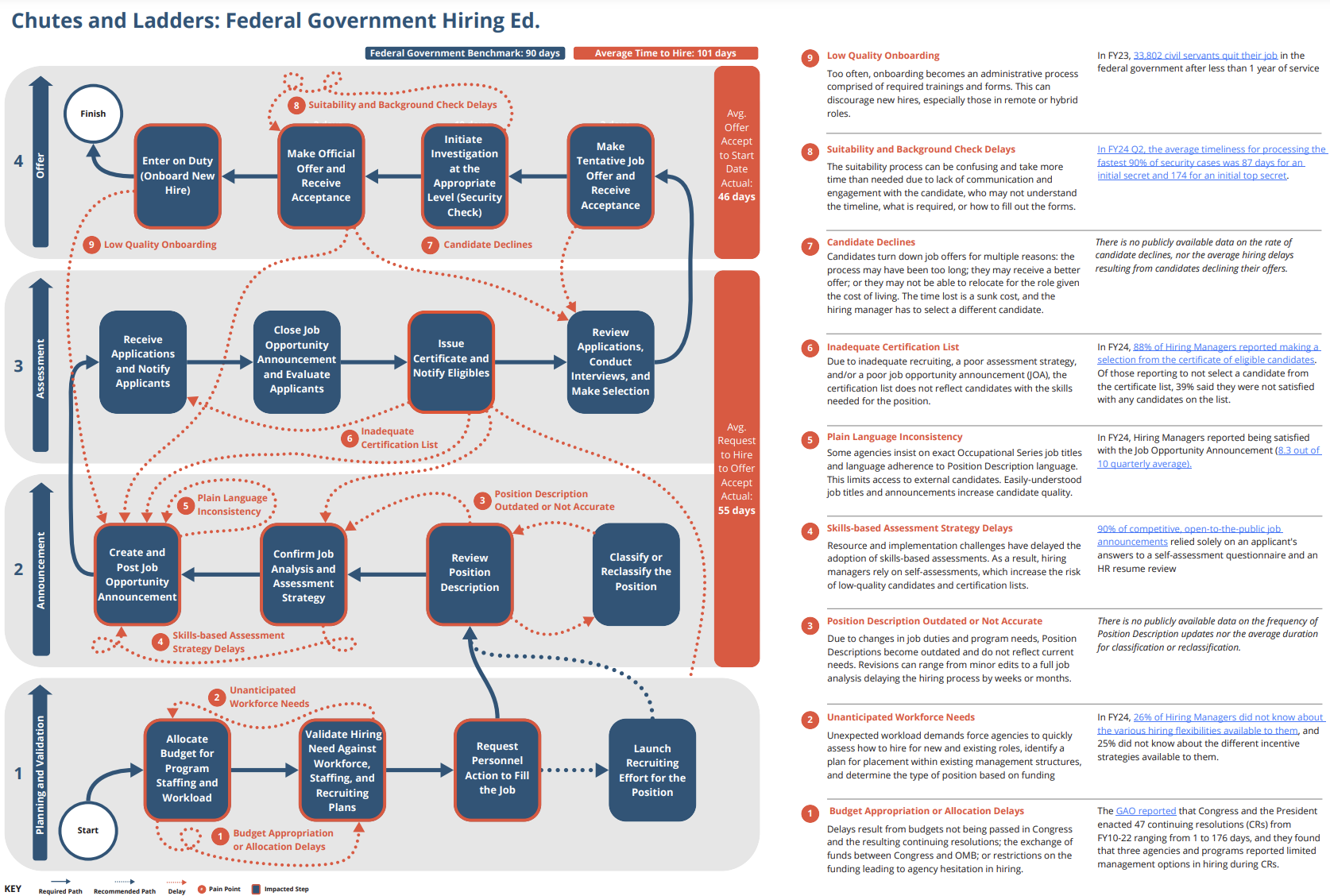
In the first phase, the major challenges experienced are receiving the funding to begin the hiring process and realigning the workforce plan to account for the new role, especially when there is a talent surge that was unanticipated. In the case of environmental permitting, the Inflation Reduction Act (IRA) and Bipartisan Infrastructure Law (BIL) provided significant funding to support talent acquisition, but agencies had not planned for the talent surge. These new talent needs did not align with their existing workforce plans nor their capacity to recruit, source, assess, and bring new staff onboard.
Additionally, budget availability has also caused a number of delays. The new legislation only provides short-term funding for talent or in other cases, is unclear how the funds can be used for staffing. As a result, agencies have hesitated in hiring. They are left weighing the tradeoffs of hiring for full time employees with uncertain future funding or hiring for term positions (i.e., roles with a limited duration). Analyzing retention and retirement rates have helped some agencies navigate this decision, but the desire to avoid future layoffs combined with the risk averse culture has made the process difficult. Some have decided to hire for term positions, but have struggled in recruiting talent interested in a short-term role. Ultimately, this short-term funding does not help address long-term talent capacity gaps.
In the second phase of the process, the pain points center around developing and preparing the final job opportunity announcement (JOA). This can be delayed if there is not a position description that accurately captures the role, there is not a strong assessment strategy, or the HR Specialist and Hiring Manager disagree on the language to be used in the announcement.
With permitting-related positions, many agencies have been looking to hire for interdisciplinary positions that have a range of expertise. OPM, the Permitting Council, and agencies have worked to create interdisciplinary position descriptions and announcements across technical disciplines. Developing the job descriptions, confirming the job duties, and formulating an assessment strategy takes more time, ultimately resulting in a longer time to hire.
Even for positions that are more regularly used across agencies (e.g., Environmental Protection Specialist) descriptions may be available and up to date, but there may not be an assessment for a particular grade. For example, OPM and the Permitting Council collaborated to create a pooled hiring, cross-government announcement for a multi-grade Environmental Protection Specialist (EPS). This allowed for one JOA to produce a list of candidates that many agencies could use for hiring. Yet the assessment remained somewhat of a bottleneck because there were not standard assessments available for each grade (e.g., GS-5-14) in the JOA, which required more time for assessment development. This is not unique; for many positions, standard assessments do not exist for each grade.
In the third phase, the primary challenge is a lack of qualified candidates. Hiring managers receive a list of candidates (i.e., certificate list) who should meet the requirements of the position, but that is not always the case. This can result from a number of issues ranging from the use of self-assessments and HR Specialists lacking the expertise to screen resumes to insufficient recruiting efforts.
In discussions with civil servants looking to hire for permitting-related positions, we have heard these challenges. Some agencies have struggled to make time for efforts given their limited capacity, resulting in a limited applicant pool. Alex’s story provides another example. Alex and their HR Specialist selected a self-assessment strategy, where applicants report their level of experience and skills on a number of questions related to the role. Both self-inflation and humility can distort these scores, resulting in qualified candidates not making it through the process. In reviewing the first certification list, Alex explained being surprised to see individuals with resumes unrelated to the role. This likely resulted from inaccurate self-assessment scores combined with a lack of expertise among the HR Specialist to effectively screen the resumes for the position. Receiving a certificate list with unqualified candidates can significantly delay the process, and in Alex’s case, result in another two month delay.
In the last phase of the process, delays often result from candidates declining their offer and the time required for background checks. Candidate declines can be very demotivating for a Hiring Manager who is excited to bring on the candidate they selected. Candidate declinations are a challenge for permitting-related positions. This is often due to constraints in negotiating salaries and relocation requirements, especially when candidates are asked to move to an area with a high cost of living. With today’s high interest rates, some candidates are just unable to move given the federal government’s stagnant pay structure.
Improving Alex’s Experience
Thinking back to Alex, this process highlights some areas where the process went astray, particularly with the assessment and HR Specialist screening. These issues can be solved through skills-based hiring and better assessment tools such as Subject Matter Expert Qualification Assessment (SME-QA) (i.e., a process that incorporates subject matter expert resume reviews into the screening process). However, an often-overlooked challenge, not highlighted in the process map, is the relationship between the Hiring Manager and HR Specialist.
The breakdown in communication between HR Specialists and Hiring Managers is not uncommon. Building a strong relationship and shared ownership across the hiring process is key to success. In Alex’s case, she was discouraged from reaching out to the HR Specialist with questions because of the HR team’s limited capacity; the team was centralized across their organization and responsible for servicing many offices. This left Alex frustrated. The process felt like a black box, leaving her with no insight as she waited for her certificate list to eventually arrive. A kickoff meeting with the HR Specialist to align on a timeline, establish roles and responsibilities, and form a line of communication to share updates throughout the process could have helped open and shine light in the black box, fostering a collaborative relationship to identify and mitigate issues as they arose throughout the process.
Summary
When we take a step back and look at this hiring process, it can feel daunting. The average time to hire one candidate is 101 days. In comparison, the private sector takes less than half the time. While it may not be possible for this current process to meet the private sector’s timeline, there are things that can be done to streamline today’s process. In our next series of blog posts, we will dive into each phase in more detail and highlight short-term solutions for hiring managers, HR specialists, program managers, and budget personnel to bypass these chutes — and focus on the ladders.
Advisory Committees for the 21st Century Recommendations Toolkit
From January 2024 to July 2024, the Federation of American Scientists interviewed 30 current and former Advisory Committee (AdComm) members. Based on these discussions, we were able to source potential policy recommendations for the executive level, for the executive level, that may assist with enhancing the FDA’s ability to obtain valuable advice for evidence-based decision-making. In this toolkit, we build off of those discussions by providing you with actionable policy reform recommendations. We hope that these recommendations catapult the Advisory Committee structure into one best suited to equip all AdComms with the necessary tools needed to continue providing the government with the best advice.
Download a PDF version of these recommendations on the left.
Recommendations and Best Practices for Actionable Policy Implementation
Voting for FDA Advisory Committees
Update Type: Process
- Maintain voting as an integral function, allowing FDA Advisory Committee members to convey their collective expertise and advice, aiding the FDA in informed decision-making on scientific and regulatory matters.
- Revise the guidance for FDA Advisory Committee Members and FDA Staff to explicitly define circumstances for which voting should occur and eliminate sequential voting
Best Practices for Implementation
The United States Food and Drug Administration can uphold their voting mechanism by updating their document entitled, “Guidance for FDA Advisory Committee members and FDA staff: Voting Procedures for Advisory Committee Meetings” to include language that clearly states a vote should be taken at all Advisory Committee meetings where a medical product is being reviewed. This guidance should also indicate that the absence of voting should only occur if an Advisory Committee meeting has been convened to discuss issues of policy. Further, this guidance should be considered a level 2 guidance as it falls into the category of addressing a “controversial issue”. To effectuate these changes, a notice of availability (NOA) may be submitted to the Federal Register for public input (public input is not a requirement before implementation).
Potential Language to be Utilized for Guidance
In an effort to continue to allow Advisory Committee members to provide unbiased, evidence-based feedback and uphold such an integral part of the Advisory Committee process, voting is hereby mandatory for all Advisory Committee meetings that are convened where the purpose is to review and assess the safety and efficacy of medical products.
Involved Stakeholders
In order for this process to successfully occur, the FDA will need to amend their guidance with the aforementioned updates. Consideration should be given to incurred costs for personnel required to complete these updates. Personnel needed for these amendments may include, but are not limited to, the (a) Office of the Commissioner, Office of Clinical Policy and Programs, Office of Clinical Policy, (b) Center for Devices and Radiological Health, (c) Center for Biologics Evaluation and Research, and (d) Center for Drug Evaluation and Research.
FDA Staff, Leadership, and AdComm Disagreements
Update Type: Process
- Ensure that all FDA staff and leadership are fully cognizant of the existence and details of the Scientific Dispute Resolution at FDA guidance and the process for submitting disputes for review.
- Develop guidance that clearly explains a transparent process to communicate effectively with AdComm members regarding decision making when parties have opposing viewpoints
Best Practices for Implementation
Implementing these recommendations will improve conflict resolution internally and between the Agency and Advisory Committee members. Best practices for implementation include (a) building the Scientific Dispute Resolution at FDA guidance into the official FDA onboarding process for new hires to raise awareness, (b) provide annual employee trainings in an effort to stay up-to-date with dispute resolution processes and procedures, and (c) develop a guidance that delineates the process for resolving conflicts between the Agency and Advisory Committees when there are differing opinions.
Note: Guidance for resolving disputes between the Agency and Advisory Committees should be submitted to the Federal Register for public comment. Guidance should also include plain language that designates the avenue to be used for official decision notifications, the timeliness of these notifications after convenings have concluded, and circumstances in which the FDA cannot notify Advisory Committees that their decision is in direct opposition of the Committee’s vote (e.g., – if this notification would breach a confidentiality agreement with the applicant). Implementing a transparent process to communicate with AdComm members regarding differences between the Agency and the AdComm will assist in improving morale between both parties, but also encourage continued support of the AdComm.
Involved Stakeholders
Successful implementation of these recommendations will require the capacity of human resources personnel and individual center leadership.
Update Type: Regulatory
- Incorporate the Scientific Dispute Resolution at FDA guidance into FDA regulations
- Amend the Scientific Dispute Resolution at FDA guidance to dictate the mandatory execution of best practices within the dispute resolution process
- This guidance should identify additional non-biased parties (that may not be government-affiliated) to provide impartial guidance on complex scientific matters affecting public safety.
Best Practices for Implementation
Center leadership can assign FDA staff to make the necessary guidance amendments which should include the requirements for inclusion in the onboarding of all FDA employees. Staff should also be responsible for obtaining feedback on amendments from all necessary internal parties and submitting proposed amendments to OMB for review and addition to the Federal Register. Federal register comments will then be reviewed by FDA staff, guidance will be updated accordingly, and a final draft submitted to OMB for review. If approved, the final regulation will be published in the Code of Federal Regulations. Congressional involvement should not be necessary.
FDA Center leadership should delegate the task of creating an annual mandatory training program for all FDA employees to review this guidance in an effort to stay abreast of the procedures for dispute resolution.
Involved Stakeholders
FDA Center leadership, FDA staff, and the Office of Management and Budget (OMB) are the intended stakeholders for implementation of these recommendations. To incorporate this guidance into FDA regulations, Center leadership will need to assign FDA staff to amend guidance and submit to OMB.
Leveraging AdComm Membership
Update Type: Process
Expanding Committee Representation
- If there is flexibility and committee composition is not bound by law, include a patient representative and pharmacist and/or pharmacologist on each Committee
- Patient representatives provide a needed perspective due to lived experiences and understanding of how specific drugs and devices affect their day-to-day life
- Drugs and devices will usually pass through the hands of pharmacists and pharmacologists. Therefore, they should have the opportunity to serve on these Committees and provide feedback. Pharmacologists also understand the clinical application of drugs.
- Have a roster of temporary members that can be used when additional expertise is needed for Committee meetings or when there is a conflict of interest (COI)
Amplifying the Role of the Chair
- Expand the role of the Committee chair that will encompass the task of recruiting both standing and ad hoc members, as well as identifying prominent issues and products for Committee consideration, thereby allowing for specialized input from their Committee
Establishing Training and Regulatory Procedures for Incoming Members
- Institute a basic 101 training for all newly appointed Advisory Committee members that covers statistical analysis, clinical trial design, and elucidates the partnership between the FDA and AdComm
- Include an overview of the regulatory process and how the FDA’s decision-making process is performed
Best Practices for Implementation
With respect to Committee composition, the FDA should consider adding patient representatives to all Committees that review medical products. The addition of a patient representative will ensure that the voice of the population who the medical product affects is heard. The FDA can select individuals best suited to fill these roles through connecting with patient advocacy organizations. If patient representatives are selected, the FDA should develop an onboarding program to familiarize the patient representative with basic knowledge of the federal regulation process. This program should educate the patient representative on (a) the types of questions presented to Advisory Committees, (b) how the FDA views the role of the patient representative in the process, (c) the internal review process for data that is submitted, and (d) other pertinent topics related to medical product regulation.
Leveraging the role of the Advisory Committee Chair can help the FDA fully optimize the use of their Committee. “Chairs possess extensive networks that could support the identification of permanent or temporary expert participants for AdComms” (Banks, 2024). Allowing Chairs the ability to identify relevant issues or products for their respective committees to review can provide an additional layer for the FDA to keep abreast of critical public concerns via appropriate committee evaluation (Banks, 2024).
Finally, while Committee members may be experts in their own right, training should be provided for all. The FDA should provide basic 101 training courses that can cater to the needs of members with various knowledge bases. Training should include information on the relationship between the FDA and Advisory Committee members, best practices for understanding statistical analysis, and the different types of clinical trial designs. Training should provide real-world examples of statistical analysis and trial design in use (this can be done by providing examples from prior medical product review).
Involved Stakeholders
FDA Center staff (including statisticians and scientists for the development of training programs).
Conflict of Interest (COI) Auditing
UPDATE TYPE: PROCESS
- Develop a process that can quickly replace individuals who have a known conflict of interest
- Clearly delineate criteria for committee service acceptance regarding individuals with potential or actualconflicts of interest
Best Practices for Implementation
To prevent recurring COIs, the FDA should develop a database of experts for various categories of expertise that can be selected to replace those with known COIs. This database should include names, contact information, credentials, all areas of expertise for each expert, and should link to public financial interest databases that can serve as a source for identifying conflicts (e.g., Open Payments, Dollars for Docs).
To prevent public confusion, the FDA should amend their Guidance for the Public, FDA Advisory Committee Members, and FDA Staff: Public Availability of Advisory Committee Members’ Financial Interest Information and Waivers to specify circumstances that warrant a COI waiver being administered. This will increase transparency and help Advisory Committee members and the public understand the reasoning in allowing members with conflicts to participate in meetings. This guidance can then be submitted to the Federal Register for public comment
UPDATE TYPE: PROCESS | REGULATORY
- Streamline the COI process to prevent duplicative work that may act as a deterrent to experts volunteering to serve on the AdComm (work with GSA on this matter if necessary)
Best Practices for Implementation
Streamlining the COI process will assist the FDA with retention efforts for Advisory Committees while maintaining compliance with conflict of interest regulations. A digital system should be developed that allows Advisory Committee members to select whether their financial information has changed through the use of a dropdown or check box. This will prevent duplicative work and also contribute to a sustainable (green) process.
Involved Stakeholders
The Office of the Commissioner, Office of Clinical Policy and Programs, Office of Clinical Policy would be the interested stakeholder to issue updates to the COI policy and would work with the General Services Administration if necessary.
The Role of Patient Advocacy in the AdComm Process
Update Type: Process
- Dedicate staff to identifying crucial public comments from patient advocates that should be considered for regulatory decision-making
- Include a patient representative on all committees that are reviewing medical products
- If possible, ensure that patient representatives selected have basic knowledge of the federal regulation process
- Establish criteria for which all public comments must abide by
- This can be done by creating a checklist for the public to review and consider before forming their comment and that clearly delineates the mandatory criteria that a medical product must meet to be considered for approval
- A disclaimer can also be added to state that there is a specific threshold or sample size of a population who must benefit from the medical product
- Promote patient focused medical product development through the use of incorporating patient perspectives into the life cycle of the regulatory process
- This can be done through hosting patient town hall discussions for areas such as rare diseases and expanding initiatives such as the Patient Focused Drug Development (PFDD) public meetings
- Make patient engagement ongoing, rather than only allowing patient engagement quarterly or annually as done with most FDA-led programs and initiatives
Best Practices for Implementation
Public comments are a crucial part of the regulatory process. The FDA should focus on increasing participation in this process, as well as notifying participants of what should be expected from the public comment period. By law, the FDA must allow a public comment period for all Advisory Committee convenings. To increase participation, the FDA should allow public comments to be vocalized in-person and virtually, in addition to the submission of public comments to the docket.
Regarding Committee composition, please refer to Best Practices for Implementation under Leveraging AdComm Membership for information on the addition of patient representatives to Advisory Committees (see prior section above).
Patient engagement in the regulatory process is necessary to inform evidence-based decisions. While the FDA currently has ways to engage these communities through the use of public comment and initiatives such as Patient Focused Drug Development (PFDD), engagement should be an ongoing process. As mentioned, the FDA can develop and leverage existing relationships with public health agencies and advocacy organizations who can then serve as the liaison of feedback to the FDA. The FDA can also consider expanding their current initiatives and programs to engage communities twice a quarter instead of quarterly or annually. Consistent engagement in this form will help to establish trust between the FDA and the public who they serve, as well as give them the needed information from the communities who are most impacted from their decisions.
Involved Stakeholders
Implementation of these recommendations and expansion of current initiatives will require the involvement of FDA Center leadership and Center staff.
Improving Public Awareness and Understanding of Advisory Committees
Update Type: Process
- FDA can leverage social media platforms to increase awareness and understanding of AdComms through the use of disseminating information (engagement, ads, etc.)
- FDA should include a disclaimer on all communications and marketing materials regarding AdComms
- These disclaimers should also be made at all public meetings
- Disclaimers should emphasize the purpose of AdComm votes (disclaimer should state that votes allow AdComm members to provide an official stance to the FDA as experts, but those votes are also non-binding)
- Develop a webpage that allows people to be placed on listserv regarding upcoming meetings
- Partner w/state and local public health agencies and advocacy organizations to spread awareness
Best Practices for Implementation
The FDA should develop a monthly content plan to utilize its current interactive and social media outlets and disseminate information related to the role of Advisory Committees and their convenings, while also maintaining compliance with the FDA’s social media policy. The social media content plan should be centered around (a) what an Advisory Committee is, (b) how members are selected, (c) information regarding votes of Advisory Committees and how they are specific to safety and efficacy, but are not voting on the approval of a medical product, (d) discussing upcoming Advisory Committee meetings, their location, and inviting the public to participate via public comment, (e) sharing information about what a public comment is, requirements for making public comments, and how the FDA reviews them, and (f) sharing a webpage where the general public can input their personal email to be notified of upcoming Advisory Committee meetings.
FDA staff should develop a plain language disclaimer to be placed on all social media posts, meeting materials, and websites related to Advisory Committees. This disclaimer should illustrate that Advisory Committee members will provide unbiased expertise to assist the FDA with their decision. However, while the Committee’s vote is included in consideration for the decision, their vote is non-binding which leaves the FDA as the final decision maker for approval.
Finally, the FDA should identify state/local public health agencies, as well as advocacy organizations that they can potentially partner with to disseminate information more broadly. These agencies and advocacy organizations have strong relationships with various communities who should be engaged in the regulatory process. Developing a relationship with these agencies and organizations in an attempt to engage the community will assist the FDA with building connections and trust, as well as mutual understanding of Advisory Committee roles. Potential partners can be identified using the linked list under involved stakeholders.
Involved Stakeholders
Implementation of these recommendations and expansion of current initiatives will require the involvement of FDA Center leadership, Center staff, Office of External Affairs (OEA) Web and Digital Media staff, Office of Information Management and Technology (OIMT), state/local public health departments, and advocacy organizations.
Note: These listings of state/local public health departments and advocacy organizations are intended to be used as a starting point in the identification of potential partners and not to be considered an exhaustive list.
For questions related to this toolkit, please contact
Cheri Banks
Health Regulatory Specialist
cbanks@fas.org
Grace Wickerson
Health Equity Policy Manager
gwickerson@fas.org