A Vision for Western Solidarity in the Mid-Transition, Beyond the Resource Curse
The energy transition happens in real places with real people, and different regions face different obstacles in moving through the “messy middle” of the energy transition toward a more fully decarbonized economy. So while clean generation and capacity are growing fast across the country, continued progress depends on supporting that growth from the ground up.
Mid-transition challenges are particularly salient in Alaska and other Western states. Along with Appalachia, the American West has long been at the core of the fossil economy. Now, at a time of federal retreat with respect to clean energy, the American West can play an outsized role in driving a new kind of energy story.
The American West has a proud history: of policy leadership, environmental stewardship, and entrepreneurialism. However, the region is also largely dependent on resource extraction and fossil fuel production, industries that are deeply woven into its social, political, and economic fabric. This resource curse has concentrated economic and political power in the hands of a few companies at the expense of residents and communities. As new pressures like climate overshoot and geopolitical turmoil have arisen, the resource curse has complicated Western states’ ability to chart a more resilient future.
Complicated, but not compromised. The flip side of the resource curse is that Western states – as the bedrock of U.S. energy production – have a unique opportunity to reinvent not only their relationship to energy, but that of our entire country. Too often, the national conversation on climate and energy centers on the Eastern states that are geographically proximate to our nation’s capital. To the extent that policymakers look west, they often focus myopically on California. This essay broadens the aperture, exploring how the principles of regulatory ingenuity can position Western states beyond California to lead on mid-transition challenges and help a region transform itself in ways that can also create new possibilities for the country as a whole, starting now.
Escaping the Resource Curse
Escaping the resource curse means envisioning a future that does not simply replace oil with other extractive industries, but instead drives shared prosperity.
As home to significant domestic oil and gas production, Western states face complex pathways to decarbonization. In states like Alaska, Texas, Arizona, and Wyoming, natural resource extraction is inseparable from economic and government structures (e.g., sovereign wealth funds that underpin public services or gas industries as majority local employers), and that relationship directly impacts how these states go about the transition. For example, Alaska’s Renewable Energy Fund, which supports more reliable and cleaner energy sources for remote and Indigenous communities, is funded by state revenue and has historically benefited from windfalls resulting from global oil shocks. Boosts (or drops) in state funding are often driven by the volatility of resource markets, and the inconsistency of that revenue makes it difficult to sustain energy transition funds like Alaska’s.
Similarly, Wyoming’s mineral resources provide at least a third of the state’s annual public revenue (not counting earnings from its sovereign wealth fund). Though mineral extraction supports the development of clean energy technology, it has its own environmental impacts. In New Mexico, a recent oil boom has helped supercharge critical services, like universal childcare and public schools, but has also made it harder for the state to provide those services long-term without the help of fossil fuel revenue.
The legal frameworks of oil-producing states often favor investment in and subsidization of fossil fuels, including through tax incentives and below-market rate land leases. That limits market development for clean tech and renewables, and makes it harder to implement conventional policy tools that drive the transition in other states, like renewables mandates and supply-side incentives. Even where Western states are moving to accelerate renewables, existing regulation can favor incumbent fossil fuels over emerging clean sources because of the deep ties between resource revenue and public services and the higher bar to entry for clean sources versus subsidized energy sources. New Mexico has made significant progress on clean generation, but its budget still relies heavily on resource wealth.
In addition, the actual time, expertise, and resources necessary to reform an entire statutory and regulatory structure can be well beyond the capacity of any legislative body, even one with the best intentions. Many Western states have legislatures that operate on a biennial cycle of short and long legislative sessions; others have very short sessions every year (California is unique, with a year-round legislature). These structures can limit legislatures’ ability to dig deeply into existing legal frameworks and start untangling these dependent policies. Hyperpolarization nationally and electoral whiplash don’t help – state officials aren’t incentivized to try new things when there might be political consequences.
Alaska’s recent political wrangling to facilitate the construction of a new natural gas pipeline from the North Slope to Southcentral Alaska is an unfortunate example of how those pressures hinder progress. State elected leaders sparred in three special legislative sessions in 2026 over creating a more favorable tax structure for the pipeline developer, while also trying to safeguard the fiscal interests of the cities through which the pipeline would pass. Legislators otherwise largely ignored renewable energy policy, beyond one-time budget allocations. Given the revenue a gas pipeline represents for Alaskans and their public services, elected officials are incentivized to spend time figuring out how to create a friendlier environment for those developers, instead of for clean energy that doesn’t represent as much direct wealth for the state.
Turning the freighter of these policy frameworks risks very real impacts on communities. In Alaska, the singular dependence on oil and gas as the state’s economic driver for nearly 50 years has made it a classic resource colony, while exposing it to untenable long-term fiscal risk as the world energy system evolves away from fossil fuels. Early resource wealth helped build civic institutions that provide basic services to communities, like education, childcare, and safety. As those resource markets become more unstable, state and local institutions have contracted – the city of Juneau is facing a $10–12 million budget gap and Alaska’s projected deficit is $1.8 billion next year. The state is already prioritizing Permanent Fund dividends over things like childcare workers and increased Medicaid payments. Communities need reliable services, and dependence on fossil fuels or resource extraction won’t provide that stability long-term. But diversifying too quickly or haphazardly could upend the current system and leave Westerners unable to access basic needs, further damaging public trust in institutions, and hobbling the state’s ability to make it through the mid-transition.
Opportunity for Transformation
How, then, do Western states break their resource curse? The ideas below are a starting point for Western states looking to diversify – and thereby strengthen – their economies while simultaneously leading on environmental stewardship and an equitable, politically attractive energy transition.
The West has long echoed with calls for a more independent and self-reliant future, but often these visions, including the Sagebrush Rebellion of the 1970s and 80s, ended instead in frustration and constraints on the very government creativity needed to reshape economies – leading to neither local control nor shared prosperity. This is a chance for a more constructive path, aimed this time at creating fiscal room for democratic creativity.
Governance/Finance
Many Western states have unique economic instruments in their policy toolboxes. Sovereign wealth funds, for instance, are inherently tied to resource extraction but can also provide the capital needed to finance economic diversification and decarbonization. Resource wealth can be invested to derisk renewables markets, build more resilient infrastructure, and catalyze innovation – the building blocks of a modern, climate-smart economy. Resource wealth can also be invested in the enablers of that economy: e.g., better public engagement strategies that increase trust in government while producing better policy, new legal regimes that decouple state budgets from resource revenues, and accountability structures for reigning industries that force them to pay their fair share and keep benefits local. Initial approaches could include:
Collaborative finance. States can pool capital from green banks and infrastructure banks across the West into shared investments, or at least align on a shared strategy to reach the scale needed to shift markets while keeping capital in the region. Mutual lending and intra-West investing could shore up regional relationships and allow states to focus on what helps them grow instead of exporting resource wealth outside of the state. The West already has much of the capital it needs for economic growth, and being more strategic about scaling within the region would support independence and diversification.
Long-term revenue sustainability, including through resource stewardship. By diversifying their funding sources and investment strategies, Western states can secure truly permanent funds. Alaska’s Permanent Fund helps stabilize its budget, but is not large enough to sustainably support public services and relies on diminishing resources, while federal safety net cuts and natural risks like wildfires and floods increasingly burden public budgets. But Alaska – like many Western states – can provide valuable services to the country that extend well beyond raw resource production. Their land bases and locations position them to reduce global risks – and secure revenue for doing so. As an example, the Tongass Rainforest is a globally important carbon storehouse whose services warrant federal investment – not just in science but in enhancing its capacity on the ground by supporting continued stewardship in the state budget. Likewise, Alaska, alone among the states, can take meaningful action to lessen methane releases from permafrost that threaten trillions in global investments, or explore new climate interventions that may be able to protect globally important sea ice and the reflectivity of the Arctic. Other Western states have aligned opportunities in their land bases, from carbon capture to forestry stewardship to novel research and experimentation with public oversight. Monetization solutions are complex, nuanced, and need development – and can receive that attention through Western collaboration. The West can be a place that reduces national and global risk, reaps federal research dollars in exchange, and potentially secures longer-term financial support to maintain critical solutions.
These new strategies can also open up more opportunities for interdependence between Western states and the federal government, through federal capital transfers (when possible) supporting the West’s role in the national transition, as well as local governments, with increased funding shoring up responsive capacity at the city level. These could include new payments to manage public health and climate risks (e.g., forest management or underwriting community resilience investments like workforce development).
Western interdependence and solidarity. Creating a system where Western resources help build shared benefits within the West – not outside of it. Western state governors have already begun to weave together Western power grids, and they should look to other shared infrastructure and economic development projects, like new transmission lines connecting regional grids to the East and Canada. States can secure the benefits of these lines within the region by activating major new opportunities to build and sell clean energy projects (while capturing those benefits in enhanced state revenue) or new regional clean industrial zones to support advanced manufacturing.
Proactive transfer of governance to Tribes. Tribal governments play a unique role in Western governance and resource management. Transferring that role through compacts and co-management of federal lands, creative financing partnerships, shared workforce development, and increased Tribal authority and decision-making power can strengthen Western and Tribal independence from extractive industries and resilience to climate risks. Tribal leaders still face similar economic pressures, but have their own sets of policymaking tools – providing Tribal governments more policymaking agency could spur more innovation and allow for more supportive regional partnerships.
Energy
As pressures for energy generation and production mount, fossil fuels will continue to play a role in the West. But states also have unique opportunities to diversify their supply of affordable, reliable, and clean power and catalyze new Western economic engines. Geothermal energy and hydropower are uniquely abundant in the West, and vast amounts of federal land, if managed appropriately and sustainably, can unlock new development opportunities that don’t rely on extraction. State regulatory structures currently tilt the scales toward fossil fuels, so while states start the process of reforming those structures, governments will need to get creative in the short term to make sure renewables have a fair shot at staying competitive. Regardless of source, states will also need to invest in grid stabilization and modernization as prices and demand increase.
Some are leading already. The New Mexico Comprehensive Energy Transition Strategy is building out an integrated roadmap to support the state on its transition toward clean energy and net-zero commitments. Both Wyoming and Utah have made significant investments in renewables markets despite their reliance on fossil fuels. Utah’s DOE-sponsored and state-supported FORGE laboratory focuses on enhanced geothermal research, and groundbreaking geothermal developments across the state have helped kickstart the industry. Wyoming hosts major wind and solar projects alongside its coal production, and the state provides matching funds for innovative energy projects to attract outside developers. These states are not unique in the West in terms of political makeup, resource wealth, and generally limited government capacity, making them useful examples of how others can adapt to a new energy reality.
Resilience
The West’s tens of millions of acres of wilderness are a crown jewel of the continent and another unique opportunity for the region. Its intact natural systems are important not just as a focus of conservation or nature-based solutions, but also as a key component of economic development, built environment, and resilience. Joint strategies to build out learning and capacity for how to leverage that nature – for example, through public–private partnerships – could aid Western states in strengthening resilience to climate shocks. Turning nature into part of states’ economic engines (while stewarding the land responsibly) is a way to further aid the transition – and is something only Western states can do.
But the increasing risks of climate overshoot also complicate those efforts. Wildfires, floods, droughts, and changing landscapes result in massive cost increases and community disruptions. Current costs associated with climate-driven wildfire risks alone are in the hundreds of billions per year, to say nothing of the health costs of wildfires that are still difficult to quantify. There is tremendous need for wildfire prevention across Western landscapes, whether on federal, state, or private lands.
Broadly, more research is needed on both climate risk and stabilization approaches, especially, as noted above, because Western states functionally manage trillions in global climate risk (permafrost, forest carbon, etc.) and can do so in ways that drive state economic development. There are enormous opportunities to put public universities and science agencies in the lead on this front, securing federal appropriations to further support this work, and linking together collaboratives across the landscape. Imagine a cross-Arctic collaborative from Alaska on emergent ideas such as protecting volatile permafrost or restoring sea ice, along with paths to develop economies around these ideas, or a Pacific Northwest academic/government/industry collaborative to move the needle on forest and ocean carbon storage. With increased global attention on ecological systems interventions, Western states can be proactive leaders in research and governance on this front. Success in any of these efforts could reduce billions, or even trillions, of dollars’ worth of risk to the country and the world – making it vital to invest and creating a path for returns not just in knowledge but in careers for young people moving through public university systems.
Capacity and Expertise
To make this regulatory and economic transformation successful, the West will need smart and capable people to carry it out. In states where the dominant industries are fossil fuels, the workforce tends to be fossil fuel-oriented as well, but deep understanding of energy systems and skills with specific infrastructure or operations can be useful foundations for other industries (like geothermal). Professional expertise, mentoring and development, and training pipelines are all critical to workforce transition and economic diversification, including educational and vocational resources, workforce development programs, and good opportunities across the public and private sectors.
States can design both push and pull strategies for workforce development. Reinvesting resource wealth into clean job opportunities in technology, manufacturing, infrastructure, and energy; creating public sector openings for key expertise in permitting and utility regulation; and redesigning educational curricula to diversify pathways for students should all be part of the playbook. Interdependence among states can help expand pipelines for resource sharing, regional collaboration, and shared learning. Western state university systems – which are already linked through the Western Undergraduate Exchange (WUE) – can work together to create professional on-ramps for the next generation of energy leaders and workers.
Why now?
With many of them facing resource curses, increased natural disasters, and uphill political battles, Western states cannot afford to wait around for new policy tools. They have the know-how and the history to be able to lead in this moment – to reimagine economic and governance structures, to work regionally toward safer and healthier communities, and to build out cleaner and more reliable energy systems. This is a critical moment. Next month, nine Western states, including Alaska, will hold gubernatorial elections at a time when constituents are hungry for new ideas that actually deliver on government promises. Policymakers who can reimagine the existing paradigm will be the ones who usher in this new era of Western leadership.
Virginia Has an Energy Plan. Now It Needs the Tools to Deliver It.
Virginia has become ground zero for one of the country’s biggest energy questions: how do we keep the lights on as electricity demand surges, without sending costs soaring or locking in the energy system of the past?
Recently, Governor Spanberger’s administration offered its answer with the release of Virginia’s 2026 State Energy Plan.
The plan recognizes that Virginia needs to meet rapidly growing electricity demand while keeping energy affordable and reliable. It calls for deploying more of the lowest-cost, fastest-to-build resources available today—distributed, small resources and large batteries and solar farms—while preparing for longer-term clean firm resources. And it recognizes that Virginia can’t simply build its way out of growing demand: the commonwealth also needs to get more out of the grid it already has.
There’s a lot to like here. But a plan is a roadmap, not the road.
Now comes the harder part: implementation. Turning the plan’s ideas into lower bills, new clean energy projects, and a more flexible grid will depend on whether Virginia’s institutions—especially the State Corporation Commission (SCC) and Virginia Energy—have the tools and capacity to make it happen.
The plan gets the moment right
Virginia is at the frontlines of the impacts of demand growth on electricity bills, and Gov. Spanberger’s plan takes the right approach: pulling on the levers within state jurisdiction that can help deploy new low-cost electricity supply the fastest.
Demand from data centers was trivial a decade ago and now makes up nearly a third of Virginia’s energy use. The commonwealth’s peak electricity demand is expected to grow by 5 percent per year and total energy use by 7 percent per year. Because of the regional grid operator PJM’s inability to integrate new supply fast, rising demand has driven up bills in the region, including in Virginia.
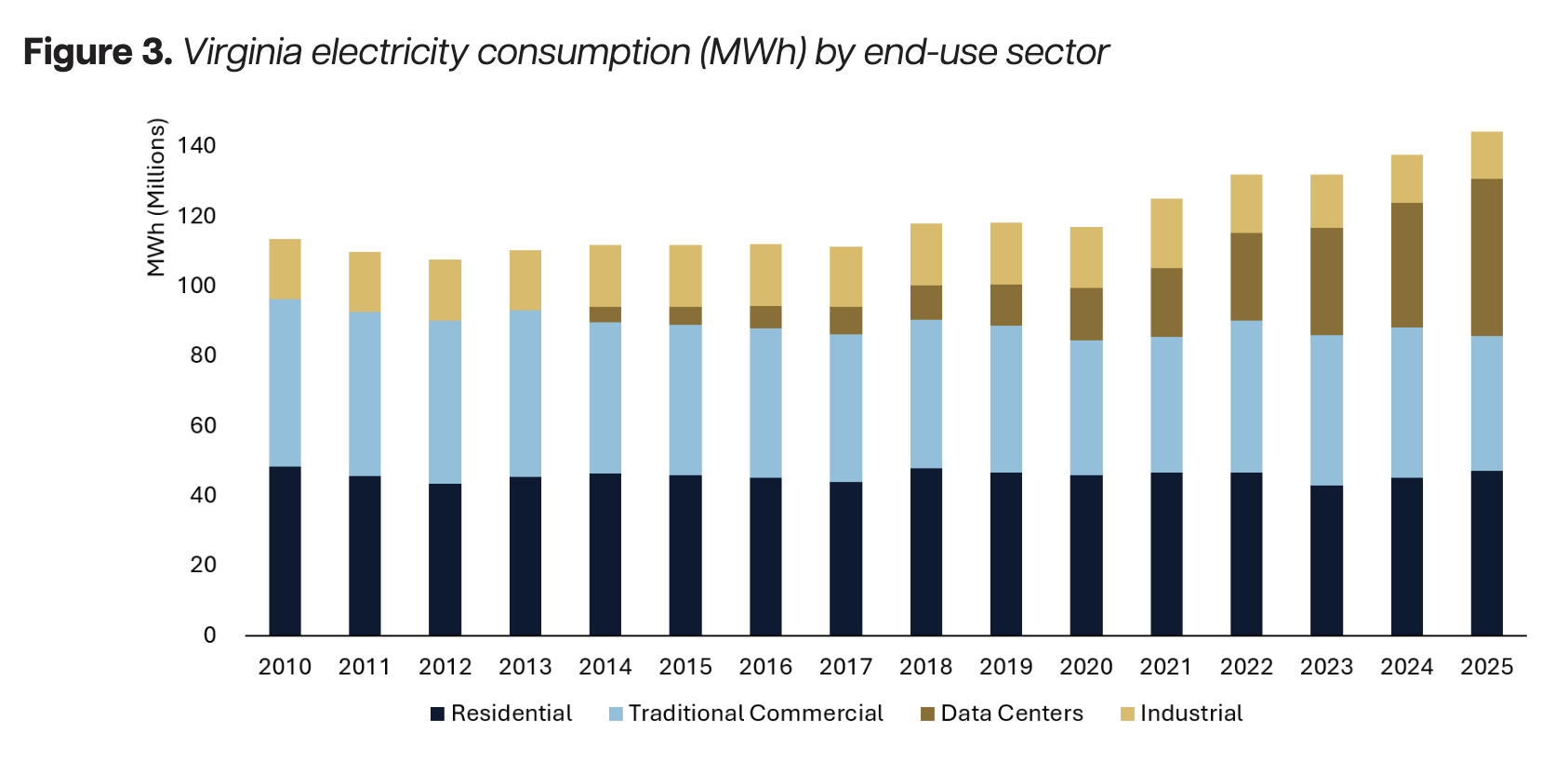
The most encouraging part of Virginia’s energy plan is that it identifies the cheapest new supply that can come online fast and lays out the levers within state control to unlock this power. And excitingly, the report is rooted in the idea that the government needs more tools—and the ability to wield those tools more effectively—to pull those levers.
The plan leans heavily on adding distributed energy resources (DERs), which can add significant new power in a matter of months and whose deployment is fully in the state’s control without waiting for PJM. The plan’s modeling shows that greater deployment of these resources, often sited at homes and businesses, could reduce total system costs by 10 percent. That would require up to 12 GW of these resources online by 2050, a big task! The plan lays out good first steps to get there, including speeding up processes to permit these projects and connect them to the grid and developing state programs to properly compensate these resources for their benefits to the grid.
For bulk power, the plan includes creative approaches to get big batteries and solar projects online faster. That includes a clever state-led procurement mechanism and efforts to help site projects at locations with surplus interconnection capacity where projects could be built faster.
The plan also looks beyond building more infrastructure to using the existing grid more effectively, including through advanced transmission (ATTs) and grid-enhancing technologies (GETs).
Beyond getting new power on the system fast, the plan lays out creative approaches to other drivers of rising bills. Take utility financing. The plan calls for pursuing debt-to-equity reforms that could reduce costs for customers while keeping utilities financially capable of making the investments Virginia needs. It also calls for examining broader reforms to utility returns and cost allocation, shifting the focus from how much utilities build toward whether they are delivering reliability and other outcomes cost-effectively.
All told, this is an impressive document with many smart and implementable ideas, grounded in modeling that shows the commonwealth’s energy needs.
Not just power capacity, Virginia needs state capacity to deliver
Gov. Spanberger’s plan rightly identifies many areas where the state government plays an essential role in building new power and reducing bills. For the plan to be successful, state institutions will need the right capacity—people, tools, and processes—to deliver.
Implementation will not be easy. Several of the plan’s critical strategies challenge established utility business models. Greater grid utilization, for example, can reduce the need for some traditional capital investments. Expanded DERs and plug-in solar can change how customers produce and consume electricity and could avoid some utility spending that shareholders like. And utilities may see a state-led marketplace or procurement process as competing with their existing procurement function.
Many of the plan’s most promising ideas will by default flow through the SCC. The new ideas in the plan come on top of a big existing workload for the SCC, including implementation of new legislation and reviewing the pending acquisition of Dominion by NextEra. And as we and others have written before, regulators and public interest intervenors are already underwater compared to utility companies, who have immense regulatory capacity.
Today’s implementation model—running these new requirements through the SCC, with utilities filing proposals and the SCC reacting and approving—is not sufficient to get the best outcomes for Virginians.
That is precisely why it’s so important to embed implementation considerations upfront when designing policies and in parallel take steps to bolster state capacity for execution. The state must have a stronger role in implementation to find the path forward that best benefits Virginians.
So what can Virginia’s leaders do to ensure strong implementation?
Embed implementation in policy design
When designing the new legislation envisioned in the plan, Virginia leaders should keep implementation front of mind. A few specific examples:
Clear Proactive Roles and Responsibilities. For new state responsibilities, like the proposed state-led market mechanism to procure new bulk power resources, legislation should clearly delineate roles and responsibilities. For major new programs, policy should lean heavily on state agencies like Virginia Energy to conduct proactive planning and procurement work, as the SCC is not equipped for that kind of function.
Explicit, Specific Requirements for Data Sharing. For proposals that hinge on utility data, such as efforts to use surplus interconnection capacity or increase transparency of the capacity of the distribution grid to host DERs, new policy should include specific, explicit requirements for data granularity, frequency of update, and transparency. Without strong, specific statutory requirements, it is often difficult to make utility data sharing useful for planning and project development purposes.
Expand state capacity for execution
Virginia leaders should include state capacity solutions—funding, staffing, authorities, and process changes—as a core part of the strategy. Here are some examples of capacity solutions Virginia could adopt:
Increasing Coordination Between the SCC and State Agencies. PUCs in other states benefit from the data, analytical, and technical capacity at state agencies. For example, Kentucky’s energy office reviews utility-submitted IRPs and helps the PUC formulate data requests, easing capacity burdens at the PUC, and Minnesota’s Division of Energy resources within the Department of Commerce provides technical assistance and analysis to the PUC to inform its work in planning and policy implementation.
Virginia Energy has capacity that is going underutilized in utility regulation—the agency conducted in-house energy-system modeling to evaluate different pathways for meeting demand. The agency is now one of the few state energy offices in the country with that modeling capability. With policies to support more coordination, the SCC could leverage Virginia Energy’s analytical capacity to support more proactive planning and more informed oversight of utility modeling.
Direction to the SCC on a More Proactive Approach. The SCC traditionally operates reactively, evaluating utility filings and weighing them against evidence submitted by other intervenors. While this should remain the core function of the SCC, relying solely on utility-led proceedings limits the creativity and effectiveness of implementation.
Opening proactive investigations into under-explored topics (e.g., grid-enhancing technologies, surplus interconnection, distributed energy resource aggregation) can yield cost-saving solutions. The legislature could direct the SCC to open investigations into particular topics and solicit proposals from a wide range of stakeholders, not just utilities.
Dedicated Funding and Hiring Direction. This year’s budget provided additional funding for the SCC’s Department of Public Utility Regulation (about $400k per year for three new positions), but that is insufficient to handle the additional complex responsibilities that the SCC is shouldering. The legislature could support implementation by providing additional funding, with direction to hire staff focused on surplus interconnection, grid utilization, data center tariffs, and distributed energy resources.
The roadmap is only the beginning
Virginia has laid out a useful vision for navigating an unusually consequential moment for its energy system. The choices Virginia makes now will shape not just how it meets today’s electricity demand, but what its energy system—and its economy—looks like for decades to come. The plan sets the direction, but now Virginia has to build the capacity to get there.
Hello Big Beautiful Bill, Goodbye Commonsense Energy Policy
Now that the One Big Beautiful Bill has been signed into law, the elimination of clean energy tax credits will cause a nation of higher energy bills – even for consumers and states that aren’t using clean energy.
Despite the “Day One” Declaration of an Energy Emergency, Congress just passed a bill that will do the opposite of addressing the real needs that the U.S. has to meet energy demand and decrease electricity costs for consumers. The bill will make it harder to connect the cheapest forms of power available to the grid, solar and wind. It also takes away the existing incentives to speed up the production of clean power.
Do you want more energy on the grid faster? To provide reliable power to your homes during storms or to support the buildout of AI data centers? The Clean Energy Investment and Production Tax Credits (45Y, 48E, and 45X), a technology-neutral tax credit, made this possible by subsidizing the production of zero-emission sources like solar, wind, nuclear, hydropower, and geothermal – not dissimilar to the subsidies fossil fuels receive like 45I. This helped with the upfront cost of these projects, and since these sources of energy are cheaper than fossil fuels, they lowered consumer energy bills and increased grid reliability by providing more clean energy, quicker. Surprise, surprise, they have been eliminated, meaning the types of projects that are going to move forward will be coal and natural gas, which are more expensive. Oil and gas won big, especially since the OBBB established accelerated National Environmental Policy Act (NEPA) reviews for oil and gas projects in exchange for a fee of up to 125% of project costs and by prioritizing fossil fuel development on public lands.
Say Goodbye to All of This
Are you a homeowner whose house is too hot in the summer or too cold in the winter? The Energy Efficient Home Improvement Credit (25C) made it possible for you to receive $1,200 to weatherize or insulate your home, making it safer and more comfortable during extreme temperatures while lowering your energy bills. This is now eliminated, making it more expensive and less feasible to make these types of home improvements.
Do you have an interest in installing solar panels or a geothermal system to one day achieve a $0 electricity bill? The Residential Clean Energy Credit (25D), made this a reality by providing a 30% tax credit for rooftop solar, wind power, geothermal heating systems, and battery systems. This is now eliminated, making it more expensive to purchase renewable systems for your home and reducing consumer choice. This tax credit also created jobs in the residential renewables industry, so you can expect to see some significant job losses as a result.
Do you own an EV or hope to own one someday to save money on gas and to lower carbon emissions? The Electric Vehicle Credits (45W, 30D, 30C, 25E) made this possible by allowing up to $7,500 for a new EV purchase, and up to $4,000 for the purchase of a used EV. These tax credits also provided a boost to the automotive industry and created thousands of jobs. Now that these credits are being eliminated, buying an EV just got more expensive and job losses and business closures are bound to happen.
The bottom line? Energy prices will go up, the job market will suffer as will clean energy investment, especially in red districts – since a total of 60% of this spending has gone to Republican-held suburban and rural districts across the U.S.
The true breadth and severity of these eliminations will reveal themselves sooner than you think.
Recommendations to Prevent Catastrophic Threat
Only three days after the 2012 national election, FAS hosted a day-long symposium that featured distinguished speakers and provided recommendations to the Obama administration on how best to respond to catastrophic threats to national security at the National Press Club in Washington, DC.
These experts addressed the policy and technological aspects of conventional, nuclear, biological and chemical weapons; nuclear safety; electricity generation, distribution, and storage, and cyber security. These policy memoranda call for a coordinated national effort to prepare for, prevent and respond to catastrophic threats to the United States.