North Korea’s Nuclear Test: Another Fizzle?
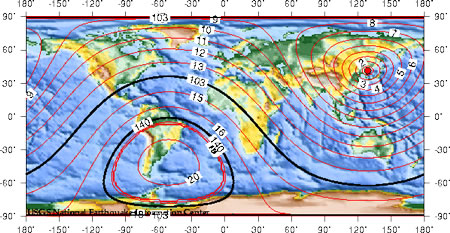 |
| The North Korean nuclear test on May 25, 2009, was “heard” loud and clear around the world despite its apparent limited size. Detection of small, clandestine nuclear tests seems to work. |
.
By Hans M. Kristensen
The Korean Central News Agency reportedly has announced that North Korea “successfully conducted one more underground nuclear test on May 25 as part of measures to bolster its nuclear deterrent for self-defense.” Several news media reported that the Russian Ministry of Defense estimating the test had a yield of approximately 10 to 20 kilotons.
Yet the preliminary seismic data published by the U.S. Geological Survey (USGS) shows that the test had a seismic magnitude of 4.7, only slightly more powerful than the 4.3 of the 2006 test.
Was it another fizzle? We’ll have to wait for more analysis of the seismic data, but so far the early news media reports about a “Hiroshima-size” nuclear explosion seem to be overblown.
Update: CTBTO’s initial findings.
.
The last remaining agreement limiting U.S. and Russian nuclear weapons has now expired. For the first time since 1972, there is no treaty-bound cap on strategic nuclear weapons.
The Pentagon’s new report provides additional context and useful perspectives on events in China that took place over the past year.
Successful NC3 modernization must do more than update hardware and software: it must integrate emerging technologies in ways that enhance resilience, ensure meaningful human control, and preserve strategic stability.
The FY2026 National Defense Authorization Act (NDAA) paints a picture of a Congress that is working to both protect and accelerate nuclear modernization programs while simultaneously lacking trust in the Pentagon and the Department of Energy to execute them.