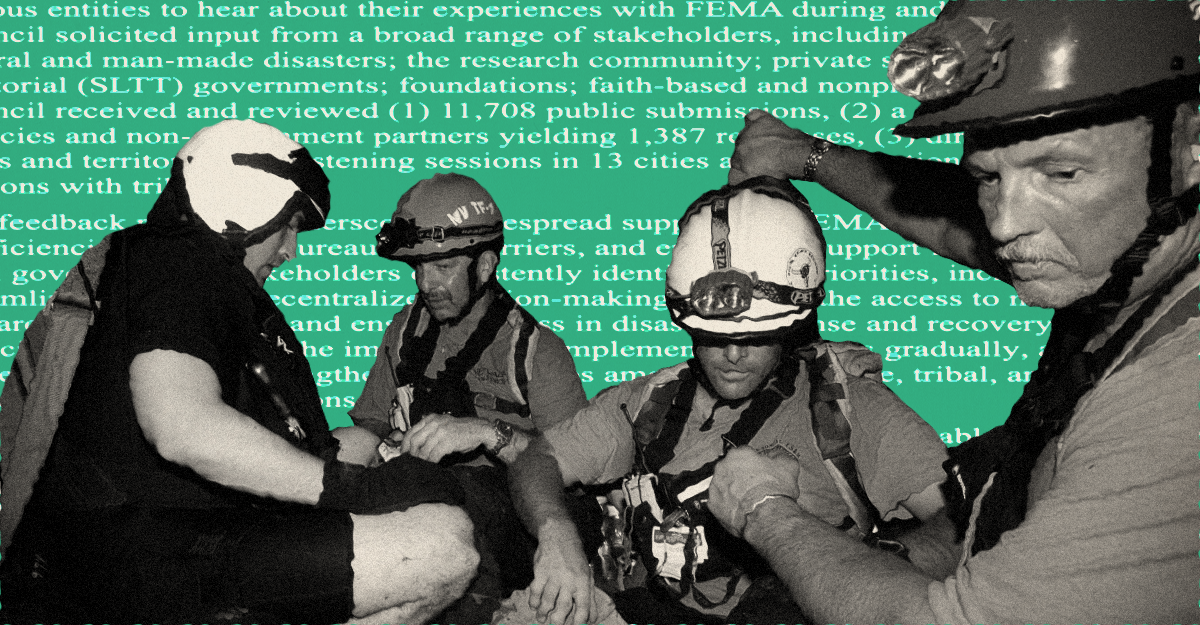
Disaster Policy Nerds Explain the Good, Bad, and Ugly in FEMA Review Council Report
It’s here! After months of delay, the council tasked by President Trump to review the Federal Emergency Management Agency (FEMA) released its final report earlier this month.
If you’re not a disaster policy nerd like we are, here’s some quick background.
Up until the founding of FEMA in 1979 under President Jimmy Carter, disaster response in the United States was largely disorganized and reactive. The agency has since gone through several major updates. Passage of the Robert T. Stafford Act in 1988 established the formal mechanism for disaster declarations and federal disaster response, while in the years following the 9/11 attacks FEMA transitioned from an independent cabinet agency to part of the newly established Department of Homeland Security.
Recently, FEMA has come under intense scrutiny from the second Trump administration for being seen as ineffective, bureaucratic, and in some cases politically biased against him. While FEMA has had issues in the past related to delayed response times and survivors receiving aid (and criticism with how it handled Hurricane Maria), reports show that many of these issues may be related to an increase in major disasters due to climate change, as well as a lack of regular training, sufficient funding, and adequate staffing – rather than structural issues with the agency. In addition, traditionally “red” states (like Texas, Louisiana, and Florida) typically receive more FEMA funding due to the amount of disasters they experience, so claims of political bias are largely unfounded.
Yet when Trump took office for the second time, there were calls to get rid of FEMA altogether. However, after pushback from citizens and lawmakers and several major disasters, the aforementioned council has opted to avoid recommending completely dismantling the agency. Instead, the council proposes major changes to the way FEMA operates (the council repeatedly refers to a “transformed agency”), via ten general recommendations. Here’s our quick snapshot of the good, the bad, and the ugly of these recommendations, with more detail below:
- The Good: An emphasis on mitigation and streamlining the application process for disaster survivors, along with a focus on getting money to states and survivors quicker.
- The Bad: Shrinking and privatizing most of the National Flood Insurance Program (NFIP), while slashing overall federal funding for disaster response and recovery.
- The Ugly: An unrealistically short timeline for implementing recommendations in the report, as well as a reductionist approach to how disasters enact damage.
Also, a quick note on the United States’ approach to disasters: there is generally an overemphasis on acute economic impacts, and not what they do to systems as a whole long-term. As many disaster researchers will tell you, while hazards can be natural, disasters are not. Disasters are the result of hazards adversely impacting people and their communities due to decisions that increase vulnerability and risk exposure. If we limit our approach to disaster recovery to include only economies and infrastructure, we’ll tend to overlook other critical factors, like public health, social connection, and community wellbeing, that contribute to these vulnerabilities. Just because a house has been rebuilt or power has been restored does not mean recovery has been achieved. Before we implement sweeping changes to the agency responsible for disaster response, it’s important that we as a nation consider this in our approach to disasters.
With that aside, onto the deeper dive into the good, the bad, and the ugly of the review council’s report.
The Good
First, the council re-emphasizes FEMA’s core mission of “[reducing] the loss of life and property and [protecting] the Nation from all hazards”, with the guiding principle of disaster response being “locally executed, state or tribally managed, and federally supported”. This is in line with the survivor-led response approach that many local recovery groups have recommended. Communities have the local knowledge and boots-on-the-ground presence needed to ensure that recovery efforts are appropriate for their situations and contexts, but often lack the funding to implement tailored solutions. The council suggests that FEMA strengthen regional coordination, which could in turn support community- and survivor-led response.
Another positive is the council’s emphasis on rapid mitigation and hardening support to increase efficiency and prevent damage from future disasters. This includes modernizing the federal disaster response by implementing the National Resilience Strategy and updating flood risk information and land use to prevent building in flood plains, both common-sense solutions that can prevent the worst damage from disasters before they even occur. They additionally recommend a two-phase program that would replace the Hazard Grant Mitigation Program (HGMP) with a new program designed to more rapidly distribute federal funding to states (the first 5% of federal funds within the first 30 days following a disaster declaration, followed by an additional 10% within six months). The council calls this new program the “Refined Risk Reduction” Program (R3P), and could potentially address issues survivors have brought up with administrative burden around disaster aid, such as by modifying the Individual Assistance Program and consolidating relief applications into a single direct payment program. There are also specific relief allocations for renters (who often get left out of recovery discussions), including the equivalent of three to six months of rent.
Finally, a recommendation could be either positive or negative (depending at least partially on the details of implementation) is changing how surviving homeowners get reimbursed for individual assistance, including how the amounts are calculated. Currently, home repair assistance payments are capped at $25,000 and based on loss estimates, regardless of property value. The council suggests changing this cap to no more than 15% of the home valuation (so a home valued at $250,000 would qualify for a maximum payment of $37,500), but expanding the purpose of such payments to cover everything from home repairs to funeral costs – i.e., requiring the payments to stretch further than they do currently. Another issue is that FEMA funding has been found to favor wealthier individuals, and basing funding on home valuation has the potential to further drive disparities in aid. Supplemental funding opportunities and/or proactive aid and assistance for lower-income families could potentially reduce this risk.
The Bad
Perhaps the most concerning recommendation of the council is its call for a “lean FEMA workforce”. While the council is less aggressive overall in demanding FEMA staffing reductions than previous drafts (and now just calls for a strategic review of requirements to “determine appropriate staffing levels”), further staffing reductions could exacerbate issues we’re already seeing with FEMA from previous personnel cuts. Disaster survivors have also condemned further FEMA staffing cuts. The council also suggests adjusting how insurance rates are calculated under the National Flood Insurance Program (NFIP) and shifting more flood insurance policies to private markets, which could prohibitively increase premiums, decrease regulation, and lead to more uninsurance and underinsurance in risk-prone areas unless there are appropriate safety measures in place.
Finally, the council recommends decreasing the overall federal share of disaster assistance funding from 75–100% to 50–75% of costs, with states expected to cover the rest. Many states do not have resources to cover the difference – at least in the near term. With a sufficient transition period, though, more heavily weighting state responsibility for disaster aid may increase sustainability in the long term given that the Disaster Relief Fund repeatedly runs low on funds, and that there are concerns with fund depletion as disasters continue to increase in frequency and severity. Another concern is the council’s prioritization of “high performing states”. While this would encourage more states to have hazard mitigation plans in place, it could result in biased decision-making that would favor certain states, and may leave states with fewer financial resources or rare disaster occurrence with less support when it’s most needed.
The Ugly
The biggest overall issue with the council’s suggestions is that they recommend a 2–3 year timeline for states and tribal governments to prepare their fiscal and physical resources to lead disaster response efforts (rather than relying on FEMA). This is an unrealistic timeline, as many states do not currently have sufficient emergency management resources, legislation to establish and support relief funding, or identified revenue streams to pay for the increased cost-share for states. And on top of that, some state governments (like Texas) only meet every two years, making the 2-3 year timeline impossible. Another issue with the council is the apparent bias in its makeup. While it did include representatives with leadership and emergency management experience from hard-hit states like Florida, Texas, Louisiana, Mississippi, and Virginia, there was a notable lack of members from other disaster-prone parts of the country, like California.
Another problem is the council’s recommendation of using a parametric insurance program to replace FEMA’s current Public Assistance Program (the main funding source for community-level disaster recovery). Parametric insurance is a type of insurance where payments are disbursed almost immediately following certain trigger events, and while it has demonstrated potential in rapidly distributing funds after certain hazardous events, there are too many variables to feasibly consider replacing the entire Public Assistance Program in 2-3 years. For example, the council includes an example of determining payment amounts by hurricane category (e.g.,: a Category 2 hurricane would disburse less funds than a Category 4). However, hurricane categories are based on wind speed alone, and hurricanes with weaker winds can still do extensive damage through other means, like storm surge and rainfall (Hurricane Ike in 2008 and Hurricane Harvey in 2017 are two such examples). These complexities would have to be accounted for when establishing the thresholds of a parametric insurance framework, and without rigorous pilot testing, runs the risk of over or underpaying states following disasters.
One final concern is the council made no mention whatsoever of the BRIC (Building Resilient Infrastructure and Communities) grant program. This absence from the report likely means BRIC is not a priority for current leadership, despite it being one of the largest sources for proactive mitigation funding for states and communities. BRIC has been the subject of much consternation following its abrupt cancellation in April of 2025 and its later reinstatement in March of 2026 (following a lawsuit from several states). However, there is now a heavy focus on “shovel-ready projects” (i.e. physical infrastructure projects that have already been planned out). While this sounds good for efficiency, as we noted earlier, not all infrastructure critical to community wellbeing and recovery is physical and “shovel-ready”. Things like social and public health infrastructure are just as important for disaster recovery, but tend to be overlooked in recovery efforts. In limiting BRIC funding to these types of projects, states and local governments will be unable to be truly proactive in their mitigation efforts to prevent future damage from disasters.
Conclusion
The review council’s recommendations are not as bad as they could have been and FEMA’s continued existence seems to be safe (for now). Indeed, many of the recommendations could yield positive results, especially when it comes to reducing the burden and obstacles that survivors face in getting help. However, some of the recommendations (like using parametric insurance methods, reducing state assistance, and attempting to implement sweeping changes over a fast 2–3 year timeline) could pose problems for states, communities, and survivors, and a longer transition period with pilot testing will be needed to ensure these changes happen efficiently and effectively.
America’s affordability problem is bigger than home prices and rents. The best housing policies make it easier to build homes, and recognize how housing connects to other domains.
America’s affordability problem, for instance, is bigger than home prices and rents. How we build affects household costs like insurance and utilities.
FAS has partnered with ICLEI USA to launch the CRI Local Advisory Council.
We sat down with Dr. Max Moritz and Chief Rob Hazard to discuss how communities use time, money, and data to reduce the risk that wildfires pose.