Integrating Automated Vehicles with 5G Networks to Realize the Future of Transportation
Summary
Widespread deployment of fully automated or “autonomous” vehicles (AVs) that can operate without human interaction would make travel easier, cheaper, and safer. Reaching this highest level of automation requires AVs to be connected to 5G networks, which in turn allows AVs to communicate with “smart”, 5G-connected roadway infrastructure. The federal government can support progress towards this goal through a three-part initiative. Part 1 would establish Transportation Infrastructure Pilot Zones to field-test the integration of AV technology with 5G networks in settings across the country. Part 2 would create a National Connected AV Research Consortium to pursue connected-vehicle research achieving massive scale. Part 3 would launch a targeted research initiative focused on ensuring safety in a connected AV era, and Part 4 would create a new U.S. Corps of Engineers and Computer Scientists for Technology to embed technically skilled experts into government. With primary support from the National Highway and Traffic Safety Administration (NHTSA), the National Science Foundation (NSF), and the Department of Defense (DOD), this initiative would also help develop a basic framework for achieving a 90% reduction in vehicle crashes nationwide, deliver new transportation services, and establish national standards for AV technology. Initiative outcomes would promote U.S. global leadership in AVs, create new jobs and economic opportunities, and prepare the U.S. workforce to integrate technology of the future into systems of the present.
Support Electrification at Regional Airports to Preserve Competitiveness & Improve Health Outcomes
Summary
The Biden-Harris Administration, Congress, and state legislatures should adopt measures to reduce the substantial health and environmental impact of America’s 5,000+ public airports while improving the competitiveness of American aviation. Aviation is our largest non-agricultural export industry, but we are losing our technological advantage to countries that have prioritized sustainable aviation technologies. Because our airports and aircraft use outdated technology, they disproportionately pollute the often-disadvantaged communities adjacent to them, causing health externalities while providing few benefits and job opportunities to local residents. Fixing this public health problem should start with the immediate phaseout of leaded aviation fuel, which is the largest source of lead emissions in the U.S. This should also be coupled with incentivizing advancements in sustainable aviation technology. The phaseout and innovation incentivization can be accomplished through regulatory agency mandates, new fees collected from combustion aircraft users, reprioritization of existing recurring federal funds for aviation, and allocation of additional funding—such as from the proposed national infrastructure plan—towards sustainable solutions. The focus of this funding should be comprehensive electrification of the entire aviation ecosystem, including airports, ground vehicles, support equipment, and aircraft. Electrification will remove the lead concern while also reducing other pollution and creating jobs. Funding for pollution mitigation and green job creation should be directed toward disadvantaged communities located near airports and U.S.-based small businesses developing green aviation technologies. These actions must be taken immediately, lest our public health continue to suffer, and lest we jeopardize the future of the U.S. aviation industry.
Challenge and Opportunity
Small aircraft are the largest source of environmental lead pollution in the US. Blood lead levels are significantly elevated for children living within 0.6 mi (1,000m) of airports where leaded aviation fuel (avgas) is used. An estimated 16 million Americans are at risk of elevated blood lead levels because they live near a regional airport, where the majority of flight operations are undertaken by small piston engine aircraft burning leaded fuel. Lead is a neurotoxin for which there is no safe level of exposure, as determined by both the Centers for Disease Control (CDC) and the Environmental Protection Agency (EPA). However, the EPA has continued to permit over 2 grams of lead content per gallon of aviation gasoline, which is aerosolized into extremely dangerous microscopic particulate matter (PM) when burned in an aircraft piston engine. When inhaled, small PM is capable of directly entering the bloodstream. This lead exposure is especially dangerous for fetal development and for cognitive development in children. The science behind these effects is very well established because of decades of research into the effects of leaded automotive gasoline; this resulted in a complete ban of leaded gasoline in 1996, although aviation successfully lobbied for a special temporary exemption.
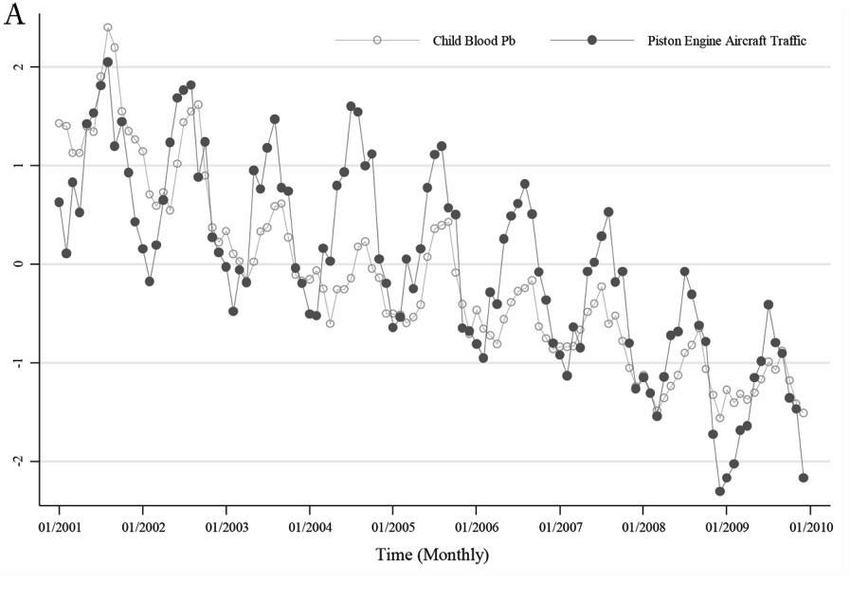
Monthly average child blood lead levels vs. sum of piston engine aircraft takeoffs and landings over time. This data was collected from over 1 million children living within 6.2 miles of 27 airports in Michigan with piston aircraft traffic. It is clear that blood lead levels rise and fall in concert with piston aircraft traffic.
Although most attention has been focused on about 30 large hub airports in the U.S., lead pollution occurs primarily at smaller regional airports due to their reliance on piston-engine aircraft. There are over 10,000 airstrips and over 5,000 public airports in the U.S., or a public airport within a 16-minute drive of the average American. The nearly 200,000 leaded-fuelburning aircraft operating from these airports are incapable of readily switching to unleaded fuel due to their outdated engine technology and the lack of availability of unleaded gasoline at most airports.

This is a map of regional airports where leaded avgas and other polluting fossil fuels are used. There are over 5,000 public airports in the US — or one within a 16-minute drive of the average American.
For both economic and technical reasons, a widespread, drop-in replacement for leaded aviation gasoline (avgas) has failed to emerge, despite the fact that leaded fuel was fully eliminated on our roads decades ago. Because of limited unleaded fuel supply, reduced power output, safety concerns, and pilot retraining needs, even engines theoretically capable of switching to unleaded fuel continue to use leaded fuel almost exclusively. However, simply switching to planes that use diesel or jet fuel is not the answer. Unlike cars, aircraft have no emissions control systems, and there is no existing way to install such systems. As a result, even aircraft that do not burn leaded fuel emit very high levels of PM and other forms of pollution detrimental to human health. For example, LAX alone produces nearly as much particulate pollution as all LA-area freeways combined, and LAX is just one of 39 airports in the local air district. It is critical to American public health that any policies to phase out leaded avgas concurrently foster adoption of reduced-emission and reduced-fuel-burn technologies (such as electric propulsion), rather than encourage switching to fuel-hungry and high-pollution unleaded gasoline engines, diesel engines, turboprops, and jet engines.
This is also critical to American economic health: European and Asian companies are beating the U.S. at developing efficient unleaded-fuel engines and electric propulsion technology, winning market share in regions traditionally dominated by US-built light aircraft (e.g. where leaded fuel is unavailable or expensive). We need to invest in sustainable propulsion systems to maintain U.S. competitiveness, and lack of supportive policy action has hampered technological advancement.
Zero funding, for example, has been allocated in the proposed American Jobs Plan to deal with dangerous aerosolized lead pollution from aviation, even though the plan dedicates $45B toward replacing lead pipes. Combating aviation pollution, however, offers a significant opportunity to pursue electrification, with a wide variety of shovel-ready airport project locations. The U.S. workforce can electrify airport infrastructure, ground vehicles, and aircraft domestically using existing and proposed federal funding as well as revenue from fees targeted at polluting aircraft. Shared charging infrastructure should be a special priority. Installing basic charging infrastructure at every one of the 5,000 public airports in the U.S. — focusing first on the 500 most heavily-used airports located closest to populated areas and in disadvantaged communities — is a highly achievable near-term goal at moderate expense. For instance, installing a 30-60 kW DC fast charger, which could charge small electric planes or ground vehicles, at the 500 highestpriority airports would cost less than $25M and could be completed in 2-3 years with sufficient federal backing.
Transitioning to biofuels or other so-called “sustainable” fuels can play a role, but should not be considered a substitute for fuel use reduction via electrification because their emissions can still be harmful. Both the biofuel supply chain and burning of biofuels, for example, emit a wide range of pollutants. Even green hydrogen, currently a tiny fraction of the world’s mostly fossil-fuel derived hydrogen supply, would still lead to emissions of water vapor. Water vapor is a powerful greenhouse gas when emitted at high altitude, and in some proposed implementations (such as direct hydrogen turbine combustion) hydrogen aircraft could also lead to significant high altitude nitrogen oxide pollution.
Electrification also offers an opportunity to better integrate airports into both urban and rural transit networks, provide clean energy and charging services to local communities (e.g., charging buses overnight), and improve resilience to power outages by offering grid storage. Electrification infrastructure at airports could include, for example, solar panels and grid storage doubling as power backup systems at airports. This would serve not just airport power needs but also those of surrounding communities, especially in remote areas prone to outages. This power system resilience is especially critical in disaster situations, where airports often serve as hubs for emergency responders.
In the near term, electrifying aviation entails plugging planes into gate power instead of burning fuel, using electric power to taxi to the runway, and operating electric tugs and ground equipment. Electrifying aviation also means investing in R&D, scaleup, and adoption of electric trainer aircraft, hybrid electric short-range cargo and passenger planes, and eventually longerrange commercial planes. As batteries and electronics improve, larger and larger planes will become more and more electric over time. To facilitate these technological advances in electric aviation and maximize public benefit, federal funding should focus on promoting adoption of electrification on routes not currently serviced or readily serviceable by rail or other alternative rapid, sustainable forms of transportation.
Plan of Action
Infrastructure Funding
Reprioritize existing funding sources, such as the Federal Aviation Administration (FAA) Voluntary Airport Low Emissions Program (VALE) program, to focus on sustainable infrastructure such as solar, storage, and chargers at both public airports and military airports. Supplement this funding by dedicating at least $10B of the proposed $25B of airport funding in the American Jobs Plan, or $20B of the proposed $56B Republican counter-offer, towards electrification across airports of all sizes. Initially prioritize:
- The 500 most heavily-used airports located closest to populated areas and in disadvantaged communities,
- Regional airports that have far fewer logistical barriers to infrastructure projects than congested hubs, and
- Airports supporting routes not currently serviced or readily serviceable by rail.
R&D Funding
Reprioritize existing federal research funding toward technologies aimed at reducing fuel burned by aircraft, such as significantly expanding current hybrid and electric aviation initiatives at the National Aeronautics and Space Administration (NASA), Department of Defense (DOD), Department of Transportation (DOT), and Department of Energy (DOE).1 Additional funding paid for by fees on polluting aircraft should be added to these existing pools of research dollars (see “Plan of Action” items 4-6). To remain competitive with accelerating civil and defense aviation technology development overseas, the government should direct a minimum of $2B in annual federal funding to electric aviation R&D. Funding should prioritize the development of US-designed and manufactured electric and hybrid electric aircraft technologies, including both retrofit and new-build planes, ground equipment, and ground vehicles. At least 50% of funds should be dedicated to small businesses.
The U.S. is currently the world leader in small aircraft production, but we are falling far behind Europe and Asia on electrifying fixed wing aircraft, funding development of new efficiency technologies, and implementing relevant policies. U.S. companies have instead focused primarily on low-capacity “flying cars” for carrying high-net-worth individuals short distances over traffic. The lack of funding and policy support for practical, high-impact innovation poses a significant threat to future U.S. competitiveness and jobs, especially in the export market.
Regulations
The EPA should issue its final endangerment finding banning leaded fuels, and the Biden-Harris Administration should issue an executive order instructing the EPA and FAA to work together to eliminate lead pollution. This includes immediately implementing a 10-year phaseout mandate for the sale of leaded fuel, with use of leaded fuel banned after 2030 except for a limited number of historic aircraft. This phaseout timeline should be extended to 2040 in Alaska, due to the disproportionate impact on the greater than 80% of Alaskan communities reliant on small planes for year-round access. During the Obama Administration, an attempt was made to phase out leaded avgas, but it stalled largely because of the perceived impact on mobility in Alaska. It is critical to ensure that a phaseout plan recognizes Alaska’s needs and funds sustainable solutions suitable for an arctic operating environment.
It is not enough to simply ban lead, because this may incentivize switching to other highly polluting technologies like dirty unleaded gasoline engines, diesel engines, and far less fuelefficient turboprop or jet engines. Thus, it is critical that a leaded fuel ban be accompanied by the immediate implementation of a fuel efficiency mandate for aircraft that are based in or that regularly fly to the U.S. Inspired by the federal automotive Corporate Average Fuel Economy (CAFE) Standards program, this efficiency mandate should utilize multiple aircraft size categories with targets based on maximum takeoff weight (e.g., <1,000 lb, 1,000-5,000 lb, 5,000- 19,000 lb, 19,000-75,000 lb, 75,000-250,000 lb, and 250,000 lb+ categories). Efficiency targets should take into consideration typical missions and technical difficulty in reducing fuel burn for various types of aircraft. For instance, <19,000 lb aircraft are readily able to use hybrid electric propulsion — and, in some cases, pure electric propulsion — with existing technology and regulations. The largest aircraft flying long distance routes, on the other hand, will initially need to focus on smaller steps such as more efficient flight patterns, plugging into gate power/HVAC, electric taxi (either onboard or via tug), etc. until future technologies are developed; therefore, larger aircraft should have less aggressive targets (similar to less aggressive CAFE standards for larger vehicles). Technologies piloted in smaller electric aircraft will eventually make their way to larger aircraft, initially as high-power subsystems. Thus, these technologies are key early targets for federal funding and mandates. The overall “CAFE” goal should be a 25% reduction in overall U.S. aviation fossil fuel burned per passenger by 2030, and a 50% reduction by 2040.
Taxes
The following programs offer pathways for making electrification programs financially sustainable beyond the initial infusions of funding for infrastructure transformation and R&D.
Immediately implement a national $10 per flight hour use tax on all aircraft with 19 passenger seats or below. This should include an additional $2 per flight hour tax on leaded fuel burning aircraft and on any other aircraft burning more than 4 gallons of fuel per seat per flight hour. It is essential to avoid solely targeting leaded fuel piston aircraft, which would incentivize a switch to less fuel-efficient turboprop aircraft and business jets. 100% of tax revenues should be dedicated to the aviation industry and airports, and at least 50% of funds should go to small businesses. Tax revenues should be allocated toward:
- The electrification of airports
- A “cash for clunkers” program to retire or retrofit polluting aircraft, with commercial and government operators receiving priority for funding. This funding should only be provided for US-manufactured or US-retrofit electrified aircraft.
- Jobs training and career development for airport-adjacent communities.
This would not be an undue burden on air travelers, because the owners and users of small aircraft are generally affluent. The Aircraft Owners and Pilots Association reports that the net worth of its average member is over $1.6 million. Aircraft operating in Alaska should be exempt from this tax until 2030. Revenue should exceed $260M/year based only on the base $10 fee, assuming pre-pandemic flight hour totals.
Immediately implement a $10 “Clean Skies Fee” per passenger for all international flights on planes with more than 19 passenger seats, excluding flights within North America, to be collected by air carriers from passengers at the time air transportation is purchased. The September 11 Security Fee offers a precedent for this type of fee.
An optional “Clean Skies Fund” contribution with suggested donations of $5, $10, $25, and $50 should also be offered at time of purchase for all flights on planes with more than 19 passenger seats—both domestic and international—to allow passengers an opportunity to further fund pollution-reducing technologies across the aviation ecosystem and to offset their personal environmental impact from flying. This fund is modeled after optional federal contributions such as the Presidential Election Campaign Fund.
A portion of collected funds should be provided to airlines and travel booking services in order to implement and maintain this contribution mechanism, which must be prominently featured in the booking process. Carriers will remit the fees to federal programs promoting reduction in fuel use, airport electrification, and jobs training. At least 50% of funds should go to small businesses. Revenue should exceed $2.34B/year assuming pre-pandemic international flight passenger demand.
For planes with more than 19 passenger seats, implement a similar $0.25/mile per passenger fee on all domestic and North America region flights effective in 2030 to fund fuel burn reduction and airport electrification. At least 50% of funds should go to small businesses, and all funds should be dedicated to projects that directly benefit airports and aviation, as well as increasing accessibility to all Americans.
Jobs
The actions above should be immediately implemented in order to preserve the millions of U.S. jobs in the aerospace industry. Aircraft are the largest non-agricultural U.S. export product and one of the largest domestic manufacturing industries. As of 2018, the aerospace industry was directly responsible for over 2.4 million primarily high-paying U.S. jobs, many of which are union jobs or in STEM fields. Airlines directly employ nearly 500,000 Americans, and a wide variety of indirect jobs in travel agencies, airports, construction, and related industries are reliant on aviation. Although we support expanded low-emissions rail transportation, continued modal shift away from aviation towards automobiles would be devastating to the airline industry and increase overall emissions.
The U.S. currently leads the world in aviation manufacturing, but we are falling behind in electric aviation technology, including both airport-based ground vehicles and aircraft. We are headed towards an inflection point that will determine the future of the U.S. aviation industry. Either U.S. policy will promote adoption of more efficient technologies for aircraft as well as airport vehicles and equipment, thereby maintaining U.S. world leadership in aviation, or the U.S. will lose this market to other nations in Asia and Europe. The only way to preserve aviation jobs is by investing in efficiency and by enacting smart policies that promote private investment in and adoption of cleaner technologies.
Not only can aviation jobs be preserved, but electrification of the aviation ecosystem will serve to create new green jobs related to air travel. This will include jobs in charging infrastructure installation, solar and storage construction, as well as related industries, which must be based locally and use U.S. labor. Further, if the U.S. leads in developing aviation electrification, there will be substantial export opportunities as other nations look to reduce aviation emissions and improve mobility. Potential clean aviation technology markets include countries such as Norway, which has committed to an electrified aircraft fleet by 2040 for all flights under 90 minutes duration, and Scotland, which has committed to a zero emissions airspace. Numerous other countries are actively considering similar policies, creating a significant opportunity for U.S. products.
Conclusion
Aviation emissions, especially lead, are a clear and present danger to the health of Americans and the global climate. Failing to develop and deploy more efficient technology represents an equal danger to U.S. jobs and competitiveness. Thankfully, practical solutions exist today and even more are being developed to mitigate these dangers. To advance this mitigation, the Biden-Harris Administration and legislators should ensure that existing and new federal funding prioritizes holistic electrification of the aviation ecosystem, in addition to enacting legislation and regulations that ensure the success of this transition.
Federal Accessibility Standards for Fully Autonomous Vehicles
Summary
Self-driving technology is uniquely positioned to benefit people who cannot drive, including people with travel-limiting disabilities and many older adults. However, the lack of federal policy guiding the development of this technology has led to piecemeal recommendations that largely fail to guarantee accessible use in both public and private implementation scenarios. To leverage the full potential of self-driving technology, the Department of Transportation (DOT) should adopt accessibility standards to support autonomous transportation for people with disabilities and older adults. The Biden-Harris Administration has an important opportunity to reimagine accessible transit, capitalize on ongoing federal research programs such as the Inclusive Design Challenge, and extend the benefits of self-driving technology to those who need it most. If enacted, these recommendations will lead to increased independence, workforce participation, and mobility in the future of transportation.
Mitigating and Preventing the Existing Harms of Digital Surveillance Technology
Summary
The rapid adoption of Digital Surveillance Technology (DST) by state and local agencies is taking place in an under-regulated environment that is causing tangible harm to the communities and individuals these same agencies are tasked to protect. DST itself is plagued by fundamental flaws and vulnerabilities, issues compounded by a lack of safeguards in the environments where DST is deployed. The four biggest problems with government use of DST today are:
- Governments falling prey to predatory or negligently marketed DST that fails to consistently achieve stated functionalities or meet reasonable standards.
- Governments deploying DST in a way that does or could falsely implicate innocent individuals in criminal matters.
- A lack of systematic oversight that fails to ensure accountability, equity, transparency, or cybersecurity.
- Governments utilizing DST in a manner inconsistent with existing laws, ordinances, and regulations.
While these issues affect everyone, they disproportionately affect those who are falsely implicated in criminal matters as a result of DST, as well as the working poor (who have been historically over-surveilled). In addition to such human costs, overuse or misuse of DST exposes cash-strapped jurisdictions to multimillion-dollar lawsuits for violation of privacy and civil rights.
This proposal offers a set of actions that the Biden-Harris Administration could take to limit the harms of DST. Specifically, we recommend that the administration:
- Issue an Executive Order to create two mandatory filings for vendors and government agencies involved in active federal contracts for DST.
- Empower and fund the Federal Trade Commission (FTC) with $10 million over two years to study and produce rules regarding DST marketing and sales.
- Allocate $50 million for a Privacy Pilot Program that would allow municipalities to utilize a tailored hybrid model of government and civilian oversight for DST.
- Condition federal dollars spent on DST for law enforcement on compliance with a set of assessments.
- Instruct the Department of Justice to create a DST Task Force to study the benefits and tradeoffs of different types of DST.
These actions would together begin to rein in the unchecked power of the surveillance complex that has attached itself to our nation’s law-enforcement systems. Doing so would advance racial and community equity across the United States while also helping restore public trust in law-enforcement institutions.
Enabling Better Access to Federal Transportation Funds for Small and Rural Communities
Summary
Most federal transportation funds are distributed to state and regional transportation entities by a legislatively set formula for different types of transportation. An exception to this rule is the U.S. Department of Transportation’s (USDOT) Better Utilizing Investments to Leverage Development (BUILD) Transportation Discretionary Grants program (formerly known as the TIGER program). The BUILD program is extremely flexible, with funding available for any kind of surface-transportation project and any government agency, and it the only transportation program that provides direct capital support to local transportation projects. This flexibility has made the BUILD program incredibly popular, receiving 10 times more applications than can be funded. However, the application process is extensive and can require outside assistance to produce, making the application itself too expensive for some areas to take on, especially considering the high level of competition. USDOT should create a simpler application that most public agencies can manage with internal staff to make the program more universally available to communities of all sizes and levels of capacity.
Sustaining the 2020 Biking Boom
Summary
The next administration should capitalize on recent interest in cycling spurred by the COVID-19 pandemic by committing to triple the share of commutes made by bicycle from 0.5% in 20191 to 1.5% by 2024. This goal is achievable through policies that make cycling safer and more affordable.
Other than walking, cycling is the least pollutive mode of transportation. Led by the Department of Transportation (USDOT), the next administration can encourage a nationwide shift from driving to cycling by adjusting various policies related to cost, road design, and automobile safety. USDOT can further encourage biking by holding states accountable for reductions in automobile vehicle miles traveled (VMT), greenhouse-gas emissions (GHG) from transportation, and traffic fatalities among cyclists and pedestrians.
Challenge and Opportunity
The COVID-19 pandemic has prompted many Americans to begin riding bicycles and electric bicycles (e-bikes) in order to exercise, enjoy the outdoors, and maintain physical distancing while traveling. Cities including Los Angeles and Houston have seen significant upticks in cycling in 2020, while bikeshare systems in Las Vegas, Chicago and New York set new ridership records. A sustained move toward cycling could reduce GHG emissions from transportation, the sector that is the largest source of GHG emissions in the United States. Pedal bikes produce less than 1/15 as much GHG/mile as taxis or ridehailing services (e.g., Uber and Lyft), and around 1/10 as much a private electric automobile. Lifecycle emissions from bikes and bikeshare are nearly as low as pedal bikes, and e-bikes in particular could replace short automobile trips in urban areas.
These data indicate that tripling the share of commutes made by bike from 0.5% today to 1.5% could, by displacing driving, reduce GHG emissions by the equivalent of 3.8 billion car trips annually. A mode shift toward biking would also improve health and reduce urban congestion (because a bike requires less street space than an automobile).2
However, there is no guarantee that the current uptick in cycling will endure. Prior “bike booms” in the United States—in the 1890s, the mid-1930s, and the early 1970s—all ultimately faded.
Part of the challenge is that the federal government has historically done little to encourage biking. In fact, federal policies frequently impede cycling by making the activity more dangerous, especially as automobiles have grown heavier and taller (e.g., guidance that speed limits be set according to the “85th percent rule,” which pushes them higher). From 2009 to 2018, cyclist fatalities grew 38% to 1,100 annually, more than eight times the number of Americans killed from rail collisions, to which USDOT allocated $245 million in FY 2020.
By implementing policies that make cycling safer and cheaper the federal government can pave the way for sustained growth.
Plan of Action
The next administration should take immediate steps to reduce the risk of injury or death to cyclists while reducing the financial cost of cycling. The next administration should also incentivize transportation projects that reduce VMT and GHG emissions, which will boost proposals that encourage biking. Recommended actions are presented below.
Safety
Under the next administration, the Federal Highway Administration (FHWA) and the National Highway Traffic Safety Administration (NHTSA) should implement the following specific measures to reduce biking deaths and injuries:
- Direct states to share locations of all traffic collisions resulting in death or serious injury, flagging those involving cyclists and pedestrians. NHTSA and FHWA should use the data to create annual High Injury Network maps.
- Direct states to submit up-to-date maps of all bicycle infrastructure, including protected and unprotected bicycle lanes. USDOT field offices should audit this information, and states should receive annual grades for their efforts to reduce pedestrian and cyclist crashes.
- NHTSA should update the Fatality Analysis Reporting System (FARS) to include metrics such as serious injuries and the presence of protected or unprotected biking infrastructure.
- NHTSA should publish revisions to the New Car Assessment Program (NCAP) that credit automakers for vehicles that minimize risk to vulnerable pedestrians and cyclists, through crash-avoidance technologies as well as through designs reducing likelihood of serious injury or death in the event of a collision.
- FHWA should issue guidance to states prohibiting them from setting “negative safety goals” that lead to annual increases in pedestrian and cyclist fatalities that are treated as successes.
- FHWA should eliminate the outdated “85th percentile rule” as a recommendation in the Manual on Uniform Traffic Control Devices (MUTCD).
- FHWA should issue guidance encouraging the use of federal funds on temporary “popup” projects designed as pilots for future infrastructure investments.
- USDOT should require states to demonstrate provision of access and safe accommodation for non-motorized users (i.e., cyclists and pedestrians).
Affordability
The next administration should take the following actions to make biking more affordable to all Americans:
- The U.S. Trade Representative should make bicycle and bicycle components exempt from Section 301 tariffs, which would reduce the cost of importing items like children’s bikes and lithium batteries from China. This would reduce the cost to consumers of purchasing and maintaining a bicycle as well as the cost to businesses and cities of operating public bikeshare services.
- The administration should support passage of H.R. 7330, which would make bicycle and bikeshare expenses eligible for pre-tax commuter benefits. The administration should also support revising IRS 30D, the Plug-In Electric Drive Vehicle Credit, to extend subsidies to e-bikes as well as electric automobiles.
Other actions
The next administration should take the following additional actions to further encourage a conducive environment for biking at the state level:
- Re-establish GHG reduction as a performance measure for transportation and issue annual ratings of state performance.
- Revise the Surface Transportation Block Grant Program to include goals of reducing VMT.
- Issue USDOT guidance on Section 109 of the US Code pertaining to federal-aid highways that clarifies that maintenance projects must demonstrate access for all transportation modes (e.g., protective infrastructure for cyclists and pedestrians).
- Support the language in H.R. 2 that the FHWA adopt “fix it first” principles favoring road maintenance over new construction.
Conclusion
Locking in the sharp growth in cycling spurred by the COVID-19 pandemic could enable the American transportation network to become safer, cleaner, and more efficient, especially in urban areas. The next administration should capitalize on this opportunity through a suite of complementary actions that make biking less dangerous and more affordable. These actions will encourage those who recently began cycling to continue, while compelling millions of additional Americans to begin using a bicycle in place of an automobile.
Though biking has enjoyed a surge of popularity in 2020, the fact remains that only a small fraction of trips is taken on a bicycle. Even in Washington DC, the city with the most bike commuters, the share of commute trips taken by bike was only 4.5 in 2018. There is significant room for growth, which the Federal Government can help encourage. 16 Furthermore, many of 2020’s new cyclists could revert to other transportation modes when the pandemic recedes. Federal efforts to make biking safer and more affordable will decrease the likelihood of reversion.
Research suggests that even the most optimistic forecasts for converting automobile fleets to electric vehicles would fail to keep global average temperature increases below two degrees this century. A shift from automobiles toward walking, biking, and transit would still be necessary. Furthermore, many e-bikes are sold for below $2,000, a fraction of the cost of an electric automobile. That makes e-bikes an affordable mobility option for a larger share of the population (and means that the taxpayer cost of subsidizing e-bikes would be far less than the current $7,500 federal electric vehicle tax credit).
No. A study from the Sierra Club found that Latinos are more likely than whites to commute by cycling. Census Bureau data suggests that almost half of those who cycle to and from work make less than $25,000 per year.
Zero Emission Fueling Stations for Trucks and Buses
The next administration can achieve significant reductions in greenhouse-gas emissions by helping transition the commercial truck and bus industries to cleaner fuels like electric power and hydrogen. A key role for the Federal Government is to support the build-out of a nationwide network of zero-emission (i.e., alternative) fueling stations, including electric charging and hydrogen fueling stations. Achieving this goal will require federal leadership and significant collaboration with Congress, states, electric utilities, the private sector, and others. The amount of effort and time necessary for this effort means that it must be a day one priority to achieve meaningful progress within four years. A robust network of zero-emission fueling stations for trucks and buses will facilitate a significant and permanent reduction in greenhouse-gas emissions, improve air quality for communities nationwide, result in safer highways, and help create of hundreds of thousands of new jobs.
Challenge and Opportunity
The threat of climate change demands immediate action. The transportation sector is the top emitter of greenhouse gas (GHG) emissions in the United States, outpacing the energy, agriculture, residential, and commercial sectors. Any serious effort to cut GHG emissions overall must therefore include serious efforts to cut transportation-related GHGs.
GHG emissions from commercial trucks and buses contribute significantly to the transportation sector’s overall emissions. From 1990 to 2018, GHG emissions from commercial trucks and buses increased far more than emissions for passenger cars (emissions increased by 90.1% for commercial trucks, 158.8% for buses, and only 21.6% for passenger cars) despite the lower number of vehicle-miles traveled for commercial trucks and buses. In 2018, the collective emissions from medium-duty and heavy-duty trucks were the second-largest category of transportation-related GHG emissions.
Alternative fuels like hydrogen fuels, biofuels, and electric power present an enormous opportunity to cut transportation-related emissions while boosting the U.S. economy. Alternative fuels are gaining commercial acceptance in the freight and tourism industries. There is also an emerging U.S. industry around manufacturing alternative-powered vehicles that promises to create millions of new jobs in the years ahead. Domestic companies that have already seen success in this space include Workhorse, a company based in Lordstown, OH that is producing electric delivery vehicles for UPS, FedEx and DHL; Rivian has recently signed a contract with Amazon to provide 100,000 electric delivery vans; and Tesla, the world’s most valuable car company, is developing its own battery-powered long-haul trucks.
But there is a major barrier hampering wider deployment of these vehicles: fueling stations. Adoption of zero-emission trucks and buses will be slow until a robust, nationwide network of zero-emission fueling stations is available. Modest efforts are already underway in California and the northeastern United States to build new zero-emission fueling stations, but federal leadership is needed to accelerate and expand these efforts to a national scale. The Federal Government can facilitate build-out of the country’s network of zero-emission fueling stations by providing tax credits and other financial incentives for station construction and by providing the nationwide planning and coordination capacities that the private sector alone cannot.
Key considerations
The U.S. Department of Energy reports that there were 41 open retail hydrogen fueling stations in the United States in 2019, with an additional 36 stations in various stages of development. Most of these stations are in California and the northeastern states. Various electric-fueling stations—most designed for passenger cars—are scattered throughout the United States. The next administration should focus on building out the national network of zero-emission fueling stations in the Midwest and other parts of the United States that currently lack zero-emission infrastructure. The following considerations can guide this effort.
The commercial truck and bus industry. Most truck and bus companies are small businesses, utilizing fleets of seven to ten vehicles and operating on tight profit margins. Capital is limited for many of these companies, especially in the wake of the devastation that COVID-19 has wreaked on the larger economy and tourism industry. Therefore, it will be difficult for these companies to invest in new, alternative-powered vehicles. Moreover, the rate of fleet turnover for most trucking and bus fleets is slow – a company will typically retain their commercial trucks and buses for a decade or more, and often times these vehicles will then be sold to a secondary market where they will be utilized for several years longer. The next administration should work closely with stakeholders to craft financial incentives that allow commercial truck and bus companies to purchase new trucks and buses that run on alternative fuels.
Travel-plaza owners. Commercial travel-plaza owners are among the largest distributors of diesel fuel and gasoline in the nation. Travel-plaza owners also generate revenue by selling food and other items to truck drivers and other motorists. The deployment of zero emission fueling stations could represent an existential threat to many of these operators if handled poorly: for instance, if zero-emission fueling stations become direct competitors to existing travel plazas. But commercial travel-plaza owners could also be important champions of zero-emission fueling stations if deployment is handled well: for instance, if resources are provided to help travel-plaza owners incorporate zero-emission fueling infrastructure into existing facilities, or if operators who build out zero-emission fueling infrastructure are rewarded with grants to upgrade on-site food and retail establishments.
Congress. Congress must provide new tools for the federal government to accelerate deployment of zero-emission fueling stations. Specifically, Congress should amend title 23, United States Code (USC) so that federal dollars are eligible to support construction of zero-emission fueling stations, including at truck rest stops and via Community Mitigation and Air Quality (CMAQ) projects.
Alternative-fuel types. There currently is no “preferred” alternative fuel in the commercial truck and bus industries. While some think hydrogen fuel has the greatest potential, others are betting on natural gas and batteries. For now, most businesses are making decisions based on current advantages and limits of different alternative fuels. For example, battery cells are less attractive for long-haul trucking and bus trips because of the batteries’ weight and their limited range compared to motor fuels. But battery-powered vehicles are ideal for city deliveries, where many daily trips can be completed on a single charge. The next administration should therefore work to expand the nation’s network of zero-emission fueling stations in ways that support multiple alternative-fuel types.
Fueling technologies and costs. The reality is that zero emission technologies are relatively new. There is still work that must be done to understand the emissions-reduction and fuel-reduction technologies that are available, the challenges to wider adoption of these technologies, where these technologies effectively fit diverse geography and efficient supply-chain needs, and the potential emissions reductions. But doing this work will result in significant impacts on truck freight emissions and fuel usage.
Existing federal regulations. The commercial truck and bus industries are highly regulated. New fueling technologies will need to work within these regulations, not against them. For example, federal requirements limit the number of hours a truck or bus driver may work per day. If refueling an alternative-fuel truck takes longer than refueling a diesel truck, drivers will lose valuable driving time. Additionally, weight limits on commercial vehicles designed to prevent damage to road and bridge infrastructure also discourage the use of heavy batteries for long-haul trips, as the weight of the batteries displace the amount of freight a truck can haul. The next administration should be aware of issues like these, crafting policies to encourage development of alternative-fueling technologies that do not inadvertently hurt businesses or undermine other priorities like highway safety or infrastructure maintenance. Truck and bus drivers should also be included in these discussions, to better understand how to successfully integrate existing practices.
Truck and bus manufacturers and dealers. A handful of companies manufacture the majority of commercial trucks and buses sold and used in the United States. Most of these companies are not significantly invested in alternative-fuel vehicles. The next administration needs to be mindful that it is not pitting established manufacturers against the startups referenced above in supporting the expansion of zero-emission fueling stations, lest it encounter serious opposition among the business community and Congress. Finally, the U.S. Department of Transportation reports approximately 12.5 million commercial trucks and buses are currently registered in the United States. There will need to be significant manufacturing capacity to support the wide-scale adoption of alternative-powered trucks and buses, and these manufacturers could be a valuable partner for this effort, especially if they understand the market potential.
Plan of Action
Keeping the considerations above in mind, there are several concrete actions that the next administration can take to build out of a national network of zero-emission fueling stations. In its first 100 days, the next administration should:
Prioritize passage of critical legislation
This legislation should provide the Federal Government the authorities and resources needed to support the build out of this zero-emission fueling network. Specifically, this legislation should
- Provide flexibility in title 23 USC to enable states to apply gas-tax dollars towards funding zero-emission fueling stations at truck parking stops and other places along highways – where such projects make sense.
- Allocate resources for financial incentives, including grants, tax rebates, and credits, to incentivize adoption of zero-emission fueling stations and vehicles.
- Utilize “Jason’s Law” surveys (a federal product that documents truck-parking capacity nationwide, including parking shortages) to identify truck-parking locations that could be used for fueling stations.
- Authorize pilot programs and public-private partnerships to provide flexibility in developing “best practices” and techniques with key stakeholders, including the private sector, for building out a commercially viable nationwide network of zero-emission fueling stations.
- Permit fast-track approval to site zero-emission fueling stations, in consultation with local utility regulators.
Strong White House coordination
The White House should work closely with key agencies to ensure coordination and eliminate redundancy with respect to federal efforts to advance zero-emission fueling stations. These agencies include the Department of Transportation (DOT) for its partnership with the states to maintain the nation’s major roads and highways, the Department of Energy (DOE) for its ongoing work to deploy alternative-fueling stations, and the Environmental Protection Agency for its regulatory work on clean air.
Gather stakeholder input
The business community recently has adopted a new level of urgency in confronting climate change. To discuss opportunities for building out zero-emission fueling infrastructure, the next administration should harness this energy by convening key stakeholders, including vehicle manufacturers, truck and bus companies, metropolitan planning organizations, port authorities, labor organizations, truck-stop owners, and owners of large freight-generating facilities (like hospitals, universities, airports, and convention centers). Opportunities may include the following: partnerships with local utilities to integrate new electric-charging stations with existing electric infrastructure; strategic plans for developing infrastructure tailored to specific routes, applications, and duty cycles in order to minimize refueling costs; and joint efforts that distribute capital expenses of infrastructure construction across private fleets as well as government agencies.
Establish pilot programs and public-private partnerships
Highly traveled truck and/or bus corridors along the National Highway System are natural places to pilot policies and public-private partnerships (PPP) designed to support construction of zero-emission fueling stations. Because there are relatively few examples of real-world experiences and limited opportunities to test emerging zero emission technologies and the strategies for their deployment, these pilots and PPPs will provide immense benefit in sharing information and developing best practices. Immense benefits towards wider adoption will come from understanding the emissions-reduction and fuel-reduction technologies available, the challenges to wider adoption of these technologies, and where these technologies effectively fit diverse geography and efficient supply-chain needs will have. The next administration should partner closely with states and the private sector on initiating and overseeing such pilots and PPPs.
Cumulatively, these activities and authorities will spur development of a nationwide zero emission fueling network because they provide stakeholders with a federal partner in navigating the risks and challenges of this effort while also providing necessary incentives to accelerate stakeholder investment in zero emission technologies and fueling stations. But the benefits of this effort may take years to fully realize, so it is critical that the next administration begin work on this effort on day one to see this through.
Conclusion
Commercial truck and bus volumes will only continue to grow in the future and with it their GHG emissions. While changing CAFÉ standards for commercial trucks and buses will make modest reductions in their GHG emissions, the reality is that the only way to significantly reduce these emissions is to accelerate the deployment and adoption of zero emission technologies. But because these technologies are relatively new and untested, the Federal Government must help stakeholders navigate the challenges and opportunities that these technologies present while also supporting the build out of critical infrastructure like fueling stations to improve confidence in adopting zero emission trucks and buses. The steps outlined in this proposal provide a roadmap to making that a reality.