Solving the Clean Energy Infrastructure Finance Rubik’s Cube
Building Blocks to Make Solutions Stick
Capital is not the constraint, alignment is: Catalyzing large-scale climate and energy infrastructure requires government to act as a systems integrator—synchronizing policy, de-risking commercialization, modernizing valuation, and coordinating markets so private capital can move with speed and confidence.
Implications for democratic governance
- Visible coordination builds credibility: Investors, communities, and companies need to see how policy pieces fit together. Fragmented, asynchronous policymaking erodes trust and slows deployment.
- Risk tolerance must be publicly legitimized: If democratic institutions punish every failed deal but ignore portfolio-level gains, agencies will default to paralysis. A mature democracy must distinguish responsible risk-taking from mismanagement.
- Transparency is market infrastructure: Open data, common modeling tools, and clearer capital pathways empower regulators, communities, and innovators to interrogate and improve investment decisions.
Capacity needs
- Systems-level policy choreography: Agencies capable of synchronizing rules, guidance, financing programs, and permitting reforms on coordinated timelines rather than rolling them out in isolation.
- Transaction-speed infrastructure: Staffing models, underwriting playbooks, and surge capacity that match private-sector deal timelines while maintaining integrity.
- Interstate coordination platforms. Formal mechanisms for states to harmonize standards, pool procurement, share data, and replicate successful pilots without restarting from scratch.
- Accessible technical/economic infrastructure: Publicly credible data sets, modeling tools, and valuation methodologies that lower barriers to entry and allow meaningful third-party scrutiny.
Deal templates and archetypes: Clear, standardized financing pathways that signal how government capital will engage at different risk tiers and technology stages.
Jump to…
- Executive summary
- “Come together”: Defragmenting markets through regional coordination
- “That’s what friends are for”: Overcoming commercialization barriers through partnerships
- “Highway to the deployment zone”: Faster, risk-weighted transaction execution
- “Okay, now let’s get in formation”: programmatic policy synchronization for fast market formation
- “C.R.E.A.M.”: More holistic valuation tools and methodologies
- “Take it to the bridge”: Rethinking the ‘missing middle’ problem
- “The Next Episode”
Executive Summary
Historic commitments. Huge demand. Massive cost reductions. Ready technologies. Yet, infrastructure deployment levels are underperforming their potential. What gives? The U.S. clean energy sector has achieved remarkable milestones: solar and wind have tripled since 2015, costs have fallen 90%, and annual clean energy investment now exceeds $280 billion. Yet deployment has arguably fallen short of what both markets and the climate moment demand. The culprit isn’t a single bottleneck: not permitting, not subsidies, not technology readiness alone. The real constraint is misalignment across the multiple interdependent factors that investors need to see in place before committing capital at scale.
Think of it like a Rubik’s Cube: solving one face means nothing if the other five stay scrambled. This paper identifies six strategic levers that, when pulled in concert, can unlock the conditions for large-scale capital deployment:
- Market defragmentation: breaking down the patchwork of ~3,000 utilities and state-by-state rules that trap promising solutions in regional silos
- Commercialization partnerships: deploying innovative public-private joint ventures to de-risk capital-intensive, first-of-a-kind energy infrastructure that traditional markets won’t move on alone
- Transaction execution speed: closing the yawning gap between private-sector deal timelines and the multi-year gauntlet of public financing processes
- Policy synchronization: coordinating the release of rules, funding programs, and guidance so investors see a complete picture, not a puzzle missing half its pieces
- Holistic valuation: building common information infrastructure and market structures that capture the full economic value of energy solutions, moving beyond narrow cost metrics that systematically undervalue transformative infrastructure
- Proactive investor engagement: later-stage investors jumping in sooner and addressing the hard questions early to help bridge the “missing middle” between venture and infrastructure finance
The good news: the capital exists, the technologies are ready, and infrastructure is a solvable problem. With over 1,000 GW of clean energy in development and electricity demand projected to grow up to 50% over the next decade, the infrastructure build-out represents one of the largest capital deployment opportunities in American history. And global demand for U.S. clean energy technology has never been higher. The barriers identified in this paper are structural and systemic, not fundamental; most of the solutions proposed are actionable in the near term, without waiting for perfect legislation or perfect markets.
The window is open, but not indefinitely. For policymakers and investors alike, the question is not whether to act, but whether to act with the clarity, coordination, and urgency the moment demands. The frameworks, partnerships, and policy tools outlined here offer a practical roadmap for unlocking decades of economic growth, cost-of-living relief, and energy security for communities across every region of the country and beyond. The energy transition is not a cost to be managed; properly coordinated, it is a generational economic opportunity.
America has experienced extraordinary momentum in the growth and transformation of the energy sector. Solar and wind generation has more than tripled since 2015. In 2024, 50 GW of solar power was added to the U.S. grid, which is not only a record, but is the most new capacity that any energy technology has added in a year. Technology costs have plummeted dramatically: utility-scale solar and battery energy storage have each fallen 90% since 2010. Those declines have made them among the lowest cost forms of electricity in many places. Domestic manufacturing capacity has also surged with hundreds of clean energy manufacturing facilities, many of which have already come online. These technologies and projects have been reinvigorating communities and creating jobs across the nation, and we should see the benefits from these advances continue as capital is flowing into this sector at an unprecedented rate. Clean energy investment in the United States more than tripled since 2018 to $280 billion annually, with multiples more in commitments, and private markets alone have raised nearly $3 trillion over the past decade. For more established technologies like utility-scale solar and onshore wind, financing has become standardized. This includes established project finance structures, robust secondary markets, accurate energy production forecasts, and predictable returns that align with the needs of institutional capital. These asset classes now exhibit many of the hallmarks of market maturity: transparent pricing, deep liquidity, sophisticated risk assessment frameworks, and predictable transaction execution. This progress has been galvanized by unprecedented governmental support, including the Bipartisan Infrastructure Law of 2021 and the Inflation Reduction Act of 2022 (IRA), alongside bold state policies, aggressive corporate clean energy procurement, sustained advocacy, and relentless technological innovation.
Yet despite these achievements and the trillions of dollars in committed capital, the pace of deployment has arguably fallen short of what the market opportunity demands and what the climate crisis requires. Hundreds of IRA-supported energy and manufacturing projects have faced delays or cancellations: much of that is due to increased economic and logistical uncertainty (e.g. in the cost and availability of equipment, permitting timelines, import and export regulations); much of that too is due to sharp reversals in federal funding priorities (e.g. tax incentive changes from the One Big Beautiful Bill Act (OBBBA), direct project cancellations). Moreover, emerging solutions are still taking time to achieve true commercial liftoff. Despite billions in federal funding allocations, only a few carbon capture projects have meaningfully progressed, with others indefinitely delayed or cancelled. Growth of some demand-side energy solutions, like behind-the-meter solar and virtual power plants, has remained relatively regional, despite favorable economics. Advanced nuclear energy, though it remains a policy priority, has been challenged with long delivery timelines, and many project investors remain wary of the risk of cost overruns. Sustainable aviation fuel production capacity increased by ten times in 2024, but it is still a very small fraction of jet fuel demand. Furthermore, transmission capacity has not grown nearly as quickly as needed and remains a key constraint to progress.
The situation – deployment deficiencies despite historic support – can be entirely solved with just one thing… and that is… to stop acting as if there is just one thing. The relative underperformance described earlier is not attributable to any singular constraint: contrary to what some have argued, for instance, it’s not solely about removing permitting roadblocks nor creating more subsidies. Rather than seeking silver bullets, real progress can be made by recognizing that there are multiple elements involved and misalignment between those elements have curbed the rate of progress.
Accelerating new energy project investment is somewhat like solving a Rubik’s Cube. The key to solving the puzzle lies in its interdependence: every twist of one face ripples across the others. You can solve one face perfectly, but if the other five remain scrambled, you haven’t solved anything in the grand scheme. Progress requires coordinated progress across multiple dimensions simultaneously in the right sequence. The cube rewards systems-thinking and algorithms over siloed, non-coordinated actions. All six of its faces must align to win.
The same is true for new energy finance. When most project investors look at a sector, they approach it as a puzzle and look for as much alignment of the full picture as possible before being sufficiently comfortable to deploy capital. That’s the indicator for the risk-reward balance being in the right place to justify investment. Rather than defining the theory of progress by singular issues, policy and industry stakeholders need to create sufficient alignment of multiple puzzle pieces at the same time.
This paper offers a few perspectives on how to achieve the conditions for larger-scale capital deployment, drawing on both lessons learned and promising concepts from across the industry. Like the six faces of the Rubik’s cube, six priority strategy areas are articulated: market defragmentation, commercialization partnerships, transaction execution speed, policy synchronization, holistic valuation methodologies, and proactive investor engagement. Note that while some of the underlying strategies may take time and require deep structural realignment, most of the concepts discussed herein are actionable in the near term. A range of stakeholders, from policymakers to infrastructure investors to community and industry advocates, need to move in concert to solve the puzzle and unlock greater investment.
The opportunity before us is immense. With over a thousand gigawatts of clean energy in development and electricity demand projected to grow up to 50% over the next decade, the infrastructure build-out required represents one of the largest capital deployment opportunities in American history. Similarly, global demand for U.S. clean energy technologies to be a bigger part of the mix has soared over the past few years, as many countries are seeking to diversify away from China or access some of the more unique technologies that the U.S. is developing. And solutions can’t come quickly enough, in this era of fast-growing energy demand, spiking electricity bills, aging physical infrastructure, and burgeoning new industries, not to mention a plethora of old and new technology solutions and operational strategies poised to meet the moment. The question is not whether the capital exists (it does!), whether energy solutions are available (they are!), nor whether there is a silver bullet salve (there isn’t!). It’s whether we can align the six faces of our energy finance cube quickly enough and strategically to channel the right types of capital where it’s needed most, when it’s needed most. The energy transition presents a real opportunity to drive economic transformation that, when properly coordinated, can unlock decades of strong economic growth, cost-of-living reductions, innovation, and prosperity across every region of the country and the planet.
Chapter 1. “Come together”: Defragmenting markets through regional coordination
For many companies across multiple sectors, the U.S. market can seem like the golden goose. Its big population, high income, diversified economy, and strong purchasing power typically mean large total addressable markets (TAM). While those drivers can be true, the reality for many energy and climate solutions, especially early on, is that the large TAM is challenging to realize, as the market can be highly fragmented. In those sectors, the U.S. is less of a “market” per se and more of a loose mosaic. There are about 3000 utilities, ranging from large publicly traded corporations to rural cooperatives, in regulated and regulated markets. States and territories not only have different market drivers, but they also have their own regulations and regulators, business processes, permitting requirements, and market rules. This also complicates the go-to-market as you typically need large and locally-focused commercial organizations to tap the markets, which can be expensive and time-consuming to build, especially for newer companies. It also often means a less efficient path to scalability, as each set of local customers and regulators need to be brought up to speed and convinced about the fit of a solution (compared to having a few entities that speak for the entire country). In addition to the commercial elements, this dynamic introduces technical barriers to scalability, especially where deep integration and redesign are required to meet local requirements. Over the years, this has often flummoxed both U.S. startups and experienced foreign investors, who have approached the U.S. market with high expectations, only to be confounded by these complexities.
Harmonize local requirements to avoid the piloting death spiral
To the extent possible, to promote more rapid and widespread investment and deployment of solutions that could benefit their communities, local (and national) governments need to work more closely together to harmonize market designs and project requirements. Oftentimes, a solution provider may implement a solution in one state, but when they go to another state, that utility might make them start from the beginning and prove themselves all over again – many innovators have likened these continuously repeated pilots to death by a thousand cuts. If a good solution is successfully deployed in one place, the barriers associated with deploying the same solution in another market need to be lower. This concept applies to permitting and design as well. The more that permitting processes and tariff structures, or modular elements within, can be templatized, time and uncertainty are reduced. Additionally, uniformity lowers development costs because the solution doesn’t have to be fully reengineered for each locale. This could also correspond to standardizing equipment and project technical requirements between them, to minimize costly product redesigns and reengineering. Furthermore, state stakeholders seeking to deploy similar solutions should consider entering into reciprocal partnerships or MOUs, supporting collaboration that’s both technical (e.g., between their utilities and independent engineering organizations) and policy-focused (e.g., between their policymakers and regulators). As such, when a solution under that type of agreement is evaluated and approved in one state, when that solution is brought forward in a partnering state, the solution can be given an expedited evaluation and approval process.
Not just physically, but digitally
The dynamic described previously is not limited to hardware. It is present for many software solutions as well, particularly those that have to integrate with local operators’ control systems. For example, a locality may be interested in deploying a virtual power plant (VPP), which is a relatively low-cost, software-based approach to aggregate distributed and controllable energy resources in order to provide large-scale energy services. A VPP deployment would have to connect to a utility’s and/or grid operator’s distributed energy management system (DERMS) to talk to devices, energy management systems (EMS), energy dispatch and trading system for wholesale market participation, customer information systems to track billing and energy usage, and also be cybercompliant – note too that several utilities have yet to fully roll out these foundational modern digital systems. Not only that, each utility and grid operator might have their own implementations (vendors, versions, configurations, rules) of these systems. Even outside of controls-oriented functions, the variety of data structures, naming conventions, and IT systems can make it difficult to access available market data (e.g., energy pricing), electricity tariff rate structures, and other highly important information. This is a reason why you tend to see that many energy software solutions have their operations concentrated in just a few markets, as the costs and time associated with integrating with another market’s cadre of systems can be hard to justify and thwart efforts to scale.
This is an area where states can work together (along with their respective utilities, grid operators, technology providers, and regulators) to agree upon more uniform ways to structure data, access market information, and securely interface with market and control systems. This could include partnering with groups that are developing common standards and protocols (such as RMI VP3, LF Energy), building an implementation roadmap across those states and utilities (accelerating implementation of FERC Order 2022), and taking corresponding legislative actions to ensure investments are made to build out the enabling foundational digital systems.
Aggregated demand and collaborative procurement
In a similar vein, collaboration between state and national governments can level the playing field and expand markets. When it comes to infrastructure, states and countries may often endeavor to ensure that local manufacturing capacity and supply chains are set up within their territories – this can create long term economic growth opportunities, reduce equipment delivery risks, and improve the public’s return on their investment.
However, issues can arise when multiple states are trying to duplicate efforts in the same sector. Take offshore wind in the early 2020s. Multiple eastern U.S. states were not only supporting a new wave of projects, many funding programs had requirements that the projects needed to source materials and equipment from suppliers located in the state.. The effect of this for a small, burgeoning industry was dilutive and slowed down factory investments as the scaling factors were harder to justify. After all, there are only so many blade, monopile, vessel, and cabling factories that can be supported at a given time, especially early on in the industry’s development. In response, thirteen states and the federal government signed a memorandum of understanding, where they agreed to take more regionalized, collaborative approaches to procurement and supply chain development.
Relatedly, an area where significant improvements could be made is around the procurement of critical common equipment. To accommodate the load growth from new factories, data centers, and building and vehicle electrification efforts, there are many pieces of equipment that will be needed irrespective of what types of energy are associated: things like transformers, circuit breakers, switchgear, and so on. There are considerable production capacity shortages and long lead times on these, which raise costs and create execution risks for projects. Despite the robust market demand, manufacturers have been somewhat hesitant to invest in expanding production as they worry that the demand will not materialize, which would leave them with underutilized or even stranded assets.
State and local governments can respond to these challenges in multiple ways. For instance, they could pool together their demand and drive standardization of the equipment so that the equipment is more fungible and interchangeable, as has been previously highlighted by the U.S. National Infrastructure Advisory Committee’s report on protecting critical infrastructure. Also, states can create well-defined demand guarantees where they can provide assurances to manufacturers and consumers that necessary equipment will be there, as needed.
For example, in 2013, the Illinois’ Department of Transportation led a seven-state procurement initiative to jointly acquire a standardized set of efficient locomotives and railcars, with additional funding provided by the Federal Railway Authority to support domestic manufacturing. This effort pulled forward new, more efficient railway vehicles into the market and lowered lifecycle costs. These concepts can additionally apply to secondary markets as well, for example, providing residual value guarantees on heavy-duty electric trucking procurement, to help mitigate risks on the initial purchase (e.g., traditional resale markets not emerging or asset residual values not being realized as projected).
Chapter 2. “That’s what friends are for”: Overcoming commercialization barriers through partnerships
The next facet of the cube pertains to early market formation and investment into technologies that are not yet fully commercialized, especially first-of-a-kind (FOAK) and early-of-kind (EOAK) infrastructure, and why capital formation has been easier for some types versus others. Differences in the ability to demonstrate, commercialize, and scale new infrastructure do not purely depend on the ultimate value of the solution; they are often driven by how the characteristics of that infrastructure affect the pathway to value realization, particularly the inherent capital-intensity and modularity of the solution.
For highly modularized solutions with lower capital requirements, the pathway can be much more straightforward. Take solar photovoltaics. Though module R&D and fabrication are far from trivial, technical demonstration and deployment are relatively simple. One can usually install and field-test new solar quickly and inexpensively. The advantage extends when scaling the solution to bigger projects: once you reach megawatt scale, given the modularity of solar cells and their balance of plant (inverters, cables, trackers, etc), you can obtain a reasonably clear picture of how even gigawatt-scale projects should fundamentally work. Other highly-modular solutions like batteries and EV chargers have enjoyed similar advantages. Tesla, for instance, in order to address potential range anxiety issues for its customers, leveraged its own balance sheet and government funding to build out a network of standardized superchargers, taking advantage of charger modularity to build in waves. This characteristic has made it easier for rapid demonstration and scaling of those solutions, as the financial community can enter the market, investigate, learn, and expand with relatively low risk.
However, the commercialization process becomes significantly more challenging with more capital- intensive and complex technologies, such as carbon capture, nuclear, e-fuels, etc. For some of these types of solutions, the early projects can require billions of dollars to construct and demonstrate. For these types of infrastructure, smaller-scale systems might not provide comparatively representative technical proof points of how the larger system needs to operate. Furthermore, larger sums of capital are often needed for early deployments. What’s more, the financial risk can be compounded as the long-term payoff is not guaranteed, as FOAK & EOAK projects typically have more uncertainty, and the learning rates of subsequent projects may also be less obvious. Furthermore, instead of a typical first-mover advantage that you often see with new technologies, early project investors here might actually suffer from a first-mover disadvantage, where they have the risk and cost of participating in the earlier projects, but don’t accrue the benefits and learnings that are seen in projects executed down the line.
To help address these types of challenges often seen with capital-intensive, less modular FOAK and EOAK infrastructure projects, adopting a new suite of partnership structures can greatly help to accelerate market formation and improve investability.
Multi-project joint ventures
Catalyzing capital for this class of infrastructure may mean going significantly farther than providing a few incentives and having strong advocacy efforts. More complex and elaborate agreements, private and/or public, are often necessary to drive deployment. Particularly in the form of deployment coalitions, consortiums, and joint ventures that support multiple projects. At the highest level, this can exist in several forms and can be originated by the private or public sector, as appropriate. For illustration, a few examples of commercial approaches to scale new nuclear energy projects, roughly in increasing order of relative deployment impact:
- Demand-side vehicles/buyers clubs. This is where consumers get together and make commitments to purchase a solution. This can be used as a market signaling mechanism to stimulate demand and attract solutions. There are example programs run by governments, such as the First Movers Coalition, and others led by the private sector, such as the Advanced Clean Electricity Initiative (Google, Nucor, Microsoft). Large corporations and governments both have a long track record of entering into energy procurement contracts for solutions with attributes that they have deemed highly desirable: like low-carbon, rapidly deliverable, and/or resilient. Some of these entities have started to strike above-market offtake contracts and guarantees in order to bring those solutions to market faster: as have some hyperscalers with nuclear, Amazon with electric delivery vans, NYSERDA with offshore wind, or the US Air Force with enhanced geothermal.
- Supply-side vehicles. This is where a development consortium, public or private, might be formed to deliver the new solutions across multiple projects and geographies, immediately delivering sufficient scale to suppliers while also amortizing some of the deployment risk. As an example, the UK government formed Great British [Energy -] Nuclear as a publicly-funded, but arm’s length, national development company of small modular reactor projects. It has been charged with performing activities like finding sites around the country, raising capital, selecting partners, and facilitating construction. As part of partner selection, it ran a fairly competitive solicitation inviting technology vendors from around the world to showcase their offerings and enter into contention to deploy across a range of sites. It ultimately selected a vendor, Rolls-Royce, as its preferred partner and is moving forward with project development. It is leveraging the power of its sovereign backing to derisk the projects, navigate regulatory hurdles, attract capital, and internalize the societal benefits of the investment (job creation, manufacturing, etc).
- Joint supply-demand venture. Here, customers and developers tightly collaborate to deploy new solutions. A version of this was created with Amazon & X-energy’s partnership to deploy small modular reactors. Here, building off X-energy’s DOE Advanced Reactor Demonstration Program-supported deployment grant and partnership with Dow Chemical (serving as both industrial offtaker and infrastructure delivery expert partner), Amazon not only committed to purchase the energy from 5 GW of SMRs across multiple sites to meet their needs, but also invested in the company itself, meaning they are more aligned and get to share in X-energy’s future success. In turn, this could be particularly meaningful as it represents the first close representation of a project ‘orderbook’ for nuclear in the US in recent years, and thereby provides an opportunity to standardize their product (particularly given the same customer and same vendor), reduce future execution risk, and accelerate cost reductions through improved learning rates. Separately, but with some parallels, the U.S. DOE’s Gen III+ SMR program, created in 2024 and awarded in 2025, also prioritized applications that formed deployment consortia.
All of them offer significant advantages over pursuing projects on an individual basis. They provide demand signals to supply chains to create manufacturing capacity and to labor groups to create a workforce. Generally, both of these stakeholders may need to see firm demand signals before they will undertake significant investments, which are in turn typically needed to reach a solution’s cost and performance entitlement (otherwise creating a chicken-and-egg problem). They also create more concrete opportunities to drive project standardization; this not only allows a technology to achieve faster learning curves, but it also helps to derisk and justify the investment by providing a more tangible line of sight to the large market. The point for manufacturers and workforce development groups is equally applicable for financiers, who often want to see a pipeline of repeatable opportunities before spinning up their underwriting teams.
Risk and reward sharing
Having an orderbook of the first several projects, per se, may not be sufficient to create sufficient activation energy at the project level. Though it sends a good signal for supply chains and others, it does not necessarily address the first-mover disadvantage issue that may exist.
A differentiator in partnership approaches, including the ones described previously, is how to think about alignment and value creation. Traditionally, the way in which governmental entities approach financial partnerships is through mechanisms like subsidies, loan guarantees, offtake guarantees, backstops, and fast-tracked processes. These help to reduce financial exposure to stakeholders, but alone, they miss a key part of the story: the long-term upside that can be created by successfully deploying and opening up a market for these solutions.
Usually, for the product owners and corporate investors, this is more naturally accounted for and balanced against the downside risk. For instance, companies, from software providers to aircraft manufacturers, might sell their first products as loss-leaders, providing lower pricing to early adopters to reduce the risk to the buyer, which they justify knowing that they should be able to rapidly recoup the costs of early expenses (and even failures) over the broader market pool, if they are successful. For large infrastructure projects, this is more challenging to achieve. When projects are highly capital-intensive, the financial exposures may be too great for the product company and/or equity investor to bear – that company or fund might be entirely wiped out by an individual project failure (for example, Westinghouse had to declare bankruptcy in 2017 when their two U.S. nuclear projects faced challenges). Project stakeholders and financiers might be asymmetrically exposed to the downside risk and, therefore, be inclined to avoid investing in early projects. For a promising technology, you may often find several customers (e.g., electric utilities) lining up for the ‘third’ or ‘nth-of-a-kind’ project, which would likely be derisked and less expensive, while at the same time taking a passive wait-and-see approach with the first project – which produce a stalemate if the first project is hard to get off the ground.
This is where deployment partnerships with structures that more fully align economic incentives and share in both the downside risk and upside of value creation can be a powerful catalyst for action. Amazon’s structure, for instance, creates this too by being involved in multiple projects where they would ultimately benefit from improvements over time and also through their equity investment into X-energy itself, so they should (depending on terms) continue to benefit down the line if the company is successful.
In addition to encouraging the formation of joint ventures and consortia as described earlier, states and/or national governments can work together to strategically invest in key solutions, run competitive tenders to prospective providers, and strike profits-sharing agreements and/or warrants (as opposed to pure equity) in situations where government investment played an outsized role in value creation.
A potential example of this is the recent $80 billion framework agreement between Brookfield and the US Government to deploy new large nuclear reactors. Notably, beyond packaging existing products and authorities (e.g., low-interest government loans for projects), this proposed deal additionally stipulates a proposed profits sharing mechanism where the US Government would receive a share of future profits from reactor sales. Noting that this partnership is early-stage and important details have yet to be disclosed, this mechanism could be appropriate here as you have a hard-to-commercialize sector, with strategic national and geopolitical value, with effectively no domestic competitive products.
State entrepreneurship
Public sector funders can also play a significant role in creating and incentivizing these kinds of deployment partnerships. Though more commonplace in countries with state-run industries, countries with free market economies have often found it more delicate to navigate. There may be legitimate concerns about how governments’ “picking winners” may create adverse incentives and undermine competitive markets, in some cases. Plus, it may confuse governments’ role of trying to maximize public benefit, versus showing favoritism or extracting economic rents from corporations.
All that said, there are models for state entrepreneurship that can be very powerful here, balancing the need to pull forward solutions and capital, while protecting the public and maintaining market competition – particularly in markets that are pre-commercial, have few players, have outsized national strategic benefits, and otherwise would not develop on their own without heavy external intervention. These are cases where, though the market benefits are considerable, the activation energy may be too high to stimulate deployment without deep governmental intervention.
Furthermore, consider where you have first-mover disadvantage challenges but a strong set of prospective fast-followers. To avoid the risk of a Spiderman-meme-like situation where stakeholders (e.g. local utilities or individual states) are pointing at each other to make the first move, downstream project investors could, for instance, co-invest (debt, equity, or backstops) for the first project, even on a minority basis, which would both mitigate risk on the first project and also enable them to access a cost-effective pathway to the technologies they desire to build down the line. You do not traditionally see state and local entities investing in infrastructure projects in other jurisdictions, but doing so could be net beneficial as a faster and lower-cost way to derisk and execute their own projects.
In addition, where appropriate, public financing entities investing domestically (e.g., states, green banks, federal agencies) could, where appropriate, consider extending their authorities to borrow some concepts from the US’s international playbook. Organizations like the Development Finance Corporation (DFC) can make equity investments in strategic, high-value projects, particularly where the normal capital markets would otherwise struggle to enter until the investment thesis is more clearly actionable. Such a process would have very clear scopes, firm guardrails, clear commercial competition plans, and be compatible with legal and market structures to create the intended benefits without confusing or distorting markets.
In any scenario, there should be a corresponding plan for how the public profits would be used. For example, it could be used to raise capital for other governmental activities or directly returned to the public in some way. Or it could be efficient to recycle the funding towards related activities and balancing of the governmental ‘venture capital’ portfolio, as would a strategic sovereign wealth fund.
Chapter 3. “Highway to the deployment zone”: Faster, risk-weighted transaction execution
There’s a common cliché from finance that time kills or wounds all deals. Increasing the speed of policy formation and deal execution is essential to unlocking growth and investment, especially for newer sectors. We will particularly focus on the public capital side of the equation. Here, there is a great mismatch between public and private investment decision time scales. In the private sector, deals are expected to be completed on the order of months or even weeks. Often in the public sector, this can add many months to years, with a high degree of uncertainty, depending on the program. There can be many idiosyncrasies associated with public funding – e.g. infrastructure projects with federal dollars may have additional compliance requirements (e.g. for environmental regulation or for domestic manufacturing). Though there are many deep policy questions here, for this discussion, this piece will focus on ways to accelerate the process.
Staffing for success
While it’s easy to say that the government should move faster, the reality for many is that the individual government program officers are typically working at a rapid pace. This is especially true at the political level where the motivation to make progress in a short amount of time tends to be very high. Particularly, when it comes to developing new programs, they do a massive amount of work, mostly unseen by the public, and with very few resources and are often overstretching to meet deliverables.
The other side of this is that when new programs and initiatives are rolled out, there often isn’t a similar level of flexibility in staffing levels and allocations. In fact, staffers at the federal, state, and city level can get overwhelmed by the volume of direct work and information requests, following the relevant laws and statutes. A new capital program may get introduced, but the number of people to implement that program might not change rapidly. For instance, the Inflation Reduction Act of 2022 introduced and/or influenced dozens of tax credit programs, and accordingly had to issue almost a hundred pieces of new guidance, so the market could act on them. A relatively small group of people led by the Treasury Department’s Office of Tax Policy were charged with generating that official guidance (as required, to ensure consistency and fairness). In addition, a number of the programs therein had complex elements which required deep technical expertise (e.g. tax law, energy markets, carbon accounting, energy technology) to complete their work well – skills that are in relatively short supply and in high demand, both inside and outside the government. The rate of progress was also slowed by some ambiguity in the law itself, where key technical questions (e.g. accounting methodologies and criteria) accordingly needed additional time to be addressed during implementation instead of beforehand. The associated teams ran at breakneck pace to complete all those issuances in just two years. Yet, many engaged market actors who were excited to proceed with shovel-ready projects experienced challenges, as they waited for guidance, thereby slowing initial progress.
To meet the rapid needs of an eager market and particularly in times when the governments are trying to push comprehensive reforms, agency leaders and legislators need to consider ways to make sure that the implementing organizations are sufficiently well-staffed and resourced. This should not only consider program staff (both existing and new), but also functional teams (e.g. legal, communications, stakeholder engagement) where bottlenecks can often form as they support multiple programs. This can include having surge capacity resources (either short and/or long-term, internal or external) bringing on technical and subject matter experts to help enable fast and fair processing. Also, an implementation staffing needs assessment should ideally be conducted as part of the policy-formation & legislative process so that the appropriate resources can be allocated early and efficiently. To further ensure efficiency of resource allocation and implementation speed, legislators should consider expedient ways to drive greater clarity and specificity at the point of legislation, where applicable.
Iterative capital deployment programs
It is tempting and important to get things totally right on the first try, particularly when it comes to government funding, which is highly scrutinized. That said, an approach which has delivered success is to release capital in phases. Here, instead of issuing all funding at one time, the program office (especially for a large competitive program) might split the deployment into phases over time. The first phase is executed quickly and the subsequent phases are introduced later. While this may introduce some short-term friction, it not only gets capital and projects moving faster, perhaps as importantly, it gives both the funders and market chances to build momentum, learn from one round, and improve towards the next ones. A good example of this was the DOE’s Grid Resilience and Innovation Partnerships (“GRIP”) program. This was a $10 billion program from the Bipartisan Infrastructure Law to enhance grid flexibility and improve the resilience of the power system against extreme weather. That $10 billion allocation was split into three phases to be issued over a few years. Over those three phases, the quality and ambition of the applications and programs funded increased significantly as all stakeholders were able to learn and adapt with each round.
Progress over perfection
For public programs, this is a major challenge driven by misalignments of risk tolerance. Many ambitious government funding programs are faced with a strange pickle. On one end, they have the duty, mandate, and power to drive innovation, do deals ahead of the commercial markets, and derisk promising solutions to a point where they can scale on their own and deliver the broad public benefits associated with that solution. On the other hand, the funds being used are raised from people’s hard-earned money or a state or country’s valuable natural resources, and neither should be handled frivolously. The fear of the political fallout from the latter may drown out the benefits of delivering the projects; that is, in the eyes of an underwriter or program officer, the downside risk may often outweigh the upside creation; doing no deal may feel safer than doing a ‘bad’ deal.
Take the case of two companies that received funding from the DOE’s Loan Programs Office (LPO) in the early 2010s. One is the solar cell manufacturer Solyndra, whose idea was to decrease the cost of solar energy by using cylindrical, thin-film solar cells that could capture the sun’s energy from multiple angles, compared to their conventional flat-panel counterparts, and thereby bring down their levelized costs. Solyndra received $535 million in federal loan guarantees, which it defaulted on and went bankrupt when market conditions changed (they, and other promising new solar companies, were undercut by plummeting prices of silicon solar cells from China). The default filled the news cycles for months, sparked several congressional hearings and investigations, and also left a profound imprint in the minds of many program funders. No government underwriter wants to be dragged to the Hill or see their name in the papers for this reason. On the other end of the spectrum, you have a little-known car company called Tesla, which received a $465 million loan to expand electric vehicle production. Tesla, as we know, went on to become one of the most transformational and successful automobile companies in recent history. And yet, comparatively little fanfare has been made about the government’s role in making that a success. Two loans, about the same size, issued around the same time, by the same organization. Not only did their actual outcomes differ, but the financial outcomes to the upside and the political fallout to the downside were diametrically-opposed.
This contrast becomes even more stark when looking at the broader picture. Again, taking the example of the LPO (now Office of Energy Dominance Financing (EDF)). It has historically had a loss rate of less than 3%, which is on par with most commercial and investment banks – entities which often invest in markets with more proven solutions and less uncertainty. Moreover, other governmental programs, like DARPA, NIH, and ARPA-E, also have strong investment track records. All that said, the perception of risk has led to an overly deep risk conservatism and a sense of fear of doing deals that might go sideways. This creates huge process drag for the entire organization and curbs the rate of progress that can be made, as underwriting processes can become elongated and difficult to navigate. Furthermore, for many loan applicants, it can take several years to get through the loan process; anecdotally, some applicants have complained it was slower and harder to access than what they could wrestle from the commercial market.
Overall, this is a situation where the tolerance for and understanding of losses for public financing needs to be reconceptualized and appropriately balanced, given the mission. Not all losses are bad. Individual losses are not necessarily detrimental if outweighed by net gains. There are significant opportunity costs of not taking risks appropriately. More can be accomplished without jeopardizing public interest.
Given the governments’ having historically demonstrated their ability to be good stewards of capital across long periods of time, the inherent risk that accompanies the pre-commercial asset classes they support, and the urgent need to make progress and unlock markets, this is a situation where more streamlined, faster underwriting processes that increase the speed of execution are critical and warranted. Furthermore, governmental funding organizations need to be given more ‘air-cover’ so that individual misses do not get over-politicized, but are understood to be reasonable elements of a process for progress. Note that accomplishing this process and cultural shift requires major work internally with staff, policymakers, and the broader public. This is an aspect where integrating concepts like state entrepreneurism and more balanced portfolio-based risk and reward approaches, described previously, can also unlock new investment and risk management strategies, greater societal benefits, and increased comfort to staff and leaders to usher in that kind of transformation.
Creating longer and more durable windows of action
A more obvious reason to move quickly on policymaking is to deliver benefits faster to project and community stakeholders – which is, of course, the main objective of the policy in the first place. But beyond that, investors understand that the political time windows covering favorable conditions could be short. This is particularly acute for assets with long development cycles and/or high upfront costs: e.g., building new manufacturing facilities or developing interregional transmission lines can take years. Indeed, it was estimated that 60% of committed IRA-funded clean energy manufacturing projects were originally not slated to come online until between 2025 and 2028.
Moreover, the IRA timeline created some interesting time crunches. Though the law was thoughtfully conceived with some longer time horizons for tax credits, in practice, the actionable investment window for that version ended up being incredibly short. The law was passed in August 2022. It then took time for programs to be formed and guidance to be released, as described earlier. In parallel, the investment community had to learn, come up the learning curve on the new opportunities, and build ecosystem collaborators (which themselves are also reacting and forming). Next thing you knew, as the election window started to ramp and policy uncertainty increased, many investors started to park their capital and take a wait-and-see approach in early 2024, as evidenced by strong increases in fund ‘dry powder’ (raised but uncommitted capital) but a sharp dropoff in actual capital deployment and assets under management at that same time.
Moving quickly is critical to give investors, communities, and other associated stakeholders as much time as possible to understand the landscape, develop deployment pathways, build new solutions, and ideally iterate, given the chance to take more shots.
That was a shorter-term perspective. In the spirit of leveraging speed to open the front end of the window, longer term, some thought should be made to how one extends the investability window. Investors typically do not decide to invest in a project purely due to the project’s merits. Particularly when entering a new sector, it’s also driven by the commercial prospect of potential follow-on deals. Short political windows and the associated ‘stroke-of-pen’ risks often raise major flags for the risk committees at financial institutions. As was mentioned earlier, many IRA programs arguably had much less than two years of impact. Deeper policy stability is critical to ensure continued, long-term investment. That type of stability has, at least historically, been a hallmark of the US regulatory & commercial system and a positive differentiator in the race to attract capital and talent from across the globe. For sectors with high strategic value, high early capital requirements, and long investment cycles, policymakers should consider more mechanisms to provide longer-term policy guarantees to give investors assurance that they have long enough windows to justify their business cases.
Chapter 4. “Okay, now let’s get in formation”: programmatic policy synchronization for fast market formation
Catalyzing the deployment of new infrastructure is usually enabled by a bevy of policy actions. This can be important as transforming a sector may require several changes in economics, behaviors, and processes. Especially when resulting from expansive new legislation and/or executive actions, the government may be required to deliver a host of new policy programs, including new rules (e.g., permitting reforms, categorical exemptions), funding allocations and programs, implementation guidance (e.g., for tax rules), informational reports (e.g., National Lab technical studies, commercialization reports, etc). These types of activities are highly valuable as they tackle different aspects of the deployment challenge and take huge amounts of effort to be effective. However, they often get rolled out and implemented on separate and independent processes. This can actually stall and frustrate deployment efforts as most investors will want to see the major policy puzzle pieces locked in place before getting comfortable enough to deploy capital – for most risk organizations, ‘stroke-of-pen’ risks are often viewed as red flags. Conversely, this hesitation can cause consternation for policymakers and advocates who may feel that they have done the heavy lifting in passing new legislation, but don’t see a corresponding flood of serious commitments immediately after.
Policy deliverable schedule alignment
One way to address this is to implement a visible and synchronized schedule, showing all the related policy efforts and programs for an initiative. The interdependencies between those activities would be easier to identify and allow relevant stakeholders to see when all the major puzzle pieces would be in place, and in turn, also align their investment and advocacy efforts accordingly.
An example of this comes from carbon capture: the federal tax credit for carbon dioxide sequestration (45Q) was first issued in 2008; however, the first set of tax guidance was not issued until 2020, as the IRS, Treasury, EPA, and other agencies had to build a suite of complex regulations around reporting, verification, stakeholder comments, and more. A consequence is that, though the tax credit was in place (and though there were strong complementary financing capabilities from renewables tax equity and thermal power plant development already in place), little to no investment went into this sector, effectively ‘wasting’ many years of eligibility and frustrating many interested stakeholders.
By contrast, take advanced transmission technologies: despite being rapidly-deployable and cost-effective solutions to increase transmission and distribution system capacity and performance, they have been historically underutilized. To increase awareness and deployment, the federal government developed a suite of products including the formation of the Federal-State Modern Grid Deployment Initiative, grant funding via the DOE’s Grid Resilience Innovation Partnerships program, loan funding from the LPO’s Energy Infrastructure Reinvestment program, categorical exemptions in federal environmental permitting on upgrading existing transmission lines, a Pathways to Commercial Liftoff report on grid modernization, new national deployment goals, technical reports and new assistance programs by the National Labs, and more. These were all released within a couple of months of each other in 2024, so the market had a fuller picture to which it could react and begin to make greater progress. Since then, dozens of states have passed new laws, and the number of projects being pursued and funded has also been on the rise.
Capital source navigators
Relatedly, new legislation may result in several new governmental funding programs or changes in missions for existing funding programs. Many of these efforts and changes might go unnoticed or disproportionately utilized. Take the energy- and climate-tech startups, who may be seeking capital to grow or transform their businesses. Government capital tends to be attractive as it is often willing to embrace early technology risk (unlike most commercial capital), is often non-dilutive to the company’s capital stack, and can give the company extra visibility. Most people in the energy sector will know of programs like DOE’s ARPA-E (Advanced Research Program Agency for Energy) or the Loan Programs Office. Far fewer may know that there may be funding available through ‘non-energy’ agencies like the US Department of Agriculture, Small Business Administration (SBA), the Governmental Services Administration (GSA), or the Department of Defense (DOD). These have increased the pool of capital available and provided a wider array of financing products that increase the chances that the right kinds of capital are available to serve the spectrum of company needs.
Initiatives like the Climate Capital Guidebook, published in 2024, can be helpful to make these types of programs less opaque and easier to access, especially for startups and small businesses. At the state level, databases like DSIRE USA have been providing a beneficial service aggregating information on state incentive programs for years.
Making information on federal, state, and/or municipal funding programs highly accessible and searchable from a centralized, common location is key. Or else they may get lost, buried in webpages that few know where to access. This process can be further enhanced using cross-cutting discovery technological tools. For example, AI-based agents could be used to continuously and automatically map these programs and keep information organized. Also, large language models can be deployed to allow stakeholders to more readily identify and compare programs of best fit (matching things like user capital needs versus program ‘ticket sizes’, usage restrictions, and eligibility requirements).
Zooming out from individual needs, this would also augment new solution developers’ and investors’ ability to more comprehensively understand the relationship between governmental capital programs and the role they play in energy solution commercialization and deployment. For instance, related to technology readiness, it would make it easier to chart what programs are available to technologies at different stages of maturity. From the National Science Foundation (NSF) for fundamental research, or the Advanced Research Program Agency-Energy (ARPA-E) for more applied technology development and early manufacturability demonstration, to planning grants from various agencies, and federal tax credits for infrastructure projects.
Similarly, funding programs could be mapped against project development phases. In areas like international project finance, this exercise would be valuable to demystify which programs and institutions are suitable for various phases of project development. In some cases, an international energy project developer using American technology might need to navigate a gauntlet of different funding institutions: from the US Trade and Development Association (USTDA) provide grants for front-end engineering development (FEED) studies, the Export-Import (EXIM) bank for domestic manufacturing loans, to the Development Finance Corporation (DFC) for equity co-investment and political risk insurance. Not to mention multilateral development banks like the World Bank and International Finance Corporation (IFC), which themselves have an array of funding programs and instruments. Here, providing clearer, more cohesive representations of how a patchwork of funding sources can work in tandem and be packaged together can have outsized strategic competitiveness for American companies. This would thereby help level the playing field for companies competing against companies backed by governments that can provide fully wrapped financing solutions.
Chapter 5. “C.R.E.A.M.”: More holistic valuation tools and methodologies
This facet addresses the challenge, which is still too common in solution valuation. Not of valuing the companies themselves, but of proving to customers and investors that the proposed energy solution is worth adopting. Especially because regulation alone is usually not a salve for driving energy transition activities in free market economies. While regulation may steer what should happen, costs and economics are often bigger drivers of how quickly that transition occurs. Borrowing a chemistry analogy, economics determines the activation energy and kinetics of transition policy. Solutions need to demonstrate their fit and attractiveness in often economically competitive and constrained environments. In addition, stakeholders with shared interests (e.g., not just federal, but also at the industry and state & city levels) should invest to build a common valuation infrastructure (e.g., resource characterization data, system models, and more) that helps lower the barriers to deployment and investment. Doing so will also make it easier to appropriately size any associated financial programs (like subsidies and grants), to ensure that there is sufficient catalysis to get multiple stakeholder groups moving and investing.
Understanding end-use unit economics
This means that solution providers, policymakers, and advocates need to develop very deep understandings of the commercial drivers and realities of the markets they are looking to serve. They need to put themselves in the shoes of their customers and related stakeholders. This is particularly important when trying to sell solutions into new and competing markets or applications that may not otherwise be required to change (e.g. regulations on fuel use or emissions). This should seem obvious and has always needed to have been a primary focus, yet it’s a step that some innovators, policymakers, and advocates have not always adequately prioritized.
This is a recipe for failure, particularly in the infrastructure space. Saying it’s good for the world is not sufficient to get traction; a need does not mean there’s a market. Getting a strong, detailed, and accurate understanding of customer unit economics is foundational to the success of any infrastructure. By their nature, this should encompass more rigorous estimations of how much a solution costs to produce and deliver (which often tends to be underestimated in early stages, and leave stakeholders to be surprised later on by cost overruns upon implementation). And it should likewise reflect an understanding of the customer’s cost and value drivers, as this affects project revenue and adoption readiness. This is a question that sometimes gets missed in the early stages, but in later stages, particularly when seeking significant capital to fund projects, it becomes highly pertinent as investors tend to take a much more critical viewpoint of the economic potential of the project, both to the upside and downside. As part of the process of developing detailed assumptions, they should develop reasonable sensitivities and scenarios that illustrate how the financial performance of the project may vary due to changing internal and macroeconomic conditions.
Diagnosing this early not only helps the solution providers to be better positioned for commercial success with their customers but also enables them to catch potential flaws early enough, make different design choices, and ensure the product’s value proposition is more robust and resilient. In turn, this helps reduce project risk and gives comfort to financial investors along the way.
Governments can help by driving easier price discovery and transparency, collaborating with project stakeholders (especially developers and customers) to compile and share relevant cost and value data in more public forums. Reports generated by government agencies (e.g., the series of Pathways to Commercial Liftoff reports by the US Department of Energy’s Office of Technology Transition/Commercialization), national laboratories, and private third-party analysts (e.g., BNEF, S&P, Lazard) have made strong contributions in attempting to fill those information gaps. Continuing to support and drive efforts like those would be valuable. Having state and regional actors (e.g., groups of state economic development organizations) can also help to make them even more granular, and perhaps more local, which would drive even more actionability. They could also compel information disclosure through legislation (akin to efforts in healthcare and drug pricing transparency over the past few years) or require a greater level of disclosure as a part of some government-funded programs, especially with new industries.
Development of accessible, trustworthy technoeconomic evaluation analysis tools
Intending to perform the types of deep technoeconomic analyses described in the previous paragraph is one thing. But having the ability to do that is another. In many situations, you either suffer from data unavailability or asymmetric access. Taking the electricity system, for example, there are very few stakeholders (usually utilities and grid operators) with deep access to information about how the system and its underlying assets are performing. Sometimes, this is intentional due to potential concerns around security and market manipulation. Sometimes, like often in the case of customers requesting their own historical hourly usage data, the process might be archaic and difficult.
That said, a major downside of this situation is that third parties are often not in a position to interrogate resource plans, challenge priorities, or test and validate new ideas. There are third-party analytics tools, but they sometimes don’t have the requisite data, fidelity, or trust to ensure that their results cannot be readily dismissed. That also makes it too easy for grid operators to dismiss new ideas without adequately considering them. Not having accessible data and models can result in excluding beneficial solutions from being part of the menu of options or from making it to market.
This has been a pretty common battle with an array of more ‘disruptive’ energy technologies, like distributed energy systems and advanced transmission technologies. But it also occurs with generation. One example is the prospective transition of the Brandon Shores coal plant in Maryland. The plant’s owner, Talen Energy, filed to retire the facility because it was no longer economically viable to operate (following a trend with many coal plants around the country). However, the grid operator, PJM, sought to force an extension of its operation (via striking a reliability must run (RMR) contract) for four years until new transmission capacity can be brought in, citing potential reliability concerns. State and congressional officials strongly opposed this plan as extending the operation via an RMR contract would increase costs to ratepayers and increase local pollution. A group of advocates and energy experts, led by the Sierra Club and GridLab, proposed replacing the plant with a mix of energy storage, reconductoring, and voltage supports, which they claimed would be not just cleaner, but more cost-effective than what was proposed – even more so in the likely event that the transmission project is delayed. Note too that a similar concept was deployed in New York City at the Ravenswood power plant. However, that suggestion was dismissed by PJM, without real allowance for iteration, arguably for not using the right modeling methodology, and for not being a project sponsor. Aside, the decision is also reflective of PJM’s energy storage market structure’s inability to effectively value energy storage’s benefits as both energy and transmission assets. Though an agreement was ultimately reached, many stakeholders view this settlement as suboptimal, not just because of its outcome (even more so as it does not help wider issues like high-capacity market prices), but because the advocates did not have the modeling tools in place to meaningfully evaluate the options and force a more substantive dialogue with the grid operator.
Rebalancing this situation is essential in order to allow additional key stakeholders like policymakers, regulators, project developers, solution providers, and other experts to interrogate the opportunity space and propose actionable new ideas. This should include creating common, accessible infrastructure for data, models, and evaluation methodologies that an interested stakeholder would need to know to assess potential project options – which are otherwise difficult or prohibitively expensive to access. Note too that government endorsement of these tools greatly assists the credibility of the prospective solution.
The Australia Energy Market Operator (AEMO), for example, did exactly this by implementing the world’s first connection simulation tool. This tool is a digital twin of the country’s electric grid that project developers are using to rapidly evaluate their prospective solutions in an accurate, safe, and trustworthy environment.
Also consider two approaches to accelerate geothermal project development, where insufficient quantification of the resource can add significant development costs and project risks. One example is Project InnerSpace: this is a collaborative effort funded by philanthropy, the US federal government, and Google to provide a common, open set of surface and subsurface characterization data. Another example is the Geothermal Development Company: this is a special purpose vehicle fully-owned by the Kenyan government, which performs the resource characterization and steam development themselves, and shares the information with prospective geothermal power producers, which in turn has significantly lowered the barriers to entry and made Kenya a global leader in geothermal power production. Both approaches are being used to help project investors to be more targeted, capital-efficient, and prolific.
Similarly, Virginia recently passed a grid utilization law requiring their local utilities to measure the utilization of their transmission and distribution systems, including establishing metrics as well as plans to improve those metrics. If implemented well and the associated data is made available, having that data can drive more targeted investments, more cost-effectively manage customer energy bills, and allow new solutions like virtual power plants, distributed energy, and grid-enhancing technologies to be appropriately valued and play bigger roles in the energy solution mix.
Quantify, aggregate, and internalize external benefits and costs
Many solutions labeled for “climate” often have a wide array of other benefits – lowering costs, boosting reliability, creating jobs, improving health, to name a few. In some cases, reducing emissions might be a secondary or even tertiary benefit. This often results in the cost-benefit of a potential solution being understated and capital being underallocated. Alternatively, it can lead to greenwashing, where the benefits are overstated relative to the impact and capital being misallocated.
In some cases, like in electricity markets and industrials, decisions are made on a narrower set of financial criteria, ignoring the broader value proposition – e.g., which solution has the lowest upfront cost? What is the least costly way to meet power demand on hourly basis or does the solution pay itself back in three years? There have been some directional approaches that at least help with the first issue of benefit underquantification.
An example is with FERC Order 1920, a rulemaking that covers new approaches to transmission planning and cost allocation. It called on state decision criteria to be expanded from just cost and reliability to a consideration of seven benefits: avoided or deferred infrastructure costs, reduced power outages, reduced production costs, reduced energy losses, reduced congestion, mitigated extreme weather impact, and reduced peak capacity costs. As it gets implemented across the country, that should provide a considerably more fair and holistic basis to assess the potential benefits of transmission projects and will likely increase the viability of game-changing concepts (e.g., reconductoring, interstate/interregional transmission).
In other cases, like in some larger governmental grantmaking or policy efforts, a suite of benefits may be quantified but are estimated and presented in siloes, where the benefits appear to be orthogonal and nonadditive. So, the key to addressing that is developing valuation frameworks that do the difficult task of weighing the benefits together in a clear manner that’s directly relatable to the investment thesis. Applying ways to translate those benefits commensurately into the project’s financial terms is critical to ensure they get prioritized and realized. The IRA had elements of this at least conceptually, for instance, by applying bonus credits to low-carbon energy projects that paid fair wages, were put in economically disadvantaged areas, or used domestically-manufactured equipment. On a local level, there are state laws like Montana’s transmission law that established a new, elevated cost-recovery mechanism for transmission projects that used more efficient, high-performance conductors.
Going further along the point of internalization, there are more structural issues where markets may not be designed to solve for the outcomes that stakeholders are seeking. In electricity, for example, power markets generally solve for meeting demand for the least cost in a short time period (following a narrowly-defined reliability scheme). This may not only ignore solutions that may save more money over longer periods of time, but it also does not explicitly solve for attributes like resilience, sustainability, or flexibility. That often means external out-of-market solutions are needed to create desired outcomes (e.g., reliability-must-run contracts, tax credits, renewable energy credits). While those have had a great impact on their specific goals, they are imperfect and may have unintended consequences, like distorting market behavior or disincentivizing cost-cutting innovations. Solving that on a greater scale and more fundamental basis in some segments may require greater reforms, like redesigning electricity market structures, revisiting the Energy Policy Act and Federal Power Act, and more.
Chapter 6. “Take it to the bridge”: Rethinking the ‘missing middle’ problem
For the last face of the cube, it is incumbent to describe the role that a whole cadre of investors needs to play. Not just venture and early stage, but particularly later stage capital providers such as project financiers (equity and debt), institutional investors, pension funds, insurance funds, and even utility balance sheets. They have a massively important role and arguably need to be more proactively involved with ensuring the maturation of promising earlier-stage solutions. The ‘missing middle’ problem in energy, where a lack of transition and demonstration capital thwarts promising venture-backed solutions from progressing to mainstream infrastructure, is well-known. While continued innovation is needed to form new capital solutions to fill that gap, there is a lot that investors can do to shrink the gap and make that chasm easier to traverse.
Engaging earlier to pull companies to maturity
Though they control the greatest share of the majority of assets under management and can support bigger ticket sizes, by the nature of their investment mandates, late-stage investors’ risk tolerances tend to skew more conservative. They tend to concentrate their efforts on solutions with established track records and large addressable markets that provide greater certainty of execution and relatively consistent returns. And they typically have more than enough deal volume to justify their focus in those markets. Consequently, though these investors typically at least follow major new trends, they tend to be hesitant to enter newer markets; in fact, many are content to just ‘wait’ for the market to come to them before they engage. This introduces several challenges.
First, at the most basic level, it means that many lower-cost sources of capital may be hard to access for newer solutions, whether climate and otherwise, which makes it more challenging for them to compete on a level playing field early on. Next, as importantly, it means that companies may miss critical opportunities to get sharper earlier. The attributes that are valued by investors change dramatically over the life cycle.
For instance, many early-stage products are rated by things like their uniqueness, differentiation, disruptiveness, and total addressable market. Those attributes that tend to attract venture capital and garner the most market visibility in the media. By contrast, at later stages, especially for project uniqueness and differentiation, might actually be seen as sources of risk: risks that get compounded if the solution is supplied by a new market entrant. Moreover, fungibility and supplier optionality may hold even greater weight. To mitigate the risk of a situation where things could go wrong with a project’s vendor, project investors are often comforted knowing there are substitutes that can be brought in as part of a contingency plan. In addition, though addressable market matters to both groups of investors, early-stage investment tends to focus on alignment with macroeconomic trends. While for later stages, micro arguably supersedes macros, as diligence tends to be more deeply and narrowly-focused on project-specific questions, like contracts, pricing, and execution. Furthermore, late-stage underwriters may need to conduct deeper diligence and acquire more data to get comfortable with the new technical attributes, features, and vendors, which can be a drag on their process as they have to spend more time and money to go through that process. Whereas for earlier stage investors, that deep focus on the new features already tends to be an integral part of the diligence and value creation process, and they get rewarded for that accordingly.
Overall, not understanding these differences can create shocks for new companies that have had great success with attracting capital early, but get stopped in their tracks when graduating to the next level of maturity. This has also often meant that prospective solutions providers miss the opportunity to sharpen their pencils, address more detailed questions, and have their key assumptions stress-tested. Even if they are not prepared to transact, later-stage investors, especially in infrastructure project finance, and their partners (such as independent engineering firms and insurers) should devote additional time to engage with promising technologies early on and bring them along. This is also in the investors’ interest as it allows them to get up the learning curve faster, be better positioned to take advantage of those opportunities when the markets come around, and ensure that the solutions that do make it to later stages are of higher quality and more likely to yield successful transactions.
Formulate deal templates and archetypes
The previous steer for early engagement comes with a conundrum. For many investors, it is hard to meaningfully engage until there is a complete deal on the table. By complete, I mean a fully-fleshed out representation of all core theses, puzzle pieces, assumptions, and more, mapped to a specific, actionable situation. This is the scaffolding onto which the financing packages are built and the basis by which most risk managers are trained to evaluate the financeability of a solution. This can be true for governmental and commercial financing programs; “bring us deals to look at” is a common refrain.
The conundrum comes because many of those details may not be fully known early on, so there may not be a fully-formed deal to bring per se, and in addition, there might not be a clear set of underwriting criteria that the company can aim for. Even for offices like the DOE LPO, which was proactive and engaged, struggled to get significant market traction for a few years, both to their and the market’s frustration. Instead of both sides staring at each other like the Spider-man meme, the impasse can be broken by creating deal templates and archetypes, which can take a more hypothetical representation of assumptions, including reasonable scenarios, and frame what the financial structure and execution pathway would look like for that.
The LPO, for instance, did just that, creating several deal archetypes based on customer type and technology, with terms and execution timing aligned based on the associated risk. For instance, deals involving more established energy solutions (e.g., solar, storage, transmission) with investment-grade utilities providing corporate guarantees were allowed to have faster execution processes than some other deals, commensurate with the comparatively low level of credit risk involved. Next, deals associated with a narrow focus, like the Advanced Technology Vehicle Manufacturing program, tended to have more well-defined execution processes. For others that may have more default risk (e.g., newer technologies, non-investment grade counterparties), those deals might take more time to diligence and underwrite. This benefitted both the Office and the applicants, as this created clear, agreeable expectations for each. Providing this clarity greatly increased deal volume and traction, as more clients brought more loan applications and had greater clarity and confidence in the transaction process they were entering into.
More broadly, this is an area where the companies, industry associations, and other advocates can play an active role, independently and in collaboration with governments. Formulating early pictures and archetypes for financial stakeholders and investors can significantly enhance feedback and capital formation.
Collaborate, Celebrate, and Replicate
Finally, energy investors, especially in less mature sectors, need to find ways to be more open, as appropriate, about their investments and investment strategy. Though for product companies, this usually comes a bit more naturally and is necessary to market their products, later-stage investor communications for individual deals often tend to be more guarded and high-level. This is usually not because the information is unavailable. Sometimes this can be hard as they may be attempting to protect sensitive information, or the move may be to protect potential market share and not lead other players on to the same strategy (particularly if they worked hard to open a new market). The richer information transfer usually happens privately during deal execution (e.g., as part of due diligence) or during project- or fund-level capital raises.
In newer spaces, however, progress itself is often catalytic (rising tides floating all boats). The easiest way to persuade a risk committee to invest is to show precedents and comparables. An underwriter can stand up with greater confidence when they can show that someone else has done it before. It can be even more validating when that ‘someone else’ is a competitor. Project investors should endeavor to share more about how they got comfortable with the deals, market, and/or technologies involved, as appropriate. This is not out of altruism. Especially in emerging sectors, rapidly expanding the market and creating a foundational flywheel can be commercially more beneficial for the firm versus purely protecting market share. Getting more investors comfortable makes the pie bigger and encourages other investors to pursue their own projects. This then sends actionable signals to ecosystem stakeholders (e.g. supply chains) to invest and create production and delivery efficiencies. The efficiencies improve unit economics, reduce risk, and increase returns both down the line and potentially even on the early projects (e.g. operating expense and replacement parts scarcity reduction). These scale efficiencies and flywheel creation should help investors generate more deal flow and revenue, building on the expertise they have built and leadership position they have established. The advantages can be extended where significant public funds were allocated to the project, perhaps in exchange for preferable financing terms from the public funding institution.
Similar ideas apply to public sector funding programs. Making announcements about projects and ribbon cuttings, though important, are shorter-term and quick-hitting communications strategies that tend to be more formulaic. Instead, policymakers should take a page from commercial product marketing. Policymakers should view their deployment policy efforts as their products. As such, they should create consistent, thematic narratives to which individual initiatives, projects, legislation, and rules, can all be framed. Even though they may be exhausted after delivering the policy itself, government officials and program officers should not undervalue the uplift phase. It is crucial to plan to spend ample time and resources to explain and repeat the micro- and macro significance of each product to investors and community stakeholders, especially in today’s competitive information environment. Building greater public buy-in both nationally and with communities, is crucial, especially to longer-term, transformational projects. Government funders should work hard to bring along additional local governments, nonprofits, and investors along to collaborate, celebrate, and replicate the successes.
Akin to what was mentioned in the valuation section about common information infrastructure, working closely with investors, industry, and other stakeholders to collate and amplify key investment theses, lessons learned, and others will be key to building investor confidence and creating more of a flywheel effect for follow-on investments.
Conclusion. “The Next Episode”
Taking a step back, we have laid out many ideas and concepts in this paper: harmonization, collaboration, acceleration, synchronization, valuation, and amplification, to name a few. It may seem daunting to look at policymaking across so many vectors, particularly in a manner where many of those puzzle pieces have to align and move in sync in order to unlock significant and consistent investment. That said, the power of a strong and well-intentioned administrative state, at both national and local levels, lies in its very ability to wrap its arms around big challenges, partner with private industry, and leverage its resources to create high-value solutions with outsized benefits. This has repeatedly been proven in the US and globally across time and multiple sectors: whether it’s going to the moon or inventing life-saving medical treatments; building massive infrastructure, or delivering nanoscale electronics. States and towns should roll up their sleeves, find creative ways to collaborate, develop foundational information tools, and remove unnecessary market barriers. Investors should take an even more active role, making their needs known to early-stage companies and policymakers, building consortia to pull new opportunities forward, and creating an actionable set of commercial opportunities that they would find attractive. What’s more, acting now to design and implement new, actionable administrative structures, especially at the state and local level, will not only create more high-value pathways for progress now, but if it is well-coordinated, it can also lay a foundation for federal actions that can be taken, nearer and longer term. Though the challenges and journey are complex, the opportunity before us is massive, the imperatives are clear, the transformations are tractable, and success is achievable. This can be done, so let’s get busy!
Why Credit Access Makes or Breaks Clean Tech Adoption and What Policy Makers Can Do About It
Building Blocks to Make Solutions Stick
For clean energy to reach everyone, government can’t just regulate behavior. It has to actively shape credit markets in partnership with the private sector.
Implications for democratic governance
- Financing programs need governance that is visibly fair, transparent, and accountable to enable trust–without that, low trust drags down their efficacy.
- Build broad constituencies to set and drive the agenda.
- Treat local lenders and communities as active implementers, not passive beneficiaries.
Capacity needs
- Talent, playbooks, and governance structures to run policy-enabled finance (credit, guarantees, revolving funds) with speed and integrity.
- Faster contracting, simpler reporting, and fewer transaction frictions.
- Clear guidance on identifying and resolving tradeoffs, instead of allowing decisions to bog down in case-by-case analysis paralysis.
- Staff who can translate between agencies, investors, and communities.
- Connective tissue to and between states to replicate smart practices and share toolkits for financing mechanisms that move beyond one-time infusions of cash.
- Quasi-public structures that give government agility without sacrificing public interest and accountability.
Access to affordable credit is a necessary condition for an equitable energy transition and an inclusive economy. Markets naturally concentrate capital where risk is low and returns are predictable, leaving low-income communities, rural areas, and smaller projects behind. Well-designed federal policy can change that dynamic by shaping markets—reducing risk, creating incentives, and unlocking private capital so clean technologies reach everyone, everywhere. This paper explores how policy-enabled finance must be part of the toolkit if we are going to drive widespread adoption of clean technologies, and can be summarized as follows:
- Problem: Clean technologies require upfront capital; tax incentives alone are insufficient for small, distributed projects and underresourced borrowers. Without targeted credit solutions, the energy transition will deepen existing economic and environmental inequities.
- Opportunity: Policy‑enabled financial services—direct investments, tax incentives, and loan guarantees—have a proven track record of expanding access to credit and driving inclusive economic growth. The climate policy playbook should be expanded to incorporate lessons from other sectors and programs that have incorporated these interventions.
- Case study: The Greenhouse Gas Reduction Fund (GGRF) was designed to augment grants and tax incentives contained in the Inflation Reduction Act by seeding revolving capital, leveraging national financing hubs, and mobilizing local lenders to scale clean investments. This program was stopped in its tracks early in the Trump administration, but lessons from its design and early implementation should be leveraged by local, state, and future federal programs.
The critical role of policy-enabled finance to drive widespread economic opportunity
Access to affordable credit is not just a financial tool—it is a cornerstone of economic opportunity. It enables families to buy homes, entrepreneurs to launch businesses, and communities to invest in technologies that reduce costs and improve quality of life. Yet, across the United States, access to credit remains deeply uneven. Nearly one in five Americans and entire regions – particularly rural and Tribal communities – are excluded from the financial mainstream, limiting their ability to thrive.
Private-sector financial institutions—banks, private equity firms, and other lenders—are designed to maximize profit. They concentrate on markets where risk is predictable, transaction costs are low, and deals are easy to close. This business model leaves behind borrowers and communities that fall outside these parameters. Without intervention, capital flows toward the familiar and away from the places that need it most.
Public policy can change this dynamic. By creating incentives or mitigating risk, policy can make lending to or investing in underserved markets viable and attractive. These interventions are not distortions — they are strategic investments that unlock economic potential where the market alone cannot, generating economic value and vitality for the direct recipients while yielding positive externalities and public benefit for local communities. And, importantly, these policy interventions act as a critical complement to regulation. Increasing access to credit is often the carrot that can be paired with, or precede, a regulatory stick so that people are not only led to a particular economic intervention, but they are also incentivized and enabled.
For decades, policy-enabled finance has delivered measurable impact through multiple programs and agencies designed to support local financial institutions – regulated and unregulated, depository and non-depository – that are built to drive economic mobility and local growth. These policies and programs have taken multiple forms, but can generally be put in three categories:
- Direct Investments: Programs like the CDFI Fund Financial Assistance awards that provide enterprise grants to Community Development Financial Institutions (CDFIs) to support balance sheet strength and increased lending and the Emergency Capital Investment Program (ECIP) that made equity investments into community development credit unions and banks.
- Tax Credits and Incentives: The Low-Income Housing Tax Credit (LIHTC), New Markets Tax Credit (NMTC), Opportunity Zones, and renewable energy credits like the Investment Tax Credit and Production Tax Credit have spurred billions in private investment for housing, community development, and clean energy.
- Loan Guarantees: Small Business Administration, U.S. Department of Agriculture, and Department of Energy guarantee programs, among others, reduce risk for the lender, enabling small businesses, rural communities, and earlier stage companies to access credit otherwise unavailable at transparent and affordable rates from participating financial institutions.
These tools enjoy broad recognition and bipartisan support because they work. They increase access, availability, and affordability of credit—fueling job creation, housing stability, and economic resilience. Policy-enabled finance is not charity; it is a proven strategy for broad and inclusive economic growth and a key tool for the policy-maker toolkit to support capital investment, project development, and adoption of beneficial technologies in a market-driven context that can increase the effectiveness of a regulatory agenda.
Most importantly, policy-enabled finance has led to major improvements in wealth-building and quality of life for millions of Americans. The 30-year mortgage was created by the Federal Housing Administration in the 1930s as a response to the Great Depression. Before this intervention, only the very wealthy could afford to buy a home given the high downpayment requirements and short-term loans. Since this policy change, thousands of financial institutions have offered long-term mortgages to millions of Americans who have bought homes that provide safety and security for their families, strong communities, and an opportunity to build wealth through appreciating assets. Broad home ownership is a public good, but until the government created the right policy and regulatory framework for the markets, it was out of reach for the majority of Americans.
Similarly, the Small Business Administration’s loan guarantee programs started in the 1950s supported financial institutions, including banks and non-bank lenders, in extending credit to small businesses that would otherwise be difficult to serve with affordable credit. These programs have collectively helped millions of small businesses access the credit they need to grow their businesses, create wealth for themselves and their families, provide critical goods and services in their communities, and create a diverse and vibrant local tax base.
The financial markets, without these types of interventions, are not structured to prioritize access and affordability. Well-designed policy and complementary regulatory interventions have been proven to drive different behaviors in the capital markets that yield real benefits for American families and businesses.
The role of access to credit in driving an equitable energy transition
The public and private sectors have spent decades and billions of dollars investing in the development of clean technologies that reduce greenhouse gas emissions, create economic benefits, and deliver a better customer experience. Now that these technologies exist, the challenge is to deploy them for everyone, everywhere.
The barrier to widespread deployment is that most clean technologies require an upfront investment to yield long-term benefits and savings (i.e., an initial capital expense to reduce ongoing operational expenses) – technologies like solar and battery storage, electric vehicles, electric HVAC and appliances, etc. – which means that people and companies with cash or access to credit are adopting these better technologies while those without access to cash or credit are being left behind. This is yielding an even greater divide – creating economic savings, health benefits, and better technologies for those who can afford them, while leaving dirty, volatile, and increasingly expensive energy sources for the lowest-income communities.
Many of the federal policy interventions to support deployment of these new technologies to date have been through tax credits. These policies have been very popular, but are not often widely adopted, particularly in rural and lower-income communities, because, (a) they are complex, (b) they often require working with individuals or businesses with large tax liabilities, and (c) they typically come with high transaction costs, making smaller, more distributed projects harder to make work. The energy transition is a huge wave of change, but it is made up of many small component parts – individual buildings, machines, vehicles, grids – so if our policies fail to enable small projects to get done, we will fail to transition quickly and equitably.
To deploy everywhere, households and businesses need credit to offset capital expenses. To expand access to credit, we need supportive clean energy policies that work within and alongside local financial services ecosystems – just like we’ve seen with housing and small businesses.
Regulation is insufficient to drive widespread adoption
Pursuing a carbon-free economy is a massive undertaking and, understandably, much of the state and federal government’s toolkit has focused on regulation of people and businesses to drive behavior change – policies like fuel economy standards, pollution restrictions, renewable energy standards, and electrification mandates. This is an important piece of the puzzle – but insufficient to drive broad (and willing) adoption.
Take, for example, the goal of electrifying heavy-duty trucks in and around port communities. States like California have attempted to set a date at which all new trucks on the registry must be zero-emissions vehicles. Predictably, this mandate was met with a lot of pushback from truck drivers, small operators, and industry associations who struggled to see a path to complying with this regulation without a major increase in cost.
It wasn’t until the regulation was paired with direct incentives for truck purchases and an attractive and feasible financing package for vehicle acquisition and charging infrastructure that the industry actors started to come around. This has helped change behavior of both buyers and incumbent sellers in the market.
Policy-enabled finance creates tools – often used in conjunction with other policy mechanisms – that can more effectively meet people where they are with affordable, appropriate, and tailored solutions and can help demonstrate a feasible path to adoption that can help buyers and sellers in these markets adapt accordingly.
The Greenhouse Gas Reduction Fund as an innovative policy-enabled finance program
The Greenhouse Gas Reduction Fund (GGRF) is more than an emissions initiative—it is a strategic investment in economic equity and market innovation that took lessons in program design from many sectors and programs of the past. Designed with three core objectives, the program aims to:
- Reduce greenhouse gas emissions at scale
- Deliver direct benefits to communities, particularly those that have been historically underserved by the financial markets
- Transform financial markets to accelerate clean energy adoption and resilience
GGRF programs, including the National Clean Investment Fund, the Clean Communities Investment Accelerator, and Solar for All, were built to complement other Inflation Reduction Act (IRA) programs by occupying a critical middle ground between grant programs and tax credits. Grant programs provide direct, one-time support for projects and programs that are not financeable (i.e., not generating revenue). Tax credits are put into the market to incentivize private investment for anyone interested in taking advantage but are not typically targeted to any specific project or population.
GGRF bridges these approaches. It channels capital into markets where funding does not naturally flow in the form of loans and investments, ensuring that clean energy and climate solutions reach every community—but does so in a way that often extends the benefits of the tax credits and incentive programs so that they reach a broader set of projects and communities where the incentive is insufficient to drive adoption. GGRF focuses on increasing access to credit and investment in places that traditional finance overlooks by reducing risk and creating scalable financing structures, empowering local lenders, community organizations, and national financing hubs to deploy resources where they are needed most. Also, because the program makes loans and investments, it recycles capital continuously – akin to a revolving loan fund – so that the work filling gaps in market adoption can continue for decades.
GGRF’s design was built on a strong foundation of successful direct investment programs for local lenders, such as CDFI Fund awards and USDA programs. What makes it unique is its scale—tens of billions of dollars—and its centralized approach, leveraging national financing hubs to drive systemic change with and through new and existing local financial capillaries (i.e., credit unions, community banks, green banks, and loan funds). This program was not built to drive incremental progress; it is a market-shaping intervention designed to accelerate the clean energy transition while promoting widespread economic growth.
Unfortunately, the program was stopped in its tracks when the Trump administration illegally froze funds already disbursed to awardees, leading to multiple lawsuits to restore funding. Without this disruption, awardees and their partners across the country would be driving direct economic benefits for families and communities across all 50 states. In the first six months of the program, awardees had pipelines of projects and investments that were projected to create over 49,000 jobs, drive $866 million in local economic benefits, save families and businesses $2.7 billion in energy costs, and leverage nearly $17 billion in private capital. The intention and mechanics of the program were working – and working fast – to deliver direct economic, health and environmental benefits for millions of Americans.
Moving at the speed of trust: Bringing the public and private sectors together for effective implementation
For a program like the Greenhouse Gas Reduction Fund to succeed, both the private and public sectors need clarity, confidence and accountability. But most importantly, they need a baseline of trust between the parties to support ongoing creative problem solving to implement a new, scaled program with exciting promise and a limited blueprint.
For the private sector, certainty is paramount. Investors and lenders (and importantly, their lawyers) require clear definitions, consistent requirements, and transparency about the availability of funds, requirements of use, and the ability to forward commit capital to projects and businesses. They need mechanisms to leverage public dollars with private capital and assurances that counterparties will be shielded from political, compliance, and policy risk. Flexibility is equally critical, allowing actors to adapt to rapid market shifts and technological innovations without being constrained by rigid program structures. Understanding these requirements – and the needs of the financial market actors involved – is outside the comfort zone of most government agencies and employees and requires significant experience and capacity building to strengthen this muscle. Nimble thinking is not often associated with government agencies, but in policy-driven financial services, it is paramount.
At the same time, the public sector has its own requirements which require patience and understanding from the private sector. Policymakers and the EPA, the implementing agency of the GGRF, must ensure that funds are used properly and that Congressional and public oversight is robust. This means designing programs that comply with all laws and regulations while advancing policy priorities. It requires mechanisms for accountability—certifications, reporting, and transparency in how funds flow – along with safeguards against undue influence from purely profit-motivated private actors. Balancing these needs is not optional when managing taxpayer funds; it is the foundation for building trust and ensuring that the program delivers on its promise of reducing emissions, benefiting communities, and transforming markets.
Implementation requires striking the balance between the needs of the private and public actors; this was difficult and time consuming for both the federal employees and for us as private recipients. There was pressure to deploy quickly to demonstrate impact and the value of the program, but it took a long time to get contracts signed and funds in the market because of the many requirements of the public and private parties involved. We speak different languages, are solving for different constraints, and work in drastically different environments – all which led to complexity and delays.
Internal EPA requirements and federal crosscutters (i.e., federal requirements from other related laws that applied to this program) increased time to market and transaction costs. Many of these requirements came with high-level policy objectives without the ability to get to a level of detail required for capital deployment.
For example, two of the major policy crosscutters were the Davis Bacon and Related Acts (DBRA) requirements around labor and workforce, and the Build America Buy America (BABA) requirements for equipment manufacturing and component parts. While the agency and private awardees were aligned at a high level on policy intention – good-paying jobs and domestically-manufactured goods – down streaming these requirements to borrowers and projects required significantly more detail and nuance than was available to the agency, adding weeks and months onto implementation and frustration among private counterparties.
Clear expectations up front on how to manage the trade-offs – policy priorities versus capital deployment – could have helped create a high-level framework for implementation, which was a one-by-one review of use cases to determine feasibility and applicability. This added complexity and friction to the process without driving outsized results.
More requirements and complexity led to slower, more costly deployment, which meant fewer communities would benefit from the program’s goals of cutting emissions, creating jobs, and cutting household and business costs.
Another key feature of the program for the National Clean Investment Fund and Clean Communities Investment Accelerator was the ability for the federal government to leverage a Financial Agent to administer the funds. This arrangement was developed between the EPA and Treasury, leveraging a long-standing practice of the Treasury Department of contracting with external banks to provide financial services that were hard for the government to provide directly. This was particularly important for the National Clean Investment Fund program because the disbursement of funds into awardee accounts enabled the awardees to meet a core statutory requirement to leverage funds with private capital. Without this function, the cash would not be available on the balance sheet of the awardees and would be difficult to leverage with private investment.
Lastly, the reporting requirements for the program were complex, making it hard to provide clarity on what data collection was required for early transactions. Again, both parties recognized the importance of transparent data collection and dissemination but implementing that intent in practice was time consuming. A simple, standardized framework to get started that could evolve over time would have helped reduce uncertainty and supported faster deployment.
Altogether, the cross-sector translation – finding common ground between two disparate worlds – added many months onto the process of getting the program to the market which, in the current political climate, was time not spent doing the important work to educate a broad set of stakeholders on the program’s promise, potential, and purpose. A lot of this complexity could have been reduced by developing a baseline of trust between the parties through the application and award process, complemented by a common goal to improve program implementation over time.
Strange bedfellows create weak alliances
In addition to the programmatic elements of translation, the actors involved in implementing direct investment strategies tend to be unknown entities to government agencies and Congress. Even though many of the implementing organizations – the “awardees” – have been around for decades doing similar work, there were weak ties with Congress, federal agencies, and other related stakeholders. Similarly, there was a lack of understanding of the role that nonprofit and community-based financial organizations play in addressing market gaps. This mutual lack of understanding and engagement leaves room for misunderstanding, distrust or generalizations that can hinder the ability to make collective progress.
Within the agency, this was a new program type for the EPA, so requirements and design process took many months before anything was shared publicly. The Notice of Funding Opportunity was released nearly a year after the legislation was signed.
The unique form and function of the program and limited direct engagement with lawmakers and other stakeholders about the program left a vacuum of information, which led to skepticism and confusion. Because the funds were provided to awardees as grants, many interpreted this as just another grant program – a large federal spending package that would lead to “handouts” – instead of what it was, the federal government seeding a sustainable fund with “equity” that would be lent out, returned, and reinvested in perpetuity. For example, here is the Wall Street Journal editorial page,and later, the EPA press release conflating investments with “handouts”:
“Imagine if Republicans gave the Trump Administration tens of billions of dollars to dole out to right-wing groups to sprinkle around to favored businesses. That’s what Democrats did in the Inflation Reduction Act (IRA). The Trump team’s effort to break up this spending racket has led to a court brawl, which could be educational.”
The fact that this policy structure and the private sector entities charged with implementing it were relative strangers led to confusion and delay during a period that could have been spent on outreach, engagement, and education. Without that broad base of support, the program unnecessarily became a political punching bag.
To mitigate this risk going forward, there needs to be greater investment in relationship building, education, stakeholder engagement and capacity building within and among the implementing partners across all relevant government actors and their private sector counterparts, especially after award selections are made. This connective tissue would go a long way in creating a baseline of common understanding of the policy objectives, program design, and implementation partners involved so all parties are aligned on strategic intent and path forward.
Making policy-enabled finance programs work in the future
If we agree that policy-enabled finance is essential to drive the energy transition and deliver broad benefits, the next step is asking the right questions about how to design these interventions for success, drawing lessons from the GGRF and other related programs.
First, what mechanisms should we use, and what are the trade-offs for each? Federally supported direct investment programs, such as managed funds, can deploy capital quickly and target underserved markets, but they require strong governance, thoughtful program design, and radical transparency, otherwise they are susceptible to the “slush fund” narrative or similar risks (i.e. conflicts of interest and political favors).
Tax credits and incentives have proven effective in attracting private investment, yet they often favor actors with existing tax liability and can leave smaller players behind. Guarantees reduce risk for lenders and unlock private capital, but they demand careful structuring to avoid moral hazard and can struggle to reach communities that are truly under-resourced.
Despite the many pitfalls of direct investment programs, they address a challenge that has plagued many of the more distributed policies: centralization and market making. Often in an attempt to let a thousand flowers bloom, policymakers underestimate the need for centralized or regional infrastructure to help with asset aggregation, data collection, product standardization, and scaled capital access. This yields local infrastructure that is sub-scale, inefficient, and unable to access the capital markets for private leverage – too small to truly shape markets.
While the GGRF’s future is uncertain given pending litigation, its purpose and role as a set of centralized financial institutions within the broader community-based financial ecosystem is critical – and needs to be more broadly understood as policymakers set future priorities.
Second, should government manage funds and programs internally or partner with external experts? Internal management within an agency offers control and accountability but can strain agency capacity and impede the ability to be an active market participant. It is also difficult to attract the right talent within the government’s pay scale, leading to an inability to recruit and high turnover. This model has been attempted through programs like the Department of Energy’s Loan Programs Office (LPO), but even that market-based program has been slower to execute, delaying critical infrastructure and technology investments by months, if not years.
On the other hand, external management brings specialized expertise and market agility, yet it raises questions about oversight and influence. No matter who the private party is, there is skepticism around the use of funds, their personal or professional gain, and their intentions with taxpayer money. In our deeply politicized world, this puts a target on the leaders of these organizations that may limit who is willing to play this role.
Quasi-public Structures
Despite the challenges, on balance it seems that internal agency management or a quasi-public structure is the most feasible path. Internal management pushes the boundaries of public agency function but goes a long way to build trust and accountability. Quasi-public structures seem to be a good compromise when feasible. Other countries have figured out how to manage these programs within a government or quasi-government agency (see the Clean Energy Finance Corporation and Reconstruction Finance Corporation, both in Australia). We can too.
At the federal level, credit programs should be managed by agencies with the skills and capacities to hold an investment function, like the Department of Energy or the Treasury Department, and leverage lessons learned from programs like DOE’s LPO and EPA’s GGRF to structure new entities. Or – like many of the state and local green banks have done – create quasi-public entities that have public sector governance and appropriations but otherwise operate independently as financial institutions with their own balance sheets, bonding authority, and staffing structure.
Lastly, if public-private partnerships are preferred, who should the government work with to implement policies meant to expand access to capital and credit? Nonprofit financial institutions often prioritize mission, community impact and are willing to arrange complex financings that require a higher touch approach but often lack scale and institutional capital access. For-profit firms bring scale and expertise but often find it hard to manage a government program with a mindset or culture that differs from their typical profit-maximization frameworks.
Depository institutions such as banks offer stability and regulatory oversight, whereas non-depositories can innovate more freely to reach the hardest to serve communities. Regulated entities provide robust and trusted infrastructure and controls, but unregulated actors may move faster and can be more creative in supporting traditionally under-resourced opportunities. Specialty firms bring deep sector or asset-class knowledge, while generalists offer broad reach and experience in managing across asset classes.
To identify the optimal path, it is helpful to look to existing programs for lessons. The U.S. Treasury’s Emergency Capital Investment Program (ECIP) demonstrates how direct investment into regulated depository institutions can mobilize significant capital for underserved communities through an existing financial ecosystem. The Loan Programs Office shows what internal management can achieve for large-scale projects. Tax credit programs like the New Markets Tax Credit (NMTC) and Investment Tax Credit (ITC)/Production Tax Credit (PTC) illustrate how incentives can transform markets, while guarantee programs such as the U.S. Department of the Treasury’s Community Development Financial Institutions Fund (CDFI) Fund Bond Guarantee and SBA 7(a) and 504 guarantees highlight the power of risk mitigation in activating and standardizing products to support secondary market access. These precedents offer valuable insights as we design future policies to accelerate a broadly beneficial energy transition.
Educating policymakers to build trust in the community finance ecosystem
Regardless of path forward, one thing remains critical – building better relationships between policymakers and the community finance industry, including community banks, credit unions, loan funds, and green banks. These are the boots-on-the-ground organizations that share a mission with many policymakers to expand economic opportunity and broaden access to capital and credit. And they are often the organizations navigating multiple public products and programs to bring affordable, quality financial services to communities.
The challenge is that most advocacy and educational work for these organizations has been siloed – there are groups representing credit unions big and small, those representing housing lenders, loan funds, green banks, and community banks. The disaggregation of these efforts has diluted the potential for policymakers to look at this ecosystem as a whole to determine how best to leverage it for public good. This is not to say that each of these individual groups does not have a role to play for their members – they all have different needs and requirements and deserve representation. But the broader industry would benefit from collaboration across these organizations to create a mechanism for these institutions to help with outreach, advocacy and education around policy-enabled finance overall. This would bring a strong and powerful group of actors together for a higher collective purpose and, ideally, create a large and diverse constituency with common goals.
State and local governments stepping up
In the near-term, the absence of federal support for clean technology deployment through policy-enabled finance creates an enormous opportunity for state and local governments to step up and push forward. Hundreds of local financial institutions were doing work to prepare for the delivery of GGRF funds to and through local projects and businesses to drive broader adoption of clean technologies. These organizations continue to have the skillsets, capacity, and pipeline to finance these projects – but need access to flexible and affordable capital to do so.
State funding efforts could mirror the program and product design of the GGRF to get deals done locally, working with one or more of the constellation of financial institutions preparing to deploy federal funds. Just because the GGRF’s programs were cut short, it doesn’t mean that the infrastructure and learnings generated should go to waste – if there are public institutions willing to commit capital, there should be many financial institutions across the country ready to put it to good use.
Conclusion
If our shared goal is an equitable, rapid energy transition, policy must do more than regulate — it must enable finance and focus on deployment, or getting great projects done. The Greenhouse Gas Reduction Fund showed both the promise and the pitfalls of large-scale, policy-enabled finance: when designed and governed well, these tools can unlock private capital, deliver measurable local benefits, and sustain long-term market transformation. When implementation gaps and weak relationships persist, even well-intentioned programs become politically vulnerable and ripe for attack. To make these programs successful within our current political context, future efforts should prioritize clear governance, cross-sector capacity, and sustained stakeholder engagement so public dollars can catalyze private investment that reaches every community.
De-Risking the Clean Energy Transition: Opportunities and Principles for Subnational Actors
Executive Summary
The clean energy transition is not just about technology — it is about trust, timing, and transaction models. As federal uncertainty grows and climate goals face political headwinds, a new coalition of subnational actors is rising to stabilize markets, accelerate permitting, and finance a more inclusive green economy. This white paper, developed by the Federation of American Scientists (FAS) in collaboration with Climate Group and the Center for Public Enterprise (CPE), outlines a bold vision: one in which state and local governments – working hand-in-hand with mission-aligned investors and other stakeholders – lead a new wave of public-private clean energy deployment.
Drawing on insights from the closed-door session “De-Risking the Clean Energy Transition” and subsequent permitting discussions at the 2025 U.S. Leaders Forum, this paper offers strategic principles and practical pathways to scale subnational climate finance, break down permitting barriers, and protect high-potential projects from political volatility. This paper presents both a roadmap and an invitation for continued collaboration. FAS and its partners will facilitate further development and implementation of approaches and ideas described herein, with the goals of (1) directing bridge funding towards valuable and investable, yet at-risk, clean energy projects, and (2) building and demonstrating the capacity of subnational actors to drive continued growth of an equitable clean economy in the United States.
We invite government agencies, green banks and other financial institutions, philanthropic entities, project developers, and others to formally express interest in learning more and joining this work. To do so, contact Zoe Brouns (zbrouns@fas.org).
The Moment: Opportunity Meets Urgency
We are in the complex middle of a global energy transition. Clean energy and technology are growing around the world, and geopolitical competition to consolidate advantage in these sectors is intensifying. The United States has the potential to lead, but that leadership is being tested by erratic federal environmental policies and economic signals. Meanwhile, efforts to chart a lasting domestic clean energy path that resonates with the full American public have fallen short. Demand is rising — fueled by AI, electrification, and industrial onshoring – yet opposition to clean energy buildout is growing, permitting systems are gridlocked, and legacy regulatory frameworks are failing to keep up. This moment calls for new leadership rooted in local and regional capacity and needs. Subnational governments, green and infrastructure banks, and other funders have a critical opportunity to stabilize clean energy investment and sustain progress amid federal uncertainty. Thanks to underlying market trends favoring clean energy and clean technology, and to concerted efforts over the past several years to spur U.S. growth in these sectors, there is now a pipeline of clean projects across the country that are shovel-ready, relatively de-risked and developed, and investable (Box 1). Subnational actors can work together to identify these projects, and to mobilize capital and policy to sustain them in the near term.
The New York Power Authority used a simple, quick Request for Information (RFI) to identify readily investible clean energy projects in New York, and was then able to financially back many of the identified projects thanks to its strong bond rating and ability to access capital. As Paul Williams, CEO of the Center for Public Enterprise, noted, this powerful approach allowed the Authority to “essentially [pull] a 3.5-gigawatt pipeline out of thin air in less than a year.”
States, cities, and financial institutions are already beginning to provide the support and sustained leadership that federal agencies can no longer guarantee. They’re developing bond-backed financing, joint procurement schemes, rapid permitting pilot zones, and revolving loan funds — not just to fill gaps, but to reimagine what clean energy governance looks like in an era of fragmentation. One compelling example is the Connecticut Green Bank, which has successfully blended public and private capital to deploy over $2 billion in clean energy investments since its founding. Through programs like its Commercial Property Assessed Clean Energy (C-PACE) financing and Solar for All initiative, the bank has reduced emissions, created jobs, and delivered energy savings to underserved communities.
Indeed, this kind of mission-oriented strategy – one that harnesses finance and policy towards societally beneficial outcomes, and that entrepreneurially blends public and private capacities – is in the best American tradition. Key infrastructure and permitting decisions are made at the state and local levels, after all. And state and local governments have always been central to creating and shaping markets and underwriting innovation that ultimately powers new economic engines. The upshot is clear and striking: subnational climate finance isn’t just a workaround. It may be the most politically durable and economically inclusive way to future-proof the clean energy transition.
The Role of Subnational Finance in the Clean Energy Transition
Recent years saw heavy reliance on technocratic federal rules to spur a clean energy transition. But a new political climate has forced a reevaluation of where and how federal regulation works best. While some level of regulation is important for creating certainty, demand, and market and investment structures, it is undeniable that the efficacy and durability of traditional environmental regulatory approaches has waned. There is an acute need to articulate and test new strategies for actually delivering clean energy progress (and a renewed economic paradigm for the country) in an ever-more complex society and dynamic energy landscape.
Affirmatively wedding finance with larger public goals will be a key component of this more expansive, holistic approach. Finance is a powerful tool for policymakers and others working in the public interest to shape the forward course of the green economy in a fair and effective way. In the near term, opportunities for subnational investments are ripe because the now partially paused boom in potential firms and projects generated by recent U.S. industrial policy has generated a rich set of already underwritten, due-diligenced projects for re-investment. In the longer term, the success of redesigned regulatory schema will almost certainly depend on creating profitable firms that can carry forward the energy transition. Public entities can assume an entrepreneurial role in ensuring these new economic entities, to the degree they benefit from public support, advance the public interest. Indeed, financial strategies that connect economic growth to shared prosperity will be important guardrails for an “abundance” approach to environmental policy – an approach that holds significant promise to accelerate necessary societal shifts, but also presents risk that those shifts further enrich and empower concentrated economic interests.
To be sure, subnational actors generally cannot fund at the scale of the federal government. However, they can mobilize existing revenue and debt resources, including via state green and infrastructure banks, bonding tools, and direct investment financing strategies, to seed capital for key projects and to provide a basis for larger capital stacks for key endeavors. They are also particularly well suited to provide “pre-development” support to help projects move through start-up phases and reach construction and development. Subnational entities can engage sectorally and in coalition to scale up financing, to draw in private actors, and to support projects along the whole supply and value chain (including, for instance, multi-state transmission and grid projects, multi-state freight and transportation network improvements, and multi-state industrial hubs for key technologies).
A wide range of financing strategies for clean energy projects already exist. For instance:
- Revolving loan funds can help public entities provide lower-cost debt financing to draw in additional private capital.
- Joint procurements or bundled financing can set technological standards, provide pricing power, and reduce the cost of capital for smaller businesses and make it easier for them to break into the clean energy economy.
- Financing programs for projects with public benefits can be designed in ways that allow government investors to take a small equity stake, sharing both risk and revenue over time.
Strategies like these empower states and other subnational actors to de-risk and drive the clean energy transition. The expanding green banking industry in the United States, and similar institutions globally, further augment subnational capacity. What is needed is rapid scaling and ready capitalization.
There is presently tremendous need and opportunity to deploy flexible financing strategies across projects that are shovel-ready or in progress but may need bridge funding or other investments in the wake of federal cuts. The critical path involves quickly identifying valuable, vetted projects in need of support, followed by targeted provision of financing that leverages the superior capital access of public institutions.
Projects could be identified through simple, quick Requests for Information (RFIs) like the one recently used to great effect by the New York Power Authority to build a multi-gigawatt clean energy pipeline (see Box 1, above). This model, which requires no new legislation, could be adopted by other public entities with bonding authority. Projects could also be identified through existing databases, e.g., of projects funded by, or proposed for funding under, the Inflation Reduction Act (IRA) or Infrastructure Investment and Jobs Act (IIJA).
There is even the possibility of establishing a matchmaking platform that connects projects in need of financing with entities prepared to supply it. Projects could be grouped sectorally (e.g., freight or power sector projects) or by potential to address cross-cutting issues (e.g., cutting pollution burdens or managing increasing power grid load and its potential to electrify new economic areas). As economic mobilization around clean energy gains steam and familiarity with flexible financing strategies grows, such strategies can be extended to new projects in ways that are tailored to community interests, capacity, and needs.
Principles for Effective, Equitable Investment
The path outlined above is open now but will substantially narrow in the coming months without concerted, coordinated action. The following principles can help subnational actors capitalize on the moment effectively and equitably. It is worth emphasizing that equitable investment is not only a moral imperative – it is a strategic necessity for maintaining political legitimacy, ensuring community buy-in, and delivering long-term economic resilience across regions.
Funders must clearly state goals and be proactive in pursuing them – starting now to address near-term instability. Rather than waiting for projects to come to them, subnational governments, financial institutions, and other funders should use their platforms and convening power to lay out a “mission” for their investments – with goals like electrifying the industrial sector, modernizing freight terminals and ports, and accelerating transmission infrastructure with storage for renewables. Funders should then use tools like simple RFIs to actively seek out potential participants in that mission.
Public equity is a key part of the capital stack, and targeted investments are needed now. With significant federal climate investments under litigation and Congressional debates on the Inflation Reduction Act ongoing, other participants in the domestic funding ecosystem must step up. Though not all federal capital can (or should) be replaced, targeted near-term investments coupled with multi-year policy and funding roadmaps by these actors can help stabilize projects that might not otherwise proceed and provide reassurance on the long-term direction of travel.
Information is a surprisingly powerful tool. Deep, shared, information architectures and clarity on policy goals are key for institutional investors and patient capital. Shared information on costs, barriers, and rates of return would substantially help facilitate the clean energy transition – and could be gathered and released by current investors in compiled form. Sharing transparent goals, needs, and financial targets will be especially critical in the coming months. Simple RFIs targeted at businesses and developers can also function as dual-purpose information-gathering and outreach tools for these investors. By asking basic questions through these RFIs (which need not be more than a page!), investors can build the knowledge base for shaping their clean technology and energy plans while simultaneously drawing more potential participants into their investment networks.
States should invest to grow long-term businesses. The clean energy transition can only be self-sustaining if it is profitable and generates firms that can stand on their own. Designing state incentive and investment projects for long-term business growth, and aligning complementary policy, is critical – including by designing incentive programs to partner well with other financing tools, and to produce long-term affordability and deployment gains, especially for entities which may otherwise lack capital access. State strategies, like the one New Mexico recently published, that outline energy-transition and economic plans and timelines are crucial to build certainty and align action across the investment and development ecosystem. Metrics for green programs should assess prospects for long-term business sustainability as well as tons of emissions reduced.
States can finance the clean energy transition while securing long-term returns and other benefits. Many clean technology projects may have higher upfront costs balanced by long-term savings. Debt equity, provided through revolving loan funds, can play a large role in accelerating deployment of these technologies by buying down entry costs and paying back the public investor over time. Moreover, the superior bond ratings of state institutions substantially reduce borrowing costs; sharing these benefits is an important role for public finance. State financial institutions can explore taking equity stakes in some projects they fund that provide substantial public benefits (e.g., mega-charging stations, large-scale battery storage, etc.) and securing a rate of return over time in exchange for buying down upfront risk. Diversified subnational institutions can use cash flows from higher-return portions of their portfolios to de-risk lower-return or higher-risk projects that are ultimately in the public interest. Finally, states with operating carbon market programs can consider expanding their funding abilities by bonding against some portion of carbon market revenues, converting immediate returns to long-term collateral for the green economy.
Financing policy can be usefully combined with procurement policy. As electrification reaches individual communities and smaller businesses, many face capital-access problems. Subnational actors should consider packaging similar businesses together to provide financing for multiple projects at once, and can also consider complementary public procurement policies to pull forward market demand for projects and products (Box 2).
Explore contract mechanisms to protect public benefits. Distributive equity is as important as large-scale investment to ensure a durable economic transition. The Biden-Harris Administration substantially conditioned some investments on the existence of binding community benefit plans to ensure that project benefits were broadly shared and possible harms to communities mitigated. Subnational investors could develop parallel contractual agreements. There may also be potential to use contracts to enable revenue sharing between private and public institutions, partially addressing any impacts of changes to the IRA’s current elective pay and transferability provisions by shifting realized income to the public entities that currently use those programs from the private entities that realize revenue from projects.

Joint procurements, whereby two or more purchasers enter into a single contract with a vendor, can bring down prices of emerging clean technologies by increasing purchase volume, and can streamline technology acquisition by sharing contracting workload across partners. Joint procurement and other innovative procurement policies have been used successfully to drive deployment of zero-emission buses in Europe and, more recently, the United States. Procurement strategies can be coupled with public financing. For instance, the Federal Transit Agency’s Low or No Emission Grant Program for clean buses preferences applications that utilize joint procurement, thereby helping public grant dollars go further.
The rising importance of the electrical grid across sectors creates new financial product opportunities. As the economy decarbonizes, more previously independent sectors are being linked to the electric grid, with load increasing (AI developments exacerbate this trend). That means that project developers in the green economy can offer a broader set of services, such as providing battery storage for renewables at vehicle charging points, distributed generation of power to supply new demand, and potential access to utility rate-making. Financial institutions should closely track rate-making and grid policy and explore avenues to accelerate beneficial electrification. There is a surprising but potent opportunity to market and finance clean energy and grid upgrades as a national security imperative, in response to the growing threat of foreign cyberattacks that are exploiting “seams” in fragile legacy energy systems.
Global markets can provide ballast against domestic volatility. The United States has an innovative financial services sector. Even though federal institutions may retreat from clean energy finance globally over the next few years, there remains a substantial opportunity for U.S. companies to provide financing and investment to projects globally, generate trade credit, and to bring some of those revenues back into the U.S. economy.
Financial products and strategies for adaptation and resilience must not be overlooked. Growing climate-linked disasters, and associated adaptation costs, impose substantial revenue burdens on state and local governments as well as on insurers and businesses. Competition for funds between adaptation and mitigation (not to mention other government services) may increase with proposed federal cuts. Financial institutions that design products that reduce risk and strengthen resilience (e.g., by helping relocate or strengthen vulnerable buildings and infrastructure) can help reduce these revenue competitions and provide long-term benefits by tapping into the $1.4 trillion market for adaptation and resilience solutions. Improved cost-benefit estimates and valuation frameworks for these interacting systems are critical priorities.
Conclusion: A Defining Window for Subnational Leadership
Leaders from across the country agree: clean energy and clean technology are investable, profitable, and vital to community prosperity. And there is a compelling lane for innovative subnational finance as not just a stopgap or replacement for federal action, but as a central area of policy in its own right.
The federal regulatory state is, increasingly, just a component of a larger economic transition that subnational actors can help drive, and shape for public benefit. Designing financial strategies for the United States to deftly navigate that transition can buffer against regulatory uncertainty and create a conducive environment for improved regulatory designs going forward. Immediate responses to stabilize climate finance, moreover, can build a foundation for a more engaged, and innovative, coalition of subnational financial actors working jointly for the public good.
Active state and private planning is the key to moving down these paths, with governments setting a clear direction of travel and marshaling their convening powers, capital access, and complementary policy tools to rapidly stabilize key projects and de-risk future capital choices.
There is much to do and no time to lose as governments and investors across the country seek to maintain clean technology progress. The Federation of American Scientists (FAS) and its partners will facilitate further development and implementation of approaches and ideas described above, with the goals of (1) directing bridge funding towards valuable and investable, yet at-risk, clean energy projects, and (2) building and demonstrating the capacity of subnational actors to drive continued growth of an equitable clean economy in the United States.
We invite government agencies, green banks and other financial institutions, philanthropic entities, project developers, and others to formally express interest in learning more and joining this work. To do so, contact Zoe Brouns (zbrouns@fas.org).
Acknowledgements
Thank you to the many partners who contributed to this report, including: Dr. Jedidah Isler and Zoë Brouns at the Federation of American Scientists, Sydney Snow at Climate Group, Yakov Feigin, Chirag Lala, and Advait Arun at the Center for Public Enterprise, and Jayni Hein at Covington and Burling LLP.
50 Years, $50 Billion in Savings: Don’t Pull the Plug on FEMP
When it comes to energy use, no one tops Uncle Sam. With more than 300,000 buildings and 600,000 vehicles, the Federal Government is the nation’s largest energy consumer. That means any effort to conserve power across federal operations directly benefits taxpayers, strengthens national security, and reduces emissions.
Since 1975, the Department of Energy’s (DOE) Federal Energy Management Program (FEMP) has been leading that charge. Born out of the oil crisis and authorized under the Federal Energy Policy and Conservation Act (1975), FEMP has quietly transformed how the federal government uses energy, helping agencies save money, modernize infrastructure, and meet ambitious energy goals.
FEMP has been backed by bipartisan support across administrations. In recent years, a bipartisan group of Senators hailing from states across the country—from Hawaii, to Ohio, to New Hampshire, and West Virginia—cosponsored legislation to formally authorize FEMP and establish energy and water reduction goals for federal buildings in an effort to reduce emissions and save money.
Over time, FEMP’s role has expanded to include a wide range of Congressional mandates: from helping agencies leverage funding for infrastructure modernization, to tracking agency accountability, to offering cutting-edge technical assistance. But perhaps its most powerful achievement isn’t written into statute: FEMP saves the federal government billions of dollars.
In fact, FEMP has done the unthinkable: it’s achieved a “50/50/50.”
Over the past 50 years, FEMP has delivered:
- A 50% reduction in federal energy intensity
- $50 billion in cumulative energy cost savings
- And this year, it marks its 50th anniversary
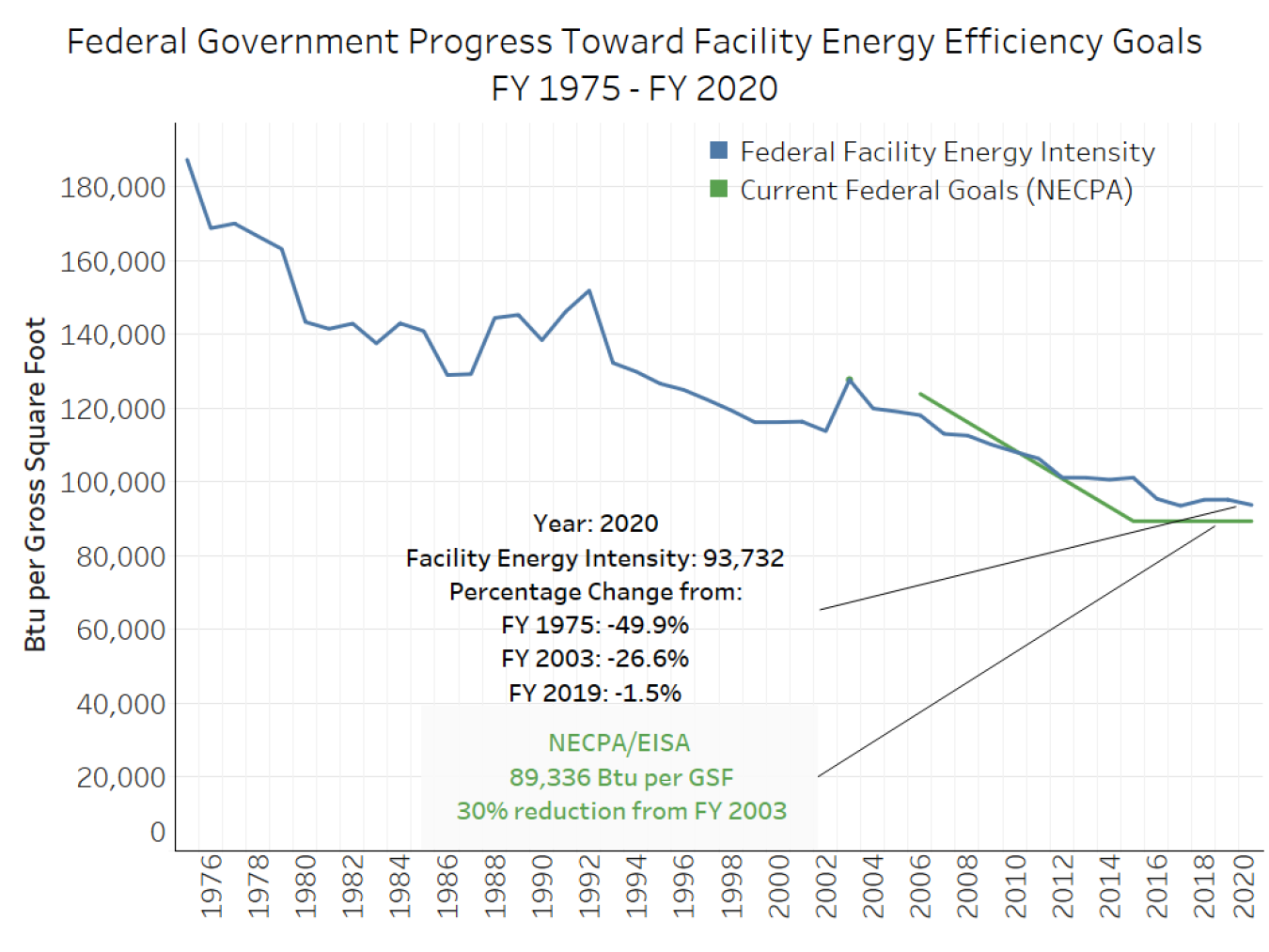
Since 1975, FEMP has helped agencies reduce the energy intensity of their facilities by 50%.
So what’s behind these staggering savings, and how can FEMP build on its legacy of efficiency to meet the challenges of the next 50 years? That is, if its operations aren’t wound down, as DOE leadership has proposed for FEMP in the FY2026 budget.1
The AFFECT Program: Investing in Smarter, Cleaner Government
When it comes to saving taxpayers money while cutting emissions, few programs punch above their weight like FEMP’s AFFECT program—short for Assisting Federal Facilities with Energy Conservation Technologies.
Launched a decade ago, AFFECT provides competitive grants to help federal agencies implement energy conservation, clean energy, and net-zero projects. These grants help agencies overcome a common obstacle: the lack of upfront capital to fund energy infrastructure improvements. By filling that gap, AFFECT empowers agencies to invest in long-term savings and resilience.
The results speak for themselves. Over the program’s lifetime, AFFECT has funded 160 projects, distributed nearly $300 million, and leveraged a staggering $4 billion in private-sector investment—yielding $137 million in cost savings to date.
These projects align with longstanding federal priorities to reduce costs, support American manufacturing, enhance energy resilience, and strengthen national security—all of which have gotten increased attention recently. AFFECT proves what’s possible when strategic funding meets real agency needs: a cleaner, more efficient, and more resilient federal government.
The Power of Performance Contracts
One of FEMP’s most impactful tools over the past 50 years has been its championing of performance contracting—a financial model that allows federal agencies to upgrade their energy systems without spending a dime in upfront Congressionally-appropriated funds.Through mechanisms like Energy Savings Performance Contracts (ESPCs) and Utility Energy Service Contracts (UESCs), FEMP helps agencies partner with private-sector energy service companies (ESCOs) to design and install energy-saving improvements. The best part? The cost of the upgrades is repaid over time using the guaranteed energy savings, so taxpayers benefit from day one.
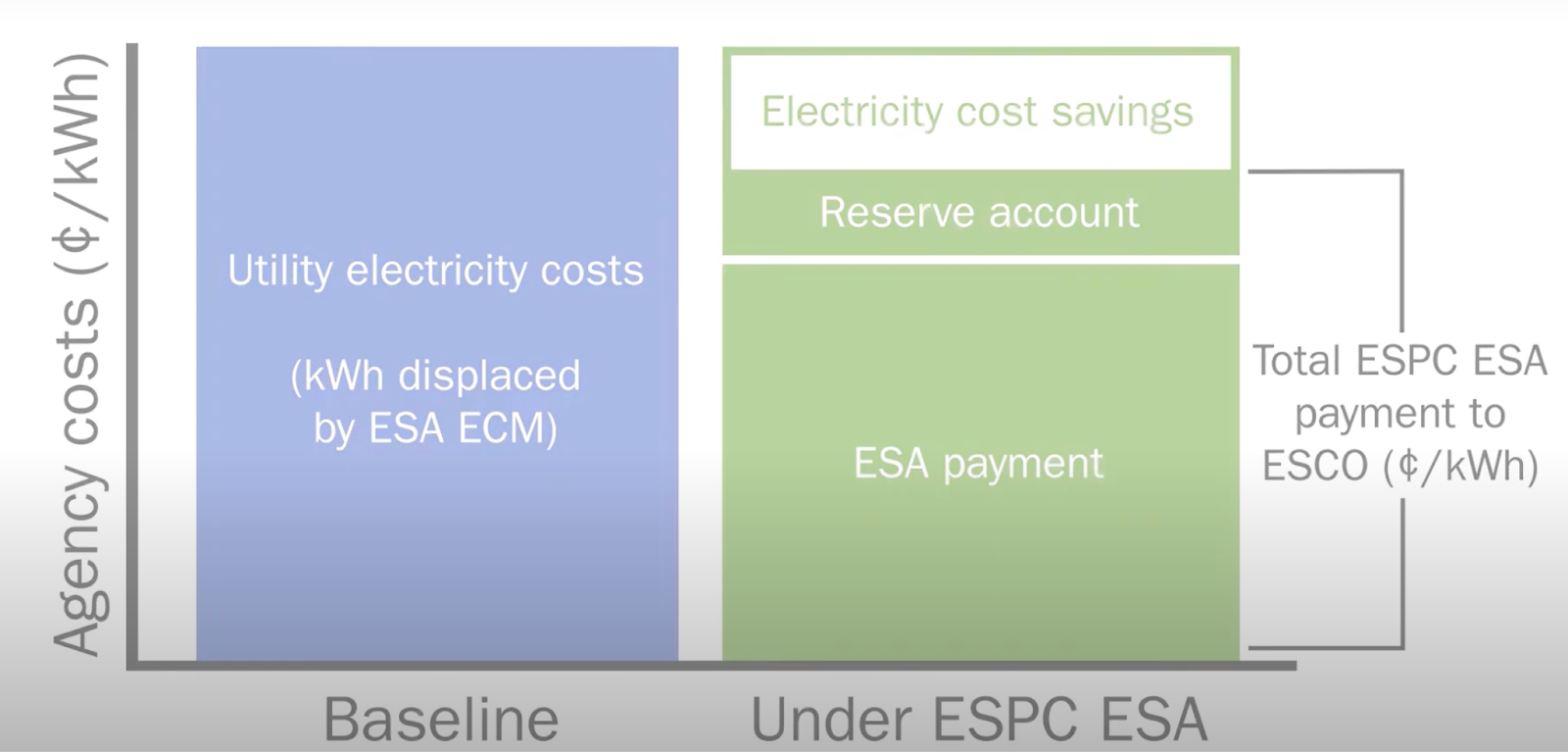
A graph that shows how ESPCs reduce agency costs by providing electricity cost savings.
These contracts have helped the federal government leverage billions of dollars in private capital, reducing emissions, modernizing aging infrastructure, and cutting utility bills at no upfront cost.
But FEMP hasn’t stopped there. Many civilian agencies don’t have the legal authority to sign long-term power purchase agreements (PPAs)—a key tool for procuring clean energy from the private sector for agency use. In response, FEMP developed a specialized contracting model: the Energy Savings Performance Contract with an Energy Sales Agreement (ESPC ESA). This innovative tool gives agencies a PPA-like pathway to procure their own distributed energy technologies—like solar installations, solar hot water, wind turbines, geothermal, and combined heat and power.
Here’s how ESPC ESAs work:
- Start with a plan. The agency figures out what kind of clean energy system they need and then hires a private energy company, called an ESCO, through a competitive process.
- The ESCO builds it—and owns it (at first). The ESCO designs and installs the system and owns it during the contract. Because it’s privately owned, the ESCO can use tax incentives that federal agencies can’t access—like the Investment Tax Credit (ITC)—which helps lower the total cost. However, if Congress rolls back clean energy tax credits like the ITC in the June 2025 reconciliation bill, it will limit one of the smartest tools we have to deliver lower-cost energy upgrades in federal facilities, ultimately costing taxpayers more to achieve the same results.
- Agencies only pay for the energy they use. Once the system is up and running, the agency pays the ESCO for the electricity it generates—and only that electricity. The rate must be cheaper than what the agency would’ve paid the utility, which means guaranteed savings.
- Eventually, the agency takes ownership. A small slice of each energy payment goes into a savings account that covers the cost of transferring ownership. By the end of the contract (usually within 20 years), the agency owns the system outright—and keeps the clean energy flowing.
So, the federal government gets to invest in reliable energy systems with no upfront cost, guaranteed savings, and long-term benefits. This approach blends financial flexibility with long-term energy independence, offering a win-win for agencies and taxpayers alike.
And the results are real. In FY 2023 alone, FEMP supported 191 federal projects that reported $566 million cost savings annually—with actual savings exceeding projections at 101% of estimated values.
Performance contracts aren’t just a workaround for limited budgets—they’re a core strategy for delivering cleaner, more resilient, and more cost-effective government operations. With these tools, FEMP is helping agencies meet today’s energy demands without waiting on tomorrow’s appropriations.
FEMP in Action on Public Lands: Naval Station Newport
FEMP’s commitment to smart stewardship extends beyond office buildings and into the heart of America’s public lands and military installations. At Naval Station Newport in Rhode Island, a 2023 FEMP-led energy and water “treasure hunt” uncovered significant savings opportunities, demonstrating how thoughtful management protects both the federal budget and the government’s consumption of public resources.
The treasure hunt—a hands-on, facility-wide assessment—identified measures projected to save $144,000 annually in energy costs while reducing greenhouse gas emissions by 288 tons per year. These findings not only highlight a direct benefit to taxpayers through reduced utility bills but also contribute to the Navy’s broader goals for energy resilience and resource stewardship.
By deploying FEMP’s technical expertise and leveraging innovative assessment techniques, Naval Station Newport took an important step toward more efficient operations. This case exemplifies how efficient energy management on public lands protects vital federal resources, enhances mission readiness, and supports America’s energy abundance goals.
Why FEMP Matters Now More Than Ever
The federal government is facing a perfect storm of challenges: the urgent need to cut carbon emissions, historic infrastructure investments in need of implementation, rising energy costs, and a shrinking federal workforce stretched thin. At the same time, global demand for electricity is projected to double by 2050. Meeting these demands without breaking budgets or burning out public servants will require solutions that are smart, scalable, and already proven.
That’s where the Federal Energy Management Program comes in.
For five decades, FEMP has helped agencies modernize their operations, cut waste, and unlock billions in savings. FEMP delivers what every taxpayer hopes for: a government that spends wisely, thinks long-term, and achieves true efficiency. As the next chapter of energy and infrastructure development unfolds, FEMP deserves recognition—and reinvestment. However, despite its proven track record, DOE’s fiscal year 2026 budget proposal requests $8 million to wind down activities at FEMP—potentially shutting its doors for good. That’s a mistake. For decades, FEMP has helped federal agencies save billions in taxpayer dollars, reduce energy waste, and strengthen mission resilience, all without expanding bureaucracy or growing the deficit. If we’re serious about decarbonizing the federal footprint, lowering costs, and building a more resilient future for all Americans, then we need to look to—and continue funding—the programs and public servants who have been doing that work for decades.
Creating an HHS Loan Program Office to Fill Critical Gaps in Life Science and Health Financing
We propose the establishment of a Department of Health and Human Services Loan Programs Office (HHS LPO) to fill critical and systematic gaps in financing that prevent innovative life-saving medicines and other critical health technologies from reaching patients, improving health outcomes, and bolstering our public health. To be effective, the HHS LPO requires an authority to issue or guarantee loans, up to $5 billion in total. Federally financed debt can help fill critical funding gaps and complement ongoing federal grants, contracts, reimbursement, and regulatory policies and catalyze private-sector investment in innovation.
Challenge and Opportunity
Despite recent advances in the biological understanding of human diseases and a rapidly advancing technological toolbox, commercialization of innovative life-saving medicines and critical health technologies face enormous headwinds. This is due in part to the difficulty in accessing sustained financing across the entire development lifecycle. Further, macroeconomic trends such as non-zero interest rates have substantially reduced deployed capital from venture capital and private equity, especially with longer investment horizons.
The average new medicine requires 15 years and over $2 billion to go from the earliest stages of discovery to widespread clinical deployment. Over the last 20 years, the earliest and riskiest portions of the drug discovery process have shifted from the province of large pharmaceutical companies to a patchwork of researchers, entrepreneurs, venture capitalists, and supporting organizations. While this trend has enabled new entrants into the biotechnology landscape, it has also required startup companies to navigate labyrinthine processes of technical regulatory guidelines, obtaining long-term and risk-friendly financing, and predicting payor and provider willingness to ultimately adopt the product.
Additionally, there are major gaps in healthcare infrastructure such as lack of adequate drug manufacturing capacity, healthcare worker shortages, and declining rural hospitals. Limited investment is available for critical infrastructure to support telehealth, rural healthcare settings, biomanufacturing, and decentralized clinical trials, among others.
The challenges in health share some similarities to other highly regulated, capital-intensive industries, such as energy. The Department of Energy (DOE) Loan Program Office (LPO) was created in 2005 to offer loans and loan guarantees to support businesses in deploying innovative clean energy, advanced transportation, and tribal energy projects in the United States. LPO has closed more than $40 billion in deals to date. While agencies across HHS rely primarily on grants and contracts to deploy research and development (R&D) funding, capital-intensive projects are best deployed as loans, not only to appropriately balance risk between the government and lendees but also to provide better stewardship over taxpayer resources via mechanisms that create liquidity with lower budget impact. Moreover, private-sector financing rates are subject to market-based interest rates, which can have enormous impacts on available capital for R&D.
Plan of Action
There are many federal credit programs across multiple departments and agencies that provide a strong blueprint for the HHS LPO to follow. Examples include the aforementioned DOE Loan Programs Office, which provides capital to scale large-scale energy infrastructure projects using new technologies, and the Small Business Administration’s credit programs, which provide credit financing to small businesses via several loan and loan matching programs.
Proposed Actions
We propose the following three actions:
- Pass legislation authorizing the HHS LPO to make or guarantee loans supporting the development of critical medicines that serve unmet or underserved public health needs.
- Establish the LPO as a staffing division within HHS.
- Appropriate a budget to support the staffing and operations of the newly created HHS LPO.
Scope
Similar to how DOE LPO services the priorities of the DOE, the HHS LPO would develop strategy priorities based on market gaps and public health gaps. It would also develop a rigorous diligence process to prioritize, solicit, assess, and manage potential deals, in alignment with the Federal Credit Reform Act and the associated policies set forth by the Office of Management and Budget and followed by all federal credit programs. It would also seek companion equity investors and creditors from the private sector to create leverage and would provide portfolio support via demand-alignment and -generation mechanisms (e.g., advance manufacturing commitments and advanced market commitments from insurers).
We envision several possible areas of focus for the HHS LPO:
- Providing loans or loan guarantees to amplify investment funds that use venture capital or other private investment tools, such as early-stage drug development or biomanufacturing capacity. While these funds may already exist, they are typically underpowered.
- Providing large-scale financing in partnership with private investors to fund major healthcare infrastructure gaps, such as rural hospitals, decentralized clinical trial capacity, telehealth services, and advanced biomanufacturing capacity.
- Providing financing to test new innovative finance models, e.g. portfolio-based R&D bonds, designed to attract additional capital into under-funded R&D and lower financial risks.
Conclusion
To address the challenges in bringing innovative life-saving medicines and critical health technologies to market, we need an HHS Loan Programs Office that would not only create liquidity by providing or guaranteeing critical financing for capital-intensive projects but address critical gaps in the innovation pipeline, including treatments for rare diseases, underserved communities, biomanufacturing, and healthcare infrastructure. Finally, it would be uniquely positioned to pilot innovative financing mechanisms in partnership with the private sector to better align private capital towards public health goals.
This action-ready policy memo is part of Day One 2025 — our effort to bring forward bold policy ideas, grounded in science and evidence, that can tackle the country’s biggest challenges and bring us closer to the prosperous, equitable and safe future that we all hope for whoever takes office in 2025 and beyond.
PLEASE NOTE (February 2025): Since publication several government websites have been taken offline. We apologize for any broken links to once accessible public data.
The DOE LPO, enabled via the Energy Policy Act of 2005, enables the Secretary of Energy to provide loan guarantees toward publicly or privately financed projects involving new and innovative energy technologies.
The DOE LPO provides a bridge to private financing and bankability for large-scale, high-impact clean energy and supply chain projects involving new and innovative technologies. It also expands manufacturing capacity and energy access within the United States. The DOE LPO has enabled companies involving energy and energy manufacturing technologies to achieve infrastructure-scale growth, including Tesla, an electric car manufacturer; Lithium Americas Corp., a company supplying lithium for batteries; and the Agua Caliente Solar Project, a solar power station sponsored by NRG Solar that was the largest in the world at its time of construction.
The HHS LPO would similarly augment, guarantee, or bridge to private financing for projects involving the development and deployment of new and innovative technologies in life sciences and healthcare. It would draw upon the structure and authority of the DOE LPO as its basis.
The HHS LPO could look to the DOE LPO for examples as to how to structure potential funds or use cases. The DOE LPO’s Title 17 Clean Energy Financing Program provides four eligible project categories: (1) projects deploying new or significantly improved technology; (2) projects manufacturing products representing new or significantly improved technologies; (3) projects receiving credit or financing from counterpart state-level institutions; and (4) projects involving existing infrastructure that also share benefits to customers or associated communities.
Drawing on these examples, the HHS LPO could support project categories such as (1) emerging health and life science technologies; (2) the commercialization and scaling access of novel technologies; and (3) expanding biomanufacturing capacity in the United States, particularly for novel platforms (e.g., cell and gene therapies).
The budget could be estimated via its authority to make or guarantee loans. Presently, the DOE LPO has over $400 billion in loan authority and is actively managing a portfolio of just over $30 billion. Given this benchmark and the size of the private market for early-stage healthcare venture capital valued at approximately $20 billion, we encourage the creation of an HHS LPO with $5 billion in loan-making authority. Using proportional volume to the $180 million sought by DOE LPO in FY2023, we estimate that an HHS LPO with $5 billion in loan-making authority would require a budget appropriation of $30 million.
The HHS LPO would be subject to oversight by the HHS Inspector General, OMB, as well as the respective legislative bodies, the House of Representatives Energy and Commerce Committee and the Senate Health, Education, Labor and Pension Committee.
Like the DOE LPO, the HHS LPO would publish an Annual Portfolio Status Report detailing its new investments, existing portfolio, and other key financial and operational metrics.
It is also possible for Congress to authorize existing funding agencies, such as BARDA, the Advanced Research Projects Agency for Health (ARPA-H), or the National Institutes for Health (NIH), with loan authority. However, due the highly specialized talent needed to effectively operate a complex loan financing operation, the program is significantly more likely to succeed if housed into a dedicated HHS LPO that would then work closely with the other health-focused funding agencies within HHS.
The other alternative is to expand the authority for other LPOs and financing agencies, such as the DOE LPO or the U.S. Development Finance Corporation, to focus on domestic health. However, that is likely to create conflicts of priority given their already large and diverse portfolios.
The project requires legislation similar to the Department of Energy’s Title 17 Clean Energy Financing Program, created via the Energy Policy Act of 2005 and subsequently expanded via the Infrastructure Investment and Jobs Act in 2021 and the Inflation Reduction Act in 2022.
This legislation would direct the HHS to establish an office, presumably a Loan Programs Office, to make loan guarantees to support new and innovative technologies in life sciences and healthcare. While the LPO could reside within an existing HHS division, the LPO would most ideally be established in a manner that enables it to serve projects across the full Department, including those from the National Institutes of Health, Food and Drug Administration, Biomedical Advanced Research and Development Authority, and the Centers for Medicare and Medicaid Services. As such, it would preferably not reside within any single one of these organizations. Like the DOE LPO, the HHS LPO would be led by a director, who would be directed to hire the necessary finance, technical, and operational experts for the function of the office.
Drawing on the Energy Policy Act of 2005 that created the DOE LPO, enabling legislation for the HHS Loan Programs office would direct the Secretary of HHS to make loan guarantees in consultation with the Secretary of Treasury toward projects involving new and innovative technologies in healthcare and life sciences. The enabling legislation would include several provisions:
- Necessary included terms and conditions for loan guarantees created via the HHS LPO, including loan length, interest rates, and default provisions;
- Allowance of fees to be captured via the HHS LPO to provide funding support for the program; and
- A list of eligible project types for loan guarantees.
Supporters are likely to include companies developing and deploying life sciences and healthcare technologies, including early-stage biotechnology research companies, biomanufacturing companies, and healthcare technology companies. Similarly, patient advocates would be similarly supportive because of the LPO’s potential to bring new technologies to market and reduce the overall Weighted Average Cost of Capital (WACC) for biotechnology companies, potentially supporting expanded access.
Existing financiers of research in biomedical sciences technology may be neutral or ambivalent toward this policy. On one hand, it would provide expanded access to syndicated financing or loan guarantees that would compound the impact of each dollar invested. On the other hand, most financiers currently use equity financing, which enables the demand for a high rate of return via subsequent investment and operation. An LPO could provide financing that requires a lower rate of return, thereby diluting the impact of current financiers in the market.
Skeptics are likely to include groups opposing expansions of government spending, particularly involving higher-risk mechanisms like loan guarantees. The DOE LPO has drawn the attention of several such skeptics, oftentimes leading to increased levels of oversight from legislative stakeholders. The HHS LPO could expect similar opposition. Other skeptics may include companies with existing medicines and healthcare technologies, who may be worried about competitors introducing products with prices and access provisions that have been enabled via financing with lower WACC.