
Page
408. Primary oceans
409. Currents
410. Major ocean currents
411. Gyres
2–2. Wind-Induced Vertical Motions
412. Coastal upwelling
413. Coastal sinking
2–3. Deep-Ocean Circulation
414. Deep-ocean circulation
415. Ocean fronts and eddies’
2–4. Waves and Tides
416. Waves
417. Surf
418. Types of breakers
419. Tides and tidal computations
AN is in a unique position regarding the Earth’s atmosphere and the oceans. We live at the bottom of one and at the top of the other. The atmosphere is an ocean of air, and the seas, an ocean of water. In many respects, the atmosphere and the oceans are similar. For example, there are air currents and ocean currents, atmospheric waves (long and short) and ocean waves, and the land (terrain) beneath the sea is much like that beneath the atmosphere.
The interaction between the ocean’s surface and the circulation of the lower atmosphere (that is, surface winds) is the primary cause of the surface currents in the oceans. A current generally refers to the horizontal movement of water. The direction, speed, and the temperature of the water masses moved by the ocean currents play an important role in climatology by transporting heat energy. Currents may be small-scale, transient features, resulting from seasonal or local effects or large-scale, permanent features, covering vast portions of the oceans, resulting from atmospheric circulation patterns. The primary modifiers of these currents include (1) coriolis, which deflects sea water and ice to the right of the prevailing wind in the Northern Hemisphere and to the left in the Southern Hemisphere and (2) bathymetry (bottom topography) which deflects and obstructs water movement.
In oceanography there are four main oceans of concern, the Atlantic Ocean, Pacific Ocean, Indian Ocean, and the Arctic Ocean (fig. 2–1).
Figure 2–1. Major oceans of the world.
Atlantic Ocean
It extends from Cape Agulhas at 20° East to the line connecting Cape Horn to the Palmer Peninsula, and northward to include the North Polar Sea.
Pacific Ocean
This extends from the Cape Horn line westward to 147° East (near Tasmania), then northward to the Bering Straits.
Indian Ocean
The Indian Ocean lies between Africa and Indonesia.
Arctic Ocean
The Arctic Ocean is frozen most of the year from 90° North to the northernmost portions of the Atlantic and Pacific Oceans.
Oceanic dimensions and characteristics
Seventy-one to seventy-six percent of the Earth’s surface is covered by water (figures vary with the reference source). Only 1 percent has depths exceeding 3,000 fathoms. Five-and-one-half percent has depths shallower than 100 fathoms (that is, the continental shelf environment).
Ocean currents are organized, coherent belts of water in horizontal motion. The general distribution of ocean currents is as follows:
Characteristics
Currents are referred to by their "drift" and "set". Usually the currents are strongest near the surface and may attain speeds over five knots. At depths, currents are generally slow with speeds less than 0.5 knots.
We refer to the speed of a current as its "drift." Drift is measured in terms of knots. The current’s "set" refers to the direction in which the current is moving (toward). The current off the California coast flows from north-to-south at about 2 knots. So, we can say that, the California Current sets southward at a drift of 2 knots. The strength of a current refers to the speed of the current also. A fast current is considered strong. A current is usually strongest at the surface and decreases in strength (speed) with depth. Most currents are less than or equal to 5 knots.
Classifications
Currents are classified as either warm or cold currents based on the water temperatures advecting into a region.
Cold currents
A cold current brings cold water into warm water. Cold currents are usually found on the west coast of continents in the low and middle latitudes (true in both hemispheres) and the east coast in the northern latitudes in the Northern Hemisphere.
Warm currents
A warm current brings warm water into cold water and is usually found on the east coast of continents in the low and middle latitudes (true in both hemispheres). In the Northern Hemisphere they are located on the west coasts of continents in high latitudes.
Types of currents
There are four types of currents that we will be concerned with: wind-driven, density, hydraulic, and tidal. Wind driven and tidal currents will have the greatest effect on amphibious operations, due to their proximity to the littoral (shore) zone. However, depending on the location of the operation, density and hydraulic currents can come into play and must be understood.
Wind-driven currents
These are initiated and sustained by the force of the wind exerting stress on the sea surface. Moving surface water transmits stress to the underlying water to a depth depending on the speed and duration of the wind (fig. 2–2).
Figure 2–2. Wind-driven currents.
Wind-driven currents do not flow in the same direction as the wind. Due to coriolis, the surface current moves in a direction 45 degrees or less to the right of the wind (in the Northern Hemisphere). The surface mass of water moves as a thin lamina, or sheet, which sets another layer beneath it in motion. The energy of the wind is passed through the water column from the surface down. The resulting surface current flows at 1 to 2 percent of the speed of the wind that set it in motion. Each successive layer of water moves with a lower speed and in a direction to the right of the one that set it in motion (fig. 2–3). The momentum imparted by the wind will gradually be lost, resulting in water at some depth (usually approximately 300 feet) moving slowly in a direction opposite the surface current. Generally, it can be said that:
Density currents (geopotential)
This current is caused by density differences, or gravity differences between currents. It retains its unmixed identity because its density differs from that of the surrounding water.
Hydraulic currents
Hydraulic currents are small-scale thermohaline subsurface circulations caused by the differences in sea level between two water bodies. These currents are commonly found in straits separating water bodies. The best example of a hydraulic current is that current set up in the Strait of Gibraltar.
The water level in the eastern Mediterranean Sea is 15 centimeters (cm) lower than in the Straits of Gibraltar, due to the excessive evaporation in the Mediterranean Basin. The evaporation cools the water and it sinks as it becomes denser. This cold dense water exits the Mediterranean Basin through the Straits of Gibraltar as an opposite flowing current underneath the incoming water. This process is typical of all closed, restricted basins where evaporation exceeds precipitation.
Tidal currents
Tidal currents are the horizontal expression of the tidal forces and are especially significant in the littoral zone, where they become the predominant flow. Tides are waves that have lengths measured in hundreds of miles and heights ranging from zero to more than 50 feet.
Tides are caused by the gravitational attraction between the Earth, Moon, and Sun. Although the gravitational attraction between the Earth and Sun is over 177 times greater than that of the Earth and Moon, the Moon dominates the tides. This is because of the distance factor; the Sun is 390 times farther from the Earth than the Moon, its tide generating force is reduces by 3903, or about 59 million times compared to that of the Moon. We explore tides in more detail in a later lesson.
The major ocean currents are established and maintained by the stresses exerted by the prevailing winds. Thus, the oceanic circulation pattern roughly corresponds to the Earth’s atmospheric circulation pattern. Since the air circulation over the oceans in the middle latitudes is chiefly anticyclonic (more pronounced in the Southern Hemisphere than in the Northern Hemisphere), the oceanic circulation is approximately the same. At higher latitudes, where the windflow is principally cyclonic, the oceanic circulation follows this pattern, although not as closely as the anticyclonic pattern of the middle latitudes. In regions of pronounced monsoonal flow, the monsoon winds control the currents.
The oceanic circulation pattern acts to transport heat from one latitude belt to another in a manner similar to the heat transported by the primary circulation of the atmosphere. The cold waters of the Arctic and Antarctic move equatorward toward warmer water, while the warm waters of the lower latitudes move poleward. The effect this circulation pattern has on climate can be seen in the comparatively mild climate that exists in the area of northwest Europe. Even in winter, Norwegian ports along the Atlantic are ice-free most of the time. This is due to the effect of the warm ocean current that sweeps northward along the Norwegian coast. In contrast, a cold ocean current flows equatorward along the coast of California and is a major reason that cities such as San Francisco experience relatively cool summer temperatures.
North Atlantic currents
The North Atlantic Ocean is dominated by the North Equatorial Current and the Gulf Stream System. Refer to figure 2–4 as you read the following information.
North Equatorial Current
The North Equatorial Current is located in the tradewind belt of the North Atlantic Ocean. The chief source of the flow is the northeasterly currents off the west coast of northwestern Africa. These currents of water of relatively high density and low temperature are an extension of the North Atlantic Current. They help lower the temperatures along the northwest coast of Africa. The temperatures near the coast are further lowered by upwelling. This is further explained in topical statement 412.
As the North Equatorial Current flows westward north of the Equator, the South Equatorial Current crosses the Equator and joins it in the western North Atlantic Ocean. Consequently, that part of the North Equatorial Current that enters the Caribbean Sea has water that is a mixture of waters from the North Atlantic Ocean and South Atlantic Ocean.
Antilles Current
The Antilles Current is the western extension of the North Equatorial Current. It flows along the northern side of the Greater Antilles. It carries water that is virtually the same as that of the Sargasso Sea (a portion of the middle North Atlantic Ocean).
Gulf Stream system
The Gulf Stream system begins in the Florida Straits and flows northward and eastward along the east coast of the United States. This system, along with the Kuroshio System of the western Pacific, is the fastest of all the ocean currents. It
moves with speeds of 25 to 75 miles per day or roughly 1 to 3 knots. The Gulf Stream system is made up of three currents: the Florida Current, Gulf Stream, and North Atlantic Current.
Figure 2–4. Currents of the North Atlantic Ocean.
Florida Current
The Florida Current extends from the Florida Straits to Cape Hatteras. Much of the flow is derived from the Caribbean Sea by way of the Yucatan Channel; the water from the Yucatan Channel takes the shortest route to the Florida straits rather than making a long sweep through the Gulf of Mexico. The Florida Current is also fed by the Antilles Current.
Oceanographers believe that the energy of the Florida Current comes from the difference in the levels of the water in the Gulf of Mexico and the water next to the Florida coast, the waters in the Gulf being higher. The difference in the two levels is due to the prevailing winds which result in the piling up of water in the Gulf of Mexico.
Gulf Stream
The Gulf Stream is the middle portion of the Gulf Stream System. It begins near Cape Hatteras and continues northward to the vicinity of the Grand Banks off Newfoundland. To the right of the Gulf Stream is the Sargasso Sea portion of the North Atlantic Ocean, and to the left are coastal and slope waters.
North Atlantic Current
The North Atlantic Current begins off the Grand Banks, where the Gulf Stream begins to fork. It consists of northerly and easterly currents terminating in subsidiary currents. One of the major subsidiaries is the Irminger Current, which flows westward off the southern coast of Iceland. Another is the Norwegian Current. It flows beyond the Norwegian Sea into the polar seas. Other branches of the North Atlantic Current, turning southward, end in huge eddies off the coast of Europe and in the relatively cold Canaries Current off the northwest coast of Africa.
North Pacific currents
The currents of the North Pacific Ocean are very similar to the currents of the North Atlantic Ocean. Even so, there are some distinct differences. These differences are due mainly to the large amounts of subarctic water in the North Pacific, compared with the small amount in the North Atlantic.
North Equatorial Current
The North Equatorial Current of the North Pacific Ocean starts near the western coast of Central America. Waters of the California Current and other western and eastern North Pacific Currents feed into it as it flows west. Toward the western side of the North Pacific most of the waters turn northward along the eastern coast of the northern Philippines and Formosa (fig. 2–5); some of the waters turn southward and become a part of the Equatorial Countercurrent. Consequently, the North Equatorial Current takes very warm water to the eastern side of the island systems in the western Pacific.
Cromwell Current
The Cromwell Current (fig. 2–5) is a narrow, swift subsurface current centered on the Equator between 2°N and 2°S. It flows from west-to-east between 140° W and 92°W. At the Equator, the easterly flow begins at approximately 20 meters and disappears at roughly 250 meters. It reaches a maximum speed of 2 to 2.5 knots at 100 meters.
Kuroshio system
The Kuroshio system is quite similar to the Gulf Stream system of the North Atlantic Ocean. It begins where the North Equatorial Current leaves off. It flows past Formosa and continues northeastward in the deep ocean area between the China Sea and the Ryukyu Islands (fig. 2–5). The system flows eastward and northeastward along the coast of Japan.
Like the Gulf Stream system, the Kuroshio system has three branches: the Kuroshio Current, Kuroshio Extension, and North Pacific Current.
Kuroshio Current
The Kuroshio corresponds to the Florida Current of the Gulf Stream system. It flows from Formosa to about 35°N. The salinity is less than that of the Florida Current, and cold offshore winds cause an annual range in SST of as much as 9°C in some localities.
Kuroshio extension
As the name implies, this current is an extension of the warm Kuroshio Current. It begins near 35°N, where the Kuroshio splits. The major well-defined portion of this current flows eastward to about 160°E. The other branch flows northeastward to about 40°N, where it turns eastward.
North Pacific Current
The North Pacific Current is not well defined, and tracing its path across the Pacific is difficult. Temperature and salinity provide the best indications of its location. The current is most recognizable between 160 and 150°W, but much of the waters turn southward before reaching 150°W, forming many of the major whirls found in this portion of the North Pacific.
South Atlantic currents
The prevailing anticyclonic wind circulation of the Southern Hemisphere gives the South Atlantic Ocean its characteristic ocean circulation. Use figure 2–6 as you read the following information.
South Equatorial Current
This current dominates the northern portion of the South Atlantic Ocean. It flows from east-to-west just south of the Equatorial Countercurrent. On reaching the eastern shores of South America, it splits. One branch turns northward along the northern coast of South America, where it merges with waters of the North Equatorial Current. The other branch flows southward as the Brazilian Current.
Brazilian Current
The Brazilian Current brings very warm, saline waters to the coasts of Brazil and Uruguay. It flows south along the east coast of South America to about 40°S, where it turns east and joins the Falkland Current. The Falkland Current is an extension of the West Wind Drift Current.
West Wind Drift Current
This cold current flows west-to-east and completely encircles the Antarctic continent. Because it encircles Antarctica, it is also called the Antarctic Circumpolar Current. In the South Atlantic the West Wind Drift flows east between 45°S and 50°S. The Falkland Current, which flows north along the coast of Argentina, and the Benguela Current, which flows north along the west coast of South Africa, are both extensions of the West Wind Drift Current.
Falkland Current
The Falkland Current brings cold waters of low salinity as far north as 40°S before turning east and merging with the Brazilian Current. The two currents develop great whirls in the middle section of the South Atlantic Ocean.
Benguela Current
The Benguela Current is the dominant current in the eastern South Atlantic. It flows north along the west coast of Africa, and its cold waters are a major contributor to the formation of low clouds and fog along the immediate southwestern coast.
Guinea Current
The Guinea Current is an extension of the Equatorial Countercurrent. It flows eastward to the African coast.
South Pacific currents
The currents of the South Pacific Ocean, like those of the South Atlantic Ocean, show the effects of the atmosphere’s anticyclonic circulation.
South Equatorial Current
The northern South Pacific is dominated by the South Equatorial Current. It flows east-to-west just south of the Equatorial Countercurrent. On reaching its western limit, it turns southward and becomes the East Australian Current.
East Australian Current
The East Australian Current (fig. 2–7) is an extension of the South Equatorial Current. It flows south along Australia’s east coast and brings warm waters to the northern and western coasts of New Zealand. As a result, the eastern coast of Australia and the western coast of New Zealand are warmer than their opposite coasts. At its southern limit, the East Australian Current meets the West Wind Drift. The West Wind Drift flows across the Pacific along or around the 50th parallel, where a branch flows north as the Peru or Humboldt Current.
Peru or Humboldt Current
The Peru Current (fig. 2–6) dominates the coastal waters of western South America. The waters are relatively cold, and there is considerable upwelling off the coasts of Chile and Peru. Coastal fog and low clouds are characteristic of the area.
Seas next to the North Atlantic
There are several currents in the seas next to the North Atlantic Ocean that are of considerable importance.
Mediterranean Sea
There is a strong current in the Strait of Gibraltar. Here, the waters of the North Atlantic flow into the Mediterranean Sea in the upper layers, and waters of the Mediterranean flow into the North Atlantic in the lower layers. The outflowing waters are colder and have a higher salinity than the waters flowing into the Mediterranean.
Labrador Sea and Baffin Bay
Waters of the North Atlantic Ocean enter the Labrador Sea along the west coast of Greenland as the West Greenland Current. Some of this current flows through the Davis Strait into Baffin Bay, while the remainder turns westward and joins the Labrador Current (fig. 2–4). The Labrador Current flows southward along the east coast of Labrador. A portion of this current turns eastward and flows along the northern border of the North Atlantic Drift. Another portion flows south along the east coast of North America to the vicinity of Cape Hatteras.
Caribbean Sea and Gulf Of Mexico
The strong westerly current that flows through the Caribbean Sea and Yucatan Channel is a continuation of the southern branch of the North Equatorial Current of the Atlantic Ocean. Two conspicuous eddies accompany this current; one eddy is in the bay between Nicaragua and Colombia, while the other is between Cuba and Jamaica.
To the west of the Yucatan Channel most of the main current turns east and joins the Florida Current through the Florida Straits. Another portion flows into the Gulf of Mexico, where pronounced eddies dominate the circulation. These eddies are caused by the contours of the coast and the character of the Gulf floor.
Other North Pacific currents
For the picture of the oceanic circulation in the North Pacific Ocean to be complete, several other currents of adjacent seas must be mentioned.
Aleutian Current
The Aleutian Current flows east poleward of the North Pacific Current and separates at the Aleutian Islands. One branch flows north of the islands. It enters the Bering Sea, where it circulates in a counterclockwise manner before flowing south through the Bering Strait and joining the Oyashio Current.
The other branch flows south of the Aleutians. On approaching the coast of North America, one portion turns north and flows into the Gulf of Alaska, while the other flows south and becomes the California Current. The portion that flows into the Gulf of Alaska is a warm current. It brings milder winter temperatures to southern Alaska than would normally be expected at that latitude. On the other hand, the southward flowing branch is a cold current.
Oyashio Current
The Oyashio Current (fig. 2–5) flows south from the vicinity of the Bering Strait to the northern islands of Japan. It divides at 40°N. One branch turns east and joins the Kuroshio Current. The other branch flows south along Japan’s eastern coast.
In the winter, the Oyashio carries cold waters as far south as Vietnam, but in the summer, the summer monsoon restricts the Oyashio to the area north of 40°N.
California Current
The California Current flows southward along the west coast of North America. In the spring and summer these cool waters have a definite cooling effect on the western coast of the United States. The prevailing north-northwest winds also create a great deal of upwelling, which adds to the cooler air temperatures of this area. Where the upwelling is intense, the spring temperatures are colder than the winter temperatures. In the areas of moderate upwelling, the winter temperatures are colder. The upwelling process ceases in the fall and gives way to a surface countercurrent known as the Davidson Current.
Davidson Current
This current exists in the fall and winter and flows northward along the California coast to about 48° N.
Indian Ocean currents
The Asiatic Monsoon influences the currents of the North Indian Ocean, while the currents of the South Indian Ocean are influenced by the atmosphere’s anticyclonic circulation (fig. 2–8).
North Equatorial Current
During the northwest monsoon (February and March), the wind blows from the continent and aids in the development of the North Equatorial Current. The current flows from east-to-west; and on reaching the east coast of Africa, a good portion turns southward, crosses the Equator, and becomes the Mozambique Current. A strong countercurrent exists south of the North Equatorial Current at this time of year.
In August and September, during the southwest monsoon, the North Equatorial Current reverses and flows west-to-east as the Monsoon Current. At the same time, the countercurrent seems to disappear.
Mozambique Current
The Mozambique Current flows south along the east coast of Africa from the vicinity of the Equator to about 35°S, where it becomes known as the Agulhas Stream.
Agulhas stream
The Agulhas Stream flows westward along the southern coast of Madagascar and joins the Mozambique Current along the east African coast. From there it flows south to the southern tip of Africa (the Cape of Good Hope), where a good portion joins up with the West Wind Drift.
West Wind Drift
The West Wind Drift flows across the Indian Ocean to the waters southwest of Australia. Here it splits; one branch continues east along the southern coast, while the other flows northward along the western coast. This branch brings relatively cool waters to the western Australian coast and contributes to the formation of fog and low stratus clouds over the region.
Effects on weather
Generally, the following statements may be made concerning the effect’s ocean currents have on weather:
Indirectly, ocean currents also influence the location of the primary frontal zones and the tracks of cyclonic storms. Located off the eastern coast of the United States in winter are two of the major frontal zones. These zones occur where the SST gradient is steep and a large amount of Tropical water is transported into the middle latitudes. This places these fronts where large amounts of energy are available. This area contrasts with the strictly cold, eastern continental United States and suggests that the development of cyclones (low-pressure centers) along these fronts may be of thermodynamic origin.
Two of the main hurricane tracks in the Atlantic also appear to be associated with warm waters. One follows the warm waters through the Caribbean, and the other follows the waters off the northern and eastern coasts of Florida and the Greater Antilles. Extratropical cyclones of fall and winter also appear to be attracted to warm waters.
Large oval, or circular, currents formed in the ocean basins by the combined effects of the winds, and the position of the continents are known as gyres. These are much like the wind patterns associated with the surface semi-permanent pressure patterns in the atmosphere. In the Northern Hemisphere the semi-permanent high-pressure systems over the ocean produce clockwise gyres. The semi-permanent low-pressure systems over the ocean produce counterclockwise gyres. However, in the Southern Hemisphere the reverse is true due to the reversed coriolis force.
Boundary currents
Each gyre in the ocean consists of four main currents that form the circulation pattern (we will look at only two). These currents are most easily seen in the subtropical gyres. Their effect on coastal weather and migrating weather systems is significant. Open-ocean currents set east or west across the ocean basins (e.g., The North Pacific Current or the North and South Equatorial Currents). Open-ocean currents have drifts of 2 to 4 nautical miles/day, or 3 to 6 kilometers/day. They usually extend only 100 to 200 meters (300 to 650 feet) below the surface. The water moving within these currents remains in the same climatic zones for many months while crossing the ocean basins.
Western boundary currents
Western boundary currents are unusually powerful, warm, narrow currents with a northward set in the Northern Hemisphere and a southward set in the Southern Hemisphere. These currents are the fastest with drifts of between 25 and 75 nautical miles/day, or 40 and 120 kilometers/day. They usually extend well below the surface to depths of 1,000 meters (3,300 feet) or more. Due to their speed the waters within these currents do not remain in the same climatic zone long enough to modify. Therefore, these currents transfer heat energy from the tropics to the polar regions. The strongest of these currents are the Gulf Stream and the Kuroshio in the Northern Hemisphere. An example of the enormous influence a current can have on the weather can be seen when a strong cold front moves over the east coast of the United States and nears the Gulf Stream Current. The warm waters of the Gulf Stream interact with the cold air creating more instability for an already unstable environment. Explosive lows often develop. In the Southern Hemisphere the Brazil and East Australia Currents perform the heat transfer function, but are not as prominent.
Eastern boundary currents
Eastern boundary currents are usually weak, cold, broad, currents set southward in the Northern Hemisphere and northward in the Southern Hemisphere. These currents are relatively slow with drifts of between 2 and 4 nautical miles/day or 3 and 7 kilometers/day. This slow speed permits their surface waters to adjust, at least partially, to local climatic conditions as they flow across climatic zones. In the Northern Hemisphere the California and Canary Currents move colder water toward the tropics. In the Southern Hemisphere the Peru and Benguela Currents transport the colder waters toward the tropics.
Subtropical gyre
The subtropical gyre develops as a result of the winds in the subtropical high-pressure system (works well for both hemispheres). The Equatorial Current is the backbone of the subtropical gyre system, as the Equatorial Currents are set in motion by the tradewinds. Coriolis deflects the water mass and gives it a westward set. As the westward set Equatorial Currents approach the proximity of a continental barrier, the currents tend to be deflected poleward. As the current flows poleward, the transport of water becomes stronger. A piling up of water occurs on the western boundary of the subtropical gyre because the western side of the gyre has a steeper slope. As a result of this, the western boundary current tends to be stronger than the eastern side of the gyre.
Subpolar gyre
These gyres develop in the North Pacific and Atlantic, as they are a direct result of the Aleutian and Icelandic low-pressure systems. South Pacific and Atlantic subpolar gyre systems are localized around the Antarctic continent, and provide some assistance in developing the West and East Wind Drift currents.
Equatorial gyre
These gyres develop in both the Atlantic and the Pacific in both hemispheres poleward of the thermal equator. Equatorial gyres develop from the equatorial currents and counter currents.
Self-Test Questions
After you complete these questions, you may check your answers at the end of the unit.
408. Primary oceans
1. Identify the four main oceans of concern in oceanography.
2. Match each correct ocean in column B with its primary oceans in column A. Items in column B may be used only once.
Column A ___1. Lies between Africa and Indonesia. ___2. Includes the North Polar Sea. ___3. Frozen most of the year. ___4. Extends northward to the Bering Sea. |
Column B a. Atlantic Ocean. b. Arctic Ocean. c. Indian Ocean. d. Pacific Ocean. |
3. How much of the earth is covered by water?
409. Currents
1. What are two components by which ocean currents are measured? Describe each.
2. What are cold currents, and where can they be found?
3. What are warm currents, and where can they be found?
4. List the four types of currents.
5. What can be said about wind-driven currents in regard to the movement of the current and the mass transport of water?
6. What is another name for geopotential currents?
7. Where are hydraulic currents normally found?
8. Where are tidal currents the most significant?
410. Major ocean currents
1. What establishes and maintains the major ocean currents?
2. Match each ocean current in column B with its function in column A. Items in column B may be used only once.
Column A ___1. Dominates the northern South Pacific. ___2. Flows northward along the California coast. ___3. Moves at speeds of 25 to 75 miles per day. ___4. Most recognizable between 160 and 150° W. ___5. Flows westward along the southern coast of Madagascar. ___6. Flows east poleward of the North Pacific Current. ___7. Centered on the Equator between 2° N and 2° S. ___8. Dominates the coastal waters of western South America. ___ 9. Similar to the Gulf Stream system. ___ 10. The chief source is the northeasterly currents off the west coast of northwestern Africa. ___ 11. Also called the Antarctic Circumpolar Current. ___ 12. Carries cold water as far south as Vietnam in the winter. |
Column B a. West Wind Drift Current. b. Aleutian Current. c. Cromwell Current. d. Agulhas stream. e. North Pacific Current. f. Kuroshio system. g. North Equatorial Current. h. South Equatorial Current. i. Oyashio Current. j. Davidson Current. k. Humboldt Current. l. Gulf Stream System. |
3. Where do oceanographers believe that the energy for the Florida Current originates?
4. The currents of the North Pacific Ocean are similar to the currents of the North Atlantic Ocean, however, there are some distinct differences. Describe the main cause for the differences.
5. What type of weather can you expect along the west coasts of continents in middle and higher latitudes?
6. What type of weather can you expect along the east coasts in the higher middle latitudes?
411. Gyres
1. What are gyre systems?
2. How deep do gyres normally extend below the surface of the water?
3. What are western boundary currents?
4. List the eastern boundary currents.
5. Why does the subtropical gyre develop?
6. Where and why does the subpolar gyre develop?
7. The equatorial current is the backbone of which gyre system?
Just as wind blowing across the ocean’s surface produces horizontal motion within the surface layer of the ocean, it also produces vertical motion.
In the ocean, vertical circulations can be either wind-induced or thermohaline in nature. With wind-induced circulations, lateral movements of water masses cause vertical circulations within the upper water mass. When surface currents carry water away from an area, upwelling occurs. When surface currents carry water into an area, downwelling occurs. Equatorial upwelling is due to the North and South Equatorial Currents flowing westward, diverting the water poleward. The net effect of this movement is a deficiency of water at the surface between the two currents. Water from deeper within the upper water mass comes to the surface to fill the void.
Cold water rising to the surface is common along western coasts of all continents
(fig. 2–9). The presence of this cold upwelled surface water produces cool summer weather with frequent fogs and (as a bonus) excellent year round fishing. The prevailing wind flow is parallel to the coast, the direction depends on the hemisphere (northern or southern). Surface waters are transported away from the coast due to coriolis force which causes surface waters to move at right angles from the prevailing winds.
The presence of the continent means that the surface water that has been moved out to sea must be replaced from below. Due to the steep slope of the ocean floor along the west coasts of continents the water from the ocean bottom that rises up to replace the water moved out to sea is considerably colder than the normal surface water. This slow upward flow is from depths of 100 to 200 meters (300 to 650 feet). Dissolved nutrients, phosphates, and nitrates in this cold water support abundant phytoplankton (minute, floating aquatic plants) and fish populations (e.g., Peru-Chile coasts before El Niño).
Figure 2–9. Upwelling off the California coast.
Warm surface waters sinking along the coastlines climatological effects are less obvious than with upwelling, but the abundance and distribution of fish may be radically changed by sinking water. The prevailing wind flow is parallel to the coast, the direction depends on the hemisphere (northern or southern). Open ocean surface waters are transported toward the coast. The presence of the continent causes the surface water that has been moved toward the coast to pile up and sink, well below its normal density level. Because there is no difference between the open ocean surface water and the coastal water, areas of coastal sinking are often hard to identify, except by the associated fish populations. (The results of which are one of the devastating results of El Niño.) Figure 2–10 shows both upwelling and sinking conditions from above and from the side.
Areas of coastal upwelling and sinking may alternate at the same spot along a coast, if the prevailing winds change and have sufficient duration (e.g., northeast/southwest Monsoon in the northern Indian Ocean).
Figure 2–10. Coastal upwelling and sinking in the Northern Hemisphere.
Self-Test Questions
After you complete these questions, you may check your answers at the end of the unit.
412. Coastal upwelling
1. Why does the surface water move away from the California coastline when the prevailing winds blow parallel to the coastline?
2. Why does the cold bottom water along the coastline move upward during periods of upwelling?
413. Coastal sinking
1. What is the easiest way to identify coastal sinking?
2. Does upwelling and coastal sinking occur in the same area? Explain why or why not.
The deep-ocean circulation is often called a thermohaline circulation, because the circulation is controlled by differences in temperature and salinity. Varying combinations of temperature and salinity produce water of varying densities, and it is these density differences that produce the deep-ocean circulation.
Methods devised to determine deep-ocean circulation have met with varying success, but all point to a quite complex pattern of subsurface currents.
The deep-ocean currents differ from surface currents in that they
Since the majority of the world’s water masses are formed at the surface, our coverage of the deep-ocean circulation must start here. We will move through the circulatory pattern, beginning and ending with the surface waters around Antarctica.
As the high density surface water around Antarctica sinks, it mixes with the warmer, more saline circumpolar water to form Antarctic bottom water, see figure 2–11. Because Antarctic bottom water is the densest water found in the ocean, it sinks to the ocean floor and spreads, or flows, northward into the deep-ocean basins of the Atlantic, Pacific, and Indian Oceans. This water mass has been tracked as far north as the 35th parallel of the Northern Hemisphere.
In the sub-Arctic regions of the Northern Hemisphere, the same type of process occurs. The cold, dense surface water sinks and forms North Atlantic deep and bottom water. This water mass spreads southward and is in contact with the bottom, except where it meets Antarctic bottom water (fig. 2–12). Being less dense than Antarctic bottom water, it is found above Antarctic bottom water wherever the two exist together.
Figure 2–12. Simplified general circulation pattern of the Atlantic Ocean.
The North Atlantic deep and bottom water eventually makes its way back to the Antarctic Ocean, where it mixes with intermediate water masses and Antarctic bottom water to form Antarctic circumpolar water. Here, the cycle begins again as the cold, dense surface water of Antarctica sinks and mixes with the circumpolar water.
Above the deep and bottom waters, the intermediate water masses also show a basic equatorward movement. Antarctic intermediate water actually crosses the Equator and moves as far north as 20 to 35°N. Its Northern Hemisphere counterpart, Arctic intermediate water, moves south but does not cross the Equator. Mediterranean and Red Sea water both cross the Equator, and have been identified far into the Southern Hemisphere.
The Central and Equatorial water of low and middle latitudes move poleward in their respective hemispheres, while in high latitudes the near-surface waters move toward the Equator.
The Atlantic circulation is considered much more vigorous than that of the Pacific, because surface-density contrasts are much greater. However, even with the greater surface-density contrasts, the circulation is slow–very slow.
The deep-sea currents associated with the deep-ocean circulation flow at a rate of a few centimeters per second or less. If we were able to free float a bottle at a designated depth, this rate of speed would equate to the bottle moving less than 2 degrees of latitude (120nm) in a year, or 0.06nm/hr.
In its simplest form, we can say that the deep-ocean circulation consists primarily of (1) equatorward-flowing sub-surface water, which moves at an extremely slow rate of speed and (2) the much faster poleward-flowing surface water.
Although oceanic fronts and eddies are not necessarily part of the deep-ocean circulation they are circulation patterns found in the ocean.
Fronts
Oceanic fronts are lines of discontinuity (temperature and/or salinity) between two water masses. Oceanic fronts are found in the upper layers of the ocean and are found very easily using meteorological satellites (METSATs). Figures 2–13 and 2–14 show the mean positions of oceanic fronts in the Pacific and Atlantic Oceans.
Seasonal effects
As with fronts on land, oceanic fronts are affected by the seasons.
Summer
In the summer, surface heating and light winds may result in minimal mixing between water masses, so SSTs may approach equal values making frontal identification a problem. Thus, frontal identification must be made below the surface.
Monsoonal
Some frontal systems, such as the East Indian Salinity front or the Somali front are present only during the southwest monsoon.
Figure 2–13. Mean position of Pacific fronts.
Figure 2–14. Mean position of Atlantic fronts.
Causes of oceanic fronts
Oceanic fronts can be caused by any assortment of reasons some examples of the causes and locations are:
Ocean currents—Gulf Stream and Kuroshio.
Water masses—Coastal waters, Maltese.
Upwelling—East Indian salinity and Somali.
Bathymetry—Murray Ridge, Iceland Furoe Sill.
Gulf Stream system
The Gulf Stream system has been studied since the late 1700’s. The Gulf Stream itself can create the strongest oceanic front known as the North Wall. The North Wall fronts’ temperature gradient is the greatest in the winter. The Gulf Stream system consists of four predominant water masses.
Sargasso Sea
The Sargasso Sea water mass has a mean temperature of 25° C at the surface and 15° C at 200 meters with salinity values of 36 to 37‰.
Gulf Stream
The Gulf Stream water mass has a mean temperature of 26° C at the surface, with a mean maximum of 28° C, the mean temperature at 800 meters is 10° C with salinity values of 35 to 37‰.
Slope water–Cape Hatteras to Grand Banks
The average SST is 13° C with a salinity of 32 to 34‰ in the slope water from Cape Hatteras to the Grand Banks.
Shelf water
The shelf water mass has an average SST of 13° C and salinity values of 32 to 34‰. Shelf water is located from the coast line out to 100 fathom curve (from Cape Hatteras to Maritime Provinces). It consists of cold water and low salinity.
North Wall identification
The North Wall can be identified using the same criteria for a strong front. It has been associated with poor acoustic parameters, distinct radar signatures, distinct water color, and abnormally high wave action. Air modification is intense as the temperature gradient becomes tight. This area generates numerous eddies.
Figure 2–15 shows a vertical depiction the North Wall and a cold-core eddy.
Ocean eddies
Ocean eddies are formed by the cutting off of meandering currents.
Figure 2–15. Vertical representation of the North Wall and a cold-core eddy.
Eddy formation
Satellites have observed dynamic changes or meanders in all western boundary currents. Occasionally, the meanders are so drastic, that water is cut off from normal current flow and an eddy is formed as in figure 2–16.
An eddy is a circular movement of water formed:
Eddies are thermal fronts around a rotating parcel of water. They range between 60 to 200nm in diameter and are classified as either warm or cold.
Warm-core eddies
These are areas of warmer water in colder water spawned on the polar side of currents with a clockwise circulation.
Cold-core eddies
These are areas of colder slope water in warmer water located equatorward of currents with a counterclockwise circulation. Cold-core eddies slowly sink and becomes unrecognizable on the surface.
Self-Test Questions
After you complete these questions, you may check your answers at the end of the unit.
414. Deep-ocean circulation
1. How are deep-ocean currents different from surface currents?
2. What is the densest water found in the ocean?
3. Why is the Atlantic circulation more vigorous than the Pacific?
4. What does the deep-ocean circulation consist primarily of?
415. Ocean fronts and eddies’
1. Define ocean front.
2. List some examples of the causes of oceanic fronts.
3. What are the four predominant water masses in the Gulf Stream system?
4. How are ocean eddies formed?
5. What type of circulation do warm-core eddies have? Cold-core eddies?
The ocean surface is rarely still. Disturbances ranging from gentle breezes at the surface to earthquakes many kilometers beneath the ocean bottom can generate waves.
Winds cause waves that range from ripples less than 1 centimeter high to giant, storm-generated waves more than 30 meters (100 feet) high. Tides also behave like waves but are so large that their wavelike characteristics are not easily seen. Seismic sea waves, caused by earthquakes, cause catastrophic damage and loss of life, especially in lands bordering the Pacific Ocean.
Figure 2–17. Wave components.
Characteristics
Before classifying ocean waves, it is important to first understand how ocean waves are characterized.
Wave height
In oceanography, there are three values that are determined and forecast, regarding wave height: the average wave height, the significant wave height, and highest 1/10th wave height. Average wave height is exactly what it sounds like, the average height of all the waves present, from the smallest ripple to the largest wave. The significant wave height is the average height of the highest 1/3rd of all the waves present. The significant wave height is always used when either observing or forecasting waves because it seems to represent wave heights better than other values. The highest 1/10th wave height is the average height of the highest 1/10th of all waves, and is used to indicate the extreme roughness of the sea.
Wave amplitude
Following wave height, the next characteristic of ocean waves is the wave amplitude. Wave amplitude is one-half of the wave height, or the vertical displacement of a particle from the "at rest" position (sea level), to the top of the wave crest or base of the trough.
Wave period
Wave period is merely the time interval between successive wave crests or troughs as they pass a fixed point. Calculations are made with equations when forecasting ocean wave parameters and surf conditions. Wave period is measured in seconds. In most equations, wave period is denoted by the letter "T". Wave period can be determined by the following formula: T = 0.33C, or 0.33 times the wave speed "C".
Wavelength
Wavelength is the horizontal distance between two successive crests or troughs. In most equations, wavelength is denoted by the letter "L", and is measured in feet. Wavelength can be determined by the following formula: L = 5.12T.
Wave speed
Wave speed is the rate at which the wave moves through the water, and is measured in knots. In forecasting, two speeds are normally used to represent this. The first is the individual wave speed, and is found by using the formula: C = 3.03T.
The second is the group wave speed. Group wave speed is one-half of the individual wave speed and is found by using the formula: C = 1.5T.
NOTE: Even if only one of these characteristics is known (speed, length, or period), the other two can be computed.
Wave frequency
Wave frequency is the last characteristic of ocean waves. It is the number of waves passing a given point during a one-second interval (the reciprocal of the period). In formulas it appears as the letter "f". Wave frequency and the height of waves are inversely proportional. The lower the wave frequency, the higher the waves, and the higher the wave frequency, the lower the waves.
Classification
There are several classifications of ocean waves, with each having distinct characteristics. Ocean waves, known as swell waves (or short waves) can have the greatest effect on amphibious operations due to their affect on surf zone conditions.
Progressive waves
Waves that are manifested by the progressive movement of the wave form are known as progressive waves. Water particles move in circular or elliptical orbits as the wave passes. The radius of these orbits decreases rapidly with depth. Theoretically, the diameter at depth of one-half of the wavelength is 1/23rd of the diameter at the surface. The rise and fall of the free surface can be attributed to convergence and divergence of the horizontal motion of water particles. The horizontal flow at the wave crest is the direction of propagation (fig. 2–18).
Therefore, while particles are in the crest of a passing wave, they move in the direction of wave propagation. The horizontal flow at the trough is opposite to the direction of propagation. Consequently, while particles are in the trough, they move in the opposite direction. Particles that are in the half of the orbit that is accomplished in the trough are moving at a lower speed than those in the crest-half of the orbit. Convergence takes place between the crest and trough and the surface rises. Due to a decrease in the velocity with depth, with particle motion faster in the crest than the trough, there is a small net transport of mass in the direction of propagation. Below the depth of perceptible motion of water particles, the pressure is not influenced by the wave.
Standing waves
Standing waves are composed of two progressive waves traveling in opposite directions. Horizontal velocity within a standing wave is "ZERO" at every point when the wave reaches its highest and lowest points. Vertical velocity is also "ZERO" at half-way between the crest and trough.
Forced waves
Forced waves are those waves that are maintained by a periodic force. The period of the forced wave is always the same as the period of the force. Such an example includes tides.
Free waves
Free waves are caused by a sudden underwater impulse such as seismic activity. The period of a free wave depends on the dimension of the ocean floor area and the effects of friction. A prime example of a free or seismic wave is a tsunami.
Short waves
The last two classifications of ocean waves depend on where the wave exists with respect to the depth of the water. Short waves are those that exist in water depths that are greater than one-half of the wavelength. The velocity of the wave depends on wavelength, but independent of depth. This classification of wave is also called deep water or surface waves.
Long waves
Short waves become long waves as they approach the surf zone. Long waves are waves that exist in water depths that are less than one-half of their wavelength. Here, the velocity of the wave depends only on the depth to the bottom and is independent of wavelength.
Development
Winds blowing across a still water surface form small wavelets or ripples with rounded crests and V-shaped troughs. As the wind speed increases, waves form and travel with the wind (fig. 2–19). The size of the wave formed by the wind depends on its speed, the time it blows in one direction, and the distance it has blown across the water. In short, wave size depends on the amount of energy imparted to the water surface by winds. In a storm, a complicated mix of superimposed waves and ripples, known as "sea waves" develop. The direction a sea wave moves is the same as the direction of the local area wind where the wave was generated. After the winds die, the waves continue moving away from the generating area. After leaving the generating area, the waves change, becoming more regular. Long, smooth, regular waves outside the generating area are known as "swell" waves.
Figure 2–19. Wave development.
The wind moving over the ocean’s surface causes waves (except for free waves). Areas of constant wind speed and direction over a time are know as fetch areas. All short waves begin their development in a given fetch area (fig. 2–20). Since a surface wind field is highly variable (on an oceanic scale), the wave spectrum is composed of varying frequencies and directions. Studies have determined that for each wind speed there is a maximum amount of energy that can be transferred to the sea surface, and additional energy dissipates as the wave breaks. If the wind is transferring more energy to the waves than is being dissipated, the waves will continue to grow. When dissipation is equal to input energy, the waves stop growing and the sea is said to be "fully developed" (fig. 2–20).
Waves grow and the size of the waves depends on the amount of energy that is transferred to the water by the winds. This transfer is accomplished in two ways: tangential stress and pressure transfer. Considering the forces of gravity and surface tension, ripples or wavelets should form on the surface at wind speeds of approximately 1 to 3 mph. Observations indicate that ripples appear at about one mph. This is tangential stress.
Pressure transfer is caused in the turbulent wind flow. Eddies are formed on the lee-side of the wavelets. Wind exerts a pressure on the windward side, while on the lee-side a suction will occur. Observations show that ripples appear at speeds of <1 mph, due to the effects of pressure. This condition will prevail as long as the wave velocity is less than the wind speed. If the wave velocity exceeds wind speed, the wave will still gain energy from stress but it will lose energy due to resistance.
The maximum height to which the waves will grow depends on wind speed, duration, and the length of the fetch. For every wind speed there exists a minimum fetch and a minimum duration in order for a fully developed sea to occur.
If the wind stops before the seas are fully developed, then the seas are said to be "duration limited." If the fetch is too short for a fully developed sea to occur, the sea is said to be "fetch limited" (fig. 2–21).
Decay
One of the processes by which ocean waves decay is called dispersion. When seas leave the fetch area, they often travel long distances through regions of calm or variable surface winds. As the swell departs the fetch area, they also leave at an angle to the direction of the wind in the fetch. Air resistance and gravity cause the waves to lose energy and decrease in height. The shorter waves soon become insignificant and the longer waves continue on as swell waves. Swell waves may encounter currents set in opposite directions that will alter their characteristics so that their length decreases, height increases, and periods remain the same. Swells that encounter currents set in the same direction will be altered so that length increases, height increases, and periods remain the same.
Figure 2–21. Wind and sea scale.
As the swell departs from the fetch area, angular spreading occurs which also plays a role in decreasing wave heights. The highest swells will be concentrated within an angle of ± 30° from the predominant wind direction. Swells roughly lose 1/3rd of their height each time they travel a distance in miles equal to their length if feet. For example, a wave has a length of 150 feet and a height of 12 feet. Once the wave has traveled 150 miles, it will have a height of 8 feet. After 300 miles, its height will be approximately 5 feet (fig. 2–22).
Due to angular spreading and dispersion, swell waves commonly have the following characteristics: low, rounded in appearance; longer periods than other types of waves (locally generated); travel great distances at relatively high speeds; and arrive at distant coasts from directions other than the local prevailing winds. An example is the big swells on the north shores of Hawaii that formed in the west Aleutian Islands, thousands of miles away.
Wind waves
Wind waves are one of the elements created by the interaction of the atmosphere and the sea surface. From small wavelets to high seas (seas 12 feet or greater), wind waves are the result of the energy of the wind being imparted to the sea.
Waves of various proportions (heights and lengths) develop within a wave-generating area (a fetch). Figure 2–23 shows the variation in wind-wave heights as recorded by a wave-recording instrument. As you can see, the quite varied wave heights are random in nature. The height attained by wind waves depends on wind speed, the time the wind blows in one direction (duration), and the length of the fetch (the area over which the wind is blowing).
Figure 2–23. Sea wave records.
When all the wind’s energy is imparted to the sea within the fetch, the sea reaches a steady state. In a steady state, the waves are at their maximum height and are fully developed for the prevailing wind speed. As an example, if over a calm (no wind) 60-nautical mile stretch of ocean a 20-knot southwesterly wind develops, the water ripples and then small wavelets develop. Eventually, all the energy of the 20-knot wind is imparted to the sea, and the waves become fully developed. Figure 2–23
shows the wind-sea relationship for fully developed seas. For a 20-knot wind, it takes a minimum of l0 hours for a fully developed sea of 5-foot to 10-foot waves to develop.
When the wind is unable to impart its maximum energy to the waves, the sea does not fully develop. This can happen under two circumstances: (1) when the distance over which the wind blows is limited (the fetch is not long enough); or (2) when the wind is not in contact with the sea for a sufficient length of time (the wind hasn’t been blowing long enough).
Fetch-limited sea
When the fetch length is too short, the wind is not in contact with the waves over a distance sufficient to impart the maximum energy to the waves. The ranges of wave frequencies and heights are therefore limited. The wave frequencies are smaller and the wave heights are less than those of a fully developed sea. The wave generation process is cutoff before the maximum energy can be imparted to the waves and the
fetch reaches a steady state. Therefore, for every wind speed, a minimum fetch distance is required for the waves to become fully developed. If this minimum fetch requirement is not met, the sea is fetch limited.
Duration-limited sea
When the wind is in contact with the sea for too short a time, it doesn’t have enough time to impart the maximum energy to the sea. Any increase in wave frequencies and heights ceases before a fully developed state-of-the-sea begins. When this occurs, the sea is duration (time) limited. Therefore, every wind speed requires a minimum time for waves to become fully developed. If this time requirement is not met, the sea is duration limited. The state-of-the-sea classifications are as follows: fully developed, fetch limited, and duration limited.
The table below shows the minimum wind duration’s and fetch lengths needed to generate fully developed sea states for various wind speeds. When actual conditions fail to meet these minimum requirements, wave properties such as frequencies, lengths, and heights are determined by means of graphs or formulas.
|
Wind speed in knots |
Fetch length in nautical miles |
Duration in hours |
|
10 |
10 |
2.4 |
|
12 |
18 |
3.8 |
|
14 |
28 |
5.2 |
|
16 |
40 |
6.6 |
|
18 |
55 |
8.3 |
|
20 |
75 |
10 |
|
22 |
100 |
12 |
|
24 |
130 |
14 |
|
26 |
180 |
17 |
|
28 |
230 |
20 |
|
30 |
280 |
23 |
|
32 |
340 |
27 |
|
34 |
418 |
30 |
|
36 |
500 |
34 |
|
38 |
600 |
38 |
|
40 |
710 |
42 |
|
42 |
830 |
47 |
|
44 |
960 |
52 |
|
46 |
1,100 |
57 |
|
48 |
1,250 |
63 |
|
50 |
1,418 |
69 |
|
52 |
1,610 |
75 |
|
54 |
1,800 |
81 |
|
56 |
2,100 |
88 |
Refer to figure 2–23 again and notice that the wave height classifications are average, significant, and highest l/10. Average wave heights are based on the heights of all the waves observed, while significant wave heights pertain to the average height of the highest one-third of all the waves, and highest l/l0 pertains to the average height of the highest one-tenth of all the waves. In a fully developed fetch of 20-knot wind, average waves are 5-feet high, significant waves average 8 feet, and highest 1/10 average 10 feet.
As wind waves move beyond the fetch, they become swell waves (also known as swell). The transformation of wind waves to swell waves also occurs when the wind over the fetch dies off.
Swell waves
Once a wave is generated, the wave train will eventually move out of the fetch area. On leaving a fetch, waves lose their energy source, and change their character. The height of the waves decrease, while the period increases. The height, period, and direction of these waves also become much more regular in comparison to wind waves. The wave will enter a wind field with different values than what it left and will degrade by losing one-third its height for every mile equal to its length in feet. (For example: a 21-foot wave with a 200-foot period will be reduced to 14 feet after it has traveled 200 miles. After 400 miles the same wave will have a 9.5-foot height, etc.).
The wave-dissipation process, or wave decay, of swells is caused by:
Even with all these factors working to cause wave dissipation, swell waves dissipate very gradually. As an example of such gradual dissipation, oceanographers at the University of California at San Diego tracked waves that developed in storms near Antarctica, crossed the Equator and eventually reached the shores of Alaska. That’s almost the entire length of the Pacific Ocean, or looked at in another way, halfway around the world.
Combined waves
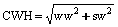
These waves come about when wind waves (ww) are superimposed on swell waves (sw). The interaction of wind waves and swell waves produces larger waves. However, observers do not report combined sea heights; they simply report the wind and swell. The resultant combined wave height (Cwh) is computed using the formula Cwh = a•sw2 or determined using combined sea-height tables (see the table below). Compute the combined-wave height using 8-foot wind waves and 15-foot swells. The combined height of these two waves works out to 17 feet, as follows:
= 
= 
= 
= 17
|
Wind-Wave Height |
|||||||||||||||||
|
5 |
6 |
7 |
8 |
9 |
10 |
11 |
12 |
13 |
14 |
15 |
16 |
17 |
18 |
19 |
20 |
||
|
5 |
7 |
8 |
9 |
9 |
10 |
11 |
12 |
13 |
14 |
15 |
16 |
17 |
18 |
19 |
20 |
21 |
|
|
6 |
8 |
8 |
9 |
10 |
11 |
12 |
13 |
13 |
14 |
15 |
16 |
17 |
18 |
19 |
20 |
21 |
|
|
S |
7 |
9 |
9 |
10 |
11 |
11 |
12 |
13 |
14 |
15 |
16 |
17 |
17 |
18 |
19 |
20 |
21 |
|
W |
8 |
9 |
10 |
11 |
11 |
12 |
13 |
14 |
14 |
15 |
16 |
17 |
18 |
19 |
20 |
21 |
22 |
|
E |
9 |
10 |
11 |
11 |
12 |
13 |
13 |
14 |
15 |
16 |
17 |
17 |
18 |
19 |
20 |
21 |
22 |
|
L |
10 |
11 |
12 |
12 |
13 |
13 |
14 |
15 |
16 |
16 |
17 |
18 |
19 |
20 |
21 |
21 |
22 |
|
L |
11 |
12 |
13 |
13 |
14 |
14 |
15 |
16 |
16 |
17 |
18 |
19 |
19 |
20 |
21 |
22 |
23 |
|
12 |
13 |
13 |
14 |
14 |
15 |
16 |
16 |
17 |
18 |
18 |
19 |
20 |
21 |
22 |
22 |
23 |
|
|
W |
13 |
14 |
14 |
15 |
15 |
16 |
16 |
17 |
18 |
18 |
19 |
20 |
21 |
21 |
22 |
23 |
24 |
|
A |
14 |
15 |
15 |
16 |
16 |
17 |
17 |
18 |
18 |
19 |
20 |
21 |
21 |
22 |
23 |
23 |
24 |
|
V |
15 |
16 |
16 |
17 |
17 |
17 |
18 |
19 |
19 |
20 |
21 |
21 |
22 |
23 |
23 |
23 |
25 |
|
E |
16 |
17 |
17 |
17 |
18 |
18 |
19 |
19 |
20 |
21 |
21 |
22 |
23 |
23 |
24 |
25 |
26 |
|
17 |
18 |
18 |
18 |
19 |
19 |
20 |
20 |
21 |
21 |
22 |
23 |
23 |
24 |
25 |
25 |
26 |
|
|
H |
18 |
19 |
19 |
19 |
20 |
20 |
21 |
21 |
22 |
22 |
23 |
23 |
24 |
25 |
25 |
26 |
27 |
|
E |
19 |
20 |
20 |
20 |
21 |
21 |
21 |
22 |
22 |
23 |
23 |
23 |
25 |
25 |
26 |
27 |
28 |
|
I |
20 |
21 |
21 |
21 |
22 |
22 |
22 |
23 |
23 |
24 |
24 |
25 |
26 |
26 |
27 |
28 |
28 |
|
G |
21 |
22 |
22 |
22 |
22 |
23 |
23 |
24 |
24 |
25 |
25 |
26 |
26 |
27 |
28 |
28 |
29 |
|
H |
22 |
23 |
23 |
23 |
23 |
24 |
24 |
25 |
25 |
26 |
26 |
27 |
27 |
28 |
28 |
29 |
30 |
|
T |
23 |
24 |
24 |
24 |
24 |
25 |
25 |
25 |
26 |
26 |
27 |
27 |
28 |
29 |
29 |
30 |
30 |
|
24 |
25 |
25 |
25 |
25 |
26 |
26 |
26 |
27 |
27 |
28 |
28 |
29 |
29 |
30 |
31 |
31 |
|
|
25 |
25 |
26 |
26 |
26 |
27 |
27 |
27 |
28 |
28 |
29 |
29 |
30 |
30 |
31 |
31 |
32 |
|
Now, use the combined sea-height table above, using the same wind and swell wave heights, and you should come up with the same answer. If your answer is something other than 17 feet, you have misread the table.
Combined sea-height charts (analyses and prognoses) are most often produced at the oceanography centers and transmitted by radio signals. The importance of such products to mariners is that it lets them know the highest seas or highest forecast seas in a particular operating area or along a particular route.
Rogue or freak waves
Rogue or freak waves get their name from their height, which is abnormally high compared to the sea heights observed before the occurrence of this type of wave. The USS Shreveport met such a wave while operating in the Virginia Capes operational area (OPAREA). The wave washed over the Shreveport’s bow and crashed into the superstructure at bridge level. It knocked out every window in the bridge, and men and equipment were battered. Before meeting this freak wave, the seas were normal, based on the wind conditions at the time. Such abnormal waves are highly infrequent and totally unpredictable. Oceanographers are not sure what causes these waves, but based on studies of encounters such as that of the USS Shreveport, oceanographers have found that these waves occur most frequently in areas of strong SST gradients. Such gradients exist where cold and warm sea currents meet. One such area is the North Wall of the Gulf Stream. Another area exists along the coast of South Africa, where the cold Benguela Current meets the warm Agulhas Stream.
Tides are caused primarily by the gravitational attraction between the Earth, Sun, and Moon. There are four tides within every 24-hour 50-minute period with two low and two high tides. Because of differing conditions, some areas may have only two discernible tides (1 high and 1 low). See topical statement 419 for more information on tides.
Catastrophic waves
Catastrophic waves can cause widespread destruction. We are only concerned with three types: seismic waves, storm surges and landslide surges.
Seismic sea waves are commonly called tsunamis. A tsunami is a wave generated by a submarine (underwater) earthquake or volcanic event. These waves are commonly called tidal waves, but they have no relationship to tides whatsoever. The proper term is tsunami. These waves are usually caused by fault movement, a displacement in the Earth’s crust along a fracture, that causes a sudden change in water level at the surface of the ocean. The upward or downward movement of the ocean bottom rapidly raises or lowers the water level. The resulting wave energy spreads out in all directions much like ripples from a rock thrown into a pond, in this case the ocean. The length will exceed 200km and the wave can travel at speeds up to 700km/hr.
The tsunamis are commonly caused by earthquake activity along unstable continental margins and oceanic trenches. For these reasons they are the most common in the Pacific Ocean. In deep water the wave height is approximately one-half meter, so they are not easily seen by ships and may go unnoticed. In shallow water, they slow down quickly as their energy is converted to height (as surf). The crests may build to heights of more than 30 meters (100 feet). Large loss of life and extensive property damage have resulted from tsunamis. Japan, Hawaii, and Alaska are especially susceptible to these catastrophic waves. In the past 150 years, the Hawaiian Islands have, on the average, experienced a seismic sea wave every four years.
The International Tsunami Warning System (ITWS) was developed in 1946 after Hawaii was hit by a destructive wave. The warning is broadcasted to ships and coastal areas by Automatic Digital Network (AUTODIN) message traffic. On receipt of this warning:
Storm surges
Tropical storms generating strong winds and low central pressures raise the sea level just before coming ashore. These surges can raise sea level to abnormal levels in less than a minute in one huge sweeping wall. One such storm surge came ashore in Galveston, Texas in 1900 killing over 6,000 people as the sea rose to almost 30 feet.
Landslide surges
Movement of large quantities of rock or ice, into the ocean, due to glacial movements or earthquakes can generate immense waves. An exceptionally large wave occurred in Lituya Bay, Alaska, in 1958. It was established that 30,000,000 meters cubed of rock fell from a height of about 1,000 meters into the bay, causing a wave that rose over 500 meters into a mountainside on the other side of the bay. Over 15,000 people where drowned by a similar wave on the Japanese island of Kyushu in 1972.
Waves originating in distant storms often travel as long low swells that are scarcely noticeable until they near a shore and become surf. Surf is defined as swell that breaks on the shore. As the swell is deflected and scattered by outlying islands and bent around points into bays, the wave crests become oriented parallel to the shoreline. Hence, there is often considerable variation in surf characteristics.
Surf is described as the breaking of waves in either single or multiple lines along a beach, submerged bank or a reef. As waves move into water depths that are £ ½ wavelength, they begin to "feel bottom". For example, a wave train with wavelengths of 90 feet is affected by the bottom when the depth of the water becomes 45 feet or less. The motion of the water near the bottom is retarded by friction, which causes the wave to slow down. As the water becomes more shallow, the wave is affected in the following ways: wave speed decreases, period remains the same, wavelength becomes shorter, and wave crest increases in height. Since the energy between crests remains constant, the wave height must increase if the energy is to be carried in a short wavelength. A wave becomes unstable and "breaks" when the forward velocity of water particles at the top of the crest is greater than the wave velocity. Basically, when the wave crest becomes too high and is moving too fast, the wave becomes unstable and breaks into the preceding trough.
Factors influencing local surf conditions are as follows: the height, period, length, and direction of the incoming wave train, the winds near shore, bottom and beach topography, the angle of the breakers with the shoreline, the distance of the outermost breakers from the shoreline, and the average water depth at the point of breaking. Some of these factors are also important in establishing and maintaining the nearshore circulation system.
The surf zone (fig. 2–24) is defined as the horizontal distance in yards or feet between the outer most breaker and the limit of wave uprush on the beach. It is the environmental conditions within the surf zone, caused by tides, winds, nearshore bottom topography and beach slope, and the cumulative effect of sea and swell waves (and their secondary effects of littoral and rip currents) that can make or break a D-Day and/or H-hour. In order for you to make a surf zone forecast, you must understand the relationship of all the environmental factors, how they interact, and how they will affect the landing area.
Figure 2–24. Surf zone.
Tides
As mentioned earlier, tides are caused by gravitational attraction between the Earth, Sun and Moon. The changes or difference in feet between high tide and low tide is referred to as tidal range. Tidal range can play a major factor as to the timing of a landing. A large tidal range (some places as much as 50 feet) on a shallow sloped beach will expose a great deal more of the nearshore bottom during low tide than a beach with a steeper slope (i.e., a tidal range of 20 feet on a beach with a slope of 1:50 will expose 500 feet more of beach at low tide). Tidal information can be retrieved from various sources, including Geophysics Fleet Mission Program Library (GFMPL) software on Tactical Environmental Support System (TESS) and Mobile Oceanography Support Facility (MOSS). It will be necessary to know the latitude and longitude of the area of operations (AOA); and from there one can narrow the information down. GFMPL information will be valid for the day(s) chosen.
Winds
Wind will affect the waves and breakers within the surf zone, depending on the direction and velocity. Wind waves, or waves created by local wind conditions, are irregular and choppy in appearance, are nearly unstable in deep water, and they "break" shortly after they enter the surf zone. If the wind is blowing offshore, the surf can break further seaward than normal, and, if velocity is high enough, can cause a partial change in breaker type from spilling to plunging. If the wind is onshore, the surf can break closer to the beach than normal, and, if velocity is high enough, cause a partial change in breaker type from plunging to spilling (fig. 2–25).
Figure 2–25. Winds and breakers.
As a wave moves from deep to shallow water the lower portion of the wave feels the bottom first. Its forward motion is slowed while the upper portion of the wave continues at the same speed. The type of breaker that occurs is the result of the beach slope the wave moves over as it approaches the beach. When a wave enters water that is shallower than half its wavelength, the motion of the water near the bottom is retarded by friction. This causes the bottom of the wave to slow and the waves are said to "feel bottom." The process of the waves increasing height continues until the crest of the wave becomes too high for its motion. At this point the wave becomes unstable and falls into the preceding wave trough; when this happens the wave is said to be breaking. The steepness of the wave in the deep water and the slope of the beach determines what type of breaker will occur.
Nearshore bottom topography and beach slope
A major factor in preparing a surf forecast for an amphibious operation is the nearshore bottom topography and beach slope. The underwater features in the littoral zone of the AOA will affect the size of the surf zone and breakers, development of littoral and rip currents, and timing of operations depending on tidal range. Not all land masses have straight in approaches to their shoreline. There are underwater (submarine) canyons and ridges, and some continents and most islands have coral reefs.
Beach slope
Beach slope is another major factor in determining the type of breakers in the surf zone. Beach slopes can vary from shallow or flat (1:120 or better) to steep or vertical (1:15). The steeper the slope, the more difficult the landing can become. Some general slope conditions are:
Refraction
Refraction of the wave train as it approaches and enters the surf zone will affect the size and speed of the breakers within the zone. Refraction is the bending of a wave that occurs when one portion of the wave moves slower than another portion. The changes in speed can occur along straight coastlines as well as irregular shaped coastlines, and due to irregularities in the nearshore bottom topography (submarine canyons/ridges). One portion of the wave will "feel bottom" first, slowing it down due to friction. The portion of the wave in deep water is moving faster and is refracted toward the beach, causing a stretching of the wave crest and a reduction in the wave height. Waves approaching a submerged ridge or sandbar that is oriented perpendicular to the beach will have the faster moving portion refracted toward the center of the beach. Conversely, waves approaching a submerged canyon will have the slower portion refracted away from the center of the beach.
With these factors in hand and knowing the sea and swell height, speed and direction, a surf forecast can be attempted. Calculation results will provide breaker type, among the many other pieces of information. There are three breaker types: spilling, plunging, and surging. The ability to distinguish between these breaker types within the surf line can be critical to the success of an amphibious operation, especially where small landing craft are concerned.
Spilling breakers are waves that break very gradually as they move through the surf zone. The appearance is characterized by white water and foam that forms at the crest of the wave as it first feels the bottom. As the wave continues toward the beach, the white water and foam will spread down the landward face of the wave. Spilling waves occur when waves approach a surf zone with a gradual beach slope, and the wind is blowing toward the beach. Wave trains generally retain an inverted "V" shape all the way to the beach
Spilling breakers (fig. 2–26) can be identified because they break gradually over a distance. When they do break, white water forms at the crest and expands down the face of the breaker. Spilling breakers normally form when the period is long and the beach slope is gradual.
Figure 2–26. Spilling breaker.
Plunging breakers are violently breaking waves that gain height rapidly as it first feels the bottom. The crest begins to curl and lean toward land until it finally collapses. Plunging breakers occur when the beach slope is moderate to steep, and the wind is blowing toward the ocean. The wave crest advances faster than the wave base causing the crest to curl and break with a crash. The resulting white water appears almost instantly over the complete front face. Water rapidly rises at the crest, while its wave crest curls and falls into the preceding trough. Wave trains break, often forming plunging curlers or tubes in the surf zone.
Plunging breakers are easily identified (fig. 2–27). The wave crest curls over and breaks violently with a crash. White water appears instantly over the complete front face of the breaker. Plunging breakers normally form when the period is long and the beach slope is steep. A good example is the waves from the television program "Hawaii Five-O".
Figure 2–27. Plunging breakers.
Surging breakers do not display a pronounced pattern of breaking. On entering the surf zone the wave increases in height very slowly, the crest peaks but does NOT break as with other types, instead it continues to move up on to the beach. The deep water wave is stable and the beach slope is very steep. Surface winds are of little or no importance in the formation of this type of breaker. The crest maintains the same speed as the base and surges up on the beach. The white water forms from the surge on the beach. Water surges up and down along surf zones without spilling or plunging.
Surging breakers are not readily identified as the previous two types, for they do not display a pronounced pattern of breaking (fig. 2–28). The crest of a surging breaker peaks, then surges onto the beach. Surface winds are of little or no importance to the formation of surging breakers, and they normally occur when the beach slope is very steep.
Figure 2–28. Surging breaker.
Secondary problems
There are secondary problems involved with certain types of breakers.
Broaching
Broaching is when a landing craft gets turned parallel to the wave train, which is usually away from its intended direction of movement. Broaching frequently occurs when a beached craft (whether on the beach itself or "hung" on an offshore sandbar) is hit by a powerful crest. The craft is moved (becoming a danger to other craft and personnel) and becomes parallel to the wave train which then makes it susceptible to swamping.
Swamping
Swamping occurs when a craft is overtaken by a plunging breaker, and the wave "breaks" into and/or over the craft, causing it to fill with water, sink, turn over, shift out of position, or incur some other hazardous ordeal.
Surf boarding
Surf boarding is when a craft is overtaken by a spilling breaker that carries the craft along, causing it to get out of control, broach, collide with another craft or hit some personnel.
Specialized types of currents
Two interrelated current systems may appear near the shore. They are the coastal current system and the nearshore current system. The coastal system is a relatively uniform drift that flows roughly parallel to shore. It may be composed of tidal currents, wind-driven currents, or local, density-driven currents. The nearshore system is more complex and is composed of shoreward moving water in the form of waves at the surface, a return flow or drift along the bottom in the surf zone, nearshore currents that parallel the beach (longshore or littoral), and rip currents.
Littoral currents
The first current is called a littoral or longshore current. These currents occur in the surf zone and are caused by waves approaching the beach at an angle. If you ever swim in the surf where ocean waves are approaching the beach at an angle, you will most likely become aware of the longshore current. Most people like to swim in the immediate proximity of the beach where they enter the water. However, what many swimmers find out after being in the water awhile is that they are transported quite a distance from where they entered the water. The transporting mechanism is the longshore current.
At times the current is almost imperceptible, but at other times, it can be quite strong. Generally, longshore currents increase with:
Also, under otherwise identical conditions, a steep beach will have a stronger longshore current than a more gently sloping beach. Another factor to consider is the development of a longshore sandbar. These bars channel the current in the trough between the bar and the beach, and quite a strong current can result.
Littoral or longshore currents are created when water from the breaking waves is carried toward the beach. If the wave train approaches the beach at an angle, the incoming water forms a current that flows parallel to the beach in the direction that the wave train is moving (fig. 2–29).
Littoral current velocity increases with increasing breaker height, increasing angle of the breaker with the beach, and with a steeper beach slope. Any one of those three conditions will increase the velocity. If sea/swell heights are forecasted to increase, expect your littoral current to increase as well.
Littoral currents are of vital importance during amphibious operations for many reasons. As littoral currents flow parallel to the coastline, sediment is transported along the beach. The amount depends on the speed of the current and the size of the particles. As a result of littoral currents, coastal features undergo seasonal changes as these currents dig deep channels and cause the beaches to erode. One of the most important things to remember about littoral currents is that they can have a devastating effect on troops as they attempt to land on a beach. While wading towards the beach, a littoral current would not only pull the troops down under the water, but also force them to be moved further down the coastline than where the objective originally was. This holds true for landing craft as well. A strong littoral current (greater than 0.5 knots) can move landing craft out of position and cause them to miss the intended beach.
Rip currents
Rip currents are quite often erroneously called "rip tides." A rip current is not associated with the tides, but is caused by the return flow of water from the beach. The current resembles a small jet or neck in the breaker zone, which fans out behind the breakers and becomes quite diffuse. The current extends from the surface to the
bottom and is quite strong. The strength or intensity of rips is not predictable, but is determined using the same factors that control longshore currents. The speed of feeder currents flowing into the jet increases as they near the jet.
Rip currents consist of three parts. The first part is the feeder current which flows parallel to the shore, inside the surf zone and is formed by opposing littoral currents (opposing currents may be formed in a variety of situations). The neck is the place where feed currents converge and flow through the breakers seaward in a narrow band or "rip", and appear as a stretch of unbroken water in the breaker line. The head is the place where the current widens and diminishes outside the surf zone; outlines of this current are usually marked by patches of foam while the head itself is usually discolored by sediment and/or sand in suspension (fig. 2–30).
Rip currents may or may not occur along a stretch of beach. When they occur, they may be irregularly spaced, or regularly spaced at long or short intervals. They commonly form at the down-current end of a beach where a headland (a point where the land juts out into the water) deflects the longshore current seaward.
Once rip currents form, they cut grooves in the sand and remain in a fairly constant position until the wave conditions change. Common locations for development of rip currents are at the head of indentations in the straight coastlines and opposite small headlines along irregular coastlines.
Current velocities of up to 2 knots, combined with the trough they cut make rip currents hazardous for swimmers and landing craft. They are not as severe and dangerous as littoral or longshore currents, yet could slow the advance of landing craft heading into a rip.
Storm surge
Depending on time of year, location, and other factors, a storm surge may be a factor during operations. A storm surge is the result of large cyclonic storms that exist over the ocean. A mass of wind-driven water that is associated with the storm winds produces a short-term abnormal increase in sea level. This phenomenon is extremely hazardous for amphibious actions that involve over the beach operations.
The storm surge begins with a "hill" of water that develops over the ocean directly under the storm. This hill of water is formed by the wind stress on the water’s surface that pulls mass directly into the storm’s center, then moves with the storm across the ocean. Coriolis force is not important in the formation of storm surge. The water involved moves only a short distance, and the storm is at one place only a short time. Storm surges produce downward vertical motions in the surface water mass. When the storm approaches land, the increase in the sea level depends on the type of land mass effected. Around islands, where there are no natural boundaries to water movement, sea level increases are usually less than a meter. Along low lying coasts, where movement of water is restricted by land, increases in local sea level may be 4 meters (13 feet) or more. The largest storm surges result from strong winds blowing across shallow waters.
Storm surges can occur with both Tropical and extratropical cyclones, often with deadly force. As a cyclone hits a coast, the highest storm surge will be associated with the right-front quadrant of the storm, with respect to movement. This is true in the Northern Hemisphere. The opposite is true in the Southern Hemisphere. Storm surges are commonly forecast by NOAA for both tropical and extratropical cyclones effecting the United States.
419. Tides and tidal computations
Tides are gravitational waves that have lengths in hundreds of miles and heights ranging up to 50 feet (i.e., Yellow Sea). The tides are a consequence of the simultaneous action of the Moon’s, the Sun’s, and the Earth’s gravitational forces, and the revolution about one another. Although the gravitational attraction between the Earth and the Sun is over 177 times greater than that of the Earth and Moon, the Moon dominates the tides due to distance and the frequency of the Earth/Moon rotation. This is because of the distance factor. Since the Sun is 390 times farther from the Earth than the Moon, its tide generating force is reduced by 390 cubed, or about 59 million times compared to that of the Moon. In principle, the other planets also exert tidal forces but their values are so small that they become nearly negligible.
The tides are of primary importance to ship captains when preparing to get underway or enter port. Although Navy Quartermasters do the majority of tidal computations in the Navy, you may be tasked with computing and publishing tidal data for the operational area during a joint exercise or maneuver.
Factors affecting tides
Gravitational attraction exists between the Earth and the Moon and the Earth and the Sun. It is an invisible force that acts to pull two bodies together. The strength, or magnitude, of the attraction depends on the mass of the two bodies and the distance between them.
Sir Isaac Newton deduced that gravitational attraction is (1) directly proportional to the product of the masses of two bodies and (2) inversely proportional to the square of the distance between them. In other words, the force of gravity increases if the product of the mass of the two bodies decreases. Even though the Earth-Sun mass is much greater than the Earth-Moon mass, the gravitational attraction between the Earth and the Moon is approximately 2 ½ times greater than the Earth-Sun attraction. The reason for this is that the Moon is nearer the Earth.
The influence of the Moon and Sun on tides
To a large extent, the height of the various tides depends on the Moon’s position in relation to the Earth. Refer to figure 2–31. On the side of the Earth facing the Moon (A), gravity is greatest, because the side of the earth facing the Moon is closer to the Moon. The Moon’s gravitational pull acts to pile water up on this side of the Earth, producing the highest of the daily tides.
The Moon’s gravitational attraction is weaker on the side of Earth facing away from the Moon (B), because that side is farther away from the Moon. High tides occur on this side of Earth as well, but they are not as high as those on the side facing the Moon.
On those parts of Earth that are not in line with the Moon (C and D), the water level of tides is lower than that occurring at A and B. The reason for the low tides over these regions is related to tractive forces. Tractive forces act tangentially to Earth’s surface and cause the horizontal movement of water associated with tides–the tidal currents.
The Moon revolves around Earth once every 24 hours and 50 minutes, producing a daily tidal effect. In oceanography, this period is referred to as a tidal day. When the Moon is new or full, the Sun and the Moon are aligned with Earth (fig. 2–32, view A). At these times, the gravitational pull on Earth is greater because of the combined gravitational attraction of the Sun and the Moon.
When the Moon is in its new and full phases, the high tides are higher than normal and the low tides are lower than normal. These tides are called the spring tides.
When the Moon is in its first- and third-quarter phases, the Sun and the Moon are at right angles to each other (fig. 2–32, view B). This alignment produces lower-than-normal high tides and higher-than-normal low tides. In other words, the range of the rise and fall of the water level is less than normal. These tides called the neap tides.
Other factors affecting tides
From the above information, it would appear that the rise and fall of the tides are pretty straightforward based on the position of the Moon and the Sun in relation to Earth. But this is not the case. The daily tides are not uniform.
Some places have two high and two low tides a day, while others may have one high and one low. Some places have tidal ranges well above 25 feet, while others have minimal ranges.
There are many variables in the processes that control the time and height of a tide at a particular maritime location. Besides the relationship of the Moon, the Sun and Earth, Earth’s coastline configurations, ocean bottom configurations, and the interaction of water (wave mechanics) all affect tides.
Mathematical models have been developed that allow desktop computers to forecast tides based on the motions of the Moon, the Sun, and Earth. These programs are available for use. The "Tide Tables" produced by the National Ocean Service computers may still be used.
Tide tables
Tide Tables is a four-volume set of books. Each volume contains tidal information on a specific geographical area of the world. Tide Tables is broken up geographically as follows:
Volume 1–Europe and West Coast of Africa, including the Mediterranean Sea
Volume 2–East Coast of North and South America, including Greenland
Volume 3–West Coast of North and South America, including the Hawaiian Islands
Volume 4–Central and Western Pacific Ocean and Indian Ocean
Within each volume there are seven tables:
Tide computations are primarily carried out using the first three tables.
Daily tide predictions
Listing the tides for every coastal location would result in volumes of tide tables so vast as to be economically infeasible. Therefore, daily tide predictions are provided for reference stations only. Reference station tides are then used to calculate tides for other nearby stations known, as subordinate stations.
A copy of a page from Daily Tide Predictions is shown in figure 2–33. The reference station is listed at the top of the page, along with the year to which the information applies. Three months of tidal information is contained on each page. Under each month, the day, time, and height of high and low water are listed. The heights are listed in meters as well as in feet.
Another feature of Table 1 of Tide Tables is the "Typical Tide Curves." The tide curves show the day-to-day variations in the tide for various reference stations along a coast. Figure 2–34 is an example of typical tide curves. The days of the month are listed across the top of the page. The range of tide heights for each station listed is on the left. The names of the reference stations are centered above each set of curves. The phase of the Moon is pictured directly under the date on which the phase begins.
Figure 2–33. Sample of tidal prediction.
Figure 2–34. Typical tidal curves.
Tidal difference and other constants
Table 2 of Tide Tables, Tidal Differences and Other Constants, provides the information required to calculate the tides for subordinate stations. Subordinate stations are arranged in geographical order and are numbered chronologically
(fig. 2–35). Note that the table also provides the latitude and longitude of the subordinate stations, the time and the height differences of high and low water, the mean and spring tidal ranges, and the mean tide levels.
Figure 2–35. Sample of tidal differences and constants.
Differences
This section of the table contains the time and the height differences of high and low water between the subordinate station and the reference station. Where differences are omitted, they are unreliable or not known.
To obtain the times and heights of tides at a subordinate station on any date, apply the differences to the times and heights of the tides at the reference station for the same date.
Time difference
The time difference is the hours and minutes you apply to the reference station’s time of high and low tide. The time difference is added to or subtracted from the reference station’s time, depending on the sign preceding the time difference.
Height difference
The height differences in figure 2–35 are applied to the height of high and low water at the reference station. Height differences are usually given in feet. However, height differences may be given using ratios. Ratios may be shown for the high tide, low tide, or both. In this case, multiply the ratio by the tide height listed for the reference station to find the height of the tide(s) at the subordinate station. Height differences may also appear in the table (fig. 2–35) as a combination of a ratio and a height measurement. In this case, multiply the corresponding tide at the reference station by the ratio; then apply the height difference.
Range
Two ranges are shown for subordinate stations. Mean range is the difference, in height, between the high tides and the low tides. Spring range is the annual average of the highest semi-diurnal range, which occurs semimonthly (twice a month), when the Moon is in its new or full phase. The spring tide range is larger than the mean range where the type of tide is either semi-diurnal (two high tides and one low or two low and one high). The difference between the spring tide range and the mean range is of no practical significance where the type of tide is diurnal (one high and one low tide a day). Where the tide is chiefly diurnal, the table gives the diurnal range, which is the difference in height between mean high water and mean low water.
NOTE: For stations where the tide is chiefly diurnal, time differences, height differences, and ratios are intended primarily for predicting the higher high and lower low waters. When the lower high water and higher low water at the reference station are nearly the same height, the corresponding tides often cannot be obtained satisfactorily by tidal differences.
Mean tide level
The mean tide level is the plane between mean low water and mean high water. Dashes are entered when the data is unreliable or unknown.
Computing height of tide
The approximate height of a tide at any time between its high and low water can be found by using "Table 3" of the Tide Tables, "Height of Tide at Any Time", or the height can be obtained graphically by using the Tidal Height Graph.
Tabular method
Figure 2–36 is used to compute a tide’s height at any time between high tide and low tide. The table is made up of two sections: time and range.
Time
Subtract the time of low water from the time of high water, or vice versa, to obtain the elapsed time (duration) between the two tides to the nearest hour (h) and minute (m). You will enter figure 2–36 with this time. Note that the duration times listed in the far-left column only cover duration’s between 4 hours (4 00) and 10 hours 40 minutes (10 40). When the duration is less than 4 hours or greater than 10 hours 40 minutes, adjust the duration time before using the table.
1. If the elapsed time is GREATER than 10 hours and 40 minutes, use one-half the duration period and then double the correction value.
2. If the elapsed time is LESS than 4 hours, double the duration period and then use one-half the correction value. When the tide is nearer high water, the correction value is subtracted. When the tide is nearer low water, the correction value is added.
Range
To obtain the range of the tide, subtract the height of low water from the height of high water. You will enter the range section of figure 2–36 with this height difference if it is 20 feet or less. Note that the table’s maximum range is 20 feet. When the range of the tide is greater than 20 feet, but less than 40 feet, halve the range before using the table, then double the correction value. When the range is greater than 40 feet, enter the table using one-third of the range, then multiply the correction by 3. The same rule applies to the height correction value as it does for time: the correction is subtracted when the tide is nearer high water, and added when nearer low water.
Graphical method
The graphical method is used if the height of a tide is needed for different times during a day. This method assumes that the rise and fall of tides conforms to a simple "cosine" curve. If the tide follows a cosine curve, the graph can provide an accurate estimate of tide heights between high and low water; however, if the tide does not follow the cosine curve, the tide estimates will be off. To determine tides using the graphical method, use the following example:
Example: High tide occurs at 0012 and is 11.3 feet; low tide occurs at 0638 and is –2.0 feet.
Figure 2–37. Time and height scales.
Figure 2–38. High tide and low tide plotted on a graph.
Figure 2–39. Divided tide line.
Figure 2–40. One-tenth of the range is plotted.
Figure 2–41. Completed tidal height graph.
The graph is now complete and ready to use. To find the height of the tide at any time, simply follow the time upward until you intersect the cosine curve. From this point move horizontally to the height scale on the left and read the height.
Tidal currents
Tides rise and fall because of the water’s movement due to gravity. As a tide rises, water moves toward shore. A rising tide, or incoming tide, is known as a flood tide. As a tide falls, water flows seaward. A falling, or outgoing, tide is known as an ebb tide. When the tide floods and ebbs, the movement of water shoreward or seaward can be significant or hardly noticeable. The horizontal movement of water caused by tide changes is often called the tidal current. In estuaries, the tidal currents are often quite fast, exceeding 5 knots; in the open ocean, tidal currents rarely exceed 1 knot.
There is a period between an ebb tide and a flood tide when there is no appreciable horizontal movement of water. This period is known as "slack water."
There is another time between an ebb tide and a flood tide when there is no appreciable vertical movement of water. This period is known as a "stand."
It would appear that the "slack water" period and the "stand" period should coincide, but this is not always the case. Along a regular coastline, the two periods should coincide. But where a larger bay connects with an ocean through a narrow channel, the tide may continue to "flood" in the channel long after the high water stand, and vice versa. In other words, the tidal current continues in the channel after the water has stopped rising or falling.
For stations well exposed to the ocean there is usually little difference between the time of high and low water and the beginning of the flood or ebb tide. However, in narrow channels, land-locked harbors, or on tidal rivers, the time of slack water may differ by 2 or 3 hours from the time of high-water or low-water stand.
Self-Test Questions
After you complete these questions, you may check your answers at the end of the unit.
416. Waves
1. What is the highest point of a wave called?
2. Match each ocean wave characteristics in column B with its ocean wave description in column A. Items in column B may be used only once.
Column A ___1. Rate at which the wave moves through the water. ___2. The time interval between successive wave crests. ___3. Horizontal distance between two successive troughs. ___4. Three values are determined and forecast from this characteristic. ___5. Number of waves passing a given point during a one-second interval. ___6. The vertical displacement of a particle from sea level to the base of the trough. |
Column B a. Wave amplitude. b. Wave frequency. c. Wave height. d. Wavelength. e. Wave period. f. Wave speed. |
3. Name the two types of wave speed.
4. What is the relationship between wave frequency and wave height?
5. Match each ocean wave in column B with its function in column A. Items may be used only once.
Column A ___1. A prime example is a tsunami. ___2. Maintained by a periodic force. ___3. Also called deep water or surface waves. ___4. Water particles move in elliptical orbits as this wave passes. ___5. Composed of two progressive waves traveling in opposite directions. ___6. Waves that exist in water depths that are less than one-half of their wavelength. |
Column B a. Forced waves. b. Free waves. c. Long waves. d. Progressive waves. e. Short waves. f. Standing waves. |
6. Define "fetch area".
7. What impact do tangential stress and pressure transfer have on waves?
8. What determines the maximum height to which a wave will grow?
9. Define duration limited and fetch limited.
10. Name the two processes by which ocean waves decay.
11. Name the characteristics of a swell wave which delineate it from other waves.
12. Describe some factors which influence the height attained by wind waves.
13. Under what two circumstances is the wind unable to impart its maximum energy to the ocean waves?
14. What can cause the wave-dissipation process of swells?
15. When do combined waves occur?
16. Where do rogue or freak waves occur most frequently?
17. What is the primary cause of tides?
18. What is a tsunami?
19. What is the common cause of tsunamis?
417. Surf
1. Define surf.
2. How is surf described?
3. Describe what happens to a wave as it "feels bottom".
4. What factors influence local surf condition?
5. What is tidal range?
418. Types of breakers
1. What determines the types of breakers?
2. What is refraction of the wave train?
3. Name the types of breakers.
4. Describe the appearance of spilling breakers.
5. Where do plunging breakers occur?
6. How are plunging breakers identified?
7. What is broaching?
8. Describe swamping.
9. What is surf boarding?
10. What are the two interrelated current systems that may appear near the shore? Describe each.
11. Where do longshore currents occur? What causes them?
12. What is one of the most important things to remember about longshore currents’ effects on amphibious operations?
13. What causes rip currents?
14. Name the three parts of a rip current and describe each.
15. What initiates the largest storm surges?
419. Tides and tidal computations
1. What are tides a result of?
2. What does the height of various tides depend on?
3. What is a tidal day?
4. What are spring tides? Neap tides?
5. What are some of the variables that affect the time and height of a tide at any particular nautical location?
6. What does the Typical Tide Curves from the Tide Tables reveal?
7. What is the mean range? Spring range?
8. Define flood tide. Ebb tide.
Answers to Self-Test Questions
408
1. The Atlantic Ocean, Pacific Ocean, Indian Ocean, and the Arctic Ocean.
2. (1) c.
(2) a.
(3) b.
(4) d.
3. Seventy-one to seventy-six percent.
409
1. Currents are referred to by their drift and set. The speed of a current is called its drift. Drift is measured in terms of knots. The current’s set is the direction in which the current is moving (toward).
2. A cold current advects cold water into warm water. They are usually found on the west coast of continents in the low and middle latitudes and the east coast in the northern latitudes in the Northern Hemisphere.
3. A warm current advects warm water into cold water and is usually found on the east coast of continents in the low and middle latitudes. In the Northern Hemisphere they are located on the west coasts of continents in high latitudes.
4. Wind-driven, density, hydraulic, and tidal.
5. Wind-driven currents do not flow in the same direction as the wind. Due to coriolis force, the surface current moves in a direction 45 degrees or less to the right of the wind in the Northern Hemisphere. The surface mass of water moves as a thin sheet, setting another layer beneath it in motion. The energy of the wind passes through the water column from the surface down. The surface current flows at 1 to 2 percent of the speed of the wind that sets it in motion. Each successive layer of water moves with a lower speed and in a direction to the right of the one that set it in motion. The momentum transmitted by the wind is gradually lost, resulting in the water, at approximately 300 feet, moving slowly in a direction opposite the surface current.
6. Density current.
7. In straits separating water bodies, such as the Strait of Gibraltar.
8. In the littoral (coastal) zone.
410
1. The stresses exerted by the prevailing winds.
2. (1) h.
(2) j.
(3) l.
(4) e.
(5) d.
(6) b.
(7) c.
(8) k.
(9) f.
(10) g.
(11) a.
(12) i.
3. From the difference in the levels of the water in the Gulf of Mexico and the water next to the Florida coast with the Gulf waters being higher. The difference is due to the prevailing winds that results in a piling up of water in the Gulf of Mexico.
4. The large amounts of subarctic water in the North Pacific in comparison to the small amount in the North Atlantic.
5. Because these areas are bordered by warm waters they have cool summers and relatively mild winters with a small annual range of temperatures.
6. Because of the adjacent cool ocean currents they have cool summers.
411
1. Gyres are large oval or circular currents formed in the ocean basins by the combined effects of the winds and the position of the continents.
2. 100 to 200 meters (300 to 650 feet) below the surface.
3. They are unusually powerful, warm, narrow currents with a northward set in the Northern Hemisphere and a southward set in the Southern Hemisphere.
4. The California and Canary Currents in the Northern Hemisphere and in the Southern Hemisphere the Peru and Benguela Currents.
5. It is a result of the winds in the subtropical high-pressure system in both hemispheres.
6. These gyres form in the North Pacific and Atlantic, and are a direct result of the Aleutian and Icelandic low-pressure systems.
7. These gyres develop from the equatorial currents and counter currents.
412
1. Coriolis force causes the surface waters to move at right angles from the prevailing winds.
2. The presence of a continent means that the surface water that has been moved out to sea must be replaced from below. Due to the steep slope of the ocean floor along the west coasts of continents the water from the ocean bottom rises up to replace the water that moved out to sea.
413
1. The abundance and distribution of the associated fish population.
2. Yes, if the prevailing winds change and have sufficient duration (e.g., northeast/southwest Monsoon in the northern Indian Ocean).
414
1. They are density driven, are much slower, move in a predominantly north-south direction, and they cross the Equator.
2. Antarctic bottom water.
3. Because the surface-density contrasts are much greater.
4. Equatorward-flowing sub-surface water and the much faster poleward-flowing surface water.
415
1. A line of discontinuity (temperature and/or salinity) between two water masses.
2. Ocean currents, water masses, upwelling, and bathymetry.
3. The Sargasso Sea mass, the Gulf Stream mass, the slope water mass (Cape Hatteras to Grand Banks), and shelf water.
4. They are formed by the cutting off of meandering currents.
5. Warm-core eddies have a clockwise circulation, while cold-core eddies have a counterclockwise circulation.
416
1. Crest.
2. (1) f.
(2) e.
(3) d.
(4) c.
(5) b.
(6) a.
3. Individual wave speed and group wave speed.
4. They are inversely proportional where the lower the wave frequency, the higher the waves, and the higher the wave frequency, the lower the waves.
5. (1) b.
(2) a.
(3) e.
(4) d.
(5) f.
(6) c.
6. Areas of constant wind speed and direction over time.
7. They are ways of transferring energy to the water by the wind allowing the waves to grow with the size of the waves depending on the amount of energy transferred.
8. Wind speed, duration and the length of the fetch.
9. Duration limited occurs if the wind stops before the seas are fully developed. Fetch limited occurs if the fetch is too short for a fully developed sea to occur.
10. Dispersion and angular spreading.
11. They have a low, rounded appearance; with longer periods than other type of locally generated wave; travel great distances at relatively high speeds; and arrive at distant coasts from directions other than the local prevailing winds.
12. Wind speed, the time the wind blows in one direction (duration), and the length of the fetch.
13. When the fetch is not long enough or when the wind hasn’t been blowing long enough.
14. Internal friction within the waves, resistance met as waves overtake the wind, restraint caused by crosswinds, action of ocean currents in the path of waves, and the effects of seaweed, ice, shoals, islands, or continents in the path of waves.
15. When wind waves become superimposed on swell waves.
16. In areas of strong SST gradients.
17. The gravitational attraction between the Earth, Sun, and Moon.
18. A wave generated by an underwater earthquake or volcanic event.
19. Earthquake activity along unstable continental margins and oceanic trenches.
417
1. It’s swells that break on the shore.
2. It’s the breaking of waves in either single or multiple lines along a beach, submerged bank or a reef.
3. The motion of the water near the bottom decelerates due to friction, causing the wave to slow down. As the water gets more shallow, the wave speed decreases, the period remains the same, the wavelength becomes shorter, and the wave crest increases in height.
4. The height, period, length, and direction of the incoming wave train, the winds near shore, bottom and beach topography, the angle of the breakers with the shoreline, the distance of the outermost breakers from the shoreline, and the average water depth at the point of breaking.
5. It’s the change or difference in feet between high tide and low tide.
418
1. The steepness of the wave in deep water and the slope of the beach.
2. It’s the bending of a wave that happens when one portion of the wave moves slower than another portion.
3. Spilling, plunging and surging.
4. They are identified by white water and foam forming at the crest of the wave as it first feels bottom.
5. They occur where the beach slope is moderate to steep with the wind blowing toward the ocean.
6. The wave crest rolls over and breaks violently with a crash with white water appearing instantly over the complete front face of the breaker.
7. Broaching is when a landing craft gets turned parallel to the wave train, which is usually away from its intended direction of movement.
8. Swamping occurs when a craft is overtaken by a plunging breaker, and the wave "breaks" into and/or over the craft, causing it to fill with water, sink, turn over, shift out of position, or incur some other hazardous ordeal.
9. Surf boarding is when a craft is overtaken by a spilling breaker that carries the craft along, causing it to get out of control, broach, collide with another craft or hit some personnel.
10. They are the coastal current system and the nearshore current system. The coastal system is a nearly uniform drift that flows approximately parallel to shore composed of tidal currents, wind-driven currents, or local, density-driven currents. The nearshore system is more complex and is composed of shoreward moving water in the form of waves at the surface, a return flow or drift along the bottom in the surf zone, nearshore currents that parallel the beach, and rip currents.
11. They occur in the surf zone and are caused by waves approaching the beach at an angle.
12. They can have a devastating effect on amphibious troops as they attempt to land on a beach. While wading towards the beach, a littoral current not only pulls the troops down under the water, but also forces them to be moved further down the coastline than where the objective originally was. This is also true for landing craft as well. A strong littoral current can move landing craft out of position and causing them to miss the intended beach.
13. They are caused by the return flow of water from the beach.
14. The first part is the feeder current that flows parallel to the shore, inside the surf zone and is formed by opposing littoral currents. The neck is the place where feed currents converge and flow through the breakers seaward in a narrow band, appearing as a stretch of unbroken water in the breaker line. The third part is the head, which is the place where the current widens and diminishes outside the surf zone.
15. Strong winds blowing across shallow water.
419
1. The simultaneous action of the Moon’s, the Sun’s, and the Earth’s gravitational forces, and the revolution about one another.
2. They depend on the Moon’s position relative to the Earth.
3. It’s the Moon revolving around Earth once every 24 hours and 50 minutes producing a daily tidal effect.
4. Spring tide occurs when the high tides are higher than normal and the low tides are lower than normal while the Moon is in its new and full phases. Neap tides occur when the Moon is in its first- and third-quarter phases and the Sun and Moon are at right angles to each other. This causes lower-than-normal high tides and higher-than-normal low tides.
5. The relationship of the Moon, the Sun and the Earth, the Earth’s coastline configurations, the ocean bottom configurations, and the interaction of water (wave mechanics).
6. It shows day-to-day variations in the tide for various reference stations along a coast.
7. The mean range is the difference, in height, between the high tides and the low tides. Spring range is the annual average of the highest semi-diurnal range, which occurs twice a month, when the Moon is in its new or full phase.
8. A flood tide is a rising tide, or incoming tide where water moves toward shore. An ebb tide is a tide that falls, with water flowing seaward.
Do the Unit Review Exercises (URE) before going to the next unit.
Unit Review Exercises
Note to Student: Consider all choices carefully, select the best answer to each question, and circle the corresponding letter.
Please read the
unit menu for Unit 3 and continue. è