FAS | Nuke | Guide | USA ||| Search | Join FAS


Chemical Weapons
Chemical agents in the modern sense were first used in World War I, when chlorine gas was released, from large cylinders, in a favorable wind. This surprise operation caused massive casualties and demoralization of the forces attacked, and demonstrated the need for protection from this new kind of warfare. The first improvised mask was a cotton pad soaked in sodium thiosulphate, glycerin and sodium carbonate. Subsequently, during the course of World War I, a great variety of chemical agents were used by both sides, the most damaging being the blister-producing mustard gas. Military clothing, even with a respirator, gave little protection against this agent.Immediately prior to World War II and during the early part of that war, Japan is supposed to have used chemical weapons against China. During World War II, President Roosevelt announced a no-first-use policy, but promised instant retaliation for any Axis use of chemical agents. Consequently, it did bring chemical munitions to the European theater. Over 600 military casualties and an unknown number of civilian casualties resulted from the 1943 German bombing in Bari Harbor, Italy, of the John Harvey, an American ship loaded with two thousand 100-pound mustard bombs. At the end of the war it was discovered that the Germans had developed and stockpiled newer agents, called "nerve gases." These were found to be effective in much lower concentrations than any other agents known up to that time.
The end of World War II did not stop the development or stockpiling of chemical weapons. The U.S. indeed maintained a chemical weapons program, although upholding President Roosevelt's no-first-use policy. In 1969, this policy was reinforced by President Nixon, who unilaterally reaffirmed the U.S. renunciation of the first use of lethal chemical weapons, extending it also to incapacitating agents. The no-first-use policy was subsequently corroborated in 1975, when, with the stated reservation that the treaty did not apply either to defoliants or to riot-control agents, the U.S. ratified the Geneva Protocol -- of note, the U.S. used defoliants and riot-control agents in Vietnam and Laos.During these years, although it renounced the first use of lethal or incapacitating agents, the U.S. retained the right to retaliate if deterrence failed to prevent the enemy's first use of chemicals. Consequently, it maintained a stockpile of chemical munitions. As is the case with nuclear weapons, the President of the United States had to approve the initial use of chemical weapons. This approval procedure was known as chemical release.
The U.S. stockpile of unitary lethal chemical warfare munitions consisted of various rockets, projectiles, mines, and bulk items containing blister agents (mustard H, HD, HT) and nerve agents (VX, GB). About 60% of this stockpile was in bulk storage containers; 40% was stored in munitions, many of which, however, were obsolete weapons in need of disposal. The stockpile was stored at eight sites throughout the Continental US (Edgewood Chemical Activity, MD; Anniston Chemical Activity, AL; Blue Grass Chemical Activity, KY; Newport Chemical Depot, IN; Pine Bluff Chemical Activity, AR; Pueblo Chemical Depot, CO; Deseret Chemical Activity, UT; and Umatilla Chemical Depot, OR) and at one site outside of the Continental US on Johnston Atoll. In 1985, the Congress passed Public Law 99-145 directing the Army to destroy the US stockpile of obsolete chemical agents and munitions. Recognizing that the stockpile program did not include all chemical warfare materiel requiring disposal, the Congress directed the Army in 1992 to plan for the disposal of materiel not included in the stockpile. This materiel, some of which dated back as far as World War I, consisted of binary chemical weapons, miscellaneous chemical warfare materiel, recovered chemical weapons, former production facilities, and buried chemical warfare materiel. In 1992, the Army established the Non-stockpile Chemical Materiel Project, now Recovered Chemical Materiel Directorate, to dispose of the materiel. In 1993, the UN-sponsored Chemical Weapons Convention -- which imposes a complete ban on the use, development, production, acquisition and stockpiling of chemical weapons -- was opened for signature. In October 1996, the 65th nation ratified the convention, thus making the treaty effective on April 29, 1997. The U.S. signed the CWC on the same day the Convention was open for signature, and subsequently ratified it in 1997, a few days before it entered into force. Through ratification, the U.S. embraced the absolute ban on chemical weapons and agreed to dispose of its unitary chemical weapons stockpile, binary chemical weapons, recovered chemical weapons, and former chemical weapon production facilities, and miscellaneous chemical warfare materiel. As of 2018, about 90% of the U.S. chemical stockpiles have been destroyed. In particular, the stockpiles at seven of the above-mentioned nine sites have been completely destroyed and disposed of, while work is ongoing at the chemical depots Pueblo and Blue Grass sites to destroy the remainder of the stockpiles in a safe and environmentally sound manner.
US Chemical Munitions
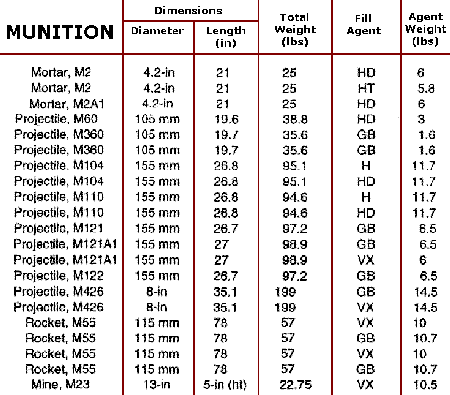
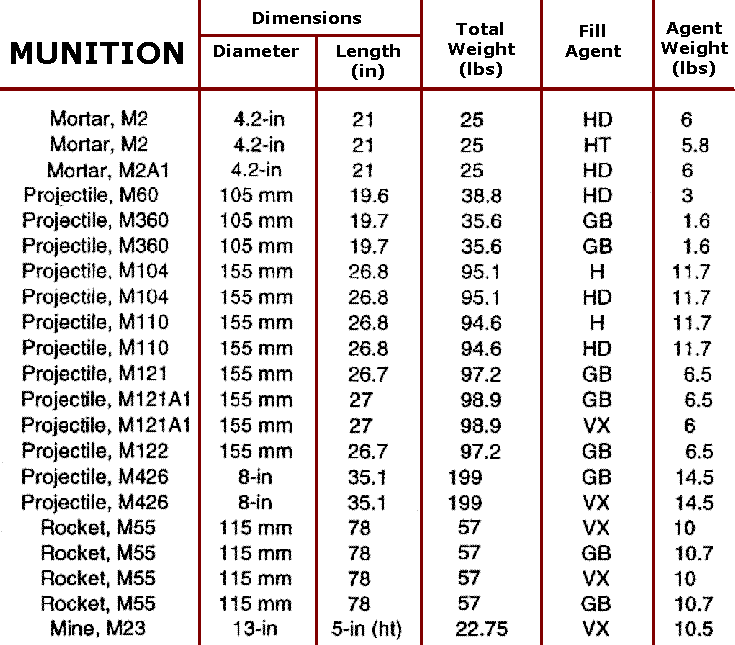
The munitions listed below used to be part of the U.S. chemical stockpiles. Some of them can still be found at the Pueblo and Blue Grass chemical depot sites, waiting for disposal.
- M60 105mm (Pueblo)
- M360 105mm (Pueblo)
- M104 155mm (Pueblo)
- M110A1/A2 155mm (Pueblo, Blue Grass)
- M121/A1 155mm
- M122 155mm
- M687 155mm
- M426 8-inch (Blue Grass)
- M23 landmine
- M55 rocket (Blue Grass)
- 4.2 inches mortar rounds (Pueblo)
As of October 2018, 90% of the chemical weapons stockpiles have already been destroyed at the sites marked with green checkmarks.
Work is ongoing at the Blue Grass and Pueblo Sites to destroy the remainder 10%.
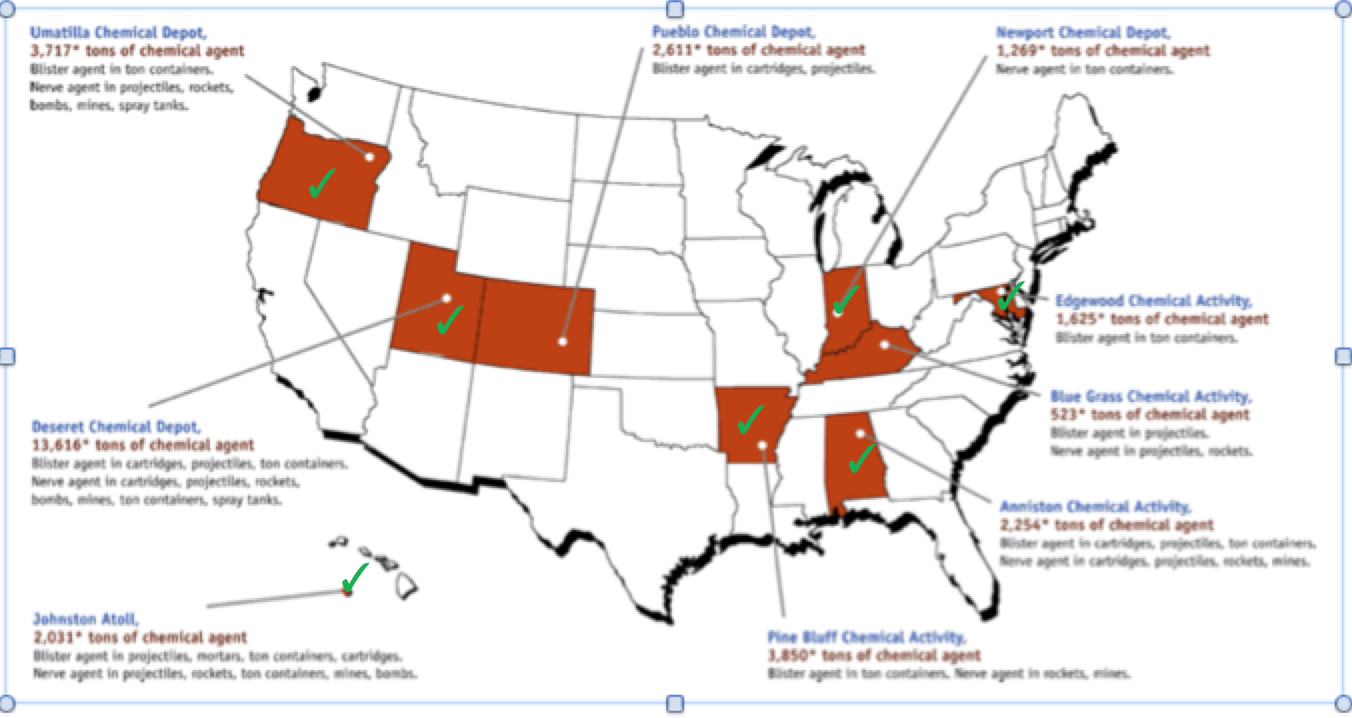
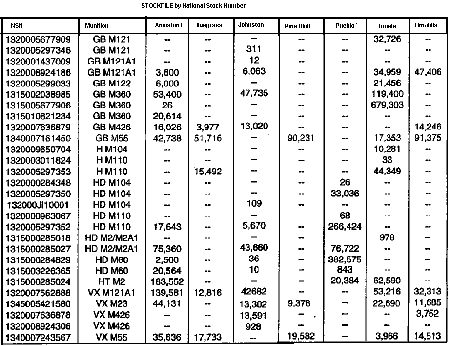
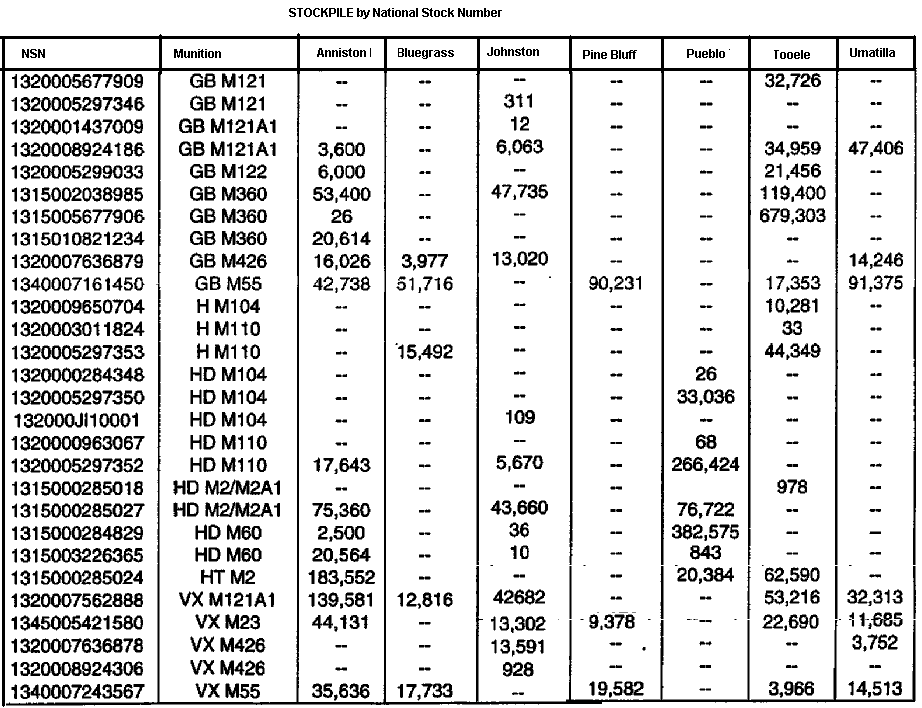
Quantity of assembled chemical weapons by site as of July 1997. By October 2018, about ninety percent of the stockpiles had been destroyed. Work is ongoing at the Blue Grass and Pueblo Sites to destroy the remainder 10%.
Weapon Type Weapon Quantities by Site (1)
Anniston
Blue Grass
Pine Bluff
Pueblo
Tooele
Umatilla
JACADS
Mustard Agent (H, HD, HT) 105-mm Projectile (HD)
155-mm Projectile (H, HD)
4.2-in. Mortar (HD, HT)
23,064
17,643
258,912
—
15,492
—
—
—
—
383,418
299,554
97,106
—
54,663
63,568
—
—
—
46
5,779
43,660
Agent GB 105-mm Projectile
155-mm Projectile
8-in. Projectile
M55 Rocket
74,040
9,600
16,026
42,738
—
—
3,977
51,716
—
—
—
90,231
—
—
—
—
798,703
89,141
—
17,353
—
47,406
14,246
91,375
47,735
6,386
13,020
—
Agent VX 155-mm Projectile
8-in. Projectile
M55 Rocket
M23 Land Mine
139,581
—
35,636
44,131
12,816
—
17,733
—
—
—
19,582
9,378
—
—
—
—
53,216
—
3,966
22,690
32,313
3,752
14,513
11,685
42,682
14,519
—
13,302
(1) Munitions quantities are as of July 11, 1997
The Non-Stockpile Project
While the stockpile project poses many challenges, the non-stockpile project faces its own set of complex issues. As explained, the term non-stockpile chemical materiel describes a wide variety of chemical warfare materiel that was not part of the unitary stockpile as declared in 1986. This materiel existed in a variety of physical configurations that range from chemical agent identification sets once used to teach soldiers how to identify chemical agents to large former weapons-production facilities. Part of this materiel was located on active or former military bases. However, much of it was buried at small, geographically dispersed sites, as burial was once an accepted disposal practice. The logistical problems posed by locating burial sites, identifying what is buried there, and determining how to remove it safely are serious and far-ranging.Despite the challenges, the Recovered Chemical Materiel Directorate completed several milestones, including the destruction of: miscellaneous chemical warfare materiel (2002), former chemical warfare production facilities (2006), binary chemical weapons (2007), treaty-declared recovered chemical warfare materiel (2010). Remediation activities are still ongoing at several locations, including the Spring Valley section of Washington, D.C., where buried chemicals and chemical munitions have been found as a consequence of the World War I chemical weapons research activities conducted by the U.S. Army at the American University Experiment Station.
Sources and Resources
Board on Army Science and Technology, National Research Council, "Disposal of Chemical Agent Identification Sets." National Academies Press, Washington, D.C., 1999.
Board on Army Science and Technology, National Research Council, "A modified baseline incineration process for mustard projectiles at Pueblo chemical depot." National Academy Press, Washington, D.C., 2001. Appendix A, "Description of Pueblo Chemical Depot Stockpile."
Board on Army Science and Technology, National Research Council, "Analysis of engineering design studies for demilitarization of assembled chemical weapons at Blue Grass Army Depot." National Academies Press, Washington, D.C., 2002.
Board on Army Science and Technology, National Research Council, "Remediation of Buried Chemical Warfare Materiel." National Academies Press, Washington, D.C., 2012.
Center for Disease Control and Prevention (CDC), "Chemical Weapons Elimination -- Infographic: 30 Years of Successful Action," October 5, 2015. Accessed: October 2, 2018.
Chemical Weapons Convention, Article 1. Accessed: October 2, 2018.
Department of Defense Office of Inspector General, DoD OIG Reports, "Chemical Demilitarization - Assembled Chemical Weapons Alternatives Program", February 22, 2018. Accessed: October 2, 2018.
Inspector General, U.S. Department of Defense, "Evaluation of Army Recovered Chemical Warfare Materiel Response Actions," December 14, 2017. Accessed: October 2, 2018.
Program Executive Office, Assembled Chemical Weapons Alternatives (PEO ACWA), "Program Timeline." Accessed: October 2, 2018.
Program Executive Office, Assembled Chemical Weapons Alternatives (PEO ACWA), "Pueblo Chemical Agent-Destruction Pilot Plant (PCAPP)." Accessed: October 2, 2018.
Program Executive Office, Assembled Chemical Weapons Alternatives (PEO ACWA), "Blue Grass Chemical Agent-Destruction Pilot Plant (BGCAPP)." Accessed: October 2, 2018.
Recovered Chemical Materiel Directorate, "Fact Sheet - RCMD Overview." Accessed: October 2, 2018.
Recovered Chemical Materiel Directorate, "Fact Sheet - Munitions." Accessed: October 2, 2018.
U.S. Department of State, Public Statements of the Presidents, "Statement on Chemical and Biological Defense Policies and Programs," November 25, 1969. Accessed: October 2, 2018.
FAS | Nuke | Guide | USA ||| Search | Join FAS
http://www.fas.org/nuke/guide/usa/cbw/cw.htm
Thanks to Stefano Costanzi, PhD, MIS
Maintained by Steven Aftergood
Originally created by John Pike
Updated October 8, 2018