
 The
TheNuclear
Information
Project
| The Nuclear Information Project |
FAS | Nuke | Guide || Search | Join FAS |
At one time, some observers classified Libya among the most dangerous countries from the standpoint of the proliferation of weapons of mass destruction, including nuclear weapons. But in recent years, concerns about Libyan nuclear ambitions faded, though apprehensions about Libyan chemical weapons efforts remained very much alive. Libya was no position to obtain access to nuclear weapons for the foreseeable future, given the extremely limited domestic technical base of the country.
In 1975, Libya ratified the United Nations Nuclear Non-Proliferation Treaty (NPT), signed during King Idris' rule in 1969. In 1980, an agreement was reached with the International Atomic Energy Agency (IAEA) to place all of Libya's nuclear installations under international inspection. Despite these steps, in the mid- and late 1970s, Muammar Qadhafi repeatedly proclaimed his country's determination to acquire nuclear weapons, primarily because he was convinced that his archenemy, Israel, had achieved such a military capability.
Qadhafi sought help in obtaining nuclear technology from a number of countries, including the People's Republic of China. Among these efforts, cooperation with Pakistan launched in 1977 seemed for a time to be producing material results. Libya appeared to be providing financial assistance and later, deliveries of uranium "yellow cake" originating in Niger in the hope of eventually being compensated by weapons from Pakistan. However, in an interview with an Indian newspaper in March 1986, Qadhafi declared that Libya would never help Pakistan acquire an atomic bomb. Qadhafi said: "We consider nuclear weapons production a great mistake against humanity."
A 10-megawatt nuclear research reactor supplied by the Soviet Union in 1979 was installed at a research center at Tajura (32°52'54"N 13°21'02"E) near Tripoli staffed by 750 Libyan specialists and technicians. Many students were sent abroad; a group of 200 was studying in the United States until early 1983 when the United States proscribed training Libyans in nuclear science.
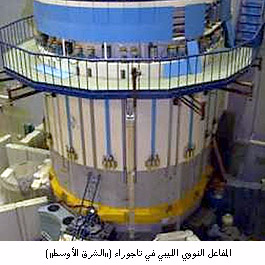
Libya planned to buy a nuclear power station from the Soviet Union, but, dissatisfied with the technology involved, negotiated with the Belgian firm of Belgonucleaire to take over the engineering contract and supply much of the needed equipment. After the United States objected, fearing use of the equipment in weapons development, Belgium decided in 1984 to refuse the US$1 billion contract. Shortly thereafter, Moscow's commitment to construct an 880-megawatt power station to be located in the Surt region was reaffirmed. It was to cost over US$4 billion, with repayment to stretch over 15 to 18 years.
In 2003, Libya officially renounced its nuclear weapons program and provided the United States and United Kingdom with extensive information on its nuclear program. Libya also agreed to declare all of its nuclear activities and projects to IAEA inspectors in addition to fully complying with the NPT and Additional Protocol. On January 6, 2004, Libya ratified the Comprehensive Nuclear-Test-Ban Treaty (CTBT).
Libya's biological warfare program is believed to have remained in the early research and development phase. Progress was slow due in part to an inadequate scientific and technical base. Though Libya may have been able to produce small quantities of usable agent, it was unlikely to transition from laboratory work to production of militarily significant quantities until well after the year 2000. Libya acceded to the Biological Weapons Convention (BWC) in 1982.
Libya experienced major setbacks to its chemical warfare program, first as a result of intense public scrutiny focused on its Rabta facility (at Qabilat az Zaribah at 32°09'27"N 12°50'32"E) in the late 1980s and more recently on its Tarhuna underground facility (aka Tarhuna, at 32°26'00"N 13°38'00"E) . Nevertheless, Libya retained a small inventory of chemical weapons, as well as chemical weapon agent production capability. Prior to closing its Rabta plant in 1990, Libya succeeded in producing up to 100 tons of blister and nerve agent at the site. Although the site was re-opened in 1995, ostensibly as a pharmaceutical plant, the facility was still believed capable of producing chemical weapon agents. Chemical weapons related activities at the Tarhuna site are believed to have been suspended. Libya had not ratified the Chemical Weapons Convention (CWC) but declared in December 2003 that it would do so. On January 6, 2004, Libya acceded to the CWC.
Libya had a theoretical capability of delivering nuclear weapons in the form of Scud and FROG missiles and missiles delivered by medium-range Tu-22 bombers. Libya is currently not a member of the Missile Technology Control Regime (MTCR). After Libya’s proclamation that it would be suspending its nuclear weapons program, Libya pledged to dismantle its longer ranged ballistic missiles, an action which was confirmed completed by the United States Department of State in 2004.
Suspicions that Libya was seeking to acquire a medium-range missile capability were aroused in 1980 when it was revealed that the West German firm, Orbital Transport-und-Raketen Aktiengesellschaft (OTRAG), had built a rocket-testing base in the Libyan desert. OTRAG, which had earlier been forced to give up a testing site in Zaire, claimed that it was working on a nonmilitary rocket to enable Third World countries to launch satellites cheaply. But this effort soon collapsed.
With the removal of Qadhafi from power in 2011, it remains unclear whether the new Libyan government will pursue policies concurrent or against the previous government’s non-proliferation practices.