 e-Printse-Prints
THE COUNTERAIR COMPANION:
A SHORT GUIDE TO AIR SUPERIORITY
FOR JOINT FORCE COMMANDERS
BY
JAMES MICHAEL HOLMES
A THESIS PRESENTED TO THE FACULTY OF
THE SCHOOL OF ADVANCED AIRPOWER STUDIES
FOR COMPLETION OF GRADUATION REQUIREMENTS
SCHOOL OF ADVANCED AIRPOWER STUDIES
AIR UNIVERSITY
MAXWELL AIR FORCE BASE, ALABAMA
JUNE 1994
Disclaimer
This publication was produced in the Department of Defense School environment in the interest of academic freedom and the advancement of national defense-related concepts. The views expressed in this publication are those of the author and do not reflect the official policy or position of the Department of Defense or the United States government.
About the Author
Major James Michael ("Mike") Holmes completed this study while assigned as a student at the School for Advanced Airpower Studies (SAAS), Maxwell Air Force Base (AFB), Alabama. Major Holmes is an F-15 Instructor Pilot, and has flown over 2200 hours during nine mission-ready years in the F-15 A/B/C/D. He has served as a Squadron and Wing Weapons and Tactics Officer, Flight Commander, and Assistant Operations Officer during operational flying assignments in the 71st Tactical Fighter Squadron at Langley AFB, VA, the 44th Tactical Fighter Squadron at Kadena AB, Japan, and the 7th and 9th Fighter Squadrons at Holloman AFB, NM.
Major Holmes' counterair experience includes operations in the Netherlands, Oman, Japan, Korea, Thailand, the Philippines, Panama, Saudi Arabia, Kuwait, Bahrain, and all over the United States. He has planned and led joint counterair operations with Navy Carrier Battle Groups in the Atlantic, the Pacific, the Caribbean, and the Persian Gulf, Marine Air Wings in Korea and Japan, and Army Air Defense Artillery Brigades in New Mexico. He has flown in over 100 large force employment exercises that linked joint air and surface counterair forces at RED FLAG, COPE THUNDER, and ROVING SANDS.
Major Holmes is a graduate of the Tactical Fighter Electronic Combat Instructor's Course, the F-15 Fighter Weapons Instructor's Course, Squadron Officer's School, and Air Command and Staff College. He holds a bachelor's degree in electrical engineering from the University of Tennessee and a master's degree in history from the University of Alabama. Major Holmes is married to the former Sara Elizabeth Lewis, and they have two children, Rebecca and Wade.
After SAAS, Major Holmes will begin a joint duty assignment in the Current Operations division of the United States European Command (USEUCOM) J-3.
Executive Summary
The early proponents of air power believed that with suitable aircraft, and control of the air, airmen would make surface operations impossible and irrelevant. In the years since they made these predictions, aircraft have gained capabilities far beyond those predicted by early advocates. However, airmen are still searching for a strategy that will guarantee the results their predecessors promised. Instead of replacing surface forces, air power has become their indispensable partner. Air power contributes to the security, mobility, and firepower of joint forces, but its primary contribution may be air superiority.
For the last forty years, United states military forces have enjoyed almost total control of the air. Although control of the air doesn't itself destroy or defeat the bulk of enemy forces, it establishes conditions that allow joint military forces to do so by providing freedom of action and strategic flexibility. Air supremacy has provided our surface, sea, and air forces the freedom to operate without fear of significant enemy surveillance or interference. This freedom of action provides strategic flexibility for Joint Force Commanders. With air supremacy, nothing is impossible. Without it, everything is difficult.
American forces have become accustomed to their air supremacy. Has forty years of familiarity bred contempt? Does are superiority still matter in a changing world? Would a reduced American counterair capability impact future joint force success?
This paper is designed to provide future Joint Force Commanders a basic understanding of counterair doctrine, strategy, forces, and issues by demonstrating the continuing importance of rapid air supremacy, identifying problem areas that may limit future counterair effectiveness, and recommending solutions. To accomplish this goal, the author analyzes service and joint counterair doctrine, examines the counterair strategy process, discusses counterair force options, describes current interservice issues that affect counterair forces, and uses service visions of war to show why counterair forces will continue to play a critical role in American joint operations.
By analyzing counterair doctrine, the author shows that, although all the services seek air superiority, each component pursues control of the air for its own purposes. Together, the service doctrines built to fit these different visions contain all the pieces of an effective counterair doctrine, but joint doctrine does not put them together into an effective whole. An effective joint counterair doctrine should provide a unified counterair vision and describe how joint forces should work together to achieve this decisive air supremacy.
The author's examination of the counterair strategy process shows how Joint Force Commanders should balance objectives, the balance of forces, the nature of the theater, and policy limits to build a counterair strategy that links means to ends by choosing methods, targets, and attack timing. A counterair force that fails to achieve an appropriate balance between air and surface elements, or offensive and defensive efforts will limit the Joint Force Commander's strategic options. A balanced counterair force doesn't guarantee command of the air, but it does provide strategic choices and allow commanders to adjust to changing situations. Air defense requires a mix of surface and air systems, but an integrated system employing an effective Joint Engagement Zone will provide adequate air and missile defense while freeing most aircraft for offensive actions. Rapid air supremacy requires offensive attacks on targets that provide short term effects across the enemy system.
The author's discussion of current counterair issues shows that the services appreciate the product (freedom of action for land, sea, and air forces) that control of the air provides, but neglect the process of obtaining it. Current air power disputes emphasize the control and targeting of air resources, and slight the potential impact of these issues on America's future ability to control the air and space.
Reduced defense budgets will force the services to concentrate their efforts and resources on the core capabilities that are essential to service visions of war. This concentration on core interests will eliminate the resource overlap that allowed US forces to enjoy air supremacy without coordinating their counterair forces, and compel the services to rely on joint assistance. No single service possesses all the counterair resources required to defend its forces or gain control of the air; joint integration is essential to continued air dominance. To ensure counterair success, integration must both eliminate redundancy and prevent the elimination of critical joint capabilities. Successful integration will require a common counterair doctrine, a timely modernization plan that stresses service capability and joint compatibility, and continuous joint training.
American forces expect air supremacy, and depend on it. Rapid, decisive control of the air promotes joint force initiative, agility, depth, synchronization, and versatility. Reduced counterair capabilities will increase the time it takes to achieve superiority, or limit the degree of superiority that can be achieved. Reduced superiority will limit, or delay, the Joint Force Commander's options and freedom of action, and may lead to higher total costs, failure to achieve the Joint Force Commander's objectives, or an American reluctance to attempt military action. Integrated joint counterair operations are the key to rapid air supremacy and essential to continued joint force success. Successful integration will depend on how well Joint Force Commanders understand and direct the counterair process.
Contents
|
Chapter |
Page |
|
|
EXECUTIVE SUMMARY |
vii |
|
|
ABOUT THE AUTHOR |
x |
|
|
1 |
AIR SUPERIORITY AND JOINT OPERATIONS |
1 |
|
Notes |
5 |
|
|
2 |
VISIONS AND DOCTRINE |
7 |
|
Doctrine |
8 |
|
|
Definitions |
9 |
|
|
Counterair Doctrine Evaluation |
11 |
|
|
Service Doctrine |
16 |
|
|
Air Force Doctrine |
17 |
|
|
Army Doctrine |
17 |
|
|
Navy Doctrine |
18 |
|
|
Marine Corps Doctrine |
18 |
|
|
Joint Doctrine |
19 |
|
|
Conclusion |
20 |
|
|
Notes |
21 |
|
|
3 |
COUNTERAIR STRATEGY, TARGETS, AND TIMING |
23 |
|
The Counterair System |
23 |
|
|
Basic Strategy Considerations |
25 |
|
|
Strategic Choices |
27 |
|
|
In the Air |
27 |
|
|
On the Surface |
28 |
|
|
In the Factory |
28 |
|
|
Offense and Defense |
29 |
|
|
Defensive Counterair |
29 |
|
|
Offensive Counterair |
31 |
|
|
In the Air |
32 |
|
|
On the Surface |
33 |
|
|
Targets |
35 |
|
|
Strategy, Targets, and Timing |
37 |
|
|
Measures of Success |
39 |
|
|
Conclusion |
40 |
|
|
Notes |
41 |
|
|
4 |
COUNTERAIR FORCES |
44 |
|
Capability and Cost |
44 |
|
|
Air-to-Air and Surface-to-Air Weapons |
45 |
|
|
Manned and Unmanned Systems |
46 |
|
|
Specialized and Multirole Forces |
47 |
|
|
Weapons |
47 |
|
|
Air Weapons |
48 |
|
|
Air-to-Surface Weapons |
48 |
|
|
Force Multipliers |
49 |
|
|
Reliability and Generation Rates |
49 |
|
|
Command and Control |
49 |
|
|
Training |
50 |
|
|
Conclusion |
51 |
|
|
Notes |
51 |
|
|
5 |
COUNTERAIR ISSUES |
53 |
|
Roles and Missions |
53 |
|
|
The Bottom Up Review |
54 |
|
|
Controlling Joint Air Forces |
60 |
|
|
The Joint Force Air Component Commander (JFACC) |
60 |
|
|
The Joint Targeting Coordination Board (JTCB) |
61 |
|
|
Fire Support Coordination |
62 |
|
|
Air Coordination |
63 |
|
|
Surface Coordination |
64 |
|
|
Theater Missile Defense |
65 |
|
|
Conclusion |
67 |
|
|
Notes |
67 |
|
|
6 |
VISIONS AND THE FUTURE |
70 |
|
The Air Force |
71 |
|
|
The Army |
73 |
|
|
The Navy |
74 |
|
|
The Marine Corps |
76 |
|
|
Conclusion |
77 |
|
|
Notes |
78 |
|
|
7 |
CONCLUSIONS AND RECOMMENDATIONS |
79 |
|
Notes |
81 |
|
|
ABBREVIATIONS AND ACRONYMS |
82 |
|
|
BIBLIOGRAPHY |
85 |
Illustrations
|
Figure |
Page |
|
|
1 |
Counterair Strategy Process |
41 |
|
Table |
||
|
1 |
What is the Goal of Air Superiority? |
12 |
|
2 |
What Degree of Air Superiority is Required? |
13 |
|
3 |
How Fast Should Air Superiority Be Achieved? |
14 |
|
4 |
What are the Threats to Air Superiority? |
14 |
|
5 |
What is the Best Way to Establish Decisive Air Supremacy? |
15 |
|
6 |
What Forces Should Be Used? |
16 |
|
7 |
Counterair Targets |
35 |
|
8 |
Strategic Options and Target Sets |
35 |
|
9 |
Counterair Processes and Target Sets |
37 |
|
10 |
Bottom Up Review FY 1996 Fixed Wing Combat Aviation Forces |
55 |
Chapter 1
Air Superiority and Joint Operations
The early proponents of air power had great expectations for their untested weapons of war. They claimed that air forces would soon bypass the carnage of modern ground war, unmolested by surface forces, to strike directly at the vital centers of enemy nations and eliminate their capability or will to fight. With suitable aircraft, and control of the air, airmen would make surface operations impossible and irrelevant.
In the intervening years, aircraft have gained capabilities far beyond those predicted by the early proponents. Nuclear armed intercontinental bombers and missiles seemed to make surface forces obsolete. The recent marriage of modern stealth attack craft and precision guided munitions created a potent weapon that can penetrate almost any current defense and destroy almost any target. As a result, aircraft have assumed an increasingly important and independent role in modern warfare.
However, airmen are still searching for a strategy that will guarantee the results promised by their predecessors. Surface forces have not become irrelevant, and armed with their own integrated aircraft and air defenses, continue to perform their traditional missions of controlling the surface by occupying it.
Instead of replacing surface forces, air power has become their indispensable partner. The US Army, Navy, and Marine Corps have all integrated their own aviation and air defense elements into their forces and doctrine. The growth of modern air power has not eliminated the surface forces, but joint forces have become so dependent on its contributions that war has become unthinkable without it. Air power contributes to the security, mobility, and firepower of joint forces, but its primary contribution may be air superiority.
For the last forty years, United States military forces have enjoyed almost total control of the air. Although control of the air doesn't itself destroy or defeat the bulk of enemy forces, it provides the freedom of action and strategic flexibility that allow joint military forces to do so.
Air supremacy has provided our surface, sea, and air forces the freedom to operate without fear of significant enemy air surveillance or interference. This freedom of action allows surface forces to maneuver in large, concentrated formations, gather and supply the resources required for offensive operations, and employ their organic aviation components without interference. It allows sea forces to operate when and where they choose, to employ their great firepower and resources offensively, and project rapid, sustainable national power. It allows air forces to use their range and speed to conduct independent and integrated air attacks, operate safely from vital air bases, and deliver and supply surface forces through the air.
This freedom of action provides joint force commanders with strategic flexibility. With air supremacy, joint force commanders can seize the initiative. The Joint Force Commander's maneuver options are only limited by space, time, and resources, while enemy options are restricted by friendly air operations. With air supremacy, joint forces acquire the agility required to react faster than the enemy, concentrate forces, and achieve overwhelming force ratios at the point of attack. With air supremacy, American firepower can be unleashed to limit the enemy's security, mobility, and firepower across the depth of his positions. Joint force commanders can aggressively synchronize combat forces with the supporting surveillance, electronic warfare, and firepower that multiply the effectiveness of all American forces. With air supremacy, versatile air, sea, and surface forces can shift from counterair roles to surface targets and concentrate in support of the Joint force Commander's ultimate objectives. Air supremacy provides strategic options for joint force commanders. With air supremacy, nothing is impossible. Without it, everything is difficult.
American forces have become accustomed to their air supremacy. Has forty years of familiarity bred contempt? Does air superiority still matter in a changing world? Would a reduced American counterair capability impact future joint force success?
Each service possesses a core vision of the nature of war and the place of their service in it. Current service visions were developed under the umbrella of American air supremacy, and the pervasive air dominance that has become "an American birthright" influences service strategies, doctrine, and force structure.
Joint operations depend on integrating forces designed to fit these separate service visions. Air superiority, like other aspects of joint operations, is not the product of any one service's vision. Each service fields significant counterair resources, and continued American air supremacy depends on the maintenance and modernization of service counterair capabilities and the successful integration of these service capabilities into a joint force. This joint counterair force is threatened by past successes, changing and uncertain threats, and reduced budgets.
American counterair forces have a history of success. US forces began to learn the importance of air superiority in World War I, and they achieved air supremacy over the Germans and Japanese in World War II after a long and costly struggle. Aggressive offensive air operations forced North Korea and North Vietnam to operate defensively. Although Korean and Vietnamese air defenses extracted a significant cost in aircraft and aircrews, they were not able to pose significant air threats to American surface forces. In the long cold war with the Soviet Union, US counterair forces expanded on their past lessons and fielded improved air superiority aircraft and deployed, for the first time, sophisticated surface-to-air missiles. Most recently, US counterair forces achieved total supremacy against Iraqi aircraft in a matter of hours and decimated enemy surface-to-air defenses in a few days. Indeed, US forces have become accustomed to air supremacy. If familiarity with air supremacy breeds contempt for the details of the counterair process, changing air threats and reduced defense budgets may limit future joint force success.
The demise of the Soviet threat and the appearance of Iraqi Scuds signaled contradictory changes in counterair threats. The collapse of the Soviet Union eliminated the planning model that American forces had used to define future requirements, and mandated corresponding cuts in American force structure. However, sophisticated Soviet weapons systems still exist, and together with exported US and European systems, they are joining third world forces in increasing numbers. The proliferation of weapons of mass destruction and cruise and ballistic missile delivery systems introduced new air threats, as well, and new requirements for American counterair forces. Superiority over air threats is no longer enough; counterair forces must now control the air and space. These new counterair requirements collide head-on with the reality of reduced defense budgets.
Reduced defense budgets will affect all the services by limiting force size, readiness, and modernization, and the services' counterair forces reflect these limits. Reduced budgets may also lead to interservice disagreements as the services vie to maintain their share of declining resources or maintain control over the forces they consider essential to their success. These struggles for control rarely address counterair forces directly, but may have unexpected effects on American counterair capabilities.
If reduced budgets limit American counterair capabilities, the counterair forces may not be able to satisfy the air superiority requirements specified by the service visions of war. A prolonged counterair campaign, or a campaign that fails to gain the degree of air superiority required by service visions, may result in reduced strategic flexibility, higher costs, or failure to achieve the Joint Force Commander's (JFC's) objectives. If enemy air or missile forces can interfere with the movement or supply of joint forces, they will reduce the options available to Joint Force Commanders. With limited options, the JFC may have to choose courses of action that increase the human and materiel costs of the campaign. Increased costs may lead to a reluctance to commit US forces and a failure to attempt military operations or achieve national objectives.
Counterair forces play a critical role in American joint operations, and Joint Force Commanders must be prepared to effectively direct counterair forces to obtain the air supremacy American forces depend on. This paper is designed to provide a basic understanding of counterair doctrine, strategy, forces, and issues for Joint Force Commanders by demonstrating the continuing importance of rapid air supremacy, identifying problem areas that may limit future counterair effectiveness, and recommending solutions. In the next chapter, I'll examine American counterair doctrine and show that the pieces of an effective doctrine are present, but they have yet to be put together. In Chapter 3, I'll discuss the factors that influence the counterair strategy process. In Chapter 4, I'll discuss the forces required to ensure continued American control of the air and space. In Chapter 5, I'll show that the US military understands the importance of air superiority, but current interservice issues neglect the process of attaining it. In Chapter 6, I'll show the continued importance of rapidly achieved air supremacy by describing the counterair requirements needed to execute the services' visions of war, the current problems that may limit counterair effectiveness, and the growing importance of a joint approach to counterair operations. In the final chapter, I'll provide recommendations and a summary.
Chapter 2
Visions and Doctrine
The US military pursues competing visions of war. Each vision is advocated by a military service, and emphasizes the importance of that service's primary medium (air, land, or sea) or mission. The services then develop the doctrine and forces required to execute these visions. For example, the Air Force believes the control and exploitation of air and space provide the key to success, and its doctrine and acquisition priorities stress air forces capable of achieving this control and exploitation through independent actions. The Army thinks that the successful execution of the land campaign is the decisive element, and directs its efforts toward perfecting the Corps' battle. The Navy and Marine Corps have put their faith in maneuver from the sea, and are building a new doctrine that stresses littoral warfare via sea control and power projection. In an attempt to reconcile these service visions, the Joint Staff provides doctrine and structure to integrate these competing views into a unified vision of joint warfare.
Competing views also divide joint visions. In one view, each service provides unique capabilities aligned with their service vision, but the broad range of capabilities maintained by each service may generate significant overlap between forces. In this specialized view, joint commanders choose a capability they need to meet their objectives, and designate a single service to lead in the execution of that mission. The other services provide support as required. This approach requires minimum joint coordination or training, and allows the services to function through service command structures with little interference. It may, however, encourage the services to pursue independent operations for independent objectives, forfeiting the cost and effectiveness benefits of cooperation.
The second approach stresses the synergy of integrated operations. Joint commanders identify a required capability, and each service provides the appropriate elements from its forces. The service forces are then combined, under a joint command, to produce the desired effect. This approach provides unity of effort and should ensure the coordination of forces toward common goals. But taken to an extreme, it may compromise combat effectiveness if the desire to include each service in the solution becomes more important than choosing the most appropriate solution.
The services all favor both approaches from time to time, and they often shift their advocacy from position to position based on whether or not they are the dominant service in a particular mission area. For example, the Air Force believes it should lead in theater air operations but advocates a synergistic approach to surface warfare. The Army thinks the Corps commander should lead in all land targeting decisions, but takes a team approach to theater air defense. The Navy believes that a naval commander must control maritime air power, but still wants to play in offensive land strikes.
Service visions, and their approach to joint operations, affect joint warfare by influencing the service doctrine and forces that provide the building blocks for joint operations. In this chapter, I'll examine current counterair doctrine as expressed in the appropriate joint and service doctrine publications.
Why Doctrine? Doctrine provides a record of what organizations declare they believe about the best way to accomplish their missions and objectives. Although the meaning and use of doctrine varies from service to service, written doctrine provides a way to examine the ideas of the individual services and compare and contrast their views. Joint Force Commanders must understand counterair doctrine to know how the services hope to achieve air superiority, and why they want to do it their way.
Doctrine
Examining this doctrine is difficult because much of current US doctrine is being revised as a result of rapidly changing international and domestic circumstances. The end of the cold war and the ascent of regional strategies have prompted the services to re-examine their doctrine in light of changing threats and shifting emphasis. In addition, rapidly shrinking defense budgets have produced a shrinking force, and current doctrine must also change to fit the new force structure. Finally, current service and joint doctrine must also reflect the increasing emphasis on joint planning and operations.
Definitions
Definitions play an important part in joint and service doctrine. These definitions are shared by all the services and provide a common language for debate and discussion. Joint definitions affect military actions by shaping the debate and forces. The Joint Chiefs of Staff (JCS) define air superiority as "that degree of dominance of one force over another which permits the conduct of operations by the former and its related land, sea, and air forces at a given time and place without prohibitive interference by the opposing force." Although the enemy can still resist, air superiority provides the freedom of action that allows the Joint Force Commander (JFC) to operate air, land, and sea forces when and where he chooses. The JCS define air supremacy as "that degree of air superiority wherein the opposing air force is incapable of effective interference." With air supremacy, friendly forces are free to operate without fear of air attack.
Both of these definitions relate air effectiveness to the friendly forces' ability to operate, and only discuss opposing air operations in terms of the enemy forces' ability, or inability, to interfere with friendly operations. With air superiority, the enemy may still be able to oppose friendly air operations in a limited area, at limited times, or at limited altitudes. With air supremacy, enemy air operations may be disregarded all the time, everywhere. The relative difference in the enemy's ability to interfere is the key distinction between definitions.
These definitions can be expanded to include the enemy's ability to mount his own air operations in the face of friendly opposition. With this extended definition, air superiority allows friendly forces to conduct operations with minimal air resistance, while at the same time, denying the enemy the ability to conduct his own effective air operations. Extending this same consideration of enemy abilities to the air supremacy definition, when friendly forces possess air supremacy, the enemy can't resist friendly air operations or mount air operations of his own.
Changes in the nature of the modern air battle make a further look at these definitions necessary. Which systems are included in this air dominance? Does air superiority only include manned aircraft? Does it extend to the unmanned reconnaissance, surveillance, and attack assets that are proliferating on the battlefield? Does it only include atmospheric threats or does it extend to ballistic missiles and space systems? These new problems challenge the old definitions and concepts of the counterair battle. Joint Force Commanders expect the freedom promised by the JCS' air supremacy definition. To provide it, future counterair forces must be prepared to counter all the systems that move through the air and space.
In addition to the degree of control required, and the types of systems that must be countered, the time required to establish control of the air adds a final distinction between air dominance conditions. By rapidly establishing air superiority, in contrast to a gradual conquest of the air, friendly forces may gain significant leverage. A well trained and equipped counterair force can achieve an important attrition rate advantage over a less prepared force in the confused opening moments of a campaign. In addition, the impact of shock and dislocation may magnify physical efforts and further decrease the enemy's effectiveness.
This initial advantage can eliminate the reaction time that would allow enemy forces to re-group and develop the countermeasures required to reverse the situation. In addition, if the enemy's plans depended on a successful challenge to initial friendly air dominance, the rapid loss of his air options may threaten his entire military strategy. If air supremacy is achieved rapidly, multimission aircraft may be re-tasked to accelerate progress toward other joint force objectives. Rapidly acquiring control of the air will increase the effectiveness of other air missions, and provide flexibility across the entire theater of operations.
By combining definitions of the degree of air dominance established, and the time required to establish it, I'll propose a new term -- decisive air supremacy -- and define it as: the ability to rapidly establish the control of the air and space required to conduct friendly air, sea, and land operations without significant interference, and the ability to rapidly prevent the enemy from conducting his own effective air and space operations. Essentially, decisive air supremacy delivers strategic flexibility and freedom of action to Joint Force Commanders very rapidly.
Counterair Doctrine Evaluation
I'll evaluate current counterair doctrine by determining how joint and service doctrines answer six questions. The first four questions are derived from the definition of decisive air supremacy:
1. What is the goal of air superiority?
2. What degree of air superiority is required?
3. How fast should air superiority be achieved?
4. What are the threats to air superiority?
The last two questions investigate how the services think decisive air supremacy should be achieved:
5. What is the best way to establish decisive air supremacy?
6. What forces should be used?
In the following sections, I'll compare the answers suggested by the proposed decisive air supremacy (DAS) definition to the answers joint and service doctrine provide for each question. By examining these questions and answers, I'll find out how well each service's doctrine answers the counterair questions, and show how each service's doctrine reflects and emphasizes a service vision of war. Finally, I'll show that current counterair doctrine is fragmented and incomplete.
Table 1
What is the Goal of Air Superiority?
|
DAS Definition |
Joint |
USAF |
USA |
USN |
USMC |
|
Counterair forces should allow Joint Force Commanders to conduct friendly air, sea, and land operations, and prevent the enemy from conducting his own air and space operations. |
Air operations seek to gain control of the air and then to allow all friendly forces to exploit this control for military and nonmilitary purposes. Control of the air protects friendly nations and US Armed Forces as well as creates advantages for operations of all components |
the main objectives of counterair missions are control of the air and protection of friendly forces |
the ultimate goal of counterair is to control the airspace to allow commanders to execute their operational plans |
battlespace dominance means that we can maintain access from the sea to permit effective entry of equipment and re supply |
the primary role of antiair warfare in amphibious operations is to ensure that the degree of air superiority required for a successful operation is achieved and maintained |
Source: Joint Pub 3-0, AFDD-10, FM 100-5, ...From the Sea, and FMFM 5-5.
The decisive air supremacy definition addresses both halves of enemy air capabilities: the enemy's ability to interfere with friendly air, land, and sea operations, and the enemy's ability to conduct his own air operations. The answers provided by joint and service doctrine all reflect the current JCS air superiority definition, and address only friendly freedom of action and enemy interference.
The underlined passages in each definition highlight the service counterair goals that reflect service visions of war. Each service wants to gain and maintain the air superiority required to accomplish their service mission and make their vision a reality.
Table 2
What Degree of Air Superiority is Required?
|
DAS Definition |
Joint |
USAF |
USA |
USN |
USMC |
|
Friendly counterair forces should prevent significant enemy air or space interference with friendly air, sea, or land forces, and prevent the enemy from conducting effective air or space operations. |
Absolute control of the environment is the ideal aim of aerospace control operations |
US forces cannot count on air supremacy. Enemy air forces will contest US control of the air creating conditions of temporary or local air superiority, air parity, or even temporary enemy domination in some areas. |
the dominated battlespace expands and contracts and has limits |
complete superiority is difficult. prevent prohibitive interference at a time and place |
Source: AFM 1-1, FM 100-5, ...From the Sea, FMFM 5-5.
The decisive air supremacy definition requires counterair forces to prevent significant enemy air or space interference, and deny effective enemy air or space operations. None of the military doctrines, however, match these requirements. Joint doctrine does not explicitly specify a desired degree of superiority. The Air Force advocates "absolute control of the environment", and this goal reflects the Air Force's theater, offensive counterair perspective and forces. The Army, Navy, and Marine Corps seek air dominance as well, but their doctrine stresses the likelihood of limited air superiority because their counterair vision and forces emphasize counterair contributions to service missions in limited areas (the corps commander's battlespace and littoral areas). These area counterair operations are unlikely to produce total air control. Air Force airmen plan to eliminate the opposing air force offensively. Soldiers, sailors, and marines prepare to fight the enemy air force when it comes to them.
Table 3
How Fast Should Air Superiority Be Achieved?
|
DAS Definition |
Joint |
USAF |
USA |
USN |
USMC |
|
Decisive air supremacy should be accomplished rapidly. |
the rapid destruction of the enemy's air capability enhances friendly force flexibility and contributes to early victory |
Source: FM 44-100.
Only Army doctrine explicitly calls for rapid air superiority. The other services recognize the benefits associated with a quick counterair victory, and contribute to the forces required to realize it, but fail to clearly express the idea in their doctrine.
Table 4
What are the Threats to Air Superiority?
|
DAS Definition |
Joint |
USAF |
USA |
USN |
USMC |
|
All enemy systems that interfere with friendly air operations, and enemy systems that use the air or space to interfere with friendly surface operations. |
include manned and unmanned fixed wing aircraft, helicopters, cruise and ballistic missiles, satellites, and enemy SOF |
all enemy systems designed to operate in the atmosphere and space |
full spectrum SOF, artillery, maneuver elements, aircraft, helicopters, and RPVs ballistic and cruise missiles |
primarily aircraft and anti-ship cruise missiles |
the enemy air and missile threat |
Source: Joint Pub 3-01.2, AFM 1-1, FM 44-100, NWP-32, FMFM 5-5.
The decisive air supremacy definition recognizes air and surface threats to air superiority. The Air Force, and the joint counterair doctrine written by the Air Force, emphasizes air threats and the ballistic and cruise missile threats that threaten large, fixed surface bases. Current Navy and Marine Corps doctrine emphasizes the aircraft and cruise missiles that threaten surface ships and amphibious operations. The Army adds the surface artillery, special operations, and maneuver elements that it can use to threaten enemy air operations. Each service emphasizes the enemy systems that threaten its own service vision, or the enemy systems that are most like its own capabilities.
Table 5
What is the Best Way to Establish Decisive Air Supremacy?
|
Joint |
USAF |
USA |
USN |
USMC |
|
The decisive air supremacy definition does not specify an approach or forces. Commanders must choose an approach that fits the available forces and the situation. |
Air superiority will probably require offensive and defensive actions, and the commander will have to determine the proper balance of forces based on the specific situation |
Offensive counter aerospace actions are usually necessary to achieve sufficient aerospace control.In most circum-stances commanders must execute the defensive counter aerospace mission. The current situation must dictate the level of emphasis on the defensive counter aerospace mission. |
OCA operations are essential to gain air superiority and establish a favorable friendly situation. effective air defense requires a mix of offensive and defensive forces |
Antiair warfare provides protection, strike warfare provides offensive attacks |
destroy air and missile threat before or after launch |
Source: Joint Pub 3-01.2, AFM 1-1, FM 100-5, FM 44-100, NWP 32, FMFM 5-5.
All the doctrines recognize the need for offensive and defensive counterair actions, and the role of the commander in selecting the proper balance to fit specific conditions. However, the services take two different approaches to achieving this balance. The Air Force and Army group offensive and defensive actions together in theater or corps counterair operations.
The Navy and Marine Corps separate offensive and defensive counterair efforts. Defensive counterair actions are part of antiair warfare. Antiair warfare, in turn, is directed by a Composite Warfare Commander as a part of his mission to gain and maintain control of the sea (surface warfare), the air (antiair warfare), and the water below the surface (antisubmarine warfare). Offensive counterair actions are grouped with other offensive air actions in strike warfare. Joint doctrine recognizes these different views by publishing separate Joint Doctrine for Theater Counterair Operations and Joint Maritime Operations (Air).
Table 6
What Forces Should Be Used?
|
Joint |
USAF |
USA |
USN |
USMC |
|
The decisive air supremacy definition does not specify forces. At times, all joint forces may be needed to secure decisive air supremacy. |
air, surface, and maritime forces may all contribute to the counterair battle |
aircraft, missiles, remotely piloted vehicles, drones, special operations forces, surface firepower |
surface to surface missiles, artillery, SOF, electronic warfare, RPVs, attack aviation |
bombs, missiles, shells, bullets, and bayonets |
interceptors, bombers, air to air guns, air to air and surface to air missiles and ECM |
Source: Joint Pub 3-01.2, AFDD-10, FM 44-100, ...From the Sea, FMFM 5-5.
All the services recognize the potential counterair impact of air, sea, and surface forces. Although the Air Force doesn't own surface forces, it includes the surface systems that can help secure its vision. The Army, Navy, and Marine Corps all possess air and surface forces, and each service emphasizes its own contributions to counterair forces.
Service Doctrine
The answers to the air superiority doctrinal questions are a reflection of the service differences that remain in spite of joint doctrinal "agreement." Service doctrines describe war as each service sees it, the best way for that service's forces to operate in that war, and how the individual service's forces should be integrated into the joint world. Much of this service doctrine is currently being created, re-written, or revised, and the new doctrine may resolve some old differences, or contribute to new ones. In this section, I'll summarize the service and joint counterair doctrines, and the visions they describe and support.
Air Force Doctrine
Air Force doctrine is based on control and exploitation of the air and space to achieve both independent air and integrated surface objectives. Basic Air Force doctrine is depicted in the two volumes of AFM 1-1, Basic Aerospace Doctrine of the United States Air Force. The mechanics of how to accomplish air superiority are described in AFM 2-1, Tactical Air Operations: Counterair, Close Air Support, and Air Interdiction. AFM 2-1 was written in 1969, and the Air Force is currently creating a new set of doctrinal publications. Air Force counterair doctrine stresses the goal of complete air supremacy and emphasizes an offensive, theater solution to counterair problems.
Army Doctrine
Army doctrine links the air superiority battle directly to the ground battle. FM 100-5, Operations, describes Army basic doctrine, emphasizing the Army as a power projection weapon and the primacy of the corps commander. FM 44-100, US Army Air Defense Operations, provides expanded counterair guidance, focus, and objectives for all levels of Army counterair forces from the theater down to division. These objectives include both control of the air and protection of resources, but the focus shifts incrementally from control of the air toward protection of resources as the echelon shifts from theater, to corps, then division. Army counterair doctrine emphasizes the synchronization of joint offensive and defensive counterair resources to deliver operational and tactical flexibility to ground commanders.
Navy Doctrine
The Navy began to focus its interest in a new direction with the publication of ...From the Sea in September, 1992. The new Navy shifted its emphasis from blue water war at sea against the Soviet Navy to brown water littoral war in regional conflicts. This new emphasis on naval contributions to joint, maneuver warfare has inspired the creation of new doctrine which is currently being developed by a new Naval Doctrine Command. Current doctrine is limited to the ideas suggested in ...From the Sea and NWP 32, Antiair Warfare. ...From the Sea provides a broad look at the Navy's new direction, while NWP 32 describes the tactical details of blue water antiair warfare. Navy doctrine emphasizes the composite, integrated relationship between air superiority and air, surface, and subsurface battlespace dominance, force protection through defense in depth, and the separation between defensive counterair (antiair warfare) and offensive counterair (strike warfare).
Marine Corps Doctrine
Marine Corps counterair doctrine closely resembles the doctrine of its sister naval service, but it has been adapted to emphasize amphibious operations. A rewrite of FMFM 1, Warfighting, directs Marine doctrine toward maneuver warfare, emphasizing requirements to shape the battlefield by creating conditions which resolve the issue before the engagement. Current Marine aviation doctrine defines and describes the capabilities of the six functions of Marine aviation (air reconnaissance, air defense, assault support, offensive air support, electronic warfare, and control of aircraft and missiles) in support roles, but does not fit air doctrine into the scheme of maneuver described in FMFM-1. Marine aviation doctrine is also currently being rewritten. Marine doctrine emphasizes defense in depth against an aircraft and missile threat to achieve air superiority for a limited time, in a limited place, to secure amphibious operations.
Joint Doctrine
Joint Doctrine should describe how the services work together by providing general guidance for joint military operations. However, joint doctrine may fall short of this ideal. It can also be a battle ground where unique service ideas and concepts are brought together to be consolidated, ironed out, or watered down until they can be packaged in a joint product acceptable to all sides. Joint counterair doctrine provides a broad description of counterair missions, and most of the joint answers about how to accomplish air superiority, but it also demonstrates how joint doctrine can become a common denominator that compromises between competing service concepts instead of melding or deciding between them.
Joint Pub 1, Joint Warfighting, can be summarized as "joint warfare is team warfare." Joint Pub 1 emphasizes the benefits of teamwork between the services and provides examples of the contributions of each service component to the joint team. Historical air superiority contributions are singled out in General MacArthur's Island hopping campaign in the Pacific, the OVERLORD invasion of Europe, and Desert Storm.
Although Joint Pub. 1 highlights the importance of air superiority, Joint Pubs 3-0, 3-01.2, and 3-04 are the primary counter-air volumes. 3-0, Doctrine for Joint Operations is the "keystone document of the joint operations series" and "offers a common perspective from which to plan and operate and fundamentally shapes the way we prepare for conflicts and other operations. It provides the bases that guide the employment of the joint air, land, sea, and space team." While 3-0 provides a broad description of counter air missions, 3-01.2, Joint Doctrine for Theater Counterair Operations, and 3-01.4, Joint Maritime Operations (Air), provide the joint answers about how to accomplish air superiority. The joint counterair doctrine publications are being revised and rewritten.
The joint publications provide an organizational model for theater forces, and general guidelines, but very little specific guidance. In addition, 3-01.2 and 3-04 arbitrarily disconnect air doctrine at the beach, an artificial boundary that divides surface media and service philosophies, equipment, and influence. This disconnect may have been appropriate when the Navy contemplated independent, blue-water operations, but land, sea, and air forces must be integrated to gain and maintain theater air superiority in a joint littoral campaign. Joint counterair doctrine accommodates competing service concepts instead of melding them into a coherent whole.
Conclusion
Together, joint and service doctrines provide adequate answers to the counterair questions suggested by the decisive air supremacy definition. However, although the pieces of an effective counterair doctrine are present, they have yet to be put together into a complete joint publication. To improve joint counterair doctrine, the joint definitions of air superiority and air supremacy should be modified and expanded, and joint doctrine should describe how service counterair forces should work together to achieve decisive air supremacy.
Joint definitions shape joint and service doctrine by framing debates and discussions. The current joint definitions of air superiority and air supremacy emphasize safeguarding friendly operations from air-breathing threats, and do not specify a desired time frame. These definitions should be expanded to include ballistic missile and space threats, enemy offensive operations, and rapid air counterair actions.
Joint doctrine should provide a framework for integrating service air, land, and sea forces to achieve the Joint Force Commander's objectives. Although the service doctrines reach a general agreement that air superiority is vital to successful US military operations, each doctrine pursues air superiority to enable specific service visions. The Air Force pursues control of the air to allow exploitation by air forces. The Army wants to control the airspace above the battlefield to allow the ground commander to execute his operational plans. The Navy and Marines seek battlespace dominance to protect the fleet and permit effective entry of equipment and re supply from the sea.
These divergent visions of war, and the air superiority requirements that support them, lead to a compartmentalization of doctrine and forces that may hinder counterair integration and lead to compartmentalized execution, as well. The joint doctrine provides definitions and basic ideas, but not the specific guidance required to successfully integrate these stove-piped service visions and weapons systems into an effective counterair process. This lack of specific guidance creates a vacuum for Joint Force Commanders, or their component commanders, to fill. Understanding the service visions and doctrine described in this chapter is one half of the information Joint Force Commanders need to integrate joint counterair actions. Understanding basic counterair strategy, targets, and forces is the other half. In the next chapter, I'll attempt to provide the specific details Joint Force Commanders need to understand about the counterair process.
Chapter 3
Counterair Strategy, Targets, and Timing
In this chapter, I'll examine the process of gaining and maintaining air superiority. Understanding the strategy, targets, and forces that make up the counterair process will help Joint Force Commanders build the right mix of counterair forces, and competently monitor, and if required, direct the air superiority process. I'll start with a brief discussion of the elements of the counterair system. Next, I'll show how counterair strategy relates the counterair forces' means to the Joint Force Commander's ends by considering basic strategic considerations and methods. I'll then use the results of the strategy discussion to suggest profitable counterair targets and attack timing. Finally, I'll make some conclusions about the counterair process.
The Counterair System
Counterair operations employ a large fraction of the total joint force, and test the broad capabilities of the entire nation. Achieving air dominance over a modern threat requires a combination of sophisticated weapons delivery and control systems and trained people. Designing, developing, and deploying this system requires a significant investment of time, money, and effort. The counterair process is not just airplanes -- its a system.
The weapons delivery component of a counterair system includes weapons, the systems that deliver them, and the resources required to support them. A weakness in any one of these elements can render the weapons delivery component of the system ineffective. Counterair weapons include air-to-air, surface-to-air, and surface-to-surface missiles, air-to-air and surface-to-air guns, anti-radiation missiles, and conventional precision and area weapons. Modern weapons deliver significant improvements in lethality and accuracy, but even the best weapons require effective delivery systems. Air and surface delivery systems can transport and orient weapons for successful attacks, help weapons penetrate enemy defenses and defeat enemy countermeasures, and link the counterair weapons to the command and control system that directs them. The effectiveness of these weapons delivery systems is enhanced by support aircraft and systems. Air and space based sensors provide reconnaissance, surveillance, and warning. Tankers extend aircraft range and station time. Electronic warfare systems exploit or jam enemy communications and emissions. Air and space based command, control, and communications systems make counterair forces more responsive and flexible. Both weapons delivery and support systems require maintenance support and the steady supply of the spare parts, fuel, and other resources that make sustained counterair operations possible.
Command and control elements provide intelligence, warning, and communications, and a successful system must meet the needs of both counterair system operators and their commanders. Intelligence provides an understanding of the enemy's capabilities and intentions. Warning, surveillance and reconnaissance build knowledge of current enemy operations. Communications allow commanders to receive and disseminate this information and control their forces.
A command and control system also ensures cooperation and integration between system components by establishing common counterair procedures and doctrine. Established procedures and doctrine are the score commanders provide to orchestrate the counterair system. This score allows system operators to understand the function of the entire system, and their part in it. The process of developing, coordinating, and institutionalizing doctrine and procedures can resolve struggles over ideas and functions, and coordinate the activities of all the components of the system. Command and control systems provide the link between the weapons delivery hardware and the people who operate the counterair system.
Finally, a counterair system requires skilled, trained people in both leadership and operator roles. Recruiting, training, and retaining quality people is a challenge, and skilled operators and leaders aren't developed overnight. The basic skills of running the components take years to master, and developing competent leadership requires additional time. Effective training is also costly. Initial training costs can run into millions of dollars, and recurrent training in expensive air control systems is a large part of annual budgets. There is, however, no substitute for this constant training. The air battle may be won or lost in the first few days, or hours. The ability of the weapons systems, command and control components, and the people who operate them to work together will determine the results of those first few hours of war.
Basic Strategy Considerations
A capable counterair system, equipped with appropriate technology and manned with competent people, does not guarantee air superiority. These systems, for all their sophistication and complexity, require an appropriate strategy to gain a successful outcome. Some basic considerations for developing an air superiority strategy include campaign objectives, the relative balance between friendly and enemy forces, the nature of the theater, and any policy restraints.
Developing a strategy begins with determining objectives, and the objectives of the air superiority battle do not exist in a vacuum. Air superiority objectives should be tied to campaign objectives. Why does the Joint Force Commander need air superiority? How much does he need? For how long? How important is air superiority to joint campaign success? Answering these questions will link the air superiority battle to the joint campaign, and the answers should provide a framework for examining the other strategic considerations.
Once counterair objectives are established, consider the relative balance of forces. What are the limits of friendly counterair resources? How well are these forces equipped and trained? Are forces optimized for the counterair battle, or required to perform multiple roles? What is the balance between offensive and defensive capabilities? Are all existing resources available or will some be held back in reserve? Will the counterair commander have centralized control over all counterair resources or share control with other commanders?
By answering these questions, the counterair commander can determine how friendly counterair resources compare with enemy forces. What is the over-all balance? Does either side possess a clear advantage in numbers of systems? In the quality of systems, weapons, or training? In the ability to control or exploit the electromagnetic spectrum? In range or on-station time? In night or adverse weather capabilities? In the number or quality of support systems? In generation rates or weapons stocks? Are there mission areas that present a clear advantage or disadvantage? Are there cultural factors that will limit or emphasize the importance of any physical factors? Will new production or reinforcements change the balance in the future or will it remain stable? Does the balance of counterair forces favor a particular joint force strategy?
With a clear view of the objectives and relative forces, counterair commanders are ready to examine the nature of the theater. Theater characteristics are defined by time and space. First, time impacts the battle in several ways. How fast must friendly forces achieve the desired level of air superiority to meet campaign objectives? How fast can they do it? How long must they maintain this desired level? Does the Joint Force Commander have a long or short term strategy? Does he plan a decisive stroke or a battle of attrition?
Space is the second theater consideration. How big is the theater of operations? How much of it must counterair forces protect? How much enemy space must they control? Will there be a surface battle? Is the desired area limited by geography or altitude? What impact will weather or the seasons have on the campaign? Does either side possess a sanctuary where they can't, or won't, be attacked? Is there a mature theater logistic infrastructure, or will forced entry require a rapid build-up coincident with initial counterair operations?
Political restraints to counterair operations are the final basic consideration for counterair strategy. National policy provides a framework for all military operations, including counterair operations. Policy considerations may dictate limits to counterair strategy based on a desire to limit the intensity of a campaign, to prevent the war from spreading to a larger area, or to limit the impact of the war on other areas or interests. These policy restraints may also dictate limits in the choice of weapons or weapons systems, and limit the choice or timing of targets. Commanders define these limits in rules of engagement.
Strategic Choices
Strategy provides a link between the means (counterair force structure) and the ends (joint force objectives). It creates the answers to how and why means are translated to ends. How has been the focus of strategy for centuries, and describes the ways power will be applied to fulfill objectives. Why provides a mechanism, or reason, why we expect our actions to produce changes in the enemy. The counterair strategy should identify how and why the available means will achieve the desired ends in light of the basic considerations described in the last section.
Enemy counterair systems can be defeated in a variety of ways. Air commanders can attack them in the air, on the ground, or in the factory. They can prevent the flow of resources to factories and bases, or eliminate the people who lead and operate the system. They can also apply these methods in sequence or combination.
In the Air
The enemy counterair force can be eliminated in the air by air-to-air or surface-to-air weapons. Air-to-air combat is glamorous and exciting, but surface-to-air systems usually account for more aircraft kills. An integrated system, that employs air and surface systems together, poses the greatest threat to enemy forces. The Patriot surface-to-air missile has demonstrated some capability against ballistic missiles, and both surface-to-air weapons and aircraft have limited capabilities against cruise missiles, but both types need significant improvements before they will seriously threaten ballistic missiles or stealthy cruise missiles and aircraft.
Counterair commanders should emphasize killing the enemy in the air if they enjoy a weapons advantage, operator advantage, or command and control advantage that guarantees a favorable exchange ratio. However, commanders must always prepare for air battles because the enemy commander may force the issue at any time. A strategy that relies on air battles alone kills aircraft one at a time, resulting in bloody, lengthy struggles -- the modern equivalent of WW1's trench warfare. Commanders will need to attack the enemy counterair system on the ground to achieve decisive air supremacy.
On the Surface
The enemy counterair force can be destroyed on the ground by air-to-surface attacks or surface forces. Air attacks on enemy air bases, command and control systems, and logistics have become a standard element of offensive counterair campaigns. Aircraft in the open make attractive targets, and one attack aircraft can destroy many aircraft parked in the open. However, modern air defenses and redundant, survivable bases make air base destruction a difficult and time consuming task.
Fortunately, these fixed bases, air defenses, and command and control centers also make excellent targets for the surface forces' long range tube artillery, the multiple launch rocket system (MLRS), or the Army Tactical Missile System (ATACMS), and may also be vulnerable to direct attacks by surface forces or helicopters. Special operations forces can eliminate aircraft, air defenses, or the key elements that allow the enemy counterair system to function. Conventional surface forces can provide the ultimate offensive counterair by taking and holding enemy air defenses, command and control centers, and air bases.
In the Factory
In a long conflict, the enemy's ability to reinforce and renew his counterair forces can be destroyed by attacks on factories. Factories, like the air bases, are static. Both air and surface forces can destroy aircraft, surface-to-air systems, and the weapons and command systems that help them function before they join fielded forces. These attacks can have a great long term influence on the future performance of enemy air forces, but will probably not generate a short term effect in a campaign designed to achieve rapid air superiority.
Offense and Defense
No matter where counterair commanders choose to destroy the enemy counterair system, their strategies will probably include both offensive and defensive components. Counterair battles require a balance between the military principle of security (and the defensive requirements that are associated with it) and the maritime principle of command of the seas (which is extrapolated to command of the air for air forces). Commanders must establish a balance between the requirement to safeguard their forces from possible enemy actions, and the desire to seize the offensive initiative and eliminate the threat posed by enemy forces before they can act. Technology can also affect the offensive-defensive balance by providing a relative advantage to one method or the other. For example, the apparent advantages that sophisticated surface-to-air defenses once held are currently countered by stealth technology. However, another generation of improved defenses will probably develop counters to stealth, completing the technological cycle.
Defensive Counterair
A defensive strategy may be appropriate for an air commander who possesses inferior forces. By safeguarding his key responsibilities and husbanding his resources, he can remain in the game until reinforcements or attrition change the balance of forces in his favor. A defensive strategy may also be appropriate against an enemy with a very sophisticated air defense system and well-protected air bases and infrastructure. By waiting for enemy aircraft to fight over friendly territory, the counterair commander can use all of his own air defense system and may be able to gradually reduce enemy forces until they can no longer challenge his air defense system.
Counterair commanders can employ both point and area approaches in a defensive strategy. The point defense strategy only defends key friendly points. By concentrating around a few points, defenses should be able to extract a substantial cost from any attacking force. However, a point defense strategy can not threaten the survival of the enemy counterair forces or extend air superiority beyond the range of the point defense systems.
An area defense expands point protection to prevent the enemy force from operating in a designated area. An area defense can provide advantages based on the depth of the defensive system. A defense in depth confronts enemy forces with a layered system that extracts a toll of effort or loss at each layer. This layered defense may employ active and passive techniques. Surface to air missile launches and fighter intercepts are the most easily identified active defensive measures, but active defense also includes the electronic emissions associated with warning and communications. Passive measures include attempts to limit damage through camouflage and decoy techniques and passive (receive only) electronic information gathering.
Airborne defenses, or Combat Air Patrols (CAPs), are also effective, but can become thirsty drains on air resources. A 24 hour CAP requires at least two aircraft for every one aircraft in the CAP, so extensive CAP requirements reduce the number of aircraft available for offensive missions. Ground alert aircraft can reduce CAP requirements, but they need extensive warning systems to get them airborne and in the right place in time to affect the attack.
Surface-to-air systems provide more efficient point and area defensive coverage. Unless friendly forces possess a surplus of air superiority fighters, ground alert aircraft and airborne CAPs should be used sparingly as added protection for high value assets, as a way to concentrate air defenses against expected attacks, or to fill gaps between surface-to-air systems. A coordinated area system that combines air-to-air and surface-to-air weapons is difficult to coordinate, but it is also more difficult to concentrate against, flank, or envelop than a system that relies on just air or surface defenses.
No matter how superior they feel, joint forces will almost certainly maintain a defensive counterair system. Even an injured enemy can mount limited offensives. A strictly defensive strategy will not, however, gain air superiority over enemy territory, or gain air superiority anywhere in a short time. Rapid air superiority requires an offensive strategy.
Offensive Counterair
An offensive strategy allows counterair commanders to maintain the initiative, forces the enemy counterair system to react, and reduces enemy decision time. Offensive actions allow friendly forces to attack or threaten all the parts of the enemy system, and force counterair battles to occur over enemy territory and away from friendly forces. Offensive attacks also provide commanders a range of options, from limited precision attacks to saturating enemy defenses with overwhelming numbers.
Offensive strategies are especially attractive for commanders with qualitative or quantitative advantages. They may also help commanders with inferior forces by inducing the enemy to keep some of his aircraft at home to defend against attacks. Offensive air attacks against sophisticated defenses require significant support operations, particularly Suppression of Enemy Air Defenses (SEAD). Stealth aircraft can make successful offensive attacks with much less support.
These offensive strategies include lethal and non-lethal actions. Attempts to confuse or disrupt the enemy, without destroying his capabilities, may complement direct attacks designed to eliminate enemy forces. For example, electronic jamming of enemy surveillance and warning radars does not damage them, but it makes lethal attacks on surface-to-air systems easier by forcing individual surface-to-air systems to operate autonomously without advance warning. A combination of lethal and non-lethal means may achieve a synergistic degrading of enemy counterair capabilities that allows decisive air superiority to be achieved rapidly.
A similar balance should be achieved between direct and indirect attacks. Direct attacks destroy the enemy's combat forces and eliminate them from the battle. Indirect attacks are aimed at the logistics and command and control systems that support combat forces. Well planned and executed indirect attacks may make direct attacks more effective by isolating or limiting enemy combat systems. Indirect attacks may limit friendly losses by avoiding the enemy combat forces and may, in rare cases, make direct attacks unnecessary. However, indirect attacks will usually limit enemy capabilities, but not eliminate them. Support systems are usually resilient and elastic, and a capable commander will find alternative ways to continue to support his forces.
The fast transient attack is a variation of the indirect approach based on John Boyd's description of the "O-O-D-A (Observe, Orient, Decide, Act) loop" decision process. It aims to slow the enemy decision cycle while enhancing the friendly process, hoping to gain a cumulative advantage based on repeated faster, better decisions. A fast transient approach usually depends on attacks on the enemy command and control system, particularly information gathering and distribution systems and leadership.
In the Air
Offensive action can destroy or disrupt air and ground elements of the enemy counterair system. Air superiority fighters destroy enemy aircraft in the air by performing fighter sweeps and force protection missions. Fighter sweeps are the most flexible of these offensive air operations. Sweeps allow friendly air superiority fighters to seek out enemy aircraft and challenge them wherever they fly -- to fight when and where they choose. However, if the enemy recognizes and avoids the sweeping aircraft, friendly counterair forces may have to attack important enemy targets to induce the enemy air force to attempt a defense. On these missions, air superiority aircraft destroy enemy fighters while they protect friendly air-to-surface attack aircraft. The effectiveness of these offensive counterair actions is multiplied by specialized support assets that make hostile territory more friendly; assets that suppress enemy surface-to-air defenses, assist with command and control, jam and exploit enemy communications and warning systems, and locate and recover downed crew members. Aircraft, missiles, and surface forces can also destroy or disrupt surface elements of the enemy counterair system.
On the Surface
Hardened aircraft shelters, although vulnerable to precision, penetrating munitions, make the systematic destruction of enemy air on the ground a time consuming task. These "shelter busting" operations can't be accomplished in significant numbers without suppressing enemy air and surface defenses. Ballistic and cruise missile preparation and launch areas are attractive targets, but hardened storage and launch facilities and mobile launch platforms make missile destruction time consuming and costly, as well.
Indirect attacks on the enemy's ability to support his counterair force can disable aircraft and missiles without destroying them. Without fuel, oxygen, or weapons, a counterair force is a paper shell. These support targets are usually large, static, and easily identified. Air base complexes are spread over several square miles, and the runways make them easy to find. Because these targets don't move, they make ideal targets for unmanned weapons like cruise and ballistic missiles. Although air forces have expended a lot of effort and resources on the precision penetrators and anti-runway weapons designed for air base attack, a hardened and well-defended air base is not an easy target. Modern experience shows that air bases may be degraded, or temporarily shut down, but their size and redundancy make them difficult to eliminate from the air.
Enemy counterair forces also depend on specialized support systems. Destroying the opposing force's tankers, AWACS, and electronic warfare aircraft can drastically reduce enemy offensive potential and pay great dividends on limited investments of counterair effort.
Command and control facilities are also rewarding targets. Disrupting a hardened command and control center requires a concentrated effort with penetrating precision and anti-radiation weapons, but even a partial success can generate effects that ripple all the way through an air defense system. Larger elements of the enemy air defense system, like radars and strategic surface-to-air missiles, are also relatively static and make good targets for friendly aircraft, missiles, and surface forces.
The counterair commander can also destroy the resources used to build and support counterair systems before they reach the factory or base. By destroying long lead time items that are essential to aircraft manufacture, enemy replacements may be eliminated months, or years, before they are needed. By destroying fuel resources at their source, or eliminating the transportation required to get them to where they are needed, an air force can be effectively eliminated without direct attack.
Finally, an enemy air force can be destroyed by eliminating the people who operate the components. Without the people who operate and support the counterair system, the machine can't function. The people can be removed from the system by killing them in direct attacks, disrupting or limiting their training, forcing an operations tempo that exhausts them over time, or discouraging them from coming to work. Targeting the system leadership for death or capture requires highly accurate and timely intelligence, but may reduce short term effectiveness.
The counterair commander's strategy should describe how and why the means (the counterair forces) are applied to achieve the ends (the Joint Force Commanders' objectives). The counterair commander will probably choose more than one of these methods for destroying the enemy air force to build a strategy that fits the Joint Force objectives, the balance of forces, the nature of the theater, and any political restraints. Choosing targets begins to transform strategy from a mental exercise to a physical act. The targets should be selected, consistent with the counterair strategy identified by the air commander, to provide a mechanism that will achieve the level of air superiority required by the Joint Force Commander in the time frame he specified.
Targets
Target choices should flow from the counterair commander's strategy decisions. A list of possible counterair target systems appears in Table 7.
Table 7
Counterair Targets
|
Weapons Systems Aircraft Surface-to-Air Missiles (SAM) Surface-to-Surface Missiles (SSM) Anti Aircraft Artillery (AAA) |
Infrastructure Bases Parts Fuel/Electricity Weapons Service Training Production Research and Development People |
Command and Control Sensors Data/Security Systems Facilities Communications Links |
Table 8 relates strategy to target effects.
Table 8
Strategic Options and Target Sets
Options
|
Target Set |
Offense |
Defense |
Area |
Point |
Active |
Passive |
lethal |
non-leth |
direct |
indirect |
transient |
|
Weapons Sys |
|||||||||||
|
Aircraft |
S |
S |
S |
S |
S |
S |
S |
S |
S |
||
|
SAMs |
S |
S |
S |
S |
S |
||||||
|
SSMs |
S |
S |
S |
S |
S |
S |
S |
S |
S |
||
|
AAA |
S |
S |
S |
S |
S |
||||||
|
Infrastructure |
|||||||||||
|
Bases |
S |
|
S |
S |
|
|
S |
||||
|
Parts |
S |
S |
S |
|
S |
||||||
|
Fuel/Electric |
S |
S |
S |
S |
|||||||
|
Weapons |
S |
S |
S |
S |
|||||||
|
Service |
S |
S |
S |
S |
|||||||
|
People |
S |
S |
S |
S |
S |
||||||
|
Training |
L |
L |
L |
L |
|||||||
|
Production |
L |
L |
L |
L |
|||||||
|
R & D |
L |
L |
L |
L |
|||||||
|
Comm & Con |
|
||||||||||
|
Sensors |
S |
S |
S |
S |
S |
S |
S |
||||
|
Data/Security |
S |
S |
S |
S |
S |
S |
|||||
|
Facilities |
S |
S |
S |
S |
S |
||||||
|
Comm Links |
S |
S |
S |
S |
S |
S |
S = short term effect L = long term effect
Table 8 shows how strategic choices affect target choices. For example, a force attempting a defensive strategy can only attack two target sets, and then only at the discretion of the enemy. A direct strategy ignores the potentially lucrative targets provided by the command and control and support systems. Attacks on the "indirect" target set will eventually affect the direct target set as well. Many of the targets can be attacked with both lethal and non-lethal means, and non-lethal methods like electronic warfare systems can complement lethal attacks, or multiply results by allowing the air commander to concentrate lethal force in some places and non-lethal force in others. Training, production, and research and development have almost no short term effects, and should be attacked only for long term benefits. Finally, Table 8 shows that the rapid, parallel destruction of the enemy counterair system will usually require extensive active, lethal, offensive counterair efforts while defensive forces provide force security.
Table 9 provides another way to look at targeting choices by comparing the possible targets to some of the essential counterair processes. First, Table 9 highlights the importance of logistic and support systems in all the counterair processes. Second, it shows why the proponents of information warfare concentrate on the potentially paralyzing effects that may be generated across the spectrum of counterair processes by concentrating on information, communications, and people. Without current, appropriate information, the systems that communicate this information to the right places (feedback loops), and the people who interpret it, all the counterair processes will be degraded, and may eventually fail.
Table 9
Counterair Processes and Target Sets
|
Target Set |
Intel |
Warning |
Command |
Operations |
Support |
|
Weapons Sys |
|||||
|
Aircraft |
S |
S |
S |
S |
S |
|
SAMs |
S |
||||
|
SSMs |
S |
||||
|
AAA |
S |
||||
|
Infrastructure |
|||||
|
Bases |
S |
S |
S |
S |
S |
|
Parts |
S |
S |
S |
S |
S |
|
Fuel/Electric |
S |
S |
S |
S |
S |
|
Weapons |
S |
S |
|||
|
Service |
S |
S |
S |
S |
S |
|
People |
S |
S |
S |
S |
S |
|
Training |
L |
L |
L |
L |
L |
|
Production |
L |
L |
L |
L |
L |
|
R & D |
L |
L |
L |
L |
L |
|
Command and Control |
|||||
|
Sensors |
S |
S |
|||
|
Data/Security |
S |
S |
S |
S |
S |
|
Facilities |
S |
S |
S |
S |
S |
|
Links |
S |
S |
S |
S |
S |
S = short term effect L= long term effect
Strategy, Targets, and Timing
Attack timing choices return the strategy process back to the basic considerations (objectives, forces, the theater, and policy limitations) that framed this chapter's initial strategy discussion. Choosing attack timing is the final step in the counterair strategy process, and provides a framework that turns strategy and targeting ideas into Air Tasking Orders (ATO).
Commanders can choose between, or combine, graduated, sequential, cumulative, or parallel attacks. In a graduated strategy, counterair commanders attempt to convince the enemy to stop fighting to avoid future consequences. To execute this strategy, counterair forces make one attack, or a short series of attacks, on elements of the enemy counterair system, and then pause to allow the enemy to consider the threat of future attacks. If the enemy continues to resist, attacks would continue against increasingly important targets. This method is most often selected in limited campaigns in pursuit of limited objectives. It depends on a credible threat of escalation and the air commander's ability to put something the enemy holds dear at risk. If the enemy values his counterair system more than his objectives, he may respond. It may not be effective against an enemy willing to suffer pain to achieve his goals.
A sequential strategy pursues individual steps or phases that lead to a final objective. Each phase depends on the successful accomplishment of the previous phase. A sequential strategy allows concentration of forces against a specific objective until that objective is accomplished. Sequential attacks may be appropriate when the balance between counterair forces is relatively close. Against an equivalent force, an air commander who concentrates his forces against one counterair target set a time can gain an effective numerical advantage against an opponent who spreads his counterair resources thin and tries to accomplish many things at once.
A cumulative strategy is a collection of individual actions that eventually create crushing results. The individual objectives are not arranged sequentially and may not seem to be related. This strategy allows service or functional components to pursue semi-independent objectives, cooperating only in the pressure they place on their opponent. For example, the combination of an oil interdiction campaign, a naval blockade, and continuous air attacks might have the cumulative effect of crushing the enemy counterair force's ability to resist by making him use up resources faster than he can replace them.
A parallel strategy pursues several objectives at once. These objectives may or not be contingent on one another, but the effect achieved against one objective may have an effect on the others. A simultaneous attack on key airfields, surface-to-air defenses, command and control facilities, and communications links might drive the entire enemy counterair system to failure. Parallel strategies are most often employed by air commanders with numerical or qualitative superiority, and are often associated with rapid air superiority.
A counterair strategy may blend sequential, cumulative and parallel attacks, with the balance determined by the basic considerations of the Joint Force Commander's objectives, the balance of forces, the nature of the theater, and policy limits. Attack timing provides a final tool for the counterair commander's efforts to deliver freedom of action for joint forces.
Measures of Success
If freedom of action is the product of air dominance, how is it measured? At the operational level, this freedom of action provides options for Joint Force Commanders. It allows them to plan and execute strategies without worrying about the potential effects of enemy air interference. They are able to employ their air, land, and sea forces to maximize the combat effectiveness of each component, and the entire force. They do not have to make trade-offs required to defend themselves against, or counter, enemy air operations. They are free to exploit the options, branches, and sequels that may occur during campaign execution.
Unfortunately, strategic flexibility and freedom of action are hard to quantify. Joint Force Commanders will know them when they have them, but the steps along the way, and measures of progress toward the goal, are hard to define. Counterair commanders need the feedback provided by a measure of success to adjust their strategy. Ultimately, success is measured through the progress toward decisive air supremacy, and attrition rates provide a simple measure of this process.
Counterair forces can measure their success by comparing the rate of friendly aircraft loss to the enemy's aircraft loss rate. For surface forces, a similar measure compares friendly surface losses to the enemy's aircraft loss rate. These measures are not perfect; they concentrate on numbers instead of effects, and they emphasize aircraft at the expense of surface-to-air missiles and other significant factors. However, a combination of declining friendly loss rates and increasing enemy loss rates indicates progress towards air superiority and the freedom of action it allows.
Accurate enemy sortie and loss rates may be difficult to determine. Friendly air loss rates and enemy sortie rates provide alternate measures that are easier to determine and simpler to evaluate. When the rate of friendly aircraft losses, expressed as a percentage of friendly sorties flown, becomes very low, the enemy air force is no longer able to interfere with friendly operations. When enemy aircraft sorties and missile launches are reduced to very low numbers, the enemy air force is losing its ability to conduct its own air operations.
Conclusion
In this chapter, I examined the process of gaining and maintaining control of the air, and stressed the importance of a balanced strategy chosen to provide answers for how and why means will accomplish ends. First, I briefly described the parts of the counterair system, and showed that it's not just airplanes, it's a system. Next, I reviewed the basic considerations and choices that shape counterair strategy. I showed how targets should be selected, consistent with the counterair strategy identified by the air commander, to provide a mechanism that will achieve the level of air superiority required by the Joint Force Commander in the time frame he specified. This discussion showed that rapid air supremacy requires offensive counterair operations against targets that provide short term effects across the enemy system. Attack timing choices provide the final cog in the counterair strategy machine, and affect the rate and degree of air superiority. Finally, attrition, sortie, and launch rates can provide the feedback that allows counterair commanders to adjust their strategy and forces. The flow chart in Figure 1 shows how basic considerations and measures of success influence the development of a mechanism that applies the counterair force means to achieve the Joint Force Commander's ends.
Figure 1
Counterair Strategy Process
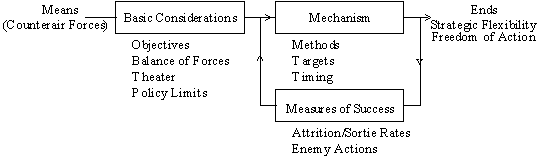
Target selection, as shown, is dominated by a choice of strategy that links ends to means. Without foresight in acquisition and training, target selection might also be restricted by the means, as well. In the next chapter, I'll discuss the balanced counterair force required to fulfill a range of counterair strategies.
Chapter 5
Counterair Issues
Current doctrine, as discussed in Chapter 2, provides a record of what the services say they think about air superiority and the best way to attain it. Current staff issues can provide clues to what the services will really do and think in the future, and these staff interests and actions, like doctrine, are primarily influenced by service visions of war. Understanding the current counterair issues allows Joint Force Commanders to organize their counterair forces to limit interservice rivalry and increase joint counterair integration and effectiveness.
Service staff issues and actions range from high level discussions of roles, missions and force reductions to controversies over controlling air power in theater campaigns through the Joint Force Air Component Commander (JFACC) and the Joint Targeting Coordination Board (JTCB). Roles, missions, and the force reductions mandated in the Bottom Up Review will directly affect counterair forces by fixing force size and capabilities. The struggles over the control of air power, reflected in the JFACC and JTCB controversies, have concentrated on who will control air targeting. Although the protagonists in these debates seldom mention counterair operations and air superiority, control issues have a significant indirect impact on America's ability to gain and maintain air superiority.
Roles and Missions
Joint and service air superiority doctrine reflects the individual service views about the best use of air power in modern war, and these service views have important consequences for counterair issues. The ongoing debate about military roles and missions addresses how multiservice air power is best used, and who should control it. Apparent redundancies between service air components have led the Congress to direct the Chairman of the Joint Chiefs of Staff to evaluate the potential benefits of realigning service air roles, missions, and forces. More radical proposals include consolidating and eliminating existing services or service air elements. The Chairman's Roles and Missions Study concluded that the United States has one air force, the US Air Force, and three other services with aviation arms essential to their war fighting roles. Each air arm provides unique, but complementary capabilities, and all work jointly to project air power.
What's different about these air arms? The Army, Navy, and Marine Corps integrate air power with their surface forces to achieve service objectives. The Air Force may integrate with surface forces, but can also apply air power across a theater to pursue and achieve objectives independent of surface forces. Each service emphasizes different capabilities, aligned with service roles and missions, and no one service possesses all the capabilities required to fulfill all military air requirements, including air superiority. All the services have offensive and defensive counterair capabilities, and "the successful conduct of air defense operations requires the integrated operation of all available component air systems."
The Chairman did not recommend any major changes in air missions and responsibilities, but he commissioned a Joint Mission Area Analysis study to determine how much air defense capability will be required in the future, and to examine the balance between air and surface counterair forces and air defense and missile defense forces. The Roles and Missions report investigated the relationship between service air components. The Bottom-up review attempted to size these forces to fit the changing world situation and the declining defense budget.
The Bottom Up Review
In his Annual Report of the Secretary of Defense to the President and Congress, the Secretary outlined five missions for US aviation forces: sustain deterrence, gain and maintain control of the air, exploit the control of the air, achieve C4I superiority, and contribute to military operations other than war. The Bottom Up Review recommends an aviation force structure designed to perform these missions against its view of current and future threats in two near simultaneous Major Regional Conflicts (MRCs). The combat elements of this force can expect to meet, in each MRC, adversaries equipped with up to 500-1000 fighter aircraft, including new Russian and western fighters, and a dense, integrated air defense system.
To defeat this threat, the Bottom Up Review recommends an aviation force consisting of 10 Air Force fighter wings augmented by up to 100 long range bombers, 4-5 Navy carrier air wings, the Marine aviation associated with 4-5 Marine brigades, and surface defenses associated with 4-5 Army divisions and the deployed Navy and Marine forces. If this force is doubled to handle 2 MRCs and the associated training requirements, US aviation forces require 20 Air Force fighter wing equivalents, 111 long range bombers, 11 carrier air wings, and 4 Marine air wings. The projected FY 1996 aviation force appears in Table 10.
Table 10
Bottom Up Review FY 1996 Fixed Wing Combat Aviation Forces
|
aircraft |
number |
mission % |
total % |
|
|
F-15C |
288(36 HARM) |
|||
|
F-14 |
172 |
|||
|
Total A/A |
460 |
17% |
+ 1314 MR |
= 67% |
|
F-16 |
738 (100 HARM) |
|||
|
F/A-18 |
576 |
|||
|
Total MR |
1314 |
50% |
= 50% |
|
F-15E/F-111 |
190 |
|||
|
F-117 |
36 |
|||
|
B-1/B-2/B-52 |
111 |
|||
|
A-6 |
48 (HARM) |
|||
|
Total Attack |
415 |
16% |
+ 1314 MR |
= 65 % |
|
F-4G |
36 |
|||
|
EA-6B |
131 |
|||
|
Total SEAD |
167 |
6% |
+ 884 MR |
= 33 % |
|
AV-8B |
140 |
|||
|
A/OA-10 |
144 |
|||
|
Total CAS |
284 |
11% |
+ 1314 MR |
= 61 % |
Source: Report of the Secretary of Defense to the President and Congress, January 1994
Table 10 divides combat air forces into air-to-air, attack, multirole, and close air support (CAS) categories, and compares the percentages of specialized aircraft available in each role to the percentage available when specialized aircraft are augmented by the multirole force. What do these force structure decisions mean to service counterair operations?
The Air Force will reduce its air superiority fighter and Suppression of Enemy Air Defenses (SEAD) aircraft inventories. After the draw down, the F-15C will make up 4.1 of the 20 Air Force wing equivalents (or 288 combat ready aircraft). The Air Force's dedicated SEAD aircraft, the aging F-4G, will be reduced to only .5 wing equivalents (36 aircraft). To aid in the SEAD mission, 100 F-16Cs and up to 36 F-15Cs may be equipped to employ the High Speed Anti-radiation Missile (HARM), but F-16s and F-15s will not be able to use the most accurate HARM firing modes. 738 multirole F-16s will provide the bulk of Air Force fighters, and 190 F-15Es and F-111s, 36 F-117s, and 111 long range bombers will provide an air-to-ground offensive punch.
The Navy's 11 carrier air wings will consist of 172 F-14s and 312 F/A-18s (plus 48 Marine F/A-18s assigned to carrier air wings). With the addition of precision air-to-ground capabilities for some F-14s, almost all these Navy aircraft will perform multiple roles. The Marines will field 264 multirole F/A-18A/C/D aircraft. 72 out of 140 AV-8B aircraft will be refitted with multimode radars that, although purchased to add a night/all weather air-to-surface capability, will also add some air-to-air capability to the Harrier. The Navy and Marines currently field 980 F/A-18 and A-6 aircraft capable of employing HARM in lethal SEAD roles, but like the F-16 and projected F-15s, these aircraft do not provide HARM the information it needs for its most accurate mode. As the A-6 retires, the 576 F/A-18s will be forced to perform air-to-air, air-to-ground, and SEAD missions. An additional 131 EA-6B aircraft can provide accurate HARM capability, but these aircraft also perform jamming missions, limiting their availability for HARM missions.
How does this reduced force compare to the idealized balanced force described in Chapter 4? Although the Bottom Up Review force retains a balanced mix of systems, force reductions will have an immediate impact on US counterair capabilities. If the force is cut in half to face two MRCs, and American aviation forces are not reinforced by allies or coalition partners, these aviation forces may have to fight without their accustomed numerical superiority.
Although American air forces planned to fight outnumbered in a possible European war with the Soviet Union, they have usually fought real wars with a numerical advantage. Of the 460 F-15s and F-14s, roughly half (230) should be available for a single MRC. However, many of the F-14s may be required for fleet defense, and some portion of them will probably perform strike missions in pursuit of naval objectives with their new air-to-ground capabilities. If the approximately 175 remaining air superiority fighters are pitted against the 500-1000 enemy aircraft predicted in the Bottom Up Review MRC scenario, they may have their hands full regardless of threat aircraft quality.
Without numerical superiority, the counterair commander will lose some strategic options. His remaining options include maintaining a defensive posture and accepting a prolonged counterair campaign, using his air superiority fighters for offensive counterair (OCA) missions while surface defenses protect rear areas, or augmenting specialized air-to-air aircraft with multirole fighters. Every multirole fighter flying air-to-air or SEAD missions is one less aircraft attacking surface force objectives. However, concentrating forces to obtain rapid air superiority will pay off if most multirole sorties are then free to exploit air superiority through attack missions.
The reduced number of responsive, accurate HARM shooters may force American aviation forces to shift from a suppressive SEAD strategy to a destructive strategy. In a suppressive SEAD strategy, surface-to-air systems across a wide area are convinced to remain dormant by the threat of timely, accurate anti radiation missiles. A destructive SEAD strategy eliminates surface-to-air threats for good, but it takes more time and resources to kill threats one at a time than it does to suppress groups of them in areas. Multirole fighters equipped with new precision weapons will have to destroy fixed sites, while the remaining HARM shooters attempt to suppress the mobile surface-to-air systems. As a result, multirole aircraft will have to devote more time to counterair operations and less to the pursuit of surface goals. The Joint Force Commander will pay an initial penalty in freedom of action while the theater is gradually cleared of surface threats, and it will take longer to establish air superiority.
Precision attack aircraft and long range surface artillery will be very popular in the opening days of a campaign. Surface commanders will want them to help shape the surface battlefield, and air commanders will covet their capabilities in strategic attack and offensive counterair roles. If these limited assets are divided between missions they may be unable to achieve any single goal. As shown in Chapter 3, OCA attacks are essential to achieve rapid air supremacy against air and missile threats. Concentrating these precious attack assets to rapidly win the counterair campaign will make more precision assets available later for surface and air commanders.
Table 10 also demonstrates both the leverage provided by specialized aircraft and the flexibility of multirole aircraft. Small numbers of specialized aircraft can use their single role superiority to achieve and exploit a decisive advantage. However, the high cost of modern aircraft limits the number of specialized aircraft that can be purchased, and makes multirole aircraft essential. While specialized aircraft perform their optimum missions, multirole aircraft can first assist with the counterair campaign, then swing to attack and CAS missions while the specialized aircraft maintain air supremacy. The superior capabilities of the specialized aircraft leverage the entire force with relatively small numbers, while the multirole aircraft provide concentrations of force to achieve the JFC's objectives. The more rapidly air superiority can be achieved, the sooner the multirole force can be unleashed on strategic attack, interdiction, or CAS sorties.
The Bottom Up Review also recommends modernization of aircraft, weapons, and surface-to-air defenses to guarantee this force will continue to be able to counter improving threats. The major aircraft programs include the F-22 (a follow on to the F-15), the F-18E/F (a replacement for Navy F-14s and F-18s), and the Joint Advanced Strike Technology (JAST) Fighter. The F-22 and F/A-18E/F are recommended in the near term to replace F-15s, F-14s, and F-18s that are already showing their age, while the JAST is the long term replacement for both services' attack/interdiction aircraft.
The bottom-up review recommends improvements to air-to-air weapons, including the Advanced Medium Range Air to Air Missile (AMRAAM) and the AIM-9 heat seeking missile, but reserves its highest recommendation for new air-to-surface weapons. These new weapons increase the survivability and lethality of aircraft by providing longer stand-off ranges and higher probability of kill. Counterair operations will enjoy the benefits of new weapons that provide increased lethal SEAD (better accuracy allows aircraft to destroy surface defenses without anti radiation missiles), allow highly defended targets to be attacked early from outside threat ranges (reducing SEAD requirements), and give precision, all-weather capability to multirole aircraft (increasing their ability to provide SEAD and kill OCA targets). Added together, these new weapons will make achieving rapid air supremacy easier by killing more OCA targets and surface defenses, requiring fewer sorties and less SEAD support.
Surface-to-air defenses will be improved against aircraft threats as well, but the primary emphasis of planned surface-to-air defense improvements is countering cruise and ballistic missile threats. Patriot PAC-3, HAWK/TPS-59, and Aegis/Standard Block IV-A improvements will provide short term improvements to US capabilities to detect and destroy missiles in their terminal phase. The Theater High Altitude Air Defense (THAAD) system is designed to improve our future capability to detect ballistic missiles earlier and destroy them at higher altitudes. Other antiballistic missile programs include efforts to locate and kill missiles before launch and during the boost phase. The Bottom Up Review recommended a force structure for future US counterair forces based on the MRC scenario. Additional counterair issues revolve around the organization or structures that will command these forces.
Controlling Joint Air Forces
Joint and service doctrine recognizes the need for a structure to coordinate the air efforts of service components, the various component air defense assets, and the airspace above the theater. However, the divergent service views of the role of air power drive disagreements about how much authority this air power structure should have over service aviation forces. Doctrine has coalesced around the position of the Joint Force Air Component Commander (JFACC), but the debate continues about the scope and amount of power the JFACC should exercise.
The Joint Force Air Component Commander (JFACC)
The Air Force is the only service that consistently takes a theater view of air power and advocates pursuing theater air power objectives. This theater view of air power (which was born shortly after the Wright flyer, and gained acceptance in the struggle for air superiority in North Africa in 1942-43) generates the Air Force desire for centralized control of all theater air power in pursuit of theater objectives. The Air Force believes offensive actions and a theater view are required to win air superiority. To the Air Force, "the essence of the JFACC concept is not simply the designation of a single commander for air. Its broader focus is the development of a concept of air operations to meet the objectives set by the JFC."
The other services, however, view their air elements as extensions of their service that should be integrated with their surface forces and employed to further service objectives. They would limit the JFACC's role to minimizing interference between the distinct service air efforts and directing only those air assets declared excess to service air requirements. The Army thinks the JFACC should only control those few air resources not required to further the corps commander's objectives in his battlespace. The Navy sees the JFACC as an analog to their Air Resources Element Coordinator (AREC), who manages the air assets excess to the anti-air, anti-surface, and anti-submarine commanders in their composite warfare system. The Army, Navy, and Marines believe the services should direct their own air power in pursuit of service goals, and the JFACC should direct air power only when it pursues joint goals.
The battles over JFACC control have a direct impact on the counterair battle. Rapid, decisive air supremacy is a theater goal. If the JFACC is not able to direct theater air forces in pursuit of theater air superiority, the counterair battle will probably drag on into a war of attrition, requiring a continuous expenditure of effort and resources that could have been directed to further other JFC objectives. JFACCs must balance independent, theater air priorities with service air priorities, but a JFACC can't balance priorities if he doesn't control the forces. Circumstances may require all theater air assets to pursue a theater objective, like decisive air superiority, or a service objective, like defending a piece of ground through CAS.
The Joint Targeting Coordination Board (JTCB)
Although service and joint opinion has coalesced around the JFACC, the power of the JFACC is balanced by the presence of the Joint Targeting Coordination Board (JTCB). Like the JFACC, the JTCB may be created by the Joint Force Commander, and is tasked to direct or monitor the development and selection of air targets. The aim of the JTCB is to insure a balance between the amount of air effort directed against independent and integrated objectives. Also like the JFACC, the JTCB is the subject of service disagreement.
The Air Force thinks the JFACC, not the JTCB, should develop and select targets across geographic boundaries in support of the JFC's objectives. Coordination would occur in the JFACC staff to insure the proper balance of effort, and apportionment should be a product of air planning, not guidance to it. "Apportionment should be determined by the JFC in consultation with component commanders based on assigned objectives and concepts of operations".
The other services see the JTCB as a check on the power of the JFACC, and a way to make sure theater air is responsive to surface, or service needs. In the Army view, the JTCB will apportion and direct the air effort and the JFACC will execute it. If the JTCB is given the power to apportion the air effort and direct targeting, it must maintain a joint force perspective. Someone must look at the overall operation and try to conceive of the best use of all assets toward overall objectives. If the JTCB members focus on satisfying all of their parent service's priorities, air operations may lack a theater perspective. Without a theater perspective, the counterair campaign will, again, be a long, bloody battle of attrition.
The JTCB may, however, offer some positive advantages for the theater counterair battle. In the JTCB, the counterair commander can argue for concentrating available air, and when appropriate, surface resources in the counterair campaign. Long range fires, army aviation, special forces, and cruise and ballistic missiles can all make important contributions to the theater counterair effort, and an initial resource investment could provide a big payback to surface commanders if rapid air supremacy makes additional air resources available later in the campaign. The JTCB could provide a forum for allocating an appropriate share of surface fires to the counterair campaign.
Fire Support Coordination
Fire support coordination is another joint issue that may affect the counterair battle. Surface forces need boundaries to allow coordination of effort and prevent fratricide. Their large formations are deconflicted by plans that emphasize geographic boundaries. However, the speed and range of aircraft make geographic boundaries less important, so air forces are more likely to deconflict their efforts by time or altitude. These different surface and air perspectives lead to conflicts about the best methods to procedurally coordinate and deconflict fires. The counterair campaign can be affected by the coordination of fires aimed at both air and surface targets.
Air Coordination
Because modern air defenses include surface-to-air and air-to-air weapons, air defense commanders must coordinate and deconflict these weapons so that enemy aircraft are targeted and destroyed, but friendly aircraft are not. The success of this coordination depends on timely aircraft identification, and aircraft can be identified either visually or electronically. Both air and surface based defenses employ weapons that are lethal beyond human visual range. These weapons must often be fired before visual identification is possible to provide time for multiple launches, ensure a successful intercept, and provide self defense from long range threats firing back. These long range systems depend on electronic cooperative or non-cooperative identification.
In cooperative identification, air defense forces interrogate unknown aircraft with a coded radio signal. Friendly aircraft respond with a coded reply and are classified as friendly aircraft. Enemy aircraft do not reply. Unfortunately, neither do friendly aircraft with inoperative equipment. Non-cooperative identification relies on various methods of identifying aircraft without a response, and is able to identify most friendly and enemy aircraft. In the past, the limited reliability of identification systems that relied on cooperative identification forced air defenses to rely primarily on procedural control. In procedural control, friendly aircraft are identified by flying predetermined flight paths, airspeeds, or altitudes, and remaining clear of designated engagement areas. This procedural identification allows air defense forces to assume aircraft that do not execute the correct procedures are hostile.
Because surface-to-air defenses are relatively static, they rely on procedural, geographic control. They prefer deconflicted missile and fighter engagement zones that allow missiles and fighters to acquire and destroy targets in their own geographic area without coordinating, or communicating with each other. Geographic deconfliction requires minimum real time coordination and communication, but may allow some enemy threats to pass through unharmed by numerically overwhelming a small area, or employing countermeasures that are effective against the only air defense asset in a specific engagement zone.
Rapidly moving aircraft, however, must cross geographic boundaries as they perform their missions over enemy territory, and can quickly stray outside procedural boundaries. Airmen prefer flexible procedures that allow them to fly wherever they need to go to perform a successful intercept. However, flexible operations may lead to confusion, missed firing opportunities, wasted weapons, or fratricide.
A new joint initiative, Joint Air Defense Operations/Joint Engagement Zone (JADO/JEZ), exploits integrated joint communications and non-cooperative identification technology to allow missiles and fighters to operate in the same geographic area, a joint engagement zone, under positive control. Under positive control, friendly systems are only permitted to fire at targets who have been positively identified as hostile. JADO/JEZ allows counterair commanders to fully integrate their air defense weapons in a flexible system that maximizes the strengths of all weapons and guards against fratricide.
Surface Coordination
The surface forces also possess surface-to-surface systems with ranges that require indirect fire (fire that can't be observed by the shooter) across long distances, and the Multiple Launch Rocket System (MLRS), Army Tactical Missile System (ATACMS), Tactical Land Attack Missiles (TLAM), and attack helicopters have extended fire support ranges even further. To coordinate these long range surface fires and air fires, surface commanders deconflict procedurally with a Fire Support Coordination line (FSCL). The surface commander controls all fires inside the FSCL, and air forces must coordinate with him to attack targets inside the line.
Prior to MLRS and ATACMS, the FSCL was usually positioned near the maximum range of surface artillery, and air forces were free to attack targets outside the FSCL when and where they chose. This freedom allowed SEAD forces to target enemy air defenses rapidly without coordination delays and select and attack counterair targets without coordinating with surface forces.
The new long range surface systems, and increasing emphasis on long range fires and maneuver in deep battle, tempt surface commanders to extend the FSCL out to the longest range of any of their systems, or to establish a new line called the Long Range Interdiction Line (LRIL). These extended coordination lines insure surface commanders can respond rapidly to fleeting targets and engage the enemy across his depth and breadth. For the counterair commander, however, an extended coordination line can limit his ability to target enemy surveillance, command and control, and surface-to-air defenses. As shown in Chapter 3, if the air commander can't target the full range of enemy counterair targets, the air battle will be prolonged. As shown in this chapter, if the air battle is lengthened, surface and air resources spend more time fighting the counterair battle and are not available to pursue the JFC's other objectives.
Theater Missile Defense
Arguments about control of theater missile defenses (TMD) parallel the arguments over control of theater air forces. The proliferation of weapons of mass destruction and ballistic missile delivery systems has created a sense of urgency about countering the ballistic missile threat. The Gulf War demonstrated that even primitive mobile ballistic missiles armed with conventional warheads can have a political, if not a strategic, impact on coalition unity and divert air resources away from more lucrative targets. Virtual air supremacy is no longer enough. TMD has become a critical issue, and control arguments hinge on two questions. Should ballistic missile threats be considered an extension of the air threat and controlled by the theater air defense commander? Does effective TMD require an offensive, defensive, or balanced approach?
The Air Force believes that ballistic missiles are an extension of the air threat and, as air threats, should properly fall under the responsibility of the theater air defense commander. They advocate an integrated theater air defense system that combines the control of all counterair and missile defense systems under the theater air defense commander, normally the JFACC. In their vision, a balanced approach should use all available offensive and defensive weapons to attack enemy air and ballistic missile systems throughout their life cycle -- production, preparation, launch, boost, mid-course, and descent. To facilitate seamless control, the Air Force wants to take the lead in developing and fielding a theater Command, Control, Communications, and Intelligence (C3I ) system capable of integrating all theater air and missile defense systems.
The Army owns Patriot, the only system to demonstrate any capability against ballistic missiles in flight. The Navy owns Aegis/Standard, which they believe can be upgraded to provide a descent phase intercept similar to Patriot. Both services advocate a point defense approach based on proven descent phase intercept concepts under the control of the Army over land and the Navy at sea. Neither service trusts the Air Force to give missile threats a high priority, because they believe TMD conflicts with the Air Force's prejudice against unmanned systems. Both services are planning to develop and acquire new systems that intercept missiles at higher altitudes across a wider area.
As shown in Chapter 2, current joint doctrine generally favors the inclusion of ballistic and cruise missiles in the roster of air threats, but service proponents of maintaining separate air and missile defense systems are attempting to redefine this doctrine. In an effort to retain control of TMD, the surface forces seek separate joint doctrine for theater air defense and theater missile defense, and have attempted to adjust the JCS definition of interdiction to include both surface and airborne resources to allow TMD to become an interdiction mission. If theater missile defense is interdiction, not counterair, then TMD would not have to be controlled by the JFACC.
To the counterair commander, dividing control of systems that can target both air and ballistic threats interferes with his ability to direct counterair forces efficiently. If a surface commander directs a Patriot battery to intercept a ballistic missile while the air defense commander is directing it to attack an aircraft, confusion, inefficiency, and mistakes are likely. Confusion, inefficiency, and mistakes may prolong the counterair battle, delay the shift of multirole aircraft to surface objectives, and limit the Joint Force Commander's strategic flexibility and freedom of action.
Conclusion
The American military services pursue their own visions of the nature of war, based on their history and traditions. These visions stress the importance of the land, sea, or air medium (the Army, Navy, and Air Force), or a mission (the Marine Corps and amphibious operations). Each vision pursues control of the air, but the services seek the control of the air required to execute their service vision. These service visions are reflected in their doctrine and their response to interservice issues.
Together, the services possess the doctrine and forces required to provide the Joint Force Commander with freedom of action through decisive air supremacy, but no single service possesses all the required elements. Joint counterair doctrine compromises between the service views, and compartmentalizes counterair forces instead of integrating service visions into a joint view.
The services appreciate the product (freedom of action for air, land, and sea forces) that control of the air provides, but neglect the process of obtaining it. Current air power disputes (the JFACC, the JTCB, and TMD) emphasize the control and targeting of air resources, and slight the potential impact of these issues on America's future ability to control the air and space. If a compartmentalized pursuit of the control of the air and lack of interest in the counterair process reduce US counterair capabilities, Joint Force Commanders will lose flexibility and freedom of action.
Chapter 5
Counterair Issues
Current doctrine, as discussed in Chapter 2, provides a record of what the services say they think about air superiority and the best way to attain it. Current staff issues can provide clues to what the services will really do and think in the future, and these staff interests and actions, like doctrine, are primarily influenced by service visions of war. Understanding the current counterair issues allows Joint Force Commanders to organize their counterair forces to limit interservice rivalry and increase joint counterair integration and effectiveness.
Service staff issues and actions range from high level discussions of roles, missions and force reductions to controversies over controlling air power in theater campaigns through the Joint Force Air Component Commander (JFACC) and the Joint Targeting Coordination Board (JTCB). Roles, missions, and the force reductions mandated in the Bottom Up Review will directly affect counterair forces by fixing force size and capabilities. The struggles over the control of air power, reflected in the JFACC and JTCB controversies, have concentrated on who will control air targeting. Although the protagonists in these debates seldom mention counterair operations and air superiority, control issues have a significant indirect impact on America's ability to gain and maintain air superiority.
Roles and Missions
Joint and service air superiority doctrine reflects the individual service views about the best use of air power in modern war, and these service views have important consequences for counterair issues. The ongoing debate about military roles and missions addresses how multiservice air power is best used, and who should control it. Apparent redundancies between service air components have led the Congress to direct the Chairman of the Joint Chiefs of Staff to evaluate the potential benefits of realigning service air roles, missions, and forces. More radical proposals include consolidating and eliminating existing services or service air elements. The Chairman's Roles and Missions Study concluded that the United States has one air force, the US Air Force, and three other services with aviation arms essential to their war fighting roles. Each air arm provides unique, but complementary capabilities, and all work jointly to project air power.
What's different about these air arms? The Army, Navy, and Marine Corps integrate air power with their surface forces to achieve service objectives. The Air Force may integrate with surface forces, but can also apply air power across a theater to pursue and achieve objectives independent of surface forces. Each service emphasizes different capabilities, aligned with service roles and missions, and no one service possesses all the capabilities required to fulfill all military air requirements, including air superiority. All the services have offensive and defensive counterair capabilities, and "the successful conduct of air defense operations requires the integrated operation of all available component air systems."
The Chairman did not recommend any major changes in air missions and responsibilities, but he commissioned a Joint Mission Area Analysis study to determine how much air defense capability will be required in the future, and to examine the balance between air and surface counterair forces and air defense and missile defense forces. The Roles and Missions report investigated the relationship between service air components. The Bottom-up review attempted to size these forces to fit the changing world situation and the declining defense budget.
The Bottom Up Review
In his Annual Report of the Secretary of Defense to the President and Congress, the Secretary outlined five missions for US aviation forces: sustain deterrence, gain and maintain control of the air, exploit the control of the air, achieve C4I superiority, and contribute to military operations other than war. The Bottom Up Review recommends an aviation force structure designed to perform these missions against its view of current and future threats in two near simultaneous Major Regional Conflicts (MRCs). The combat elements of this force can expect to meet, in each MRC, adversaries equipped with up to 500-1000 fighter aircraft, including new Russian and western fighters, and a dense, integrated air defense system.
To defeat this threat, the Bottom Up Review recommends an aviation force consisting of 10 Air Force fighter wings augmented by up to 100 long range bombers, 4-5 Navy carrier air wings, the Marine aviation associated with 4-5 Marine brigades, and surface defenses associated with 4-5 Army divisions and the deployed Navy and Marine forces. If this force is doubled to handle 2 MRCs and the associated training requirements, US aviation forces require 20 Air Force fighter wing equivalents, 111 long range bombers, 11 carrier air wings, and 4 Marine air wings. The projected FY 1996 aviation force appears in Table 10.
Table 10
Bottom Up Review FY 1996 Fixed Wing Combat Aviation Forces
|
aircraft |
total % |
|||
|
F-15C |
288(36 HARM) |
|||
|
F-14 |
172 |
|||
|
Total A/A |
460 |
17% |
+ 1314 MR |
= 67% |
|
F-16 |
738 (100 HARM) |
|||
|
F/A-18 |
576 |
|||
|
Total MR |
1314 |
50% |
= 50% |
|
F-15E/F-111 |
190 |
|||
|
F-117 |
36 |
|||
|
B-1/B-2/B-52 |
111 |
|||
|
A-6 |
48 (HARM) |
|||
|
Total Attack |
415 |
16% |
+ 1314 MR |
= 65 % |
|
F-4G |
36 |
|||
|
EA-6B |
131 |
|||
|
Total SEAD |
167 |
6% |
+ 884 MR |
= 33 % |
|
AV-8B |
140 |
|||
|
A/OA-10 |
144 |
|||
|
Total CAS |
284 |
11% |
+ 1314 MR |
= 61 % |
Source: Report of the Secretary of Defense to the President and Congress, January 1994
Table 10 divides combat air forces into air-to-air, attack, multirole, and close air support (CAS) categories, and compares the percentages of specialized aircraft available in each role to the percentage available when specialized aircraft are augmented by the multirole force. What do these force structure decisions mean to service counterair operations?
The Air Force will reduce its air superiority fighter and Suppression of Enemy Air Defenses (SEAD) aircraft inventories. After the draw down, the F-15C will make up 4.1 of the 20 Air Force wing equivalents (or 288 combat ready aircraft). The Air Force's dedicated SEAD aircraft, the aging F-4G, will be reduced to only .5 wing equivalents (36 aircraft). To aid in the SEAD mission, 100 F-16Cs and up to 36 F-15Cs may be equipped to employ the High Speed Anti-radiation Missile (HARM), but F-16s and F-15s will not be able to use the most accurate HARM firing modes. 738 multirole F-16s will provide the bulk of Air Force fighters, and 190 F-15Es and F-111s, 36 F-117s, and 111 long range bombers will provide an air-to-ground offensive punch.
The Navy's 11 carrier air wings will consist of 172 F-14s and 312 F/A-18s (plus 48 Marine F/A-18s assigned to carrier air wings). With the addition of precision air-to-ground capabilities for some F-14s, almost all these Navy aircraft will perform multiple roles. The Marines will field 264 multirole F/A-18A/C/D aircraft. 72 out of 140 AV-8B aircraft will be refitted with multimode radars that, although purchased to add a night/all weather air-to-surface capability, will also add some air-to-air capability to the Harrier. The Navy and Marines currently field 980 F/A-18 and A-6 aircraft capable of employing HARM in lethal SEAD roles, but like the F-16 and projected F-15s, these aircraft do not provide HARM the information it needs for its most accurate mode. As the A-6 retires, the 576 F/A-18s will be forced to perform air-to-air, air-to-ground, and SEAD missions. An additional 131 EA-6B aircraft can provide accurate HARM capability, but these aircraft also perform jamming missions, limiting their availability for HARM missions.
How does this reduced force compare to the idealized balanced force described in Chapter 4? Although the Bottom Up Review force retains a balanced mix of systems, force reductions will have an immediate impact on US counterair capabilities. If the force is cut in half to face two MRCs, and American aviation forces are not reinforced by allies or coalition partners, these aviation forces may have to fight without their accustomed numerical superiority.
Although American air forces planned to fight outnumbered in a possible European war with the Soviet Union, they have usually fought real wars with a numerical advantage. Of the 460 F-15s and F-14s, roughly half (230) should be available for a single MRC. However, many of the F-14s may be required for fleet defense, and some portion of them will probably perform strike missions in pursuit of naval objectives with their new air-to-ground capabilities. If the approximately 175 remaining air superiority fighters are pitted against the 500-1000 enemy aircraft predicted in the Bottom Up Review MRC scenario, they may have their hands full regardless of threat aircraft quality.
Without numerical superiority, the counterair commander will lose some strategic options. His remaining options include maintaining a defensive posture and accepting a prolonged counterair campaign, using his air superiority fighters for offensive counterair (OCA) missions while surface defenses protect rear areas, or augmenting specialized air-to-air aircraft with multirole fighters. Every multirole fighter flying air-to-air or SEAD missions is one less aircraft attacking surface force objectives. However, concentrating forces to obtain rapid air superiority will pay off if most multirole sorties are then free to exploit air superiority through attack missions.
The reduced number of responsive, accurate HARM shooters may force American aviation forces to shift from a suppressive SEAD strategy to a destructive strategy. In a suppressive SEAD strategy, surface-to-air systems across a wide area are convinced to remain dormant by the threat of timely, accurate anti radiation missiles. A destructive SEAD strategy eliminates surface-to-air threats for good, but it takes more time and resources to kill threats one at a time than it does to suppress groups of them in areas. Multirole fighters equipped with new precision weapons will have to destroy fixed sites, while the remaining HARM shooters attempt to suppress the mobile surface-to-air systems. As a result, multirole aircraft will have to devote more time to counterair operations and less to the pursuit of surface goals. The Joint Force Commander will pay an initial penalty in freedom of action while the theater is gradually cleared of surface threats, and it will take longer to establish air superiority.
Precision attack aircraft and long range surface artillery will be very popular in the opening days of a campaign. Surface commanders will want them to help shape the surface battlefield, and air commanders will covet their capabilities in strategic attack and offensive counterair roles. If these limited assets are divided between missions they may be unable to achieve any single goal. As shown in Chapter 3, OCA attacks are essential to achieve rapid air supremacy against air and missile threats. Concentrating these precious attack assets to rapidly win the counterair campaign will make more precision assets available later for surface and air commanders.
Table 10 also demonstrates both the leverage provided by specialized aircraft and the flexibility of multirole aircraft. Small numbers of specialized aircraft can use their single role superiority to achieve and exploit a decisive advantage. However, the high cost of modern aircraft limits the number of specialized aircraft that can be purchased, and makes multirole aircraft essential. While specialized aircraft perform their optimum missions, multirole aircraft can first assist with the counterair campaign, then swing to attack and CAS missions while the specialized aircraft maintain air supremacy. The superior capabilities of the specialized aircraft leverage the entire force with relatively small numbers, while the multirole aircraft provide concentrations of force to achieve the JFC's objectives. The more rapidly air superiority can be achieved, the sooner the multirole force can be unleashed on strategic attack, interdiction, or CAS sorties.
The Bottom Up Review also recommends modernization of aircraft, weapons, and surface-to-air defenses to guarantee this force will continue to be able to counter improving threats. The major aircraft programs include the F-22 (a follow on to the F-15), the F-18E/F (a replacement for Navy F-14s and F-18s), and the Joint Advanced Strike Technology (JAST) Fighter. The F-22 and F/A-18E/F are recommended in the near term to replace F-15s, F-14s, and F-18s that are already showing their age, while the JAST is the long term replacement for both services' attack/interdiction aircraft.
The bottom-up review recommends improvements to air-to-air weapons, including the Advanced Medium Range Air to Air Missile (AMRAAM) and the AIM-9 heat seeking missile, but reserves its highest recommendation for new air-to-surface weapons. These new weapons increase the survivability and lethality of aircraft by providing longer stand-off ranges and higher probability of kill. Counterair operations will enjoy the benefits of new weapons that provide increased lethal SEAD (better accuracy allows aircraft to destroy surface defenses without anti radiation missiles), allow highly defended targets to be attacked early from outside threat ranges (reducing SEAD requirements), and give precision, all-weather capability to multirole aircraft (increasing their ability to provide SEAD and kill OCA targets). Added together, these new weapons will make achieving rapid air supremacy easier by killing more OCA targets and surface defenses, requiring fewer sorties and less SEAD support.
Surface-to-air defenses will be improved against aircraft threats as well, but the primary emphasis of planned surface-to-air defense improvements is countering cruise and ballistic missile threats. Patriot PAC-3, HAWK/TPS-59, and Aegis/Standard Block IV-A improvements will provide short term improvements to US capabilities to detect and destroy missiles in their terminal phase. The Theater High Altitude Air Defense (THAAD) system is designed to improve our future capability to detect ballistic missiles earlier and destroy them at higher altitudes. Other antiballistic missile programs include efforts to locate and kill missiles before launch and during the boost phase. The Bottom Up Review recommended a force structure for future US counterair forces based on the MRC scenario. Additional counterair issues revolve around the organization or structures that will command these forces.
Controlling Joint Air Forces
Joint and service doctrine recognizes the need for a structure to coordinate the air efforts of service components, the various component air defense assets, and the airspace above the theater. However, the divergent service views of the role of air power drive disagreements about how much authority this air power structure should have over service aviation forces. Doctrine has coalesced around the position of the Joint Force Air Component Commander (JFACC), but the debate continues about the scope and amount of power the JFACC should exercise.
The Joint Force Air Component Commander (JFACC)
The Air Force is the only service that consistently takes a theater view of air power and advocates pursuing theater air power objectives. This theater view of air power (which was born shortly after the Wright flyer, and gained acceptance in the struggle for air superiority in North Africa in 1942-43) generates the Air Force desire for centralized control of all theater air power in pursuit of theater objectives. The Air Force believes offensive actions and a theater view are required to win air superiority. To the Air Force, "the essence of the JFACC concept is not simply the designation of a single commander for air. Its broader focus is the development of a concept of air operations to meet the objectives set by the JFC."
The other services, however, view their air elements as extensions of their service that should be integrated with their surface forces and employed to further service objectives. They would limit the JFACC's role to minimizing interference between the distinct service air efforts and directing only those air assets declared excess to service air requirements. The Army thinks the JFACC should only control those few air resources not required to further the corps commander's objectives in his battlespace. The Navy sees the JFACC as an analog to their Air Resources Element Coordinator (AREC), who manages the air assets excess to the anti-air, anti-surface, and anti-submarine commanders in their composite warfare system. The Army, Navy, and Marines believe the services should direct their own air power in pursuit of service goals, and the JFACC should direct air power only when it pursues joint goals.
The battles over JFACC control have a direct impact on the counterair battle. Rapid, decisive air supremacy is a theater goal. If the JFACC is not able to direct theater air forces in pursuit of theater air superiority, the counterair battle will probably drag on into a war of attrition, requiring a continuous expenditure of effort and resources that could have been directed to further other JFC objectives. JFACCs must balance independent, theater air priorities with service air priorities, but a JFACC can't balance priorities if he doesn't control the forces. Circumstances may require all theater air assets to pursue a theater objective, like decisive air superiority, or a service objective, like defending a piece of ground through CAS.
The Joint Targeting Coordination Board (JTCB)
Although service and joint opinion has coalesced around the JFACC, the power of the JFACC is balanced by the presence of the Joint Targeting Coordination Board (JTCB). Like the JFACC, the JTCB may be created by the Joint Force Commander, and is tasked to direct or monitor the development and selection of air targets. The aim of the JTCB is to insure a balance between the amount of air effort directed against independent and integrated objectives. Also like the JFACC, the JTCB is the subject of service disagreement.
The Air Force thinks the JFACC, not the JTCB, should develop and select targets across geographic boundaries in support of the JFC's objectives. Coordination would occur in the JFACC staff to insure the proper balance of effort, and apportionment should be a product of air planning, not guidance to it. "Apportionment should be determined by the JFC in consultation with component commanders based on assigned objectives and concepts of operations".
The other services see the JTCB as a check on the power of the JFACC, and a way to make sure theater air is responsive to surface, or service needs. In the Army view, the JTCB will apportion and direct the air effort and the JFACC will execute it. If the JTCB is given the power to apportion the air effort and direct targeting, it must maintain a joint force perspective. Someone must look at the overall operation and try to conceive of the best use of all assets toward overall objectives. If the JTCB members focus on satisfying all of their parent service's priorities, air operations may lack a theater perspective. Without a theater perspective, the counterair campaign will, again, be a long, bloody battle of attrition.
The JTCB may, however, offer some positive advantages for the theater counterair battle. In the JTCB, the counterair commander can argue for concentrating available air, and when appropriate, surface resources in the counterair campaign. Long range fires, army aviation, special forces, and cruise and ballistic missiles can all make important contributions to the theater counterair effort, and an initial resource investment could provide a big payback to surface commanders if rapid air supremacy makes additional air resources available later in the campaign. The JTCB could provide a forum for allocating an appropriate share of surface fires to the counterair campaign.
Fire Support Coordination
Fire support coordination is another joint issue that may affect the counterair battle. Surface forces need boundaries to allow coordination of effort and prevent fratricide. Their large formations are deconflicted by plans that emphasize geographic boundaries. However, the speed and range of aircraft make geographic boundaries less important, so air forces are more likely to deconflict their efforts by time or altitude. These different surface and air perspectives lead to conflicts about the best methods to procedurally coordinate and deconflict fires. The counterair campaign can be affected by the coordination of fires aimed at both air and surface targets.
Air Coordination
Because modern air defenses include surface-to-air and air-to-air weapons, air defense commanders must coordinate and deconflict these weapons so that enemy aircraft are targeted and destroyed, but friendly aircraft are not. The success of this coordination depends on timely aircraft identification, and aircraft can be identified either visually or electronically. Both air and surface based defenses employ weapons that are lethal beyond human visual range. These weapons must often be fired before visual identification is possible to provide time for multiple launches, ensure a successful intercept, and provide self defense from long range threats firing back. These long range systems depend on electronic cooperative or non-cooperative identification.
In cooperative identification, air defense forces interrogate unknown aircraft with a coded radio signal. Friendly aircraft respond with a coded reply and are classified as friendly aircraft. Enemy aircraft do not reply. Unfortunately, neither do friendly aircraft with inoperative equipment. Non-cooperative identification relies on various methods of identifying aircraft without a response, and is able to identify most friendly and enemy aircraft. In the past, the limited reliability of identification systems that relied on cooperative identification forced air defenses to rely primarily on procedural control. In procedural control, friendly aircraft are identified by flying predetermined flight paths, airspeeds, or altitudes, and remaining clear of designated engagement areas. This procedural identification allows air defense forces to assume aircraft that do not execute the correct procedures are hostile.
Because surface-to-air defenses are relatively static, they rely on procedural, geographic control. They prefer deconflicted missile and fighter engagement zones that allow missiles and fighters to acquire and destroy targets in their own geographic area without coordinating, or communicating with each other. Geographic deconfliction requires minimum real time coordination and communication, but may allow some enemy threats to pass through unharmed by numerically overwhelming a small area, or employing countermeasures that are effective against the only air defense asset in a specific engagement zone.
Rapidly moving aircraft, however, must cross geographic boundaries as they perform their missions over enemy territory, and can quickly stray outside procedural boundaries. Airmen prefer flexible procedures that allow them to fly wherever they need to go to perform a successful intercept. However, flexible operations may lead to confusion, missed firing opportunities, wasted weapons, or fratricide.
A new joint initiative, Joint Air Defense Operations/Joint Engagement Zone (JADO/JEZ), exploits integrated joint communications and non-cooperative identification technology to allow missiles and fighters to operate in the same geographic area, a joint engagement zone, under positive control. Under positive control, friendly systems are only permitted to fire at targets who have been positively identified as hostile. JADO/JEZ allows counterair commanders to fully integrate their air defense weapons in a flexible system that maximizes the strengths of all weapons and guards against fratricide.
Surface Coordination
The surface forces also possess surface-to-surface systems with ranges that require indirect fire (fire that can't be observed by the shooter) across long distances, and the Multiple Launch Rocket System (MLRS), Army Tactical Missile System (ATACMS), Tactical Land Attack Missiles (TLAM), and attack helicopters have extended fire support ranges even further. To coordinate these long range surface fires and air fires, surface commanders deconflict procedurally with a Fire Support Coordination line (FSCL). The surface commander controls all fires inside the FSCL, and air forces must coordinate with him to attack targets inside the line.
Prior to MLRS and ATACMS, the FSCL was usually positioned near the maximum range of surface artillery, and air forces were free to attack targets outside the FSCL when and where they chose. This freedom allowed SEAD forces to target enemy air defenses rapidly without coordination delays and select and attack counterair targets without coordinating with surface forces.
The new long range surface systems, and increasing emphasis on long range fires and maneuver in deep battle, tempt surface commanders to extend the FSCL out to the longest range of any of their systems, or to establish a new line called the Long Range Interdiction Line (LRIL). These extended coordination lines insure surface commanders can respond rapidly to fleeting targets and engage the enemy across his depth and breadth. For the counterair commander, however, an extended coordination line can limit his ability to target enemy surveillance, command and control, and surface-to-air defenses. As shown in Chapter 3, if the air commander can't target the full range of enemy counterair targets, the air battle will be prolonged. As shown in this chapter, if the air battle is lengthened, surface and air resources spend more time fighting the counterair battle and are not available to pursue the JFC's other objectives.
Theater Missile Defense
Arguments about control of theater missile defenses (TMD) parallel the arguments over control of theater air forces. The proliferation of weapons of mass destruction and ballistic missile delivery systems has created a sense of urgency about countering the ballistic missile threat. The Gulf War demonstrated that even primitive mobile ballistic missiles armed with conventional warheads can have a political, if not a strategic, impact on coalition unity and divert air resources away from more lucrative targets. Virtual air supremacy is no longer enough. TMD has become a critical issue, and control arguments hinge on two questions. Should ballistic missile threats be considered an extension of the air threat and controlled by the theater air defense commander? Does effective TMD require an offensive, defensive, or balanced approach?
The Air Force believes that ballistic missiles are an extension of the air threat and, as air threats, should properly fall under the responsibility of the theater air defense commander. They advocate an integrated theater air defense system that combines the control of all counterair and missile defense systems under the theater air defense commander, normally the JFACC. In their vision, a balanced approach should use all available offensive and defensive weapons to attack enemy air and ballistic missile systems throughout their life cycle -- production, preparation, launch, boost, mid-course, and descent. To facilitate seamless control, the Air Force wants to take the lead in developing and fielding a theater Command, Control, Communications, and Intelligence (C3I ) system capable of integrating all theater air and missile defense systems.
The Army owns Patriot, the only system to demonstrate any capability against ballistic missiles in flight. The Navy owns Aegis/Standard, which they believe can be upgraded to provide a descent phase intercept similar to Patriot. Both services advocate a point defense approach based on proven descent phase intercept concepts under the control of the Army over land and the Navy at sea. Neither service trusts the Air Force to give missile threats a high priority, because they believe TMD conflicts with the Air Force's prejudice against unmanned systems. Both services are planning to develop and acquire new systems that intercept missiles at higher altitudes across a wider area.
As shown in Chapter 2, current joint doctrine generally favors the inclusion of ballistic and cruise missiles in the roster of air threats, but service proponents of maintaining separate air and missile defense systems are attempting to redefine this doctrine. In an effort to retain control of TMD, the surface forces seek separate joint doctrine for theater air defense and theater missile defense, and have attempted to adjust the JCS definition of interdiction to include both surface and airborne resources to allow TMD to become an interdiction mission. If theater missile defense is interdiction, not counterair, then TMD would not have to be controlled by the JFACC.
To the counterair commander, dividing control of systems that can target both air and ballistic threats interferes with his ability to direct counterair forces efficiently. If a surface commander directs a Patriot battery to intercept a ballistic missile while the air defense commander is directing it to attack an aircraft, confusion, inefficiency, and mistakes are likely. Confusion, inefficiency, and mistakes may prolong the counterair battle, delay the shift of multirole aircraft to surface objectives, and limit the Joint Force Commander's strategic flexibility and freedom of action.
Conclusion
The American military services pursue their own visions of the nature of war, based on their history and traditions. These visions stress the importance of the land, sea, or air medium (the Army, Navy, and Air Force), or a mission (the Marine Corps and amphibious operations). Each vision pursues control of the air, but the services seek the control of the air required to execute their service vision. These service visions are reflected in their doctrine and their response to interservice issues.
Together, the services possess the doctrine and forces required to provide the Joint Force Commander with freedom of action through decisive air supremacy, but no single service possesses all the required elements. Joint counterair doctrine compromises between the service views, and compartmentalizes counterair forces instead of integrating service visions into a joint view.
The services appreciate the product (freedom of action for air, land, and sea forces) that control of the air provides, but neglect the process of obtaining it. Current air power disputes (the JFACC, the JTCB, and TMD) emphasize the control and targeting of air resources, and slight the potential impact of these issues on America's future ability to control the air and space. If a compartmentalized pursuit of the control of the air and lack of interest in the counterair process reduce US counterair capabilities, Joint Force Commanders will lose flexibility and freedom of action.
Chapter 6
Visions and the Future
Counterair forces have typified the independent approach to joint issues. The services all have significant organic counterair forces. Each service maintains defensive counterair forces that ensure the security of their own forces from air attack, and enough offensive counterair (OCA) forces to earn them a role and a voice in OCA decisions. In spite of (or because of) this overlap, counterair missions have not excited much interservice rivalry. The service's independent counterair forces, and 40 years of air supremacy against air breathing threats, have allowed each service to pursue independent counterair goals with independent forces. In this chapter, I'll examine each service's vision of war from a counterair perspective, identify possible problems that may influence the joint force's ability to gain and maintain rapid air supremacy, and recommend modernization plans to maintain this key capability and the freedom of action it provides joint force commanders.
In the past, robust American forces often possessed sufficient resources to conduct simultaneous, independent campaigns in a cumulative strategy. In the present, reduced defense budgets will lead to increased emphasis on integrated joint operations. First, the reduced force structure mandated by the Bottom Up Review will limit the size and capabilities of future forces. With a reduced budget, each service may have to concentrate on the core capabilities that support its vision of war, and may no longer be able to afford all the overlapping capabilities that it maintained in competition with the other services. Without these extra capabilities, the services will come to depend more on teamwork with other services. Although successful joint operations will still require a balance between synergistic and specialized approaches, the reduced defense budget will probably tilt the balance toward synergy.
Service disagreements about air power usually concentrate on who will apportion, control, and choose targets for air resources. As shown in Chapter 5, the collateral effects of these issues on counterair operations are rarely considered and may have a significant impact on America's ability to achieve rapid air supremacy. Continued decisive US air superiority depends on the balanced integration of joint counterair assets. Successful integration demands the resolution of service conflicts.
An unbalanced solution, in favor of either a single service or theater viewpoint, could limit future abilities by limiting integration. A service oriented Air Force Joint Force Air Component Commander (JFACC) could limit joint integration by overemphasizing manned, offensive, Air Force forces and neglecting surface-to-air defenses or unmanned resources. On the other hand, a JFACC oriented exclusively on maintaining component independence by "coordinating" counterair assets could lead to over dependence on defensive forces, limited offensive counterair efforts, and a prolonged, attritional air superiority campaign. The JFACC, with or without a Joint Target Coordination Board (JTCB), must remain responsive to the Joint Force Commander's objectives and balance competing service views and theater air missions to fit the circumstances. Continued arguments over control and influence may limit the joint integration mandated by reduced force structures.
The Air Force
I'll begin the investigation of service visions with the Air Force. The Air Force's vision emphasizes independent, offensive air operations aimed at strategic centers of gravity. This independent mission requires control of the air and space, and air superiority is the first Air Force priority. Potential Air Force problem areas include modernization, readiness, training, and integration.
Air Force air superiority dominance rests on three factors: aircraft capabilities, weapons and avionics, and operator training and skill. Potential threats will have the ability to challenge US dominance in all three areas in the next 10-20 years. The economy of scale and cost benefits provided by foreign markets encourages increased exports of advanced aircraft, avionics, and weapons. Systems developed in Russia, Europe, or the United States could find their way to Major Regional Conflict enemies in significant numbers. All three groups are developing new aircraft, weapons, and avionics. Moreover, upgrading older aircraft with new weapons and avionics might rejuvenate air forces relatively cheaply. Aggressive training has provided US aircrews with a significant skill advantage over their adversaries, but there is little to prevent other nations from training to the same skill level. Israel's small, but competent, air force demonstrates the possible performance levels that a regional power might achieve with money and consistent, purposeful effort.
The Air Force must react to these threats by building an affordable, long term plan to modernize its forces without limiting readiness and training. To make this plan affordable, the Air Force may have to concentrate on the theater air capabilities at the core of its vision, and reduce its contribution to collateral service support missions. By concentrating on theater counterair, strategic attack and interdiction, and strategic and theater airlift forces, the Air Force will retain the capabilities that make it unique and balance the service air power visions of the other services.
Readiness also takes time and money. Readiness can't be saved or mothballed. Counterair systems have to be kept ready every day. It takes months or years to recover from low availability rates or reduced operations tempo. It also costs money. High readiness levels require high spare parts stocks. Reduced budgets can tempt leaders to reduce spare parts funding in favor of current expenses, but reducing parts acquisition now only delays the impact of budget cuts -- it doesn't avoid it.
Finally, the reduced Air Force budget and force structure create training problems that could jeopardize continued US air dominance. First, maintaining a continued US presence in peacekeeping and peace enforcement missions with a smaller force requires frequent, long deployments. During these deployments, aircrews spend their time "flying in circles" to demonstrate US presence and resolve instead of flying rigorous training missions. If flying training hours are constantly spent enforcing no fly zones, combat skills and proficiency will suffer.
Second, the increasing emphasis on multirole aircraft creates its own unique training problems. Aircraft are only as capable as the crews who fly them. Each additional mission assigned to a crew member requires additional training. "If pilots are forced to perform a larger variety of missions, expertise in specialized functions could be overcome by token proficiency and mediocre performance."
Finally, reduced funds limit opportunities for Air Force units to train with the joint or combined forces they will fight with in combat. Integrated counterair systems require integrated training to be effective. Cutting training costs by limiting integrated training generates combat "spool up" times that will limit the air forces' ability to achieve rapid air supremacy.
The Army
The Army's vision of war emphasizes the decisiveness of land battles as executed by Corps commanders. They recognize air superiority as an important contribution to this goal and provide significant joint counterair resources, including most of the joint force's surface-to-air defenses. Potential Army problem areas include balancing Army surface priorities with joint air defense requirements, balancing air and missile defense modernization, and joint integration.
The budget crunch may force the Army to choose between funding joint force air defenses or supporting the Corps commander. Reduced surface-to-air defenses would make airborne defenses more important, and this increased burden on a shrinking aircraft force structure would force the Joint Force Commander (JFC) to make difficult choices. Should he emphasize gaining theater air superiority or shaping the Corps' battlefield? These reduced forces may also limit the JFC to sequential strategies that pursue objectives in phases. If the JFC emphasizes corps' operations, the loss of offensive counterair forces may lengthen campaign phases. These longer phases may translate into delayed role changes for the multirole force, and actually decrease the air assets available to support the maneuver battle. The reduced air force structure may also generate demands for the integration of long range Army systems into the offensive counterair campaign. Thus, any decision to reduce the Army contribution to joint air defenses would probably delay and limit the Corps' offensive by reducing the ground and air resources available for shaping and preparing the battlefield.
The Army must develop a counterair modernization plan that balances: Army point defense requirements with theater air superiority goals; air defense with ballistic missile defense; and capability and readiness with cost. Overall budget reductions and 40 years of American air supremacy will make air defenses attractive targets for budget cuts, and the emerging ballistic missile threat further complicates the Army's modernization efforts by adding an additional threat in the face of a decreasing budget.
Theater ballistic missile defense systems are a Department of Defense priority, but they compete with surface forces and air defenses in the Army budget. The Army owns the joint force's only land-based missile defense system, and is currently seeking improvements to this system while developing a new, more capable replacement. However, as the primary contributor to joint surface-to-air defenses, the Army must continue to provide capable surface-to-air and missile defenses, and continue to improve its ability to integrate with joint force counterair resources. Integration will require command and control system improvements (particularly compatibility) and continued joint training. The power projection Army's Corps Commanders will depend, more than ever, on rapid air supremacy.
The Navy
The Navy now concentrates on power projection from the sea, and this shift from blue water sea control to brown water littoral dominance and has created increased emphasis on old threats. Mines, diesel attack submarines, surface-to-surface missiles, and land-based aviation are now the primary obstacles to naval success, and each new threat increases the importance of air supremacy. The Navy's increasing interest in joint warfare will require more emphasis on compatibility, and reduced defense budgets will force the Navy to choose between maintaining old capabilities or defeating new threats.
Mines require air and surface operations to clear and mark them, and the helicopters and minor surface combatants that perform these missions can't survive against even a limited air threat. Diesel attack submarines become difficult to detect in noisy littoral areas, and antisubmarine warfare also requires near total air supremacy. Together, mines and submarines force the fleet to operate at a greater distance from the shore, and this increased distance limits surface radar and missile coverage. Land-based air and missiles pose a third major threat to fleet survival. An effective land-based air threat may force the fleet to move further out to sea to gain warning and reaction time and defense in depth. The further the Navy "stands off" from a littoral area, the more it will require air refueling to project its power effectively. Air refueling operations, whether land or sea based, require air superiority. Hence a vicious circle develops. Power projection from the sea depends on the joint force's ability to counter these threats and control the littoral region above, below, and beneath the surface. The Navy must improve its ability to counter these threats to its core mission.
As a response to reduced Naval Aviation forces, the Navy is reorganizing carrier air wings to reduce the number of aircraft and emphasize multirole fighters. The Navy's increased emphasis on cruise missiles to augment offensive strike warfare, and AEGIS equipped ships to extend air and missile defense coverage, provides substitutes for dwindling Navy aircraft. However, in sustained littoral operations against a representative MRC threat, the Navy will require land-based offensive and defensive aircraft, AWACS, and tankers to gain sufficient air superiority.
In these MRC scenarios the Navy can plan to operate with 10 Air Force tactical fighter wing equivalents plus Marine air. The Navy is working to improve its ability to integrate with other theater air forces through the JFACC. Naval aviation also contributes a large share of some of the joint force's critical counterair resources, notably electronic warfare and SEAD.
If reduced funding makes the Navy choose between maintaining the antisubmarine, mine countermeasures, and air defense forces required to make ...From the Sea a reality or maintaining a strike arm that competes with the Air Force, the Navy may have to cede the offensive counterair mission to the Air Force. Navy carrier wings would continue to provide the joint force's fleet defense, antiship, and antisubmarine aviation, and contribute to the multirole swing force required for MRC scenarios. Multirole carrier air wings, augmented by AEGIS, long range bombers, tankers, and AWACS, would still provide potent power projection forces tailored to fit smaller scenarios with less capable air threats. Whatever it decides, the Navy must continue to improve its ability to integrate with joint forces.
The Navy is an enthusiastic, but relatively late, convert to joint operations, and many of its tactics, procedures, and equipment are radically different from those developed by the Army and Air Force. Navy aircraft, for example, do not possess the same threat identification systems as Air Force aircraft, because they were developed for the blue water Navy environment. Much of the Navy's communications equipment is incompatible with Army and Force systems because it, too, was designed for a different environment. However, the Navy's secure data links lead the other services, and some Navy equipment should be adopted by the other services. The Navy has made great strides in improving its ability to integrate with joint forces, but it must continue to stress compatibility and complimentary capabilities in its modernization programs.
The Marine Corps
The Marine Corps has developed and refined the joint force's forced entry capability. Their vision of war stresses combined arms teamwork, and although capable of augmenting traditional naval air missions, Marine air concentrates on integrated, combined arms missions in support of surface forces. By stressing multirole aircraft and integrated surface-to-air defenses, Marine Air has maintained capabilities in the major theater air roles. These self-contained capabilities provide land-based air to augment carrier air and make the Navy and Marine Corps team capable of independent operations in smaller scenarios against limited air threats.
In a larger scenario, the Marines will perform as part of a joint team, and Marine Air will concentrate on supporting Marine ground forces. Some of the air capabilities required for independent Marine operations may become redundant in large scale joint scenarios, and these capabilities are the subject of arguments over the JFACC and Marine aviation. In these joint operations, Marine counterair, interdiction, and deep strike missions become theater resources, and must be coordinated into the theater campaign.
The Marines live in two worlds. By developing forced entry expertise and maintaining force mobility, the Marines have made themselves the key ground element in small scenarios. However, the reduced force structure recommended by the Bottom Up Review also makes Marine forces essential for ground combat in MRC scenarios with, or without a forced entry requirement. They must balance the requirements of independent and joint environments by maintaining the independent capabilities they require for small scenarios, while making sure their forces remain compatible with joint operations in larger scenarios.
Conclusion
The services pursue independent counterair objectives based on their distinct visions of the nature of war. Reduced defense budgets will force the services to concentrate their efforts and resources on the core capabilities that are essential to their visions. This concentration on core interests eliminates the force overlap that allowed US forces to enjoy air supremacy without coordinating their counterair forces, and forces the services to rely on joint assistance. In the future, reduced forces must integrate these service visions to guarantee continued counterair success. To ensure counterair success, integration must both eliminate redundancy and guard against the elimination of critical joint capabilities. A successful counterair integration will require a joint approach.
Chapter 7
Conclusions and Recommendations
In the previous chapters, I've demonstrated the continuing importance of air supremacy, and identified problem areas that may limit future American counterair effectiveness. Rapid, decisive air supremacy delivers strategic flexibility and freedom of action to Joint Force Commanders. Joint Force Commanders need a balanced strategy and balanced forces to guarantee this rapid control of the air in diverse scenarios. The US military understands the importance of air superiority, but current doctrine, inter service issues, and writings neglect the process of attaining it. Reduced force structures, and evolving service visions of war require a joint approach to counterair operations. In this final chapter, I'll provide a summary, and recommendations for the future.
As joint forces confront the probability of radically reduced defense budgets, they will be forced to make choices that American forces have avoided in the past. No longer able to do everything, the services must identify and emphasize the core capabilities that are essential to their functions, and de-emphasize others. Integrating these core capabilities into an effective team is the key challenge for joint forces, and integration offers America an opportunity to maintain its military superiority in the face of reduced defense budgets and changing world threats.
For counterair forces, integration is essential to continued air dominance. No single service possesses all the counterair resources required to defend its forces or gain control of the air. The flexibility and freedom of action rapid air supremacy provides for Joint Force Commanders can only be achieved by a balanced, joint force.
Air defense requires a mix of surface and air systems, but an integrated system employing an effective Joint Engagement Zone will provide adequate air and missile defense while freeing most aircraft for offensive actions. Specialized air-to-air, SEAD, and precision attack aircraft, augmented by multirole fighters and long range bombers and surface systems, can quickly gain command of the air by destroying enemy aircraft, missiles, and support systems on the ground and in the air. With command of the air, attack aircraft can continue to weaken the enemy through strategic attack, while multirole and CAS aircraft reduce enemy combat forces and shape the battlefield for ground operations. The balanced forces described in the Bottom Up Review can maintain the capability to achieve these results if they are properly integrated.
To assure integration, joint counterair forces require a common counterair doctrine, a timely modernization plan that stresses service capability and joint compatibility, and continuous joint training. American forces can satisfy these requirements by adding a joint interest in the counterair process to the services' emphasis on the counterair product.
A common doctrine should be specific enough to describe how joint forces should work together to provide rapid air supremacy, but not so specific that it handcuffs future commanders. It should integrate joint counterair assets under a joint commander, the JFACC. It should define procedures and systems to guarantee timely communications between all the air and surface components of the counterair system. It should task the JFACC to maintain a theater perspective and balance theater and service air objectives toward the JFC's theater goals. It should require a robust and joint JFACC staff to help provide that balance. It should link service core air capabilities to maintain force balance and avoid duplication. It should provide clear guidance to eliminate fratricide. Finally, it should focus the counterair resources on the goal of rapid air supremacy to provide flexibility and freedom of action for the JFC.
Counterair modernization should focus on maintaining service capabilities against evolving threats, and making service resources compatible. Service forces will continue to require a mix of multirole and specialized systems. America's increasing dependence on multirole systems is mandated by growing system costs and reduced budgets, but specialized systems, in limited numbers, justify their costs by providing superiority in key areas. The superior air-to-air and precision attack capabilities provided by specialized aircraft make rapid air supremacy possible, and make multirole aircraft available for other objectives sooner.
Current communications devices, collection assets, and weapons systems are optimized for one service, and have limited ability to communicate with each other. Interservice communication, if possible, requires complicated electronic translators. The delays and errors produced by this incompatibility produce an inaccurate, outdated common air picture that makes control and coordination of surface and air defenses difficult. The services acquire excellent weapons, sensors, and command platforms. Joint agencies should concentrate on making them compatible.
Finally, joint counterair operations require constant training across service and system boundaries. Joint training identifies doctrine and equipment problems in time to get them fixed. It allows operators to see how their skills fit in to the big picture of theater operations, and improves their ability to work with the operators of other systems. Understanding how and why the counterair system works, and understanding the strengths and weakness of other system components, will allow operators to make timely, accurate decisions under the stress of real world operations.
American forces expect air supremacy, and depend on it. Rapid, decisive control of the air promotes joint force initiative, agility, depth, synchronization, and versatility. Reduced counterair capabilities will increase the time it takes to achieve superiority, or limit the degree of superiority that can be achieved. Reduced superiority will limit the Joint Force Commander's options and freedom of action, and may lead to higher total costs, failure to achieve the Joint Force Commander's objectives, or an American reluctance to attempt military action. Integrated joint counterair operations are the key to rapid air supremacy and essential to continued joint force success.
Bibliography
Books
Art, Robert J. Strategy and Management in the Post-Cold War Pentagon. Carlisle
Barracks, PA: Strategic Studies Institute, U.S. Army War College. June 1992.
Bradley, Omar N., Military Advisor, United States Strategic Bombing Survey and Air Effects Committee, 12th Army Group. Effect of Air Power on Military Operations: Western Europe. Wiesbaden: 1945.
Builder, Carl H. The Masks of War: American Military Styles in Strategy and Analysis. Baltimore: The Johns Hopkins University Press. 1989.
Cooling, Benjamin F., Ed.. Case Studies in the Achievement of Air Superiority. Washington: Office of Air Force History, United States Air Force. forthcoming.
Elsam, M. B. Air Defence. London; Washington: Brassey's Defence Publishers. 1989.
Hansell, Heywood S. Jr. The Air Plan That Defeated Hitler. Atlanta, GA: printed by Higgins-McArthur/Longino & Porter. 1972.
Mason, R.A. War in the Third Dimension: Essays in Contemporary Air Power. London; Washington: Brassey's Defence Publishers. 1986.
_________. Airpower: An Overview of Roles. London; Washington: Brassey's Defence Publishers. 1987.
Shiner, John F. Foulois and the U.S. Army Air Corps: 1931-1935. Washington: Office of Air Force History. United States Air Force. 1983.
Walker, J. R. Air Superiority Operations. London; Washington: Brassey's Defence Publishers. 1989.
_________. Air-to-Ground Operations. London; Washington: Brassey's Defence Publishers.1987.
Studies and Reports
Congress. House. Committee on Armed Services. Roles, Missions, and Functions for the Armed Forces of the United States: Hearing before the Committee on Armed Services. 103rd Cong. 1st sess. 24 February 1993.
Corley, John D. W. Air Superiority: Blunting Near Sighted Criticism. Study Project. Carlisle Barracks: US Army War College.1993.
Day, John W. Air Superiority and AirLand Operations. Fort Leavenworth: US Army Command and General Staff College. 1992.
Grosvenor, Robert C. Joint Engagement Zone (JEZ): Air Defense At the Operational Level of War. Study Project. Fort Leavenworth: Army Command and General Staff College. School for Advanced Military Studies. 1991.
Howey, Allan W. Four U.S. "Air Forces:" Overlap and Alternatives. Congressional Research Service. Report no. 93-823 F. Washington: September 10, 1993.
Lambeth, Benjamin S. The Winning of Air Supremacy in Operation Desert Storm. Rand Corp. study no. P-7837. Santa Monica, CA: 1993.
________________. The Outlook for Tactical Airpower in the Decade Ahead. Rand Corp. study no. P-7260. Santa Monica, CA: September 1986.
Mets, David R. Checking Six Is Not Enough: The Evolution and Future of Air Superiority Armament. Maxwell Air Force Base, AL: Air University Press. April 1992.
Perla, Peter P., Barry P. Messina, John Parsons, Richard K. Phares, Gregory Swider, and Maureen Wigge. The Navy and the JFACC: Making Them Work Together. Center for Naval Analyses report no. CNR 202. Alexandria, VA: April 1993.
Shaver, Russell D., Edward R. Harshberger, and Natalie W. Crawford. Modernizing Airpower Projection Capabilities: Future Needs and Options. Rand Issue Paper. Santa Monica, CA: September 1993.
Swider, Gregory M. The Navy's Experience with Joint Air operations: Lessons Learned From Operations Desert Shield and Desert Storm. Center for Naval Analysis report no. CRM 92-166. Alexandria, VA: July 1993.
United States. Air Force. Deputy Chief of Staff, Plans and Operations. JFACC Primer, Second Edition. Washington: February 1994.
United States. Department of Defense. Report of the Secretary of Defense to the President and Congress. Washington: Department of Defense. January 1994.
United States. Navy. ... From the Sea: Preparing the Naval Service for the 21st Century. Washington: 1993.
United States. Navy. Naval Doctrine Command. A Review of JFACC Organization and Processes, Second Draft. Norfolk, VA: 10 November 1993.
Whittenberg, Stephen E. Joint Doctrine: The Army/Air Force Disconnect. study project. Newport, RI: Naval War College. 1992.
Unpublished Documents
Boyd, John. A Discourse on Winning and Losing. briefing slides. August 1987.
Meilinger, Phillip S. Achieving Air Superiority: Issues and Considerations. unpublished paper. School of Advanced Airpower Studies, Maxwell AFB, AL.
Owen, Robert C. Joint Doctrine Issues. unpublished briefing paper. 20 Oct 1993.
Pentland, Pat A. unpublished notes. School for Advanced Airpower Studies.1994.
United States. Air Force. Deputy Chief of Staff, Plans and Operations. Theater Air Defense. Theater Air Defense: A Joint Perspective. briefing slides. Washington: March 1994.
Periodical Articles
Cardwell, Thomas A., III. "How Interservice Issues Arise". Air University Review. May/June 1986.
Dixon, William H., Jr. "The ACE Is Not a Maneuver Element - Yet". Marine Corps Gazette. Feb 1992.
Gamboa, John D. "The Neck Down Strategy: Institutionalizing Mediocrity". Marine Corps Gazette. May 1993.
Hasbrouck, Allen P., and Frank J. Caravella. "Why Move ADA to the USAF?". Military Review. September 1993.
Owens, William A. "Living Jointness" Joint Forces Quarterly. Number 3/Winter 1993-94.
Regulations, Manuals, and Pamphlets
AFDD-10. Counterair Operations. 1 March 94 draft.
AFM 1-1. Basic Aerospace Doctrine of the United States Air Force. March 1992.
AFM 2-1. Tactical Air Operations: Counterair, Close Air Support, and Air Interdiction. 1969.
FM 100-103-1/FMFRP 5-61/ACCP 50-38/PACFP 50-38/USAFEP 50-38/NDC TAC NOTE 3-52.1. ICAC2: Multi-Service Procedures for Integrated Combat Airspace Command and Control. June 1993.
FM 100-5. Operations. June 1993.
FM 44-100. US Army Air Defense Operations. 22 Nov 1988.
FMFM 5. Marine Aviation.
FMFM 5-5. Antiair Warfare. 1980.
FMFM-1. Warfighting. 6 March 1989.
Joint Pub 1. Joint Warfare of the US Armed Forces.11 November 1991.
Joint Pub 1-02. Department of Defense Dictionary of Military and Associated Terms. 1 December 1989.
Joint Pub 3-0. Doctrine for Joint Operations. 9 September 1993.
Joint Pub 3-01.2. Joint Doctrine for Theater Counterair Operations. 1 April 1986
Joint Pub 3-04. Joint Maritime Operations (Air). 31 July 1991
NWP 32. Antiair Warfare. August 1987.